Hi,
We're doing some testing of mesh protocols and their latencies using the nRF5340 DK. We want to isolate the wireless communication from interference as much as possible, and have set up a wired coaxial network which we connect the DK to using the J1 SWF connector. From the nRF5340 user guide: "When connecting the testprobe, the internal switch in the SWF connector will disconnect the onboard antenna and connect the RF signal from the nRF5340SoC to the test probe."
We are however observing a very similar rate of packet loss in both open air and through the coaxial network. Our assumption was be that the packet loss in open-air testing primarily comes from wireless interference, but that would suggest we should see a significant improvement in packet loss when testing in a coax network, which we do not.
Either our assumptions about where packet loss comes from are wrong, or we are wrong in our assumption about how isolated the wired connection is. If someone could enlighten us it would be greatly appreciated.
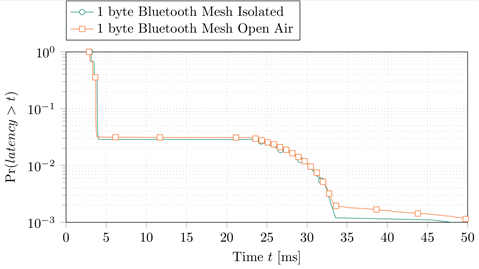
For reference, a description of our test setup for one-way single-hop latency of Bluetooth Mesh, and results for both open-air and isolated:
We're using two nRF5340 Dev Kits with Zephyr, using Bluetooth Mesh from the Zephyr Bluetooth stack. To measure one-way latency, we have a wired GPIO connection from the transmitter to the receiver, which is used to trigger an interrupt at the receiver at the time of transmission. This interrupt starts a timer that stops once the Bluetooth Mesh message is received. We record the latency and repeat for 10 000 messages.
See the CDFs for the latency in both open air and isolated testing. Note the log scale on the y-axis. The sudden jump from ~4ms to ~24ms is due to a (configurable) 20ms interval between retransmissions in bluetooth mesh, and the position of this jump on the y-axis indicates the probability of packet loss on the first transmission. Note the similarity of open air and isolated testing.