Excuse me,If the spi master sent a 255-byte packet to SPIS every 300 nanoseconds continuously,Can SPIS receive the data in its entirety?
Excuse me,If the spi master sent a 255-byte packet to SPIS every 300 nanoseconds continuously,Can SPIS receive the data in its entirety?

Hi,
Excuse me,If the spi master sent a 255-byte packet to SPIS every 300 nanoseconds continuously,Can SPIS receive the data in its entirety?
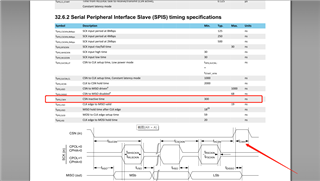
300 ns is the minimum idle time between each transaction, regardless of size of that transaction.
Kind regards,
Håkon
Excuse me,If the spi master sent the first 255-byte packet to SPIS ,then the spi master send the second 255-byte packet to SPIS at 300 nanoseconds .Can SPIS receive the second 255-byte packet ?
Hi,
Theoretically, yes, but you have to ensure that you are able to update the pointers, as described in the PS:
Kind regards,
Håkon
Excuse me, Where is the pointer update mechanism in the PS,I don't know if the pointer can be updated in 300 nanoseconds in the PS.
Hi,
The description on how to update the pointers is described in the SPIS chapter that I previously posted.
The 300 ns number defined here is the minimal CSN inactive time between two transfers for the SPIS peripheral to successfully detect it properly.
Yes, I agree that if you should handle the event, and update the pointer registers; 300 ns is very tight timing. In most cases, you would most likely need a bit more time, depending on how your firmware is setup.
Kind regards,
Håkon
Hi,
The description on how to update the pointers is described in the SPIS chapter that I previously posted.
The 300 ns number defined here is the minimal CSN inactive time between two transfers for the SPIS peripheral to successfully detect it properly.
Yes, I agree that if you should handle the event, and update the pointer registers; 300 ns is very tight timing. In most cases, you would most likely need a bit more time, depending on how your firmware is setup.
Kind regards,
Håkon