Hi guys
I am working on a NRF52832 device. My SDK is 15.2. I am on S132.
To initialiser the Softdevice, I use the following function :
/**@brief Function for initializing the BLE stack.
 *
 * @details Initializes the SoftDevice and the BLE event interrupt.
 */
void ble_stack_init(void)
{
    extern uint8_t __data_start__;
    ret_code_t err_code;

    err_code = nrf_sdh_enable_request();
    APP_ERROR_CHECK(err_code);

    // Configure the BLE stack using the default settings.
    // Fetch the start address of the application RAM.
    uint32_t app_ram_base = 0;

    err_code = nrf_sdh_ble_default_cfg_set(APP_BLE_CONN_CFG_TAG, &app_ram_base);
    APP_ERROR_CHECK(err_code);

    // Enable BLE stack.
    err_code = nrf_sdh_ble_enable(&app_ram_base);

    // Check if we do memory allocation correctly.
    if (err_code == NRF_SUCCESS)
    {
        // Verify that value provided in linked script (LD file) matches the SD calculations.
        if (app_ram_base == (uint32_t) &__data_start__)
        {
            //NRF_LOG_INFO("Soft Device enabled, __data_start__ is set correctly.");
            printf("Soft Device enabled, __data_start__ is set correctly.\n");
        }
        else
        {
            //NRF_LOG_INFO("Soft Device enabled, __data_start__ is set incorrectly (should be = 0x%08X instead of 0x%08X).", app_ram_base, (uint32_t) &__data_start__);
            printf("Soft Device enabled, __data_start__ is set incorrectly (should be = 0x%08X instead of 0x%08X).\n", app_ram_base, (uint32_t) &__data_start__);
#if (!SECURITY_MODE)
            APP_ERROR_CHECK(NRF_ERROR_FORBIDDEN); //AKR for test
#endif
        }
    }
    else if (err_code == NRF_ERROR_NO_MEM)
    {
        // Not enough memory for the Soft Device (value provided is too low).
        //NRF_LOG_INFO("Soft Device failed to enabled, __data_start__ is set incorrectly (should be = 0x%08X instead of 0x%08X).", app_ram_base, (uint32_t) &__data_start__);
    }
    APP_ERROR_CHECK(err_code);

    // Register a handler for BLE events.
    NRF_SDH_BLE_OBSERVER(m_ble_observer, APP_BLE_OBSERVER_PRIO, ble_evt_handler, NULL);
}
You can see that we added a condition, after nrf_sdh_ble_enable() function, in the case where the err_code == NRF_SUCCESS
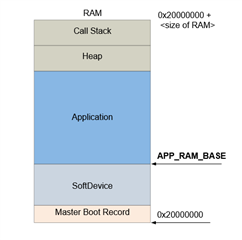
Here we check if the the value provided in linked script, __data_start__, is the same as the value returned by the nrf_sdh_ble_enable() function, app_ram_base, so the SD calculations.
When i don't use the Security Layer, so the Peer manager, the error code from nrf_sdh_ble_enable() is NRF_SUCCESS, and __data_start__ and app_ram_base are the same.
When i implement the Peer manager and all the modules needed, error code from nrf_sdh_ble_enable() is NRF_SUCCESS, but __data_start__ and app_ram_base are not the same.
I have commented in this case the following APP_ERROR_CHECK(NRF_ERROR_FORBIDDEN), and we have done many tests and all seems to work anyway, but it worries me.
Do you know why in this case __data_start__ and app_ram_base are different ? What are the consequences ?
Is there a way to correct that ?
I should mention that I tried to correct this problem by changing the RAM size with RAM_START and RAM_SIZE, but It didn't change anything.
Thanks !