This post is older than 2 years and might not be relevant anymore
More Info: Consider searching for newer posts

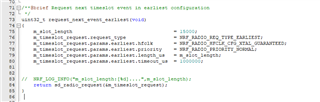
Timeslot API

I use SDK 15.3, nrf52840.

https://devzone.nordicsemi.com/nordic/short-range-guides/b/software-development-kit/posts/setting-up-the-timeslot-api

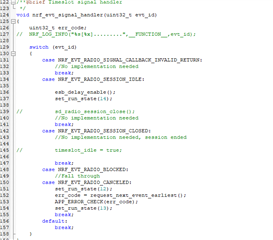
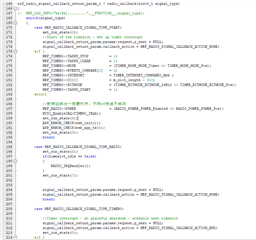
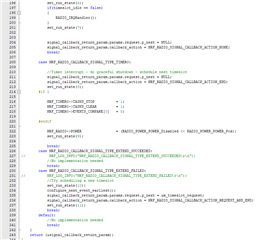
Normal use most of the time, after transmitting for a period of time, NRF_RADIO_CALLBACK_SIGNAL_TYPE_RADIO cannot be received.

NRF_RADIO_CALLBACK_SIGNAL_TYPE_START, NRF_RADIO_CALLBACK_SIGNAL_TYPE_TIMER0 can be received,What is the problem?

Parents Reply Children
  • It would be good to know which SoftDevice assert you get, as I explained. Without knowing it there are still a few things you can do:

    * Doubel check that you always properly disable interrupts etc for devices that the SoftDevice use before the end of the timeslot (like the Radio and TIMER0).

    * Add some margin so that you end the timeslot a bit earlier than you normally should have to. This can be especially relevant if you time the duration of the timeslot sing a timer (which runs of the HF clock), as the SoftDevice relies on RTC0 in this case (which runs of the LF clock). If there is more drift between these clocks for some reason, more margin would help.

  • SoftDevice assert:

    m_error_data.err_code=0,m_error_data.line_num=0,m_error_data.p_file_name=NULL

  • Hi,

    The error code, line number and file name is only relevant for SDK errors. When there is a SoftDevice assert you need to look at the PC. If you are using the default app_error_fault_handler() in SDK 15.3 it looks like this:

    __WEAK void app_error_fault_handler(uint32_t id, uint32_t pc, uint32_t info)
    {
        __disable_irq();
        NRF_LOG_FINAL_FLUSH();
    
    #ifndef DEBUG
        NRF_LOG_ERROR("Fatal error");
    #else
        switch (id)
        {
    #if defined(SOFTDEVICE_PRESENT) && SOFTDEVICE_PRESENT
            case NRF_FAULT_ID_SD_ASSERT:
                NRF_LOG_ERROR("SOFTDEVICE: ASSERTION FAILED");
                break;
            case NRF_FAULT_ID_APP_MEMACC:
                NRF_LOG_ERROR("SOFTDEVICE: INVALID MEMORY ACCESS");
                break;
    #endif
            case NRF_FAULT_ID_SDK_ASSERT:
            {
                assert_info_t * p_info = (assert_info_t *)info;
                NRF_LOG_ERROR("ASSERTION FAILED at %s:%u",
                              p_info->p_file_name,
                              p_info->line_num);
                break;
            }
            case NRF_FAULT_ID_SDK_ERROR:
            {
                error_info_t * p_info = (error_info_t *)info;
                NRF_LOG_ERROR("ERROR %u [%s] at %s:%u\r\nPC at: 0x%08x",
                              p_info->err_code,
                              nrf_strerror_get(p_info->err_code),
                              p_info->p_file_name,
                              p_info->line_num,
                              pc);
                 NRF_LOG_ERROR("End of error report");
                break;
            }
            default:
                NRF_LOG_ERROR("UNKNOWN FAULT at 0x%08X", pc);
                break;
        }
    #endif
    
        NRF_BREAKPOINT_COND;
        // On assert, the system can only recover with a reset.
    
    #ifndef DEBUG
        NRF_LOG_WARNING("System reset");
        NVIC_SystemReset();
    #else
        app_error_save_and_stop(id, pc, info);
    #endif // DEBUG
    }

    When you get a NRF_FAULT_ID_SD_ASSERT, the relevant here is the value of the pc parameter. I you can tell me what it is, and the exact SoftDevice version you use I can check which assert failed. Without it, I can only make assumptions like in my previous post.

Related