I have flashed DFU OTA bootlaoder to my nRF82540 DK. (C:\nRF5_SDK_17.0.2_d674dde\examples\dfu\secure_bootloader\pca10056_s140_ble_debug)
It shows the two LEDs 1 and 2.
I can flash ble_blinky. It shows LEDs 1 and 3 when flashing. It works.
BUT So I can get some understanding of what is going on I would like to flash plain old blink to the device using the OTA.
I change the blink *.ld file from
MEMORY
{
FLASH (rx) : ORIGIN = 0x1000, LENGTH = 0xff000
RAM (rwx) : ORIGIN = 0x20000008, LENGTH = 0x3fff8
}
to
MEMORY
{
FLASH (rx) : ORIGIN = 0x27000, LENGTH = 0xff000
RAM (rwx) : ORIGIN = 0x20000008, LENGTH = 0x3fff8
}
So that the application is now above the softdevice. It all looks fine, but it doesn't work.
So how do things work. I'm assuming that somewhere there is a jump to the address where the blinky app is loaded (at 0x27000?) and then blinky runs.
I'm guessing that my ignorance is going to give me a heart attack at some point.
Is there a document that explains for newbies how all of this hangs together?
Gordon
(In my research I've seen references to a define for APPLICATION_START_ADDRESS or something similar, but I can't find it. It may have been an old sdk?)
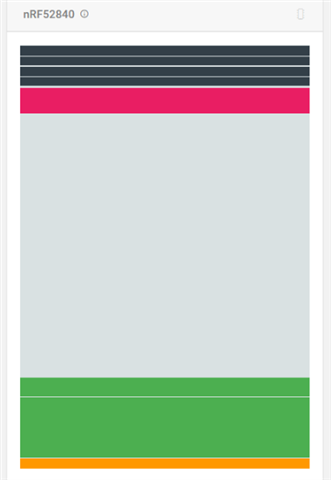
Here is my memory map