

Hi,
I have been working on nRF since last week now. I've followed the tutorials on how to setup a custom service and custom characterics (Bluetooth low energy Services, a beginner's tutorial and Bluetooth low energy Characteristics, a beginner's tutorial). After setting up, I wanted to do my own thing, but I have been hitting a wall for a day now and I still don't know how to move on.
I'm working on the BLE_peripheral example of the heart rate service and I added the NUS example as well. I've also added a custom service and what I am trying to do is to send a payload of 69 bytes to a custom characteristic upon the writing of a character on the serial port (see code below).
/**@brief   Function for handling app_uart events.
 *
 * @details This function will receive a single character from the app_uart module and append it to
 *          a string. The string will be be sent over BLE when the last character received was a
 *          'new line' '\n' (hex 0x0A) or if the string has reached the maximum data length.
 */
/**@snippet [Handling the data received over UART] */
void uart_event_handle(app_uart_evt_t * p_event)
{
    static uint8_t data_array[BLE_NUS_MAX_DATA_LEN];
    static uint8_t index = 0;
    uint32_t       err_code;

    switch (p_event->evt_type)
    {
        case APP_UART_DATA_READY:
            UNUSED_VARIABLE(app_uart_get(&data_array[index]));
            index++;

            if ((data_array[index - 1] == '\n') ||
                (data_array[index - 1] == '\r') ||
                (index >= m_ble_nus_max_data_len))
            {
                if (index > 1)
                {
                    NRF_LOG_DEBUG("Ready to send data over BLE NUS");
                    NRF_LOG_HEXDUMP_DEBUG(data_array, index);

                    do
                    {
                        uint16_t length = (uint16_t)index;
                        err_code = ble_nus_data_send(&m_nus, data_array, &length, m_conn_handle);
                        if ((err_code != NRF_ERROR_INVALID_STATE) &&
                            (err_code != NRF_ERROR_RESOURCES) &&
                            (err_code != NRF_ERROR_NOT_FOUND))
                        {
                            APP_ERROR_CHECK(err_code);
                        }
                    } while (err_code == NRF_ERROR_RESOURCES);
                }

                index = 0;
            }
            //custom code
            else if ((data_array[index - 1] == 'c'))
            {
                index = 69;
                uint16_t length = (uint16_t)index;
                uint8_t data[index];
                memset(data, 0, index);
                data[0] = 0x01;
                data[3] = 0x18;
                data[4] = 0x42;

                err_code = ble_nus_data_send(&m_nus, data, &length, m_conn_handle);
                if ((err_code != NRF_ERROR_INVALID_STATE) &&
                    (err_code != NRF_ERROR_RESOURCES) &&
                    (err_code != NRF_ERROR_NOT_FOUND))
                {
                    APP_ERROR_CHECK(err_code);
                }
                characteristic_data_update(&m_my_service, m_conn_handle, data, &length);

                index = 0;
            }
            break;

        case APP_UART_COMMUNICATION_ERROR:
            APP_ERROR_HANDLER(p_event->data.error_communication);
            break;

        case APP_UART_FIFO_ERROR:
            APP_ERROR_HANDLER(p_event->data.error_code);
            break;

        default:
            break;
    }
}
/**@snippet [Handling the data received over UART] */
void characteristic_data_update(ble_ms_t *p_my_service, uint16_t    conn_handle, uint8_t* data, uint16_t* length)
{
    if (conn_handle != BLE_CONN_HANDLE_INVALID)
    {
        //uint16_t               len = length;
        ble_gatts_hvx_params_t hvx_params;

        memset(&hvx_params, 0, sizeof(hvx_params));

        hvx_params.handle = p_my_service->device_control_handles.value_handle;
        hvx_params.type   = BLE_GATT_HVX_NOTIFICATION;
        hvx_params.offset = 0;
        hvx_params.p_len  = length;
        hvx_params.p_data = data;

        sd_ble_gatts_hvx(conn_handle, &hvx_params);
    }
}
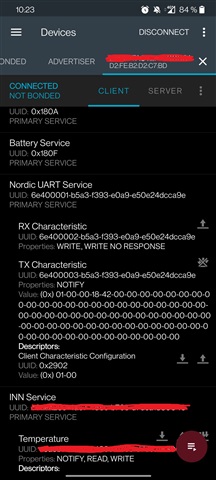
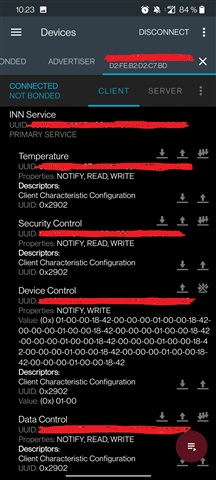
I have added a condition where on 'c' character input it sends a payload full of 0x00 except for 3 bytes. The payload works just fine with the NUS service, but it starts to get itchy when it comes to the custom service. The first 8 bytes (sometimes the first 16 bytes) repeat themselves for the entire length of the payload. I suspected first my parameters but then I took the same as the NUS function, still the same problem. I also checked for parameters in sdk_config.h file like ATT_MTU but the value seems fine.
On the debugger; I looked for length pointer value once it is returned by hvx_params struct, and it said 8 but still wrote 69 bytes on the characteristic.
I work on Windows 10 with nRF52840 DK with nRF Connect for Mobile on my Android. My SDK is v17.0.2 and my softdevice is the pca10056.
Screens :
Thanks in advance for any tips that might help me.
FM

