Hi:
I want to know structure of nRF52810 GPIO. Also what's different structure bewteen output standard drive and output strength drive. where could I find these information.
Hi:
I want to know structure of nRF52810 GPIO. Also what's different structure bewteen output standard drive and output strength drive. where could I find these information.
Hello,
where could I find these information.
In general you will find all the information about the GPIO peripheral in the GPIO Peripheral documentation.
what's different structure bewteen output standard drive and output strength drive.
You can read about this in the Electrical Specification section of the GPIO peripheral documentation.
Best regards,
Karl
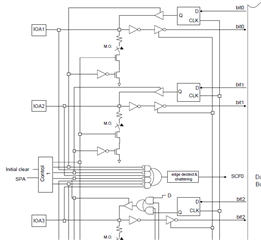
I need something like this.

You can implement this in the firmware so that the IOA* pins change according to the truth table for this diagram, if this is what you are asking about. I recommend that you simplify this as much as possible by using Boolean algebra before proceeding to implement this on your device, to make the implementation easier.
Best regards,
Karl
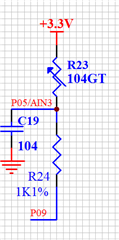
It measured temperature by P05(ADC) and P09(standard output mode, output low), just like the follow.The temperature sensor is NTC, so resistance of temperature sensor was smaller when temperature was higher.We found there was voltage on the P09,and voltage was higher while resistance of temperature sensor( resistance could be 100 R) was smaller.That't why I want to know the structure.

james said:We found there was voltage on the P09
What do you mean that you found voltage on a pin you had set low? Please elaborate. Do you mean that you disconnected P09 from the setup you show here, and measured it, or that you used the provided setup and then measured a voltage on it? I would expect there to be a voltage on P09 with the setup you provide above, since you have got 3.3V over R23 and R24. How big is R24?
Please be advised that the absolute maximal current that the GPIO can sink in high drive is 15 mA and 4 mA in standard drive. If you exceed these ratings you risk damaging the device.
james said:That't why I want to know the structure.
If I understand your question here correctly, you can see the structure of the GPIO in Figure 1 of the GPIO Peripheral documentation.
Best regards,
Karl
james said:We found there was voltage on the P09
What do you mean that you found voltage on a pin you had set low? Please elaborate. Do you mean that you disconnected P09 from the setup you show here, and measured it, or that you used the provided setup and then measured a voltage on it? I would expect there to be a voltage on P09 with the setup you provide above, since you have got 3.3V over R23 and R24. How big is R24?
Please be advised that the absolute maximal current that the GPIO can sink in high drive is 15 mA and 4 mA in standard drive. If you exceed these ratings you risk damaging the device.
james said:That't why I want to know the structure.
If I understand your question here correctly, you can see the structure of the GPIO in Figure 1 of the GPIO Peripheral documentation.
Best regards,
Karl
I measured P09 with the setup. The range of R24 is bewteen 100k and 100 ohm.So max current is 3mA. I want to know why there is a voltage on P09.