

Hi,
I am using a specific LED that has the PWM specification to drive as below.
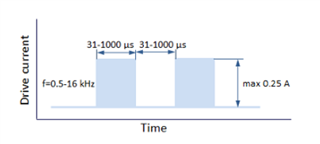
Would it possible to drive the LED with nrf52840. I see the PWM clock upto 256KHz , but not sure if i am missing somehting.
Hi,
I am using a specific LED that has the PWM specification to drive as below.
Would it possible to drive the LED with nrf52840. I see the PWM clock upto 256KHz , but not sure if i am missing somehting.
Hi,
Yes, that is possible.
Here is some example code(based on example in sdk_folder\examples\peripheral\pwm_driver):
/**
 * Copyright (c) 2015 - 2021, Nordic Semiconductor ASA
 *
 * All rights reserved.
 *
 * Redistribution and use in source and binary forms, with or without modification,
 * are permitted provided that the following conditions are met:
 *
 * 1. Redistributions of source code must retain the above copyright notice, this
 *    list of conditions and the following disclaimer.
 *
 * 2. Redistributions in binary form, except as embedded into a Nordic
 *    Semiconductor ASA integrated circuit in a product or a software update for
 *    such product, must reproduce the above copyright notice, this list of
 *    conditions and the following disclaimer in the documentation and/or other
 *    materials provided with the distribution.
 *
 * 3. Neither the name of Nordic Semiconductor ASA nor the names of its
 *    contributors may be used to endorse or promote products derived from this
 *    software without specific prior written permission.
 *
 * 4. This software, with or without modification, must only be used with a
 *    Nordic Semiconductor ASA integrated circuit.
 *
 * 5. Any software provided in binary form under this license must not be reverse
 *    engineered, decompiled, modified and/or disassembled.
 *
 * THIS SOFTWARE IS PROVIDED BY NORDIC SEMICONDUCTOR ASA "AS IS" AND ANY EXPRESS
 * OR IMPLIED WARRANTIES, INCLUDING, BUT NOT LIMITED TO, THE IMPLIED WARRANTIES
 * OF MERCHANTABILITY, NONINFRINGEMENT, AND FITNESS FOR A PARTICULAR PURPOSE ARE
 * DISCLAIMED. IN NO EVENT SHALL NORDIC SEMICONDUCTOR ASA OR CONTRIBUTORS BE
 * LIABLE FOR ANY DIRECT, INDIRECT, INCIDENTAL, SPECIAL, EXEMPLARY, OR
 * CONSEQUENTIAL DAMAGES (INCLUDING, BUT NOT LIMITED TO, PROCUREMENT OF SUBSTITUTE
 * GOODS OR SERVICES; LOSS OF USE, DATA, OR PROFITS; OR BUSINESS INTERRUPTION)
 * HOWEVER CAUSED AND ON ANY THEORY OF LIABILITY, WHETHER IN CONTRACT, STRICT
 * LIABILITY, OR TORT (INCLUDING NEGLIGENCE OR OTHERWISE) ARISING IN ANY WAY OUT
 * OF THE USE OF THIS SOFTWARE, EVEN IF ADVISED OF THE POSSIBILITY OF SUCH DAMAGE.
 *
 */
/** @file
 * @defgroup pwm_example_main main.c
 * @{
 * @ingroup pwm_example
 *
 * @brief PWM Example Application main file.
 *
 * This file contains the source code for a sample application using PWM.
 */

#include <stdio.h>
#include <string.h>
#include "nrf_drv_pwm.h"
#include "app_util_platform.h"
#include "app_error.h"
#include "boards.h"
#include "bsp.h"
#include "app_timer.h"
#include "nrf_drv_clock.h"

#include "nrf_log.h"
#include "nrf_log_ctrl.h"
#include "nrf_log_default_backends.h"

#define OUTPUT_PIN LED_1

#define TOP_VALUE 2000
static nrf_drv_pwm_t m_pwm0 = NRF_DRV_PWM_INSTANCE(0);

// Declare variables holding PWM sequence values. In this example only one channel is used
nrf_pwm_values_individual_t seq_values[] = {0, 0, 0, 0};
nrf_pwm_sequence_t const seq =
{
    .values.p_individual = seq_values,
    .length          = NRF_PWM_VALUES_LENGTH(seq_values),
    .repeats         = 0,
    .end_delay       = 0
};


void pwm_update_seq_value(uint16_t seq_value)
{


        seq_values->channel_0 = seq_value;


    nrf_drv_pwm_simple_playback(&m_pwm0, &seq, 1, NRF_DRV_PWM_FLAG_LOOP);
}

static void pwm_init(void)
{
    nrf_drv_pwm_config_t const config0 =
    {
        .output_pins =
        {
            OUTPUT_PIN, // channel 0
            NRF_DRV_PWM_PIN_NOT_USED,             // channel 1
            NRF_DRV_PWM_PIN_NOT_USED,             // channel 2
            NRF_DRV_PWM_PIN_NOT_USED,             // channel 3
        },
        .irq_priority = APP_IRQ_PRIORITY_LOWEST,
        .base_clock   = NRF_PWM_CLK_1MHz,
        .count_mode   = NRF_PWM_MODE_UP,
        .top_value    = TOP_VALUE,
        .load_mode    = NRF_PWM_LOAD_INDIVIDUAL,
        .step_mode    = NRF_PWM_STEP_AUTO
    };
    // Init PWM without error handler
    APP_ERROR_CHECK(nrf_drv_pwm_init(&m_pwm0, &config0, NULL));

}

int main(void)
{
    APP_ERROR_CHECK(NRF_LOG_INIT(NULL));
    NRF_LOG_DEFAULT_BACKENDS_INIT();

    // Start clock for accurate frequencies
    NRF_CLOCK->TASKS_HFCLKSTART = 1;
    // Wait for clock to start
    while(NRF_CLOCK->EVENTS_HFCLKSTARTED == 0) ;

    pwm_init();
    pwm_update_seq_value(TOP_VALUE/2);

    for (;;)
    {
        // Wait for an event.
        __WFE();

        // Clear the event register.
        __SEV();
        __WFE();

        NRF_LOG_FLUSH();
    }
}


/** @} */
