This post is older than 2 years and might not be relevant anymore
More Info: Consider searching for newer posts

Custom PCB: Checking if PCB is correct before sending off to manufacture

Hello,

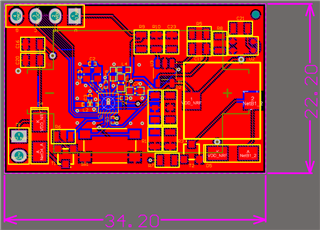
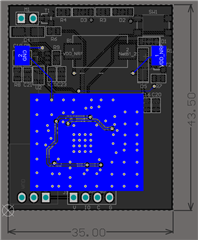
I have been using the nRF52840 DK board and have designed a PCB based on it. I made a previous post asking some questions before designing the PCB, so this is a follow-up.

https://devzone.nordicsemi.com/f/nordic-q-a/78124/going-from-nrf52840-dk-to-pcb

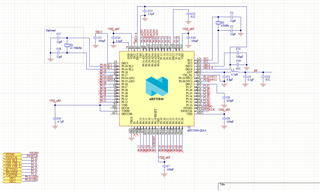
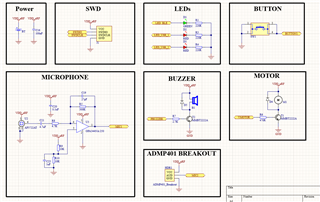
With the schematic, I haven't changed anything except adding my connections to the pins, and using Generic No ERC markers on the unused pins. The PCB I kept the same and add my components above it, and the battery on the bottom layer. The only changes I made were extending the top layer ground polygon (red), and using the vias around the nRF chip to branch out a ground and VCC line.

1) Is my PCB fine to manufacture or are there any changes I should make to it. My design uses a few GPIO pins, analog pins, and Bluetooth to communicate with. I used configuration 6, from the reference design. 

2) On the schematic there is an optional section with a crystal connected to XL1/XL2. Do I need to have this on my design?

Kind regards,

J
Parents
  • Hello,

    Apologies for the late reply.

    I'll take a look at this today and get back to you.

    Best regards,

    Martin S.

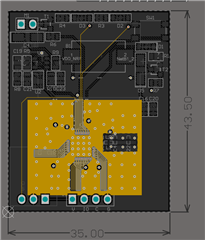
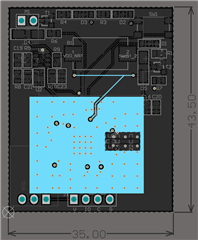
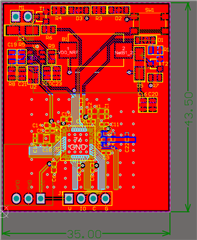
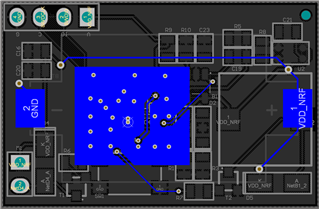
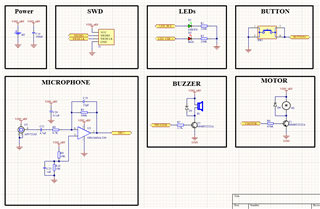
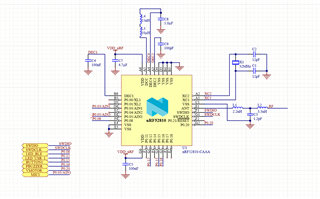
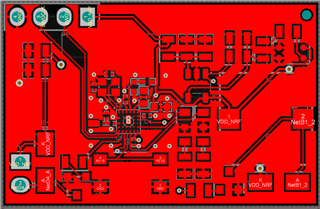
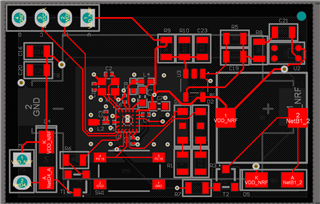
  • No worries. I actually changed the nRF chip I used in the initial post. I noticed that there is a cheaper and "simpler" one, that I can use, as I only need a few GPIO pins. I ended up using the nRF52810. I haven't used this chip before, so I hope my code will still work with minor changes. I added the screenshots of the new PCB below.

    I added the original post below but changed the questions:

    With the schematic, I haven't changed anything except adding my connections to the pins, and using Generic No ERC markers on the unused pins. The PCB I kept the same and add my components above it, and the battery on the bottom layer. The only changes I made were extending the top layer ground polygon (red), and using the vias around the nRF chip to branch out the ground and VCC lines.

    1) Out of the reference designs for the nRF52810, I picked the nrf52810_caaa_2-layer as opposed to the nrf52810_caaa and nrf52810_caaa_dcdc designs. I'm not sure what advantage the other two have over the one I picked, based on the simplicity of my design. 

    2) Will this PCB work or are there any changes I should make?

    Kind regards,

    J

  • Hi,

    Apologies again for the late reply, i was planning on taking a look at this before the weekend, but my kid got sick.

    I'll take a look at it tomorrow and get back to you.

    Best regards,

    Martin S.

  • Hi,

    I have taken a look at the design now and here are my initial comments:

    JSCBLOG said:
    The only changes I made were extending the top layer ground polygon (red)

    You need to extend the bottom layer polygon as well and connect the top and bottom ground using via stitching as well as adding vias right next to all component ground pads.

    JSCBLOG said:
    Out of the reference designs for the nRF52810, I picked the nrf52810_caaa_2-layer as opposed to the nrf52810_caaa and nrf52810_caaa_dcdc designs. I'm not sure what advantage the other two have over the one I picked, based on the simplicity of my design. 

    I recommend using the nrf52810_qcaa_dcdc as the package type is easier to implement for simple designs like this. It's 5x5mm instead of 2.5x2.5mm, so if you can spare the space I'd make the change. You can read a bit about the reference circuitry in the product specification.

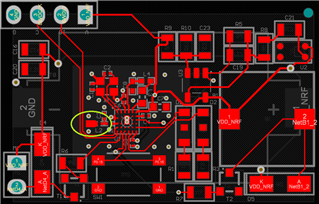
    You also need an antenna on the board, the thick trace marked with green is the beginning of the antenna transmission line:

    You need unbroken ground on the bottom layer under the antenna transmission line, i.e. no routing or components under it.

    You can look at the hardware files for for example the nRF52832 Development Kit on how to implement a simple quarterwave monopole PCB antenna. It includes a connector in the transmission line for ease of radio measurement, but you can remove that from the design.

    You also have the choice between other antennas, to quote one of my colleagues:

    For the antenna type, antenna choice is complex and depends on many factors including technical and commercial considerations:

    Monopole, printed PCB antenna: This is easy to make and easy to tune, you also only need one impedance matching component, so it’s cost effective. Here the spacing is the issues, you need to make it about 23 mm long needs a minimum of 5 mm clearance to the ground plane. High bandwidth, making it fairly resistant to detuning. Link to our whitepaper: https://infocenter.nordicsemi.com/pdf/nwp_008.pdf?cp=12_18


    Meander antenna, printed PCB antenna, ex. our dongle antenna design: Requires a smaller area than the monopole antenna, but usually requires a pi-network for tuning in addition to length. Lower bandwidth than a quarter wave monopole antenna. Here is a link to our nRF52840 Dongle design files as an example of this: https://www.nordicsemi.com/Software-and-Tools/Development-Kits/nRF52840-Dongle/Download#infotabs

    Inverted F antenna: This is relatively large, and should in theory be matched to 50 Ohm, but usually requires passive tuning components (pi-network). h bandwidth, making it fairly resistant to detuning. 

    Chip antenna: Higher BOM, but the antenna is small. The downside is that it usually has less gain. It requires a matching network, based on the vendors recommendations. It has a lower bandwidth than a quarter wave monopole antenna so it can be sensitive to detuning.

    Reducing antenna size most often results in reduced performance. Some of the parameters that suffer are:

    • Reduced efficiency (or gain)
    • Shorter range
    • Smaller bandwidth
    • Distorted radiation pattern
    • More critical tuning
    • Increased sensitivity to component and PCB spread
    • Increased sensitivity to external factors (“body” effect, ground plane etc.)

    It is often better not to reduce antenna size too much, if you can avoid it.

    This is perhaps enough to get you started.

    Please share the updated design with me and I can guide you further.

    Best regards,

    Martin S.

  • What are your thoughts on Ignion's Virtual Antenna technology? In this case, as the PCB that is using doesn't change in size, reducing the antenna size shouldn't be a problem but maybe a solution to ease things up by using a small chip with high performance capabilities. Also, if someone wants to get help to design the PCB's matching network and antenna positioning, there is a service available for any client who needs it.

  • Sorry for the delay in response. I'm pretty busy atm, so might be a little time before I can come back to this project.

  • Hi,

    That's fine.

    We're ready to assist whenever you need.

    Don't be afraid to ask if you need clarification on something.

    Best regards,

    Martin S.

Reply Children
No Data
Related