This post is older than 2 years and might not be relevant anymore
More Info: Consider searching for newer posts

Variation of Radio performance and efficiency with supply voltage

Hi,

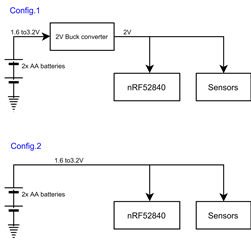
We are planning a product with BLE mesh capability using nRF52840 and a few sensors. The system power is from 2 AA batteries. We have 2 configurations in terms of power. Can please you compare them based on the radio performance and power efficiency.

The 2 configurations are,
  1. Using a buck converter a 2V is generated from the battery, and the system works on 2V
  2. The battery is directly connected to the nRF52840
Our aim is to use the complete battery capacity and to have maximum TX power and RX sensitivity.
Also, does the variation in supply voltage affect the radio performance?
Here is the image showing the 2 configurations.
Parents
  • All parts of the device, including the radio, have separate voltage regulators. The radio for instance, operates at 1.6 V. So there's no change in performance across the full voltage range of 1.7 to 3.6 V. 

    When you supply it from 2xAA in series, you can supply the nRF52840 directly from the battery. This way you can also use the ADC to measure the voltage on the VDD pin to estimate the capacity left on the battery. 

    Note that once the battery voltage drops below 1.1 v pr. cell, there's very little capacity left in the cell and further drain may cause the cell to leak.

Reply
  • All parts of the device, including the radio, have separate voltage regulators. The radio for instance, operates at 1.6 V. So there's no change in performance across the full voltage range of 1.7 to 3.6 V. 

    When you supply it from 2xAA in series, you can supply the nRF52840 directly from the battery. This way you can also use the ADC to measure the voltage on the VDD pin to estimate the capacity left on the battery. 

    Note that once the battery voltage drops below 1.1 v pr. cell, there's very little capacity left in the cell and further drain may cause the cell to leak.

Children
Related