nrf_delay_ms clock issues

I'm using nrf_delay_ms in main on "ble_app_beacon", but the delay time is much longer than I set.

I have set 2000ms delay to log, but it seems 4s or longer than I set.

int main(void)
{
	uint32_t num=0;
    // Initialize.
    log_init();
    timers_init();
    leds_init();
    power_management_init();
    ble_stack_init();
    advertising_init();

    // Start execution.
    NRF_LOG_INFO("Beacon example started.");
		NRF_LOG_FLUSH();
    advertising_start();

    // Enter main loop.
    for (;; )
    {
			nrf_delay_ms(2000);
			NRF_LOG_INFO("beacon test %d",num);
			NRF_LOG_FLUSH();
			num++;
        idle_state_handle();
    }
}

  • Hello,

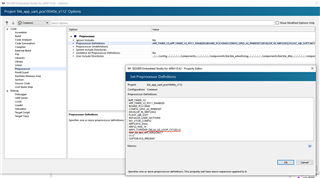
    I see you tagged the question with 'nRF52810', does that mean you are you running this code on an actual nRF52810 SoC? In that case, please make sure you don't have the NRFX_COREDEP_DELAY_US_LOOP_CYCLES flag defined in your project settings (see Transferring the project to nRF52810 hardware for details). This flag is used by the nrf_delay implementation to determine how many NOP instructions it needs to run for a given delay.

  • Thanks!

    I'll delete the NRFX_COREDEP_DELAY_US_LOOP_CYCLES in preprocessor symbols. And DEVELOP_IN_NRF52832  should be deleted too? I have not find issues because of that.

  • Hi Vidar,

    I have tested after deleted the NRFX_COREDEP_DELAY_US_LOOP_CYCLES  and DEVELOP_IN_NRF52832, the clock seems worked normally, but there is another problem.

    In my code, LED will change the status for every 2 seconds, but the LED just changed two times and then never change.

    int main(void)
    {
    	  uint8_t  rcv = 0;
    		const char * txbuff = "AnyTek";
    		uint8_t rcvbuff[ 32 ] = { 0 };
        // Initialize.
    		log_init();
        timers_init();
    //    leds_init();
        power_management_init();
        ble_stack_init();
        advertising_init();
    
        // Start execution.
        NRF_LOG_INFO("Beacon example started.");
    		NRF_LOG_FLUSH();
        advertising_start();
    		platform_gpio_initialize();
    		platform_gpio_int_initialize();
    		twi_master_init();
    		m_sensor_work_init();
    //		m_CC1101_Init(0xAA);
    //		CC1101_Init();
    //		NRF_LOG_FLUSH();
        // Enter main loop.
        for (;; )
        {
    //			if(GSENSOR_Get_Transient_Detection_Flag() == true)
    //			{
    //				nrf_gpio_pin_toggle(GREEN_PIN);
    //				nrf_delay_ms(200);
    //			}
    //			NRF_LOG_INFO("Test");
    //					CC1101_Tx_Packet((uint8_t *)txbuff,6,ADDRESS_CHECK);
    //			NRF_LOG_FLUSH();
    //			CC1101_Tx_Packet((uint8_t *)txbuff,6,ADDRESS_CHECK);
    //				CC1101_Clear_RxBuffer( );
    //				CC1101_Set_Mode( RX_MODE );
    //				rcv = CC1101_Rx_Packet( rcvbuff );
    				nrf_delay_ms(2000);
    				nrf_gpio_pin_toggle(GREEN_PIN);
    //			NRF_LOG_FLUSH();
          idle_state_handle();
        }
    }

  • Hi,

    The device will stay inside the idle_state_handle() function in sleep (System ON mode) unless you have a periodic application interrupt to wake up it up again. This is probably why the the LED stops toggling.

    That said, busy waiting with nrf_delay_ms() should generally be avoided on battery powered devices as it keeps the CPU active. I would instead recommend you use a low power app timer interrupt for toggling the LED. I posted an example showing how you can add a timer instance in the beacon example in this thread here: https://devzone.nordicsemi.com/f/nordic-q-a/71940/low-power-mode-using-saadc-with-ble_app_beacon

  • Hi,

    In SDK_CONFIG there are NRX_TIMER_ENABLED and TIMER_ENABLED  APP_TIMER_ENABLE, should I select them all? APP_TIMER_ENABLE is already seleted in example. I had created timer in SDK14.02, but I don't know SDK17.2 well.

Related