
What are the transmission delays of nrf52832 Bluetooth and 2.4G private protocols respectively?

What are the transmission delays of nrf52832 Bluetooth and 2.4G private protocols respectively?
Can we talk over the phone so that we can communicate more thoroughly

Hi,
In case of additional support like a phone call, you should contact your Regional Sales Manager (RSM). I could provide you with some more details which can be of help. You can read about the basic details of packet transmission, radio and packet length from here.
So there is a transmitter and receiver and packets are sent and received on-air. Ideally without any packet loss, the latency depends on radio startup time and the time taken to send the packet on-air. There might also be the processing time of the RX to be considered.
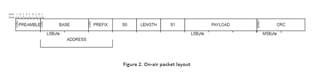
Shown above is the basic structure of a packet. The radio startup time is typically 140us but is 40us in the fast startup mode. You can find more about these here.
As you can see from the basics earlier, there is the 1M mode and 2M mode. In the 1M mode, each bit takes 1us on air and in 2M mode, each bit takes 0.5us.
As for the processing time at the RX end, this could be around 10us or less before triggering the interrupt (this is not really documented).
Regarding other factors that affect the latency, there can be the time of flight (time which the packet is in air), which can vary depending on distance of transmission. But this won't affect much since this might add like 1us of delay for 300m or so. There can also be delays added by the TX and RX clocks which will have random phase as they are not synchronized. (this too is really small and negligible).
Regards,
Priyanka
Hi,
In case of additional support like a phone call, you should contact your Regional Sales Manager (RSM). I could provide you with some more details which can be of help. You can read about the basic details of packet transmission, radio and packet length from here.
So there is a transmitter and receiver and packets are sent and received on-air. Ideally without any packet loss, the latency depends on radio startup time and the time taken to send the packet on-air. There might also be the processing time of the RX to be considered.
Shown above is the basic structure of a packet. The radio startup time is typically 140us but is 40us in the fast startup mode. You can find more about these here.
As you can see from the basics earlier, there is the 1M mode and 2M mode. In the 1M mode, each bit takes 1us on air and in 2M mode, each bit takes 0.5us.
As for the processing time at the RX end, this could be around 10us or less before triggering the interrupt (this is not really documented).
Regarding other factors that affect the latency, there can be the time of flight (time which the packet is in air), which can vary depending on distance of transmission. But this won't affect much since this might add like 1us of delay for 300m or so. There can also be delays added by the TX and RX clocks which will have random phase as they are not synchronized. (this too is really small and negligible).
Regards,
Priyanka
