

Hi all:
I have a software version that allows Bluetooth to be connected to the phone normally,
When I tried to use the SPI interface, it happened as long as I used
"nrf_drv_spi_init(&spi, p_spi_cfg, spi_event_handler, NULL)" function,
test the BLE connection with the mobile phone again, it will appear about 3 seconds after the connection is successful, and the HardFault_Handler will be triggered
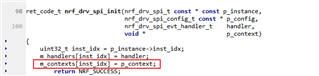
Troubleshoot the problem in depth and found that when the initial is executed to the following figure "m_contexts[inst_idx]=p_context", even if I leave directly later and do not perform any SPI transmission, HardFault_Handler will be triggered after the BLE connection,Any suggestions?
// <e> SPI_ENABLED - nrf_drv_spi - SPI/SPIM peripheral driver - legacy layer
//==========================================================
#ifndef SPI_ENABLED
#define SPI_ENABLED 1
#endif
// <o> SPI_DEFAULT_CONFIG_IRQ_PRIORITY  - Interrupt priority


// <i> Priorities 0,2 (nRF51) and 0,1,4,5 (nRF52) are reserved for SoftDevice
// <0=> 0 (highest)
// <1=> 1
// <2=> 2
// <3=> 3
// <4=> 4
// <5=> 5
// <6=> 6
// <7=> 7

#ifndef SPI_DEFAULT_CONFIG_IRQ_PRIORITY
#define SPI_DEFAULT_CONFIG_IRQ_PRIORITY 6
#endif

// <o> NRF_SPI_DRV_MISO_PULLUP_CFG  - MISO PIN pull-up configuration.

// <0=> NRF_GPIO_PIN_NOPULL
// <1=> NRF_GPIO_PIN_PULLDOWN
// <3=> NRF_GPIO_PIN_PULLUP

#ifndef NRF_SPI_DRV_MISO_PULLUP_CFG
#define NRF_SPI_DRV_MISO_PULLUP_CFG 0
#endif

// <e> SPI0_ENABLED - Enable SPI0 instance
//==========================================================
#ifndef SPI0_ENABLED
#define SPI0_ENABLED 1
#endif
// <q> SPI0_USE_EASY_DMA  - Use EasyDMA


#ifndef SPI0_USE_EASY_DMA
#define SPI0_USE_EASY_DMA 0
#endif

// </e>

// <e> SPI1_ENABLED - Enable SPI1 instance
//==========================================================
#ifndef SPI1_ENABLED
#define SPI1_ENABLED 0
#endif
// <q> SPI1_USE_EASY_DMA  - Use EasyDMA


#ifndef SPI1_USE_EASY_DMA
#define SPI1_USE_EASY_DMA 1
#endif

// </e>

// <e> SPI2_ENABLED - Enable SPI2 instance
//==========================================================
#ifndef SPI2_ENABLED
#define SPI2_ENABLED 0
#endif
// <q> SPI2_USE_EASY_DMA  - Use EasyDMA


#ifndef SPI2_USE_EASY_DMA
#define SPI2_USE_EASY_DMA 0
#endif

// </e>

// <q> SPIM_NRF52_ANOMALY_109_WORKAROUND_ENABLED  - Enables nRF52 anomaly 109 workaround for SPIM.


// <i> The workaround uses interrupts to wake up the CPU by catching
// <i> a start event of zero-length transmission to start the clock. This
// <i> ensures that the DMA transfer will be executed without issues and
// <i> that the proper transfer will be started. See more in the Errata
// <i> document or Anomaly 109 Addendum located at
// <i> https://infocenter.nordicsemi.com/

#ifndef SPIM_NRF52_ANOMALY_109_WORKAROUND_ENABLED
#define SPIM_NRF52_ANOMALY_109_WORKAROUND_ENABLED 0
#endif

