Trying to receive only one packet per connection interval for every connection on a multi-link environment on SDK 1.7.0

Hi,

The project is a multi-link environment of nrf52840, The 7 peripherals has the task of send data constantly of a sensors. All is working on coded_s8.

The objective is keep the higher data rate of msgs received by central, but to guarantee the uniformity between every peripheral. For that i have done a deep investigation on how the central schedule the connections, and what is the best strategy to receive the data.

The ATT_MTU is set to minimum 23 bytes because of coded_s8.
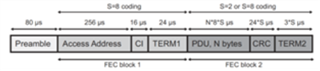
Time on air of a packet= 80+256+16+24+(23*8*8)+(24*8)+(3*8)=2'064ms

So if I disable Connection Event Length extension with:

static int EvtLen(void)
{       
        int err;
	struct net_buf *buf;
	sdc_hci_cmd_vs_conn_event_extend_t *evt_enable;

	buf = bt_hci_cmd_create(SDC_HCI_OPCODE_CMD_VS_CONN_EVENT_EXTEND,
				sizeof(*evt_enable));
	if (!buf) {
		printk("Could not allocate LLPM command buffer\n");
		return -ENOMEM;
	}
        evt_enable = net_buf_add(buf, sizeof(*evt_enable));
	evt_enable->enable = 0;

	err = bt_hci_cmd_send_sync(SDC_HCI_OPCODE_CMD_VS_CONN_EVENT_EXTEND, buf, NULL);
	if (err) {
		printk("Error enabling EVENT %d\n", err);
		return err;
	}

	printk("EVENT mode enabled\n");
	return 0;
}

And fix the maximum T event length on Kconfig with:

CONFIG_SDC_MAX_CONN_EVENT_LEN_DEFAULT=2500
Theorically making this configuration i guarantee that on a connection interval of 2500ms*7devices=17500ms/1.25=14 units i have enought time to attend the 7 devices and receive 1 packet of every one (Maybe could be packet drop but no may be systematic). Unfortunately I am not able to achieve this. Most of the times one or 2 devices keep sending half data comparing with the rest. I tried to modify a little the conn_interval without success.
If you could suggest me something more to try I will appreciate it, all code shared is done on Central
Thank you and regards.
Parents
  • I have another related question of schedule of central:

    Imagine the next context, only one peripheral with a maximum forced Tevent=2.5ms, Extended connection Event disabled, and a Conn_interval=1000ms.

    Independently of how much messages queued on tx of peripheral, theorically the Central only is going to receive 1 message every second, isn't it? Because on all Conn_interval of 1000ms the Central attend to peripheral once while the 2.5ms of Tevent.

    Thank you, regards.

  • Hi,

    If you could suggest me something more to try I will appreciate it

    Yes, if you could try to increase CONFIG_SDC_MAX_CONN_EVENT_LEN_DEFAULT closer to 3600 us. Looking at a sniffer trace a captured  a while back, the transmission time plus T_IFS for a 27 byte s8 encoded packet is actually 2600 us. You also need  time to time receive the acknowledgment packet from the central.

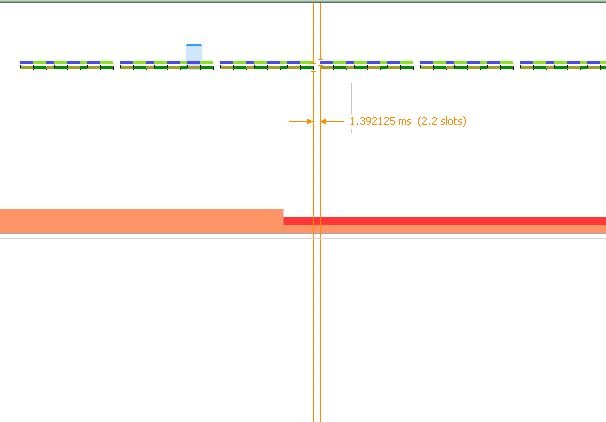
    Also, when determining what connection interval to use, note that there is a ~1.4 ms delay between scheduling of connection events that need to be accounted for:

    sotillo2409 said:
    Independently of how much messages queued on tx of peripheral, theorically the Central only is going to receive 1 message every second, isn't it? Because on all Conn_interval of 1000ms the Central attend to peripheral once while the 2.5ms of Tevent.

    Yes, that is correct.

    Best regards,

    Vidar

  • Hi,

    Thanks for sharing your findings. I didn't expect the connection event length to have to be that long.

    sotillo2409 said:
    Probably I need to combine two centrals to have more than 20 peripherals connected. There are many way to avoid noise between both centrals? As i know on One central with multiple peripherals there aren't noise problems due to Central coordinate the data transfer. But if I add another one this isn't going to happen and probably throughput go lower. There are some technique to don't disturb one with other? I hear about changing chanels of data transfer, this could solve my problem?? If I put one central working on the first half of channels availables and the second one on the final chanels for example. On advertisment  this don't have solution I guess.

    I'm not sure how much degradation of throughput you can expect in this scenario, if any. It's obviously best if you are able to actually test it. Other external noise sources (wifi,etc) and range may be a bigger factor.

    BLE has 37 different data channels that are used for channel hopping to mitigate interference problems, and you normally don't have update the channel map yourself.

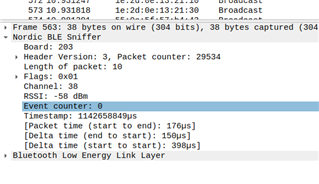
    Note that the channel number is displayed for each packet in the sniffer trace:

  • Hi, 

    BLE has 37 different data channels that are used for channel hopping to mitigate interference problems, and you normally don't have update the channel map yourself.

    Ok so firstly i would try without update channel map and late within. I would try and share with you the results.

    Other external noise sources (wifi,etc) and range may be a bigger factor.

    That is a good new to me so Slight smile, i thought that have 2 Centrals would be a noiser environment.

    thank you, 

    regards

  • Sorry,

    there are some way to sniff the central side? I only am able to follow the connections on the side of every peripheral.

    Thanks, regards.

  • The sniffer is only able track peripheral connections. I have not tried it myself, but it may be possible to do multiple connections simultaneously if you do the capture from "multiple hardware interfaces".

Reply Children
No Data
Related