This discussion has been locked.
You can no longer post new replies to this discussion. If you have a question you can start a new discussion

How to combine the ble_app_uart with libuartes example ?

Hi,
I have a project that is comunication between nRF and Smartphone via BLE and using libuartes to comunicate with 2 another devices via 2Uarts.
Now I need to combine 2 examples into 1 project. How many stepI have to do ?
I have compared 2 sdk_config.h of 2  examples. there are some differences in 2 sdk_config.h. I think just merge them into one file

What about another files? What I need to combine them and work in 1 project step by step? 
Hope your reply soon. Thank you 
Best regard,

Parents
  • Hello,

    When combining different examples from the nRF5 SDK, my advice is usually to start with one of them (in this case I would start with the one containing the softdevice, so ble_app_uart). 

    Start by adding the libuarte functions that you see in the main.c file from the libuarte example, and the .h and .c files where these are declared and defined, respectively. Then start compiling your application, and look for the missing functions or headers. If you struggle to find what file they are defined in, look them up in the libuarte example. Remember that you need to both include the file, and enable them if they have a guard. (enable them by setting the define from sdk_config.h). If you lack the definitions from sdk_config.h, then copy them from the libuartes example.

    Give it a go, and let me know if you are stuck. 

    Best regards,

    Edvin

  • Hi Edvin,

    Thanks for your reply. I understand flow you suggested but I stuck in step how to include header file ?

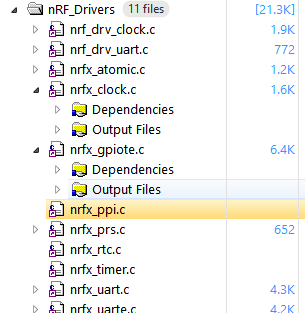
    In Project Explorer window I just find .c file. 

    step1 : added the links to the folder which contain .c files in Preferences -> General -> Processors > User include directories

    step2 : then I added .c file by right clicking => add existing file.
    And I don't know where contain header file (.h file) and how to add them ?

    Addititon, How to add Dependencies and Output Files in .c file ? When I add nrfx_ppi.c I didn't find them like nrfx_gpioe.c, nrfx_clock.c....  which are already in ble_app_uart example 


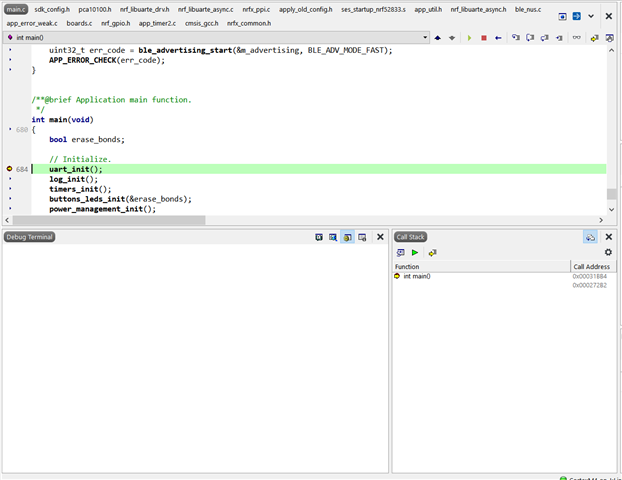
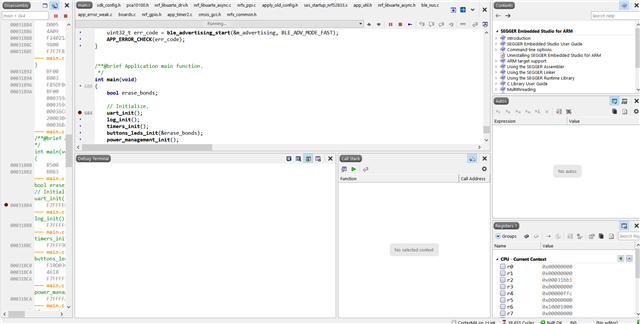
  • Hi Edvin, I try settting a breakpoint at uart_init() and here is the result

  • Looks like you are using app_timer in your application as well. app_timer is using RTC1, so you can't use that for the libuarte either. 

    The reason the log doesn't print anything is because it crashes before log_init(). Try to set log_init() first. 

    Since you only have 3 RTCs, and want to use 1 for the softdevice, 1 for the app_timer, you don't have 2 left to use for libuarte. However, if you look at the definition of NRF_LIBUARTE_ASYNC_DEFINE() in nrf_libuarte_async.h, you can see that if you set _rtc1_idx and _timer1_idx to NRF_LIBUARTE_PERIPHERAL_NOT_USED, then it will use the app_timer instead. Try that. 

    If you want to use the app_timer for the libuarte timer like this, then you need to make sure that the libuarte has a higher interrupt priority than the app_timer itself. Therefore, set:

    .int_prio   = APP_IRQ_PRIORITY_LOW_MID.

    Best regards,

    Edvin

  • Hi Edvin, thanks for your reply.  I'll try this
    When I move log_init() above uart_init()
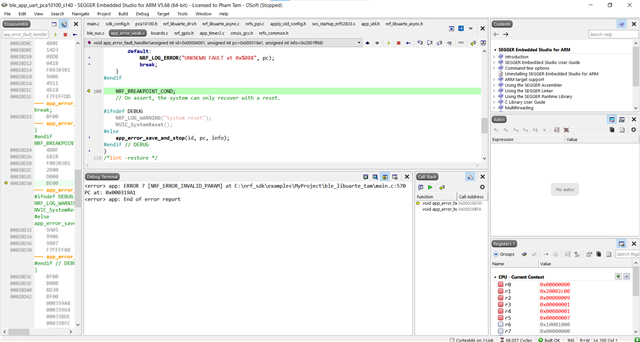
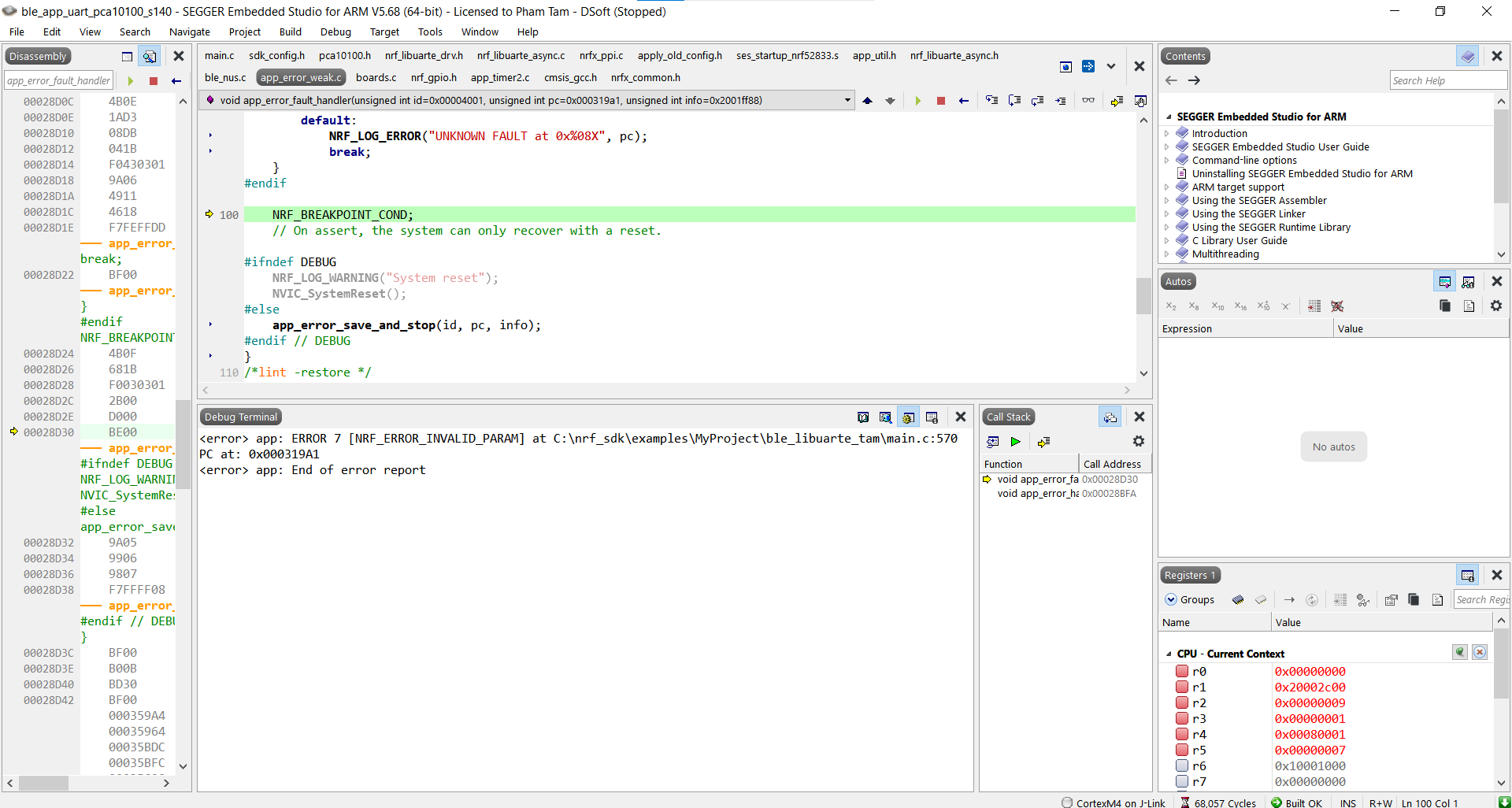
    i got this problem 

  • That is the problem you had all along. The only difference is that you are now able to see what the problem is, because you moved it to after log_init(). Please see the details in my previous reply on how to fix the NRF_ERROR_INVALID_PARAM.

  • If you want to use the app_timer for the libuarte timer like this, then you need to make sure that the libuarte has a higher interrupt priority than the app_timer itself. Therefore, set:

    .int_prio   = APP_IRQ_PRIORITY_LOW_MID.

    Thanks for your reply Edvin,
    I followed this suggestion and it worked  ^^
    Can you explain for me the reson why we has to set libuarte's higher interrupt priority than the app_timer.?


     And this one

    Since you only have 3 RTCs, and want to use 1 for the softdevice, 1 for the app_timer, you don't have 2 left to use for libuarte. However, if you look at the definition of NRF_LIBUARTE_ASYNC_DEFINE() in nrf_libuarte_async.h, you can see that if you set _rtc1_idx and _timer1_idx to NRF_LIBUARTE_PERIPHERAL_NOT_USED, then it will use the app_timer instead. Try that. 

    I try to set like that but when I debug I still got the same problem. I don't know why ?
    Having said that, I completed my main functions of my application. Thank Edvin for your supports in long day. Thank you so much, Edvin. I hope this thread will be useful for another one who got the same problem like me.

Reply
  • If you want to use the app_timer for the libuarte timer like this, then you need to make sure that the libuarte has a higher interrupt priority than the app_timer itself. Therefore, set:

    .int_prio   = APP_IRQ_PRIORITY_LOW_MID.

    Thanks for your reply Edvin,
    I followed this suggestion and it worked  ^^
    Can you explain for me the reson why we has to set libuarte's higher interrupt priority than the app_timer.?


     And this one

    Since you only have 3 RTCs, and want to use 1 for the softdevice, 1 for the app_timer, you don't have 2 left to use for libuarte. However, if you look at the definition of NRF_LIBUARTE_ASYNC_DEFINE() in nrf_libuarte_async.h, you can see that if you set _rtc1_idx and _timer1_idx to NRF_LIBUARTE_PERIPHERAL_NOT_USED, then it will use the app_timer instead. Try that. 

    I try to set like that but when I debug I still got the same problem. I don't know why ?
    Having said that, I completed my main functions of my application. Thank Edvin for your supports in long day. Thank you so much, Edvin. I hope this thread will be useful for another one who got the same problem like me.

Children
  • Pham Tam said:
    Can you explain for me the reson why we has to set libuarte's higher interrupt priority than the app_timer.?

    I am not familiar with the details, but I imagine it has to do with the libuarte needs to be able to process interrupts even though you are in an app_timer interrupt. 

    Pham Tam said:
    I try to set like that but when I debug I still got the same problem. I don't know why ?

    What problem?

    BR,
    Edvin

  • Since you only have 3 RTCs, and want to use 1 for the softdevice, 1 for the app_timer, you don't have 2 left to use for libuarte. However, if you look at the definition of NRF_LIBUARTE_ASYNC_DEFINE() in nrf_libuarte_async.h, you can see that if you set _rtc1_idx and _timer1_idx to NRF_LIBUARTE_PERIPHERAL_NOT_USED, then it will use the app_timer instead. Try that. 

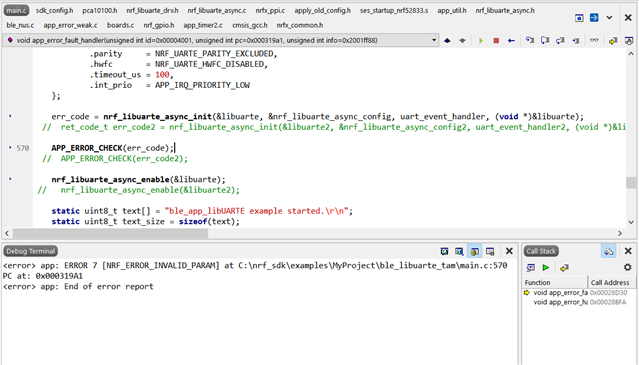
    I got this problem

  • What function returned the err_code that was checked using APP_ERROR_CHECK on l ine 570 in your main.c? And what check inside that function made it return NRF_ERROR_INVALID_PARAM? 

    I assume it is related to the initialization of libuarte.

    I used these settings, and it didn't return NRF_ERROR_INVALID_PARAM in my case:

    NRF_LIBUARTE_ASYNC_DEFINE(libuarte, 0, 1, NRF_LIBUARTE_PERIPHERAL_NOT_USED, NRF_LIBUARTE_PERIPHERAL_NOT_USED, 255, 3);
    NRF_LIBUARTE_ASYNC_DEFINE(libuarte2, 1, 2, NRF_LIBUARTE_PERIPHERAL_NOT_USED, NRF_LIBUARTE_PERIPHERAL_NOT_USED, 255, 3);
    
    ...
    
    static void uart_init(void)
    {
        uint32_t                     err_code;
    
        nrf_libuarte_async_config_t nrf_libuarte_async_config = {
                .tx_pin     = 26,
                .rx_pin     = 8,
                .baudrate   = NRF_UARTE_BAUDRATE_115200,
                .parity     = NRF_UARTE_PARITY_EXCLUDED,
                .hwfc       = NRF_UARTE_HWFC_DISABLED,
                .timeout_us = 100,
                .int_prio   = APP_IRQ_PRIORITY_LOW_MID
        };
            nrf_libuarte_async_config_t nrf_libuarte_async_config2 = {
                .tx_pin     = 6,
                .rx_pin     = 27,
                .baudrate   = NRF_UARTE_BAUDRATE_115200,
                .parity     = NRF_UARTE_PARITY_EXCLUDED,
                .hwfc       = NRF_UARTE_HWFC_DISABLED,
                .timeout_us = 100,
                .int_prio   = APP_IRQ_PRIORITY_LOW_MID
        };
    
        err_code = nrf_libuarte_async_init(&libuarte, &nrf_libuarte_async_config, uart_event_handler, (void *)&libuarte);
        ret_code_t err_code2 = nrf_libuarte_async_init(&libuarte2, &nrf_libuarte_async_config2, uart_event_handler2, (void *)&libuarte2);

  • Hi, Edvin now I can use 2 libuartes. But I got a problem
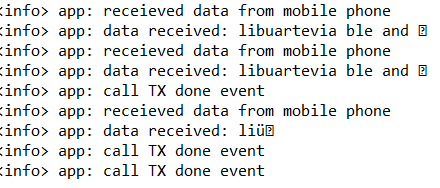
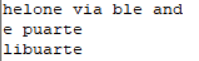
    when I used BLE App send to my nRF a string "hello nrf from mobile phone via ble and libuarte"
    Here is my debug terminal and the result show on Hercules

     But in case I send from my Mobile Phone to nRF a short string like "123456789_123456789". I don't get this problem


    #include <stdint.h>
    #include <string.h>
    #include "nordic_common.h"
    #include "nrf.h"
    #include "ble_hci.h"
    #include "ble_advdata.h"
    #include "ble_advertising.h"
    #include "ble_conn_params.h"
    #include "nrf_sdh.h"
    #include "nrf_sdh_soc.h"
    #include "nrf_sdh_ble.h"
    #include "nrf_ble_gatt.h"
    #include "nrf_ble_qwr.h"
    #include "app_timer.h"
    #include "ble_nus.h"
    #include "app_util_platform.h"
    #include "bsp_btn_ble.h"
    #include "nrf_pwr_mgmt.h"
    
    #include "nrf_libuarte_async.h"
    
    #include "nrf_log.h"
    #include "nrf_log_ctrl.h"
    #include "nrf_log_default_backends.h"
    #include "nrf_delay.h"
    
    #define APP_BLE_CONN_CFG_TAG            1                                           /**< A tag identifying the SoftDevice BLE configuration. */
    
    #define DEVICE_NAME                     "nRF_libUARTE"                               /**< Name of device. Will be included in the advertising data. */
    #define NUS_SERVICE_UUID_TYPE           BLE_UUID_TYPE_VENDOR_BEGIN                  /**< UUID type for the Nordic UART Service (vendor specific). */
    
    #define APP_BLE_OBSERVER_PRIO           3                                           /**< Application's BLE observer priority. You shouldn't need to modify this value. */
    
    #define APP_ADV_INTERVAL                64                                          /**< The advertising interval (in units of 0.625 ms. This value corresponds to 40 ms). */
    
    #define APP_ADV_DURATION                18000                                       /**< The advertising duration (180 seconds) in units of 10 milliseconds. */
    
    #define MIN_CONN_INTERVAL               MSEC_TO_UNITS(20, UNIT_1_25_MS)             /**< Minimum acceptable connection interval (20 ms), Connection interval uses 1.25 ms units. */
    #define MAX_CONN_INTERVAL               MSEC_TO_UNITS(75, UNIT_1_25_MS)             /**< Maximum acceptable connection interval (75 ms), Connection interval uses 1.25 ms units. */
    #define SLAVE_LATENCY                   0                                           /**< Slave latency. */
    #define CONN_SUP_TIMEOUT                MSEC_TO_UNITS(4000, UNIT_10_MS)             /**< Connection supervisory timeout (4 seconds), Supervision Timeout uses 10 ms units. */
    #define FIRST_CONN_PARAMS_UPDATE_DELAY  APP_TIMER_TICKS(5000)                       /**< Time from initiating event (connect or start of notification) to first time sd_ble_gap_conn_param_update is called (5 seconds). */
    #define NEXT_CONN_PARAMS_UPDATE_DELAY   APP_TIMER_TICKS(30000)                      /**< Time between each call to sd_ble_gap_conn_param_update after the first call (30 seconds). */
    #define MAX_CONN_PARAMS_UPDATE_COUNT    3                                           /**< Number of attempts before giving up the connection parameter negotiation. */
    
    #define DEAD_BEEF                       0xDEADBEEF                                  /**< Value used as error code on stack dump, can be used to identify stack location on stack unwind. */
    
    NRF_LIBUARTE_ASYNC_DEFINE(libuarte, 0, 1, 2, NRF_LIBUARTE_PERIPHERAL_NOT_USED, 255, 3);
    NRF_LIBUARTE_ASYNC_DEFINE(libuarte2, 1, 2, 3, NRF_LIBUARTE_PERIPHERAL_NOT_USED, 255, 3);
    //NRF_LIBUARTE_ASYNC_DEFINE(libuarte2, 1, 2,  NRF_LIBUARTE_PERIPHERAL_NOT_USED, NRF_LIBUARTE_PERIPHERAL_NOT_USED, 255, 3);
    
    BLE_NUS_DEF(m_nus, NRF_SDH_BLE_TOTAL_LINK_COUNT);                                   /**< BLE NUS service instance. */
    NRF_BLE_GATT_DEF(m_gatt);                                                           /**< GATT module instance. */
    NRF_BLE_QWR_DEF(m_qwr);                                                             /**< Context for the Queued Write module.*/
    BLE_ADVERTISING_DEF(m_advertising);                                                 /**< Advertising module instance. */
    
    static uint16_t   m_conn_handle          = BLE_CONN_HANDLE_INVALID;                 /**< Handle of the current connection. */
    static uint16_t   m_ble_nus_max_data_len = BLE_GATT_ATT_MTU_DEFAULT - 3;            /**< Maximum length of data (in bytes) that can be transmitted to the peer by the Nordic UART service module. */
    static ble_uuid_t m_adv_uuids[]          =                                          /**< Universally unique service identifier. */
    {
        {BLE_UUID_NUS_SERVICE, NUS_SERVICE_UUID_TYPE}
    };
    
    
    /**@brief Function for assert macro callback.
     *
     * @details This function will be called in case of an assert in the SoftDevice.
     *
     * @warning This handler is an example only and does not fit a final product. You need to analyse
     *          how your product is supposed to react in case of Assert.
     * @warning On assert from the SoftDevice, the system can only recover on reset.
     *
     * @param[in] line_num    Line number of the failing ASSERT call.
     * @param[in] p_file_name File name of the failing ASSERT call.
     */
    void assert_nrf_callback(uint16_t line_num, const uint8_t * p_file_name)
    {
     NRF_LOG_INFO("call assert_nrf_callback");
     app_error_handler(DEAD_BEEF, line_num, p_file_name);
    }
    
    /**@brief Function for initializing the timer module.
     */
    static void timers_init(void)
    {
        ret_code_t err_code = app_timer_init();
        APP_ERROR_CHECK(err_code);
    }
    
    /**@brief Function for the GAP initialization.
     *
     * @details This function will set up all the necessary GAP (Generic Access Profile) parameters of
     *          the device. It also sets the permissions and appearance.
     */
    static void gap_params_init(void)
    {
        uint32_t                err_code;
        ble_gap_conn_params_t   gap_conn_params;
        ble_gap_conn_sec_mode_t sec_mode;
    
        BLE_GAP_CONN_SEC_MODE_SET_OPEN(&sec_mode);
    
        err_code = sd_ble_gap_device_name_set(&sec_mode,
                                              (const uint8_t *) DEVICE_NAME,
                                              strlen(DEVICE_NAME));
        APP_ERROR_CHECK(err_code);
    
        memset(&gap_conn_params, 0, sizeof(gap_conn_params));
    
        gap_conn_params.min_conn_interval = MIN_CONN_INTERVAL;
        gap_conn_params.max_conn_interval = MAX_CONN_INTERVAL;
        gap_conn_params.slave_latency     = SLAVE_LATENCY;
        gap_conn_params.conn_sup_timeout  = CONN_SUP_TIMEOUT;
    
        err_code = sd_ble_gap_ppcp_set(&gap_conn_params);
        APP_ERROR_CHECK(err_code);
    }
    
    
    /**@brief Function for handling Queued Write Module errors.
     *
     * @details A pointer to this function will be passed to each service which may need to inform the
     *          application about an error.
     *
     * @param[in]   nrf_error   Error code containing information about what went wrong.
     */
    static void nrf_qwr_error_handler(uint32_t nrf_error)
    {
        APP_ERROR_HANDLER(nrf_error);
    }
    
    
    /**@brief Function for handling the data from the Nordic UART Service.
     *
     * @details This function will process the data received from the Nordic UART BLE Service and send
     *          it to the UART module.
     *
     * @param[in] p_evt       Nordic UART Service event.
     */
    /**@snippet [Handling the data received over BLE] */
    static void nus_data_handler(ble_nus_evt_t * p_evt)
    {
        if (p_evt->type == BLE_NUS_EVT_RX_DATA)
        {
            uint32_t err_code;
            NRF_LOG_INFO("receieved data from mobile phone");
            NRF_LOG_DEBUG("Received data from BLE NUS. Writing data on UART.");
            NRF_LOG_HEXDUMP_DEBUG(p_evt->params.rx_data.p_data, p_evt->params.rx_data.length);
            NRF_LOG_INFO ("data received: %s",p_evt->params.rx_data.p_data);
            uint8_t uart_string[BLE_NUS_MAX_DATA_LEN+2] = "";
            memcpy(uart_string, p_evt->params.rx_data.p_data, p_evt->params.rx_data.length);
            uart_string[p_evt->params.rx_data.length] = '\r';
            uart_string[p_evt->params.rx_data.length+1] = '\n';
            nrf_delay_ms(50);
             do
                { 
                  err_code = nrf_libuarte_async_tx(&libuarte,uart_string, p_evt->params.rx_data.length + 2);
                    if ((err_code != NRF_SUCCESS) && (err_code != NRF_ERROR_BUSY))
                    {
                        NRF_LOG_ERROR("Failed receiving NUS message. Error 0x%x. ", err_code);
                        APP_ERROR_CHECK(err_code);
                    }
                } while (err_code == NRF_ERROR_BUSY);
                  
        }
    }
    /**@snippet [Handling the data received over BLE] */
    
    
    /**@brief Function for initializing services that will be used by the application.
     */
    static void services_init(void)
    {
        NRF_LOG_INFO("call services_init");
        uint32_t           err_code;
        ble_nus_init_t     nus_init;
        nrf_ble_qwr_init_t qwr_init = {0};
    
        // Initialize Queued Write Module.
        qwr_init.error_handler = nrf_qwr_error_handler;
    
        err_code = nrf_ble_qwr_init(&m_qwr, &qwr_init);
        APP_ERROR_CHECK(err_code);
    
        // Initialize NUS.
        memset(&nus_init, 0, sizeof(nus_init));
    
        nus_init.data_handler = nus_data_handler;
    
        err_code = ble_nus_init(&m_nus, &nus_init);
        APP_ERROR_CHECK(err_code);
    }
    
    
    /**@brief Function for handling an event from the Connection Parameters Module.
     *
     * @details This function will be called for all events in the Connection Parameters Module
     *          which are passed to the application.
     *
     * @note All this function does is to disconnect. This could have been done by simply setting
     *       the disconnect_on_fail config parameter, but instead we use the event handler
     *       mechanism to demonstrate its use.
     *
     * @param[in] p_evt  Event received from the Connection Parameters Module.
     */
    static void on_conn_params_evt(ble_conn_params_evt_t * p_evt)
    {
        NRF_LOG_INFO("call on_conn_params_evt");
        uint32_t err_code;
    
        if (p_evt->evt_type == BLE_CONN_PARAMS_EVT_FAILED)
        {
            err_code = sd_ble_gap_disconnect(m_conn_handle, BLE_HCI_CONN_INTERVAL_UNACCEPTABLE);
            APP_ERROR_CHECK(err_code);
        }
    }
    
    
    /**@brief Function for handling errors from the Connection Parameters module.
     *
     * @param[in] nrf_error  Error code containing information about what went wrong.
     */
    static void conn_params_error_handler(uint32_t nrf_error)
    {
        APP_ERROR_HANDLER(nrf_error);
    }
    
    
    /**@brief Function for initializing the Connection Parameters module.
     */
    static void conn_params_init(void)
    {
        uint32_t               err_code;
        ble_conn_params_init_t cp_init;
    
        memset(&cp_init, 0, sizeof(cp_init));
    
        cp_init.p_conn_params                  = NULL;
        cp_init.first_conn_params_update_delay = FIRST_CONN_PARAMS_UPDATE_DELAY;
        cp_init.next_conn_params_update_delay  = NEXT_CONN_PARAMS_UPDATE_DELAY;
        cp_init.max_conn_params_update_count   = MAX_CONN_PARAMS_UPDATE_COUNT;
        cp_init.start_on_notify_cccd_handle    = BLE_GATT_HANDLE_INVALID;
        cp_init.disconnect_on_fail             = false;
        cp_init.evt_handler                    = on_conn_params_evt;
        cp_init.error_handler                  = conn_params_error_handler;
    
        err_code = ble_conn_params_init(&cp_init);
        APP_ERROR_CHECK(err_code);
    }
    
    
    /**@brief Function for putting the chip into sleep mode.
     *
     * @note This function will not return.
     */
    static void sleep_mode_enter(void)
    {
        NRF_LOG_INFO("call slepp_mode_enter");
        uint32_t err_code = bsp_indication_set(BSP_INDICATE_IDLE);
        APP_ERROR_CHECK(err_code);
    
        // Prepare wakeup buttons.
        err_code = bsp_btn_ble_sleep_mode_prepare();
        APP_ERROR_CHECK(err_code);
    
        // Go to system-off mode (this function will not return; wakeup will cause a reset).
        err_code = sd_power_system_off();
        APP_ERROR_CHECK(err_code);
    }
    
    
    /**@brief Function for handling advertising events.
     *
     * @details This function will be called for advertising events which are passed to the application.
     *
     * @param[in] ble_adv_evt  Advertising event.
     */
    static void on_adv_evt(ble_adv_evt_t ble_adv_evt)
    {
        uint32_t err_code;
        NRF_LOG_INFO("call on_adv_evt");
        switch (ble_adv_evt)
        {
            case BLE_ADV_EVT_FAST:
                NRF_LOG_INFO("call BLE_ADV_EVT_FAST");
                err_code = bsp_indication_set(BSP_INDICATE_ADVERTISING);
                APP_ERROR_CHECK(err_code);
                break;
            case BLE_ADV_EVT_IDLE:
                NRF_LOG_INFO("call BLE_ADV_EVT_IDLE");
                sleep_mode_enter();
                break;
            default:
                break;
        }
    }
    
    
    /**@brief Function for handling BLE events.
     *
     * @param[in]   p_ble_evt   Bluetooth stack event.
     * @param[in]   p_context   Unused.
     */
    static void ble_evt_handler(ble_evt_t const * p_ble_evt, void * p_context)
    {
        uint32_t err_code;
    
        switch (p_ble_evt->header.evt_id)
        {
            case BLE_GAP_EVT_CONNECTED:
                NRF_LOG_INFO("Connected");
                err_code = bsp_indication_set(BSP_INDICATE_CONNECTED);
                APP_ERROR_CHECK(err_code);
                m_conn_handle = p_ble_evt->evt.gap_evt.conn_handle;
                err_code = nrf_ble_qwr_conn_handle_assign(&m_qwr, m_conn_handle);
                APP_ERROR_CHECK(err_code);
                break;
    
            case BLE_GAP_EVT_DISCONNECTED:
                NRF_LOG_INFO("Disconnected");
                // LED indication will be changed when advertising starts.
                m_conn_handle = BLE_CONN_HANDLE_INVALID;
                break;
    
            case BLE_GAP_EVT_PHY_UPDATE_REQUEST:
            {
                NRF_LOG_DEBUG("PHY update request.");
                ble_gap_phys_t const phys =
                {
                    .rx_phys = BLE_GAP_PHY_AUTO,
                    .tx_phys = BLE_GAP_PHY_AUTO,
                };
                err_code = sd_ble_gap_phy_update(p_ble_evt->evt.gap_evt.conn_handle, &phys);
                APP_ERROR_CHECK(err_code);
            } break;
    
            case BLE_GAP_EVT_SEC_PARAMS_REQUEST:
                // Pairing not supported
                err_code = sd_ble_gap_sec_params_reply(m_conn_handle, BLE_GAP_SEC_STATUS_PAIRING_NOT_SUPP, NULL, NULL);
                APP_ERROR_CHECK(err_code);
                break;
    
            case BLE_GATTS_EVT_SYS_ATTR_MISSING:
                // No system attributes have been stored.
                err_code = sd_ble_gatts_sys_attr_set(m_conn_handle, NULL, 0, 0);
                APP_ERROR_CHECK(err_code);
                break;
    
            case BLE_GATTC_EVT_TIMEOUT:
                // Disconnect on GATT Client timeout event.
                err_code = sd_ble_gap_disconnect(p_ble_evt->evt.gattc_evt.conn_handle,
                                                 BLE_HCI_REMOTE_USER_TERMINATED_CONNECTION);
                APP_ERROR_CHECK(err_code);
                break;
    
            case BLE_GATTS_EVT_TIMEOUT:
                // Disconnect on GATT Server timeout event.
                err_code = sd_ble_gap_disconnect(p_ble_evt->evt.gatts_evt.conn_handle,
                                                 BLE_HCI_REMOTE_USER_TERMINATED_CONNECTION);
                APP_ERROR_CHECK(err_code);
                break;
    
            default:
                // No implementation needed.
                break;
        }
    }
    
    
    /**@brief Function for the SoftDevice initialization.
     *
     * @details This function initializes the SoftDevice and the BLE event interrupt.
     */
    static void ble_stack_init(void)
    {
        NRF_LOG_INFO("call ble_stack_init");
        ret_code_t err_code;
    
        err_code = nrf_sdh_enable_request();
        APP_ERROR_CHECK(err_code);
    
        // Configure the BLE stack using the default settings.
        // Fetch the start address of the application RAM.
        uint32_t ram_start = 0;
        err_code = nrf_sdh_ble_default_cfg_set(APP_BLE_CONN_CFG_TAG, &ram_start);
        APP_ERROR_CHECK(err_code);
    
        // Enable BLE stack.
        err_code = nrf_sdh_ble_enable(&ram_start);
        APP_ERROR_CHECK(err_code);
    
        // Register a handler for BLE events.
        NRF_SDH_BLE_OBSERVER(m_ble_observer, APP_BLE_OBSERVER_PRIO, ble_evt_handler, NULL);
    }
    
    
    /**@brief Function for handling events from the GATT library. */
    void gatt_evt_handler(nrf_ble_gatt_t * p_gatt, nrf_ble_gatt_evt_t const * p_evt)
    {
        if ((m_conn_handle == p_evt->conn_handle) && (p_evt->evt_id == NRF_BLE_GATT_EVT_ATT_MTU_UPDATED))
        {
            m_ble_nus_max_data_len = p_evt->params.att_mtu_effective - OPCODE_LENGTH - HANDLE_LENGTH;
            NRF_LOG_INFO("Data len is set to 0x%X(%d)", m_ble_nus_max_data_len, m_ble_nus_max_data_len);
        }
        NRF_LOG_DEBUG("ATT MTU exchange completed. central 0x%x peripheral 0x%x",
                      p_gatt->att_mtu_desired_central,
                      p_gatt->att_mtu_desired_periph);
    }
    
    
    /**@brief Function for initializing the GATT library. */
    void gatt_init(void)
    {
        ret_code_t err_code;
    
        err_code = nrf_ble_gatt_init(&m_gatt, gatt_evt_handler);
        APP_ERROR_CHECK(err_code);
    
        err_code = nrf_ble_gatt_att_mtu_periph_set(&m_gatt, NRF_SDH_BLE_GATT_MAX_MTU_SIZE);
        APP_ERROR_CHECK(err_code);
    }
    
    
    /**@brief Function for handling events from the BSP module.
     *
     * @param[in]   event   Event generated by button press.
     */
    void bsp_event_handler(bsp_event_t event)
    {
        uint32_t err_code;
        switch (event)
        {
            case BSP_EVENT_SLEEP:
                sleep_mode_enter();
                break;
    
            case BSP_EVENT_DISCONNECT:
                NRF_LOG_INFO("call bsp_event_disconnect");
                err_code = sd_ble_gap_disconnect(m_conn_handle, BLE_HCI_REMOTE_USER_TERMINATED_CONNECTION);
                if (err_code != NRF_ERROR_INVALID_STATE)
                {
                    APP_ERROR_CHECK(err_code);
                }
                break;
    
            case BSP_EVENT_WHITELIST_OFF:
            NRF_LOG_INFO("call whitelist off");
                if (m_conn_handle == BLE_CONN_HANDLE_INVALID)
                {
                    err_code = ble_advertising_restart_without_whitelist(&m_advertising);
                    if (err_code != NRF_ERROR_INVALID_STATE)
                    {
                        APP_ERROR_CHECK(err_code);
                    }
                }
                break;
    
            default:
                break;
        }
    }
    
    
    /**@brief   Function for handling app_uart events.
     *
     * @details This function will receive a single character from the app_uart module and append it to
     *          a string. The string will be be sent over BLE when the last character received was a
     *          'new line' '\n' (hex 0x0A) or if the string has reached the maximum data length.
     */
    /**@snippet [Handling the data received over UART] */
    void uart_event_handler(void * context, nrf_libuarte_async_evt_t * p_evt)
    {
        nrf_libuarte_async_t * p_libuarte = (nrf_libuarte_async_t *)context;
        ret_code_t     ret;
        uint16_t index = 0;
    
        switch (p_evt->type)
        {
            case NRF_LIBUARTE_ASYNC_EVT_ERROR:
                break;
            case NRF_LIBUARTE_ASYNC_EVT_RX_DATA:  
                NRF_LOG_INFO("call rx Data event");           
                while (index < p_evt->data.rxtx.length)
                {
                    uint16_t length = (uint16_t)(p_evt->data.rxtx.length - index > BLE_NUS_MAX_DATA_LEN) ? BLE_NUS_MAX_DATA_LEN : p_evt->data.rxtx.length - index;
                    do
                    {
                        NRF_LOG_INFO("call after do");
                        ret = ble_nus_data_send(&m_nus, p_evt->data.rxtx.p_data + index, &length, m_conn_handle);
                        if ((ret != NRF_ERROR_INVALID_STATE) &&
                            (ret != NRF_ERROR_RESOURCES) &&
                            (ret != NRF_ERROR_NOT_FOUND))
                        {
                            APP_ERROR_CHECK(ret);
                        }
                    } while (ret == NRF_ERROR_RESOURCES);
                    index += length;
                }
                nrf_libuarte_async_rx_free(p_libuarte, p_evt->data.rxtx.p_data, p_evt->data.rxtx.length);
                break;
    
            case NRF_LIBUARTE_ASYNC_EVT_TX_DONE:
                 NRF_LOG_INFO("call TX done event");
                break;
            default:
                break;
        }
    }
    
    void uart_event_handler2(void * context, nrf_libuarte_async_evt_t * p_evt)
    {
        nrf_libuarte_async_t * p_libuarte = (nrf_libuarte_async_t *)context;
        ret_code_t     ret;
        uint16_t index = 0;
    
        switch (p_evt->type)
        {
            case NRF_LIBUARTE_ASYNC_EVT_ERROR:
                break;
            case NRF_LIBUARTE_ASYNC_EVT_RX_DATA:  
                NRF_LOG_INFO("call rx Data");           
                while (index < p_evt->data.rxtx.length)
                {
                    uint16_t length = (uint16_t)(p_evt->data.rxtx.length - index > BLE_NUS_MAX_DATA_LEN) ? BLE_NUS_MAX_DATA_LEN : p_evt->data.rxtx.length - index;
                    do
                    {
                        ret = ble_nus_data_send(&m_nus, p_evt->data.rxtx.p_data + index, &length, m_conn_handle);
                        if ((ret != NRF_ERROR_INVALID_STATE) &&
                            (ret != NRF_ERROR_RESOURCES) &&
                            (ret != NRF_ERROR_NOT_FOUND))
                        {
                            APP_ERROR_CHECK(ret);
                        }
                    } while (ret == NRF_ERROR_RESOURCES);
                    index += length;
                }
                nrf_libuarte_async_rx_free(p_libuarte, p_evt->data.rxtx.p_data, p_evt->data.rxtx.length);
                break;
    
            case NRF_LIBUARTE_ASYNC_EVT_TX_DONE:
    
                break;
            default:
                break;
        }
    }
    /**@snippet [Handling the data received over UART] */
    
    
    /**@brief  Function for initializing the UART module.
     */
    /**@snippet [UART Initialization] */
    static void uart_init(void)
    {
        uint32_t                     err_code;
    
        nrf_libuarte_async_config_t nrf_libuarte_async_config = {
                .tx_pin     = TX_PIN_NUMBER1,
                .rx_pin     = RX_PIN_NUMBER1,
                .baudrate   = NRF_UARTE_BAUDRATE_115200,
                .parity     = NRF_UARTE_PARITY_EXCLUDED,
                .hwfc       = NRF_UARTE_HWFC_DISABLED,
                .timeout_us = 100,
                .int_prio   = APP_IRQ_PRIORITY_LOW_MID
        };
            nrf_libuarte_async_config_t nrf_libuarte_async_config2 = {
                .tx_pin     = TX_PIN_NUMBER2,
                .rx_pin     = RX_PIN_NUMBER2,
                .baudrate   = NRF_UARTE_BAUDRATE_115200,
                .parity     = NRF_UARTE_PARITY_EXCLUDED,
                .hwfc       = NRF_UARTE_HWFC_DISABLED,
                .timeout_us = 100,
                .int_prio   = APP_IRQ_PRIORITY_LOW_MID
        };
    
        err_code = nrf_libuarte_async_init(&libuarte, &nrf_libuarte_async_config, uart_event_handler, (void *)&libuarte);
       // ret_code_t err_code2 = nrf_libuarte_async_init(&libuarte2, &nrf_libuarte_async_config2, uart_event_handler2, (void *)&libuarte2);//edited2
    
        APP_ERROR_CHECK(err_code);
      //  APP_ERROR_CHECK(err_code2);//edited2
    
        nrf_libuarte_async_enable(&libuarte);
      //  nrf_libuarte_async_enable(&libuarte2);//edited2
    
        static uint8_t text[] = "ble_app_libUARTE example started.\r\n";
        static uint8_t text_size = sizeof(text);
    
        err_code = nrf_libuarte_async_tx(&libuarte, text, text_size);
        //err_code2 = nrf_libuarte_async_tx(&libuarte2, text, text_size);//edited2
        APP_ERROR_CHECK(err_code);
       // APP_ERROR_CHECK(err_code2);//edited2
    }
    /**@snippet [UART Initialization] */
    
    
    /**@brief Function for initializing the Advertising functionality.
     */
    static void advertising_init(void)
    {
        uint32_t               err_code;
        ble_advertising_init_t init;
    
        memset(&init, 0, sizeof(init));
    
        init.advdata.name_type          = BLE_ADVDATA_FULL_NAME;
        init.advdata.include_appearance = false;
        init.advdata.flags              = BLE_GAP_ADV_FLAGS_LE_ONLY_LIMITED_DISC_MODE;
    
        init.srdata.uuids_complete.uuid_cnt = sizeof(m_adv_uuids) / sizeof(m_adv_uuids[0]);
        init.srdata.uuids_complete.p_uuids  = m_adv_uuids;
    
        init.config.ble_adv_fast_enabled  = true;
        init.config.ble_adv_fast_interval = APP_ADV_INTERVAL;
        init.config.ble_adv_fast_timeout  = APP_ADV_DURATION;
        init.evt_handler = on_adv_evt;
    
        err_code = ble_advertising_init(&m_advertising, &init);
        APP_ERROR_CHECK(err_code);
    
        ble_advertising_conn_cfg_tag_set(&m_advertising, APP_BLE_CONN_CFG_TAG);
    }
    
    
    /**@brief Function for initializing buttons and leds.
     *
     * @param[out] p_erase_bonds  Will be true if the clear bonding button was pressed to wake the application up.
     */
    static void buttons_leds_init(bool * p_erase_bonds)
    {
        bsp_event_t startup_event;
    
        uint32_t err_code = bsp_init(BSP_INIT_LEDS | BSP_INIT_BUTTONS, bsp_event_handler);
        APP_ERROR_CHECK(err_code);
    
        err_code = bsp_btn_ble_init(NULL, &startup_event);
        APP_ERROR_CHECK(err_code);
    
        *p_erase_bonds = (startup_event == BSP_EVENT_CLEAR_BONDING_DATA);
    }
    
    
    /**@brief Function for initializing the nrf log module.
     */
    static void log_init(void)
    {
        ret_code_t err_code = NRF_LOG_INIT(NULL);
        APP_ERROR_CHECK(err_code);
    
        NRF_LOG_DEFAULT_BACKENDS_INIT();
    }
    
    
    /**@brief Function for initializing power management.
     */
    static void power_management_init(void)
    {
        ret_code_t err_code;
        err_code = nrf_pwr_mgmt_init();
        APP_ERROR_CHECK(err_code);
    }
    
    
    /**@brief Function for handling the idle state (main loop).
     *
     * @details If there is no pending log operation, then sleep until next the next event occurs.
     */
    static void idle_state_handle(void)
    {
        if (NRF_LOG_PROCESS() == false)
        {
            nrf_pwr_mgmt_run();
        }
    }
    
    
    /**@brief Function for starting advertising.
     */
    static void advertising_start(void)
    {
        NRF_LOG_INFO("call advertising start");
        uint32_t err_code = ble_advertising_start(&m_advertising, BLE_ADV_MODE_FAST);
        APP_ERROR_CHECK(err_code);
    }
    
    
    /**@brief Application main function.
     */
    int main(void)
    {
        bool erase_bonds;
    log_init();
        // Initialize.
        uart_init();
        timers_init();
        buttons_leds_init(&erase_bonds);
        power_management_init();
        ble_stack_init();
        gap_params_init();
        gatt_init();
        services_init();
        advertising_init();
        conn_params_init();
        // Start execution.
        NRF_LOG_INFO("Debug logging for UART over RTT started.");
        advertising_start();
    
        // Enter main loop.
        for (;;)
        {
            idle_state_handle();
        }
    }
    
    
    /**
     * @}
     */
    

    Here is my main.c

    Thank Edvin

  • Try to debug and see if the entire string or only parts of the strings are there. You need to figure out whether the data is lost on the air (most likely not), or in the log, or on the UART. 

    What is your MTU? And when you initilalize the nus service, what max length do you use?

    If you set a breakpoint on line 149 in your snippet (turn off optimization), and you send a message, is p_data correct, or corrupted? If it is corrupted, try all the message lengths from ~20 and up, and see at what length it starts behaving weird.

    BR,

    Edvin

Related