

Hi
We are working on an algorithm applicable to the indoor positioning of ships. We want to improve the algorithm further on top of the existing algorithm for Bluetooth AOA localization in order to enhance the accuracy of Bluetooth AOA in the indoor environment of ships. We have gradually gained a very detailed understanding of the whole localization process after reading a lot of literature and discussions. We learned that I/Q data is an important factor in determining positioning accuracy. Therefore, we wanted to have an understanding of the process of I/Q data generation. After our search, we purchased the ISP1907-AOA-DK AoA Demo Kit. According to the user manual of ISP1907-AOA-DK AoA Demo Kit (www.insightsip.com/.../isp_aoa_AN210401.pdf), we use RealTerm to receive Raw data. Raw data is displayed as shown in Figure 1. According to our communication with ISP engineers, their product does not use the I/Q data to calculate the location of Tag. To further understand Raw data, we have the following questions:
1) I/Q data as shown in Figure 1. We want to know the meaning of each number "IQ:0,0,11,6,-13".
2) As shown in Figure 1, we would like to know the meaning of SW, RR, SS, FR, ME, MA, KE, and KA.
3) As shown in Figure 1, there are 36 I/Q data received in total. We would like to know if more I/Q data can be received?
4) Also, we would like to know if Elevation and Azimuth are calculated directly by Nordic Semiconductor's firmware? If so, we would like to know if the I/Q data is input to MUSIC (MUltiple SIgnal Classification) to calculate Elevation and Azimuth.
5) We noticed that there is a value of "255" in Raw data, does this mean that the data needs to be discarded?
6) We want to know the whole process of I/Q data generation.
The above are some of the doubts about using RealTerm to receive Raw data. As mentioned above, to further understand I/Q data. We are eager to know the process of I/Q data generation. Therefore, we tried to search for a lot of information. We found the relevant content about IQ sampling in Nordic's technical documentation (infocenter.nordicsemi.com/index.jsp, as shown in Figure 2). We think this part is the process of converting I/Q signals to digital. We also note that "Out of range samples are saturated at value -32768." Therefore, we have the following questions.
1) Is the valid information of the I/Q signal lost in the process of conversion to digital?
2) Is the ratio relationship of I/Q that needs to be used to calculate the phase, and will this ratio relationship change during the numerical conversion? That is, does the error arise here?
3) We want to know all the factors that can affect the I/Q data to produce measurement errors.
4) We want to know the whole process that causes errors in the I/Q data.
5) As far as we know, different antennas need to be switched in order to calculate the phase difference. In the CTE (Continuous tone extension), the switching time is defined. What we want to know is whether there will be a delay between the actual switching time and the defined switching time? How does this delay lead to errors in the IQ data? Also, does the error due to this delayed increase with time?
6) We would like to know the whole process of multi-path effects causing errors in I/Q data.
7) Can we consider that there are two types of errors. One is the error of the I/Q signal itself, and the other is the measurement error of the I/Q signal?
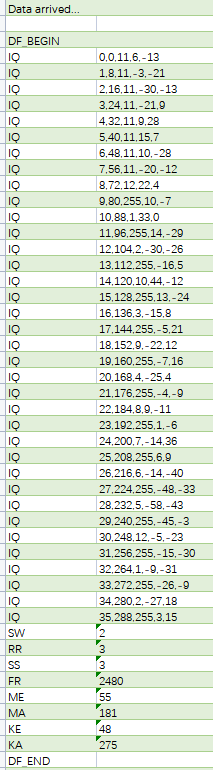
Fig. 1
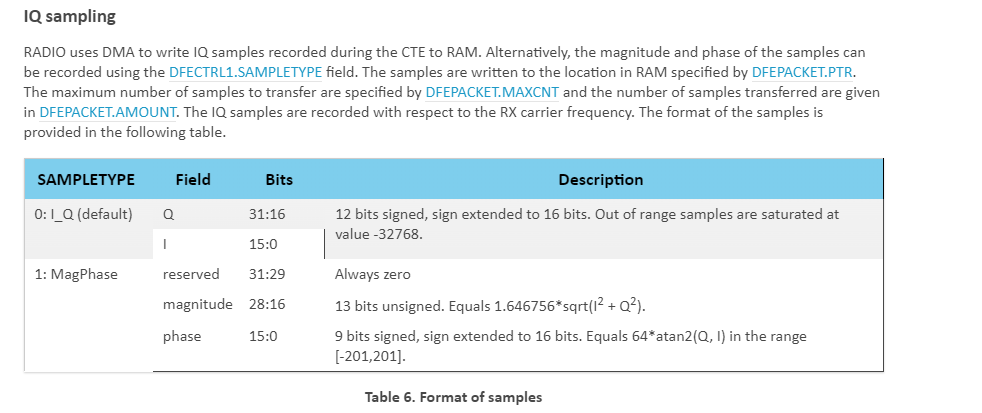
Fig. 2
Best Regards,
LIN
Best Regards,
LIN

