

Hi,
I have a nrf5340dk configured as a NUS peripheral, it collects some sensor data, packs it into a 138 byte buffer and sends it to the central.
On the central side there is a nrf52840 USB dongle connected to a Windows 10 PC communicating via Blatann library.
The system starts the stream with the following steps:
- Central connects to the peripheral
- Central negotiates the following parameters with the peripheral: 247 MTU, 2Mphy, 7.5ms connection interval
- Central waits for negotiation to finish, discovers peripherals UART service and sends a command to start streaming
- Peripheral initiates a 1khz timer that collects the data, packs it into a buffer and sends it to central. A timestamp is part of that buffer that is used to detect any discrepancies between the time the packets were sampled and received on central
- Central parses and profiles those packets, and after some determined amount of time it will send a command to stop the stream to the peripheral and it will display a graph of all the profiled packets
The aim is to have the "Timestamp average" field to be as close as possible to 1000 μs and a good throughput needs to be achieved for that to be so.
What I observed that that DLE size needs to be pretty specific for that throughput to be properly matched.
For example, when I set DLE to 251 I get: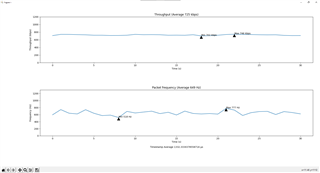
But if I set it to 150 I get exactly what I expect (about ~30 μs discrepancy due to profiler precision and other factors)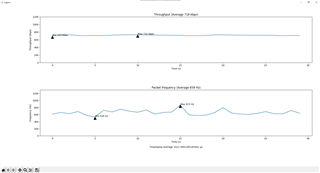
Then if I set it to a lower value, in this case 120, I get a falloff again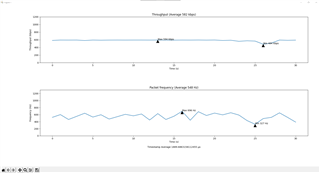
In another example, sending a 27 byte buffer at 1khz with 251 DLE yields this result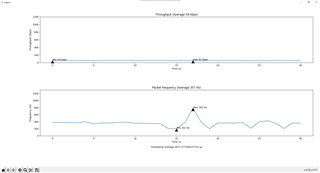
But when I set DLE to 27 I get better results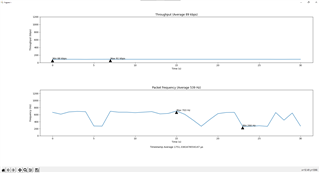
My question is, what is the proper relationship between transmitted packet size and negotiated DLE size for best throughput?
