Multiple unknown transmissions

Hello,

We developed a system that consists of 1 central and 10 peripherals, all are based on nRF52840. Below is the configuration of the system:

Central: AWSFreeRTOS

Peripherals: SDK V15.3.0

Connection Interval: 200ms

Slave latency: 10

CodedPHY S=8 (125kbps)

We measured the current consumption of peripheral using Power Profiler, and captured the packet exchange using sniffer. With above configuration, we expect that the peripheral transmits every 2 seconds (10 connection intervals) when idle.

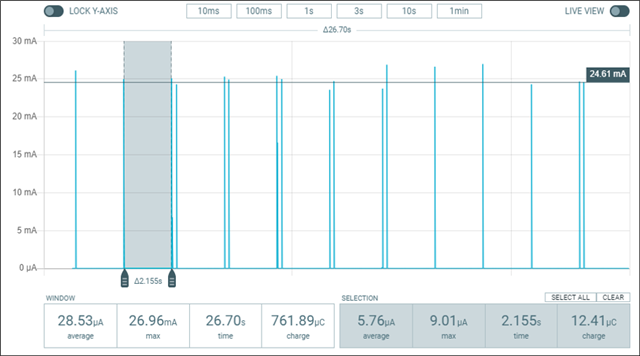
However, we notice something we don't understand: from the Power Profiler, it seems the peripheral transmits 1 or 2 consecutive intervals (200ms apart), then wait around 2 seconds (10 intervals) and transmit again:
But from the sniffer log, only one peripheral packet is captured every 2 seconds:
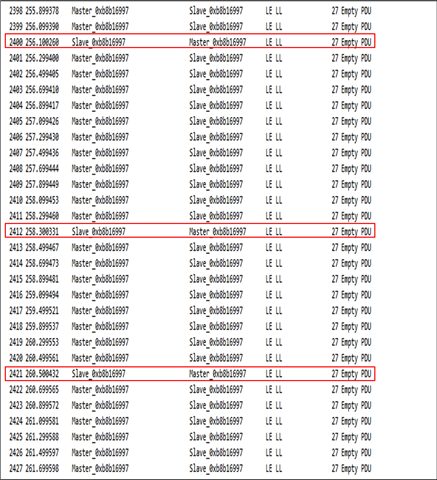
The above is captured when one peripheral is connected to the central.

More interestingly, when 10 peripherals are connected to the central, the power profiler waveform shows the peripheral transmits for 12 - 13 consecutive connection intervals, and then wait 2 seconds and transmits for 12 - 13 intervals again. This kills the battery quick.

Is there anything in the SDK config we missed to take care of?

Thanks,

Sheldon

Parents
  • Hello Einar,

    The connection parameters are as below:

    Connection Interval: 200ms

    Slave latency: 10

    CodedPHY S=8 (125kbps)

    MaxPDU: 27 bytes

    GAP event length: 6

    Is the above good enough?

    Thanks,

    Sheldon

  • Can you upload the sniffer trace as well (you have a screenshot from it in the original case). That should include everything from connection setup, so that we can see everything that has happened on the link, including any connection parameter updates etc.

    Also, can you zoom in on the current consumption spikes so that we can more easily see if they are radio activity or looks like they could be something else (for all I know just looking at the spikes it could be anything that happens periodically, though of course it matches the empty packet exchange in the sniffer trace)?

Reply
  • Can you upload the sniffer trace as well (you have a screenshot from it in the original case). That should include everything from connection setup, so that we can see everything that has happened on the link, including any connection parameter updates etc.

    Also, can you zoom in on the current consumption spikes so that we can more easily see if they are radio activity or looks like they could be something else (for all I know just looking at the spikes it could be anything that happens periodically, though of course it matches the empty packet exchange in the sniffer trace)?

Children
  • Hi Einar,

    We have captured two wireshark logs. One with slave latency 10, and one with slave latency 20. Please see if these logs can help.

    Thanks,

    Sheldon

    WPEL_button_connected mode_SL20.pcapng

    WPEL_button_connected mode_SL10_test1.pcapng

  • Hi,

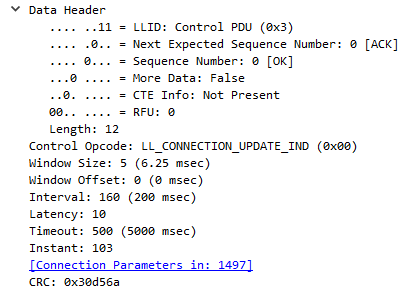
    In both traces the slave latency seems to be 10. For instance, this is from the connection update in #1631 in WPEL_button_connected mode_SL10_test1.pcapng:

    And looking at the time between data is transmitted form the peripheral that seems to always be more than 2 seconds (10 * 200 ms), so the sniffer trace do not indicate an issue per se. I notice that the central also skips some connection events, but that could be due to anything (typically other activities like other BLE links being prioritized at that time).

    So this looks good and as expected, is it not?

    Is the question then what happens since you have two peaks of current consumption close in time? The answer about that does not lie in the sniffer trace, but it is worth looking at a zoomed in plot of you can make that. Other than that, what else is the nRF doing at these points in time? The current consumption could in principle be caused by "anything" the nRF is doing (which does not have to be BLE related at all). For instance, what LF clock source are you using? Could it be regular LFRC calibration?

Related