LOG freeze at mqtt

Using a NRF9160DK. SDK2.0.0. Modem 1.3.2.

I have a problem when setting up a new NRF board to run with MQTT with AWS. 

When the setup is running, I get LOG <inf> for modem connect and the broker IP and then when mqtt_connect is run there are no more LOG events. (And the callback function is not activated). I have tried setting in some printk, which prints fine after the mqtt_connect. The printk sees at is get CONACK and SUBACK and that I publish to the MQTT. AWS logs also show that the publish is received and a response is created and published. 

The code is borrowed from mqtt_simple. the mqtt_connect function returns errorcode 0.

The strange thing is I have 1 board running as should.

  • It is at aws.c by the 536 the log stops. when mqtt_connect is called.

    The prj.conf file

    # Logging interface
    CONFIG_LOG=y
    
    # Stacks and heaps
    CONFIG_HEAP_MEM_POOL_SIZE=16384 
    CONFIG_MAIN_STACK_SIZE=16384
    CONFIG_SYSTEM_WORKQUEUE_STACK_SIZE=4096
    
    # UART interface
    CONFIG_SERIAL=y
    CONFIG_UART_INTERRUPT_DRIVEN=y
    
    # cJSON interface
    CONFIG_CJSON_LIB=y
    
    # AT host interface
    CONFIG_AT_HOST_LIBRARY=y
    
    # Date time interface
    CONFIG_DATE_TIME=y
    
    # Use GPIO
    CONFIG_GPIO=y
    CONFIG_GPIO_NRFX=y
    CONFIG_NRFX_GPIOTE=y
    
    # MQTT interface
    CONFIG_MQTT_LIB=y
    CONFIG_MQTT_LIB_TLS=y
    CONFIG_MQTT_CLEAN_SESSION=y
    
    # Network interface
    CONFIG_NETWORKING=y
    CONFIG_NET_SOCKETS=y
    CONFIG_NET_NATIVE=n
    
    # Library for the LTE network
    CONFIG_LTE_LINK_CONTROL=y
    CONFIG_LTE_AUTO_INIT_AND_CONNECT=n
    CONFIG_LTE_NETWORK_MODE_LTE_M=y
    CONFIG_MODEM_KEY_MGMT=y
    CONFIG_NRF_MODEM_LIB=y
    
    #Enable reboot from software
    CONFIG_REBOOT=y
    
    # newlibc
    CONFIG_NEWLIB_LIBC=y
    CONFIG_NEWLIB_LIBC_FLOAT_PRINTF=y
    
    # Use PWM
    CONFIG_PWM=y
    CONFIG_PWM_NRFX=y
    
    # use ADC
    CONFIG_ADC=y
    CONFIG_ADC_NRFX_SAADC=y
    
    # USE I2C
    CONFIG_I2C=y
    CONFIG_I2C_NRFX=y
    
    # WatchDog interface
    CONFIG_WATCHDOG=y
    CONFIG_WDT_DISABLE_AT_BOOT=n
    
    # Pin control
    CONFIG_PINCTRL=y
    

    The main file:

    #include <zephyr.h>
    #include <sys/printk.h>
    #include <kernel.h>
    #include <stdio.h>
    
    #include "modem.h"
    #include "scheduler.h"
    #include "https.h"
    #include "cloud.h"
    #include "aws.h"
    #include "watch.h"
    
    /**
     * @brief Setting up the initializing functions.
     */
     void configure_system_on_start_up(void) {
         // Set the modem client id.
        modem_set_client_id();
        
        // Initialize modem module.
        modem_init();
    
        // Initialize the cloud.
        cloud_init(modem_get_client_id());
    
        // Initialize the watch.
        watch_init();
    
        // Set time offset.
        watch_set_offset(1);
    
        // Initialize the scheduler.
        scheduler_init();
    
        // Connect the modem to LTE network.
        modem_connect();
    
        // Connect to AWS.
        aws_connect();
    
        // Synchronize the watch.
        watch_update();
        k_sleep(K_MSEC(500));
    
     }
    
    /**
     * @brief The application main entry.
     */
    void main(void) {
    
        // Initialize system.
        configure_system_on_start_up();
    
        // Enter main loop.
        while(1) {
    
            // Run client.
            /*CLI_RUN();
    
            // Update the outlet current.
            va_update_outlet_current();
    
            // Run through the outlets.
            for(uint8_t i = 0; i <= number_of_outlets; i++) {
    
                // Update state machine.
                state_update(i);
            }
    
            // Feed the dog.
            wdt_feed_dog();*/
        }
    }

    Modem.h

    #ifndef MODEM_H_
    #define MODEM_H_
    
    /**
     * @brief   Initialize the modem.
     */
    void modem_init(void);
    
    /**
     * @brief   Connect the modem to the LTE network.
     */
    void modem_connect(void);
    
    /**
     * @brief   Disconnect the modem from the LTE network.
     */
    void modem_disconnect(void);
    
    /**
     * @brief   Set the client id.
     */
    void modem_set_client_id(void);
    
    /**
     * @brief   Get the client ID.
     *
     * @return  The client ID.
     */
    const uint8_t* modem_get_client_id(void);
    
    #endif /* MODEM_H_ */

    The modem.c file:

    #include <stdio.h>
    #include <string.h>
    
    #include <zephyr.h>
    #include <logging/log.h>
    #include <modem/lte_lc.h>
    #include <modem/modem_key_mgmt.h>
    #include <nrf_modem_at.h>
    
    
    //! Register the modem module to the logging system.
    LOG_MODULE_REGISTER(Modem, 3);
    
    //! The modem connection status flag.
    static bool is_connected;
    
    //! An array holding the client id.
    static uint8_t client_id[20];
    
    void modem_init(void) {
    
        int error;
    
        // Turn off the psm mode.
        error = lte_lc_psm_req(false);
    
        if(error) {
    
            LOG_ERR("Failed to turn off PSM mode, error: %d.", error);
    
            return;
        }
    
        // Turn off the edrx mode.
        error = lte_lc_edrx_req(false);
    
        if(error) {
    
            LOG_ERR("Failed to turn off EDRX mode, error: %d.", error);
    
            return;
        }
    
        // Initialize the LTE network.
        error = lte_lc_init();
    
        if(error) {
    
            LOG_ERR("Failed to initialize the modem, error: %d.", error);
    
            return;
        }
    }
    
    void modem_set_client_id(void) {
    
        // Fetch the IMEI number from the modem.
        char imei_buffer[26];
        modem_write_at_command("AT+CGSN", imei_buffer, sizeof(imei_buffer));
    
        // Add null terminator to the IMEI number.
        imei_buffer[15] = '\0';
    
        // Create the client id.
        snprintf(client_id, sizeof(client_id), "acdc-%.*s", 15, imei_buffer);
    
        LOG_INF("Client ID: %s.", log_strdup(client_id));
    }
    
    const uint8_t* modem_get_client_id(void) {
    
        return client_id;
    }

    aws.h

    #ifndef AWS_H_
    #define AWS_H_
    
    #include <stdint.h>
    #include <stdbool.h>
    
    #include "software_settings.h"
    
    /**
     * @brief   Subscribe data used when packets are published on AWS.
     */
    typedef struct {
    
        bool is_subscribed;             //!< Flag indicating if the topic is subscribed.
        char* topic;                    //!< The subscribe/publish topic.
        char* failure_message;          //!< The payload message when failed on AWS.
        char* success_message;          //!< The payload message when succeeded on AWS.
        char* qos;                      //!< The Quality of Service.
    
    } aws_mqtt_status_t;
    
    //! Event identifiers used by the @ref aws_event_callback_t.
    typedef enum  {
    
        AWS_EVENT_NONE,                 //!< This ID is never used. Dummy value for completeness.
        AWS_EVENT_RESPONSE_READY,       //!< A complete AWS response packet is ready.
    
    } aws_event_t;
    
    /**
     * @brief   AWS publish information.
     */
    typedef struct {
    
        char* topic;                    //!< The topic that is published to.
        uint8_t* data;                  //!< The data to publish.
    
    } aws_publish_info_t;
    
    //! Cloud event callback function type.
    typedef void (*aws_event_callback_t)(const aws_event_t, const uint8_t* const);
    
    /**
     * @brief   Initialize the AWS and MQTT broker.
     *
     * @param   _client_id  The client id.
     * @param   _callback   Function to be called when a aws event is detected.
     */
    void aws_init(const uint8_t* const _client_id, const aws_event_callback_t _callback);
    
    /**
     * @brief   Connect to the AWS MQTT broker.
     */
    void aws_connect(void);
    
    /**
     * @brief   Disconnect from the AWS MQTT broker.
     */
    void aws_disconnect(void);
    
    /**
     * @brief   Verify if the AWS MQTT broker connection is requested.
     *
     * @retval  false   MQTT broker connection is not requested.
     * @retval  true    MQTT broker connection is requested.
     */
    bool aws_is_connection_requested(void);
    
    /**
     * @brief   Run for the AWS MQTT broker events and inputs.
     *          This function shall only be called inside a thread.
     */
    void aws_run(void);
    
    /**
     * @brief   Subscribe to the configured topic.
     *
     * @param   _subscribe_topic    The topic that shall be subscribed to.
     *
     * @retval  0           Success.
     * @retval  Negative    Error.
     */
    int16_t aws_subscribe(const char* const _subscribe_topic);
    
    /**
     * @brief   Publish data on the configured topic.
     *
     * @note    The functionality is handled through a work queue.
     *
     * @param   _topic      The topic that the data shall be published to.
     * @param   _data       The data that shall be published.
     */
    void aws_publish(const char* const _topic, const uint8_t* const _data);
    
    /**
     * @brief   Get the MQTT status.
     *
     * @param   _aws_mqtt_status    The MQTT status.
     */
    void aws_get_status(aws_mqtt_status_t* _aws_mqtt_status);
    
    #endif /* AWS_H_ */


    aws.c file: (notice defines for broker address and port)

    #include <stdio.h>
    
    #include <zephyr.h>
    #include <logging/log.h>
    #include <net/mqtt.h>
    #include <net/socket.h>
    #include <random/rand32.h>
    
    #include "aws.h"
    #include "watch.h"
    
    //! Register the AWS module to the logging system.
    LOG_MODULE_REGISTER(AWS, 3);
    
    //! The MQTT broker address details structure.
    static struct sockaddr_storage mqtt_broker;
    
    //! The MQTT polling file descriptor structure.
    static struct pollfd mqtt_pollfd;
    
    //! The MQTT client structure.
    static struct mqtt_client client;
    
    //! The MQTT publish mutex structure.
    static struct k_mutex aws_publish_mutex;
    
    //! The MQTT publish worker structure.
    static struct k_work aws_publish_work;
    
    //! The AWS callback function.
    static aws_event_callback_t aws_callback = NULL;
    
    //! The MQTT status when data is published on AWS.
    static aws_mqtt_status_t aws_mqtt_status;
    
    //! The MQTT client RX buffer.
    static uint8_t mqtt_rx_buffer[8192];
    
    //! The MQTT client TX buffer.
    static uint8_t mqtt_tx_buffer[8192];
    
    //! The MQTT payload buffer.
    static uint8_t mqtt_payload_buffer[8192];
    
    //! The MQTT broker connection requested flag.
    static atomic_t is_connect_requested;
    
    //! The AWS publish information.
    static aws_publish_info_t aws_publish_info;
    
    #define BROKER_HOSTNAME "xxxxxx"
    #define MQTT_BROKER_PORT 8883
    
    /**
     * @brief   Publish data to the AWS (Work).
     *
     * @param   work     The k_work structure.
     */
    static void aws_publish_work_handler(struct k_work* work) {
    
        ARG_UNUSED(work);
    
        // Lock the AWS publish mutex and has it succeeded?
        if(0 != k_mutex_lock(&aws_publish_mutex, K_MSEC(1000U))) {
    
            LOG_ERR("AWS publish mutex cannot be locked.");
    
            return;
        }
    
        // The parameters for the published message.
        struct mqtt_publish_param mqtt_param;
        memset(&mqtt_param, 0, sizeof(mqtt_param));
    
        // Fill out the parameters.
        mqtt_param.message.topic.qos = MQTT_QOS_1_AT_LEAST_ONCE;
        mqtt_param.message.topic.topic.utf8 = aws_publish_info.topic;
        mqtt_param.message.topic.topic.size = strlen(aws_publish_info.topic);
        mqtt_param.message.payload.data = aws_publish_info.data;
        mqtt_param.message.payload.len = strlen(aws_publish_info.data);
        mqtt_param.message_id = sys_rand32_get();
        mqtt_param.dup_flag = 0;
        mqtt_param.retain_flag = 0;
    
        LOG_INF("MQTT published to topic: %s, length: %u.", log_strdup(aws_publish_info.topic), strlen(aws_publish_info.data));
    
        // Publish the message to the topic.
        int16_t error = mqtt_publish(&client, &mqtt_param);
    
        if(0 > error) {
    
            LOG_ERR("Publish data failed: %d.", error);
        }
    
        // Unlock the AWS publish mutex.
        (void)k_mutex_unlock(&aws_publish_mutex);
    }
    
    /**
     * @brief   Get the published MQTT payload.
     *
     * @param   _c          The MQTT client.
     * @param   _length     The length of the payload.
     *
     * @retval  0           Success.
     * @retval  Negative    Error.
     */
    static int16_t aws_mqtt_publish_get_payload(struct mqtt_client* const _c, const size_t _length) {
    
        // Is the published payload too long?
        if(sizeof(mqtt_payload_buffer) < _length) {
    
            return -EMSGSIZE;
        }
    
        // Read all the published payload.
        return mqtt_readall_publish_payload(_c, mqtt_payload_buffer, _length);
    }
    
    /**
     * @brief   Handle the MQTT client events (Callback).
     *
     * @param   c       The MQTT client.
     * @param   evt     The MQTT event data.
     */
    static void aws_mqtt_event_handler(struct mqtt_client* const c, const struct mqtt_evt* evt) {
    
        int16_t error;
    
        // Reset the AWS event.
        uint8_t event = AWS_EVENT_NONE;
    
        // Go through the event type.
        switch(evt->type) {
    
            // Acknowledgement of connection request.
            case MQTT_EVT_CONNACK:
    
                // Has an error occurred?
                if(0 != evt->result) {
    
                    LOG_ERR("MQTT connection failed: %d.", evt->result);
    
                    break;
                }
    
                LOG_INF("MQTT client is connected.");
    
                // Subscribe the status topic to AWS.
                error = aws_subscribe(aws_mqtt_status.topic);
    
                // Has an error occurred?
                if(0 > error) {
    
                    LOG_ERR("Subscribe Status failed: %d.", error);
                }
    
                // Or has it succeeded?
                else {
    
                    LOG_INF("Subscribe Status succeeded.");
                }
    
                break;
    
            // Disconnection event.
            case MQTT_EVT_DISCONNECT:
    
                LOG_INF("MQTT client is disconnected.");
    
                atomic_set(&is_connect_requested, 0);
    
                break;
    
            // Publish event received when message is published on a topic client is subscribed to.
            case MQTT_EVT_PUBLISH: {
    
                // Read the parameters for the publish message.
                const struct mqtt_publish_param* p = &evt->param.publish;
    
                LOG_INF("MQTT PUBLISH result = %d, length = %d.", evt->result, p->message.payload.len);
    
                // Is QoS set to MQTT_QOS_1_AT_LEAST_ONCE?
                if(MQTT_QOS_1_AT_LEAST_ONCE == p->message.topic.qos) {
    
                    // Prepare the QoS1 ack message.
                    const struct mqtt_puback_param ack = {
    
                        .message_id = p->message_id
                    };
    
                    // Send the ack message.
                    error = mqtt_publish_qos1_ack(&client, &ack);
    
                    // Has an error occurred?
                    if(0 != error) {
    
                        LOG_ERR("MQTT publish QoS1 ack failed: %d.", error);
                    }
                }
    
                // Is QoS set to MQTT_QOS_2_EXACTLY_ONCE?
                else if(MQTT_QOS_2_EXACTLY_ONCE == p->message.topic.qos) {
    
                    // Prepare the QoS2 receive message.
                    const struct mqtt_pubrec_param receive = {
    
                        .message_id = p->message_id
                    };
    
                    // Send the receive message.
                    error = mqtt_publish_qos2_receive(&client, &receive);
    
                    // Has an error occurred?
                    if(0 != error) {
    
                        LOG_ERR("MQTT publish QoS2 receive failed: %d.", error);
                    }
                }
    
                // Read the published MQTT payload.
                error = aws_mqtt_publish_get_payload(c, p->message.payload.len);
    
                // Has an error occurred?
                if(0 != error) {
    
                    LOG_ERR("MQTT PUBLISH payload failed: %d.", error);
    
                    break;
                }
    
                // Has the payload been read successfully?
                LOG_INF("MQTT PUBLISH topic: %s.", log_strdup(p->message.topic.topic.utf8));
    
                // Has an AWS status topic occurred?
                if(0 == strcmp(p->message.topic.topic.utf8, aws_mqtt_status.topic)) {
    
                    // Set the AWS response ready event.
                    event = AWS_EVENT_RESPONSE_READY;
                }
    
                // Or is the response unknown?
                else {
    
                    LOG_INF("MQTT PUBLISH response is unknown.");
                }
    
                break;
            }
    
            // Acknowledgement for published message with QoS 1.
            case MQTT_EVT_PUBACK:
    
                // Has an error occurred?
                if(0 != evt->result) {
    
                    LOG_ERR("MQTT PUBACK received error: %d.", evt->result);
    
                    break;
                }
    
                LOG_INF("MQTT PUBACK received with id: %u.", evt->param.puback.message_id);
    
                break;
    
            // Reception confirmation for published message with QoS 2.
            case MQTT_EVT_PUBREC: {
    
                // Has an error occurred?
                if(0 != evt->result) {
    
                    LOG_ERR("MQTT QoS2 PUBREC received error: %d.", evt->result);
    
                    break;
                }
    
                // Read the parameters for the pubrec message.
                const struct mqtt_pubrec_param* p = &evt->param.pubrec;
    
                // Prepare the release message.
                const struct mqtt_pubrel_param release = {
    
                    .message_id = p->message_id
                };
    
                // Send the release message.
                error = mqtt_publish_qos2_release(&client, &release);
    
                // Has an error occurred?
                if(0 != error) {
    
                    LOG_ERR("MQTT publish QoS2 release failed: %d.", error);
    
                    break;
                }
    
                LOG_INF("MQTT PUBREC received with id: %u.", p->message_id);
    
                break;
            }
    
            // Release of published message with QoS 2.
            case MQTT_EVT_PUBREL: {
    
                // Has an error occurred?
                if(0 != evt->result) {
    
                    LOG_ERR("MQTT QoS2 PUBREL received error: %d.", evt->result);
    
                    break;
                }
    
                // Read the parameters for the pubrel message.
                const struct mqtt_pubrel_param* p = &evt->param.pubrel;
    
                // Prepare the complete message.
                const struct mqtt_pubcomp_param complete = {
    
                    .message_id = p->message_id
                };
    
                // Send the complete message.
                error = mqtt_publish_qos2_complete(&client, &complete);
    
                // Has an error occurred?
                if(0 != error) {
    
                    LOG_ERR("MQTT publish QoS2 complete failed: %d.", error);
    
                    break;
                }
    
                LOG_INF("MQTT PUBREL received with id: %u.", p->message_id);
    
                break;
            }
    
            // Confirmation to a publish release message with QoS 2.
            case MQTT_EVT_PUBCOMP: {
    
                // Has an error occurred?
                if(0 != evt->result) {
    
                    LOG_ERR("MQTT PUBCOMP received error: %d.", evt->result);
    
                    break;
                }
    
                LOG_INF("MQTT PUBCOMP received with id: %u.", evt->param.pubcomp.message_id);
    
                break;
            }
    
            // Acknowledgement to a subscribe request.
            case MQTT_EVT_SUBACK:
    
                // Has an error occurred?
                if(0 != evt->result) {
    
                    LOG_ERR("MQTT SUBACK received error: %d.", evt->result);
    
                    break;
                }
    
                LOG_INF("MQTT SUBACK received with id: %u.", evt->param.suback.message_id);
    
                aws_mqtt_status.is_subscribed = true;
    
                break;
    
            // Acknowledgment to a unsubscribe request.
            case MQTT_EVT_UNSUBACK:
    
                // Has an error occurred?
                if(0 != evt->result) {
    
                    LOG_ERR("MQTT UNSUBACK received error: %d.", evt->result);
    
                    break;
                }
    
                LOG_INF("MQTT UNSUBACK received with id: %u.", evt->param.unsuback.message_id);
    
                aws_mqtt_status.is_subscribed = false;
    
                break;
    
            // Ping Response from server.
            case MQTT_EVT_PINGRESP:
    
                break;
    
            default:
    
                break;
        }
    
        // Has a AWS callback been set?
        if((AWS_EVENT_NONE != event) && (NULL != aws_callback)) {
    
            // Set the callback function.
            aws_callback(event, mqtt_payload_buffer);
        }
    }
    
    /**
     * @brief   Initialize the MQTT broker structure.
     */
    static void aws_broker_init(void) {
    
        // Fill out the initial address info struct.
        struct addrinfo hints = {
    
            .ai_flags = 0,
            .ai_family = AF_INET,
            .ai_socktype = SOCK_STREAM,
            .ai_protocol = 0,
        };
    
        // The resulting address info struct.
        struct addrinfo* result;
        struct addrinfo* address;
    
        // Convert text strings representing hostnames/IP addresses into a linked list of struct addrinfo structure.
        int error = getaddrinfo(BROKER_HOSTNAME, NULL, &hints, &result);
    
        // Did an error occur?
        if(0 != error) {
    
            LOG_ERR("Getaddrinfo failed, error: %d.", errno);
    
            return;
        }
    
        // Store the resulting address info.
        address = result;
    
        // Look for the IPv4 Address of the broker.
        while(NULL != address) {
    
            // Is it an IPv4 Address?
            if(sizeof(struct sockaddr_in) == address->ai_addrlen) {
    
                // Initialize the broker structure.
                struct sockaddr_in* broker = ((struct sockaddr_in*)&mqtt_broker);
    
                // Fill out the socket IPv4 address for the broker.
                broker->sin_addr.s_addr = ((struct sockaddr_in*)address->ai_addr)->sin_addr.s_addr;
                broker->sin_family = AF_INET;
                broker->sin_port = htons(MQTT_BROKER_PORT);
    
                // An array holding the IP address.
                char ipv4_address[NET_IPV4_ADDR_LEN];
    
                // Convert the IP address from internal to numeric ASCII form.
                inet_ntop(AF_INET, &broker->sin_addr.s_addr, ipv4_address, sizeof(ipv4_address));
    
                LOG_INF("MQTT broker is connected with IP address: %s.", log_strdup(ipv4_address));
    
                break;
            }
    
            // Increment the address pointer.
            address = address->ai_next;
        }
    
        // Free the resulting memory struct.
        freeaddrinfo(result);
    }
    
    void aws_init(const uint8_t* const _client_id, const aws_event_callback_t _callback) {
    
        // Set the callback function.
        aws_callback = _callback;
    
        // Initialize the MQTT client instance.
        mqtt_client_init(&client);
    
        // MQTT client configuration.
        client.broker = &mqtt_broker;
        client.evt_cb = aws_mqtt_event_handler;
        client.client_id.utf8 = _client_id;
        client.client_id.size = strlen(client.client_id.utf8);
        client.password = NULL;
        client.user_name = NULL;
        client.protocol_version = MQTT_VERSION_3_1_1;
    
        // MQTT buffers configuration.
        client.rx_buf = mqtt_rx_buffer;
        client.rx_buf_size = sizeof(mqtt_rx_buffer);
        client.tx_buf = mqtt_tx_buffer;
        client.tx_buf_size = sizeof(mqtt_tx_buffer);
    
        // MQTT transport configuration.
        client.transport.type = MQTT_TRANSPORT_SECURE;
    
        // The security tag.
        static sec_tag_t sec_tag_list[] = { CC_MODEM_CERTIFICATE_SEC_TAG };
    
        // TLS configuration for secure MQTT transports.
        struct mqtt_sec_config* tls_config = &(client.transport).tls.config;
        tls_config->peer_verify = 2;
        tls_config->cipher_count = 0;
        tls_config->cipher_list = NULL;
        tls_config->sec_tag_count = ARRAY_SIZE(sec_tag_list);
        tls_config->sec_tag_list = sec_tag_list;
        tls_config->hostname = BROKER_HOSTNAME;
        tls_config->session_cache = TLS_SESSION_CACHE_DISABLED;
    
        // Fill out the MQTT status topic struct.
        aws_mqtt_status.is_subscribed = false;
        aws_mqtt_status.topic = (uint8_t*)_client_id;
        aws_mqtt_status.failure_message = "FAILURE";
        aws_mqtt_status.success_message = "SUCCESS";
        aws_mqtt_status.qos = "1";
    
        // Initialize a mutex.
        k_mutex_init(&aws_publish_mutex);
    
        // Initialize a work queue.
        k_work_init(&aws_publish_work, aws_publish_work_handler);
    }
    
    void aws_connect(void) {
    
        // Is the connection already requested?
        if(1 == atomic_get(&is_connect_requested)) {
    
            return;
        }
    
        // Initialize the MQTT broker.
        aws_broker_init();
    
        // Connect to the MQTT broker.
        int error = mqtt_connect(&client);
    
        // Has an error occurred?
        if(0 != error) {
    
            LOG_ERR("MQTT connection failed: %d.", error);
    
            return;
        }
    
        // Set the MQTT transport to secure.
        mqtt_pollfd.fd = client.transport.tls.sock;
        mqtt_pollfd.events = POLLIN;
    
        // The connection is now requested.
        atomic_set(&is_connect_requested, 1);
    }
    
    // cppcheck-suppress    unusedFunction
    void aws_disconnect(void) {
    
        // Is the connection not requested?
        if(0 == atomic_get(&is_connect_requested)) {
    
            return;
        }
    
        // Disconnect from the MQTT broker.
        int error = mqtt_disconnect(&client);
    
        // Has an error occurred?
        if(0 != error) {
    
            LOG_ERR("MQTT disconnection failed: %d.", error);
        }
    }
    
    bool aws_is_connection_requested(void) {
    
        return (bool)atomic_get(&is_connect_requested);
    }
    
    void aws_run(void) {
    
        // Wait on an event on the file descriptor.
        int error = poll(&mqtt_pollfd, 1,  mqtt_keepalive_time_left(&client));
    
        // Has an error occurred?
        if(0 > error) {
    
            LOG_ERR("MQTT poll failed: %d.", errno);
    
            return;
        }
    
        // Keep the connection alive by sending a ping request.
        error = mqtt_live(&client);
    
        // Has an error occurred?
        if((0 != error) && (-EAGAIN != error)) {
    
            LOG_ERR("MQTT live failed: %d.", error);
    
            return;
        }
    
        // Is there data to read (returned event)?
        if(POLLIN == (mqtt_pollfd.revents & POLLIN)) {
    
            // Receive an incoming MQTT packet. The registered callback will be called with the packet content.
            error = mqtt_input(&client);
    
            // Has an error occurred?
            if(0 != error) {
    
                LOG_ERR("MQTT input failed: %d.", error);
    
                return;
            }
        }
    
        // Does the returned event contain an error condition?
        if(POLLERR == (mqtt_pollfd.revents & POLLERR)) {
    
            LOG_ERR("MQTT failed with POLLERR.");
    
            return;
        }
    
        // Does the returned event contain an invalid request?
        if(POLLNVAL == (mqtt_pollfd.revents & POLLNVAL)) {
    
            LOG_ERR("MQTT failed with POLLNVAL.");
    
            return;
        }
    }
    
    int16_t aws_subscribe(const char* const _subscribe_topic) {
    
        // Is the topic already subscribed?
        if(true == aws_mqtt_status.is_subscribed) {
    
            return 0;
        }
    
        // Create the subscribed topic.
        struct mqtt_topic topic = {
    
            .topic = {
    
                .utf8 = _subscribe_topic,
                .size = strlen(_subscribe_topic)
            },
    
            .qos = MQTT_QOS_1_AT_LEAST_ONCE
        };
    
        // Add the topic to the subscription request.
        const struct mqtt_subscription_list subscription_list = {
    
            .list = &topic,
            .list_count = 1,
            .message_id = sys_rand32_get()
        };
    
        LOG_INF("MQTT subscribed to topic: %s", log_strdup(_subscribe_topic));
    
        // Subscribe to the topic.
        return mqtt_subscribe(&client, &subscription_list);
    }
    
    void aws_publish(const char* const _topic, const uint8_t* const _data) {
    
        // Lock the AWS publish mutex and has it succeeded?
        if(0 != k_mutex_lock(&aws_publish_mutex, K_MSEC(CC_WORK_MUTEX_LOCK_TIMEOUT_MS))) {
    
            LOG_ERR("AWS publish mutex cannot be locked.");
    
            return;
        }
    
        // Store the AWS publish information.
        aws_publish_info.topic = (char*)_topic;
        aws_publish_info.data = (uint8_t*)_data;
    
        // Unlock the AWS publish mutex.
        (void)k_mutex_unlock(&aws_publish_mutex);
    
        // Submit a work item to the system work queue.
        (void)k_work_submit(&aws_publish_work);
    }
    
    void aws_get_status(aws_mqtt_status_t* _aws_mqtt_status) {
    
        // Get the AWS MQTT status struct.
        memcpy(_aws_mqtt_status, &aws_mqtt_status, sizeof(aws_mqtt_status));
    }

    cloud.h

    #ifndef CLOUD_H_
    #define CLOUD_H_
    
    //! Cloud topic types.
    typedef enum  {
    
        CLOUD_TOPIC_TYPE_GET_PCC_LOAD,                  //!< The "Get PCC load" type.
        CLOUD_TOPIC_NUMBER_OF_TYPES                     //!< The number of types.
    
    } cloud_topic_type_t;
    
    //! Event identifiers used by the @ref cloud_event_callback_t.
    typedef enum  {
    
        CLOUD_EVENT_NONE,                               //!< This ID is never used. Dummy value for completeness.
        CLOUD_EVENT_GET_PCC_LOAD_PACKET_SUCCEEDED,      //!< A complete "Get PCC Load" packet has succeeded.
        CLOUD_EVENT_GET_PCC_LOAD_PACKET_FAILED          //!< A complete "Get PCC load" packet has failed.
    
    } cloud_event_t;
    
    /**
     * @brief   Cloud publish information.
     */
    typedef struct {
    
        char* topic;                                    //!< The topic that is published to.
        uint8_t* data;                                  //!< The data to publish.
    
    } cloud_publish_info_t;
    
    //! Event callback function type.
    typedef void (*cloud_event_callback_t)(const cloud_event_t);
    
    /**
     * @brief   Initialize the cloud.
     *
     * @param   _client_id      The client id.
     */
    void cloud_init(const uint8_t* const _client_id);
    
    /**
     * @brief   Set the callback function.
     *
     * @param   _callback   Function to be called when an event is detected.
     */
    void cloud_set_callback(const cloud_event_callback_t _callback);
    
    /**
     * @brief   Create a JSON object so it is ready for publishing.
     *
     * @note    The function acts as an interface handling all different object types defined by @ref cloud_topic_type_t.
     *          The data parameters consist of different data depending of the type (2 set of data arrays are needed for some types).
     *
     * @param   _type                   The packet type.
     * @param   _primary_data           The generic primary data. (Unused = NULL).
     * @param   _primary_data_length    The length of the primary data. (Unused = NULL).
     * @param   _secondary_data         The generic secondary data. (Unused = NULL).
     * @param   _secondary_data_length  The length of the secondary data. (Unused = NULL).
     */
    void cloud_create_object(const uint8_t _type,
                             const uint8_t** const _primary_data,
                             const uint16_t* const _primary_data_length,
                             const uint8_t** const _secondary_data,
                             const uint16_t* const _secondary_data_length);
    
    /**
     * @brief   Publish the stored data to the AWS topic.
     */
    void cloud_publish(void);
    
    #endif /* CLOUD_H_ */

    cloud.c:

    #include <string.h>
    #include <stdio.h>
    #include <stdlib.h>
    
    #include <zephyr.h>
    #include <logging/log.h>
    #include <cJSON.h>
    
    #include "cloud.h"
    #include "watch.h"
    #include "aws.h"
    
    //! Register the cloud module to the logging system.
    LOG_MODULE_REGISTER(CLOUD, 3);
    
    //! The callback function.
    static cloud_event_callback_t cloud_callback = NULL;
    
    //! A list of the topics that can be published to AWS MQTT.
    static const char* const topics[CLOUD_TOPIC_NUMBER_OF_TYPES] = { "acdc/get_pcc_load" };
    
    //! A list of the response types from AWS MQTT.
    static const char* const response_types[CLOUD_TOPIC_NUMBER_OF_TYPES] = { "getPCCLoad" };
    
    //! The cloud publish information.
    static cloud_publish_info_t cloud_publish_info;
    
    /**
     * @brief   Find the response type index from the type string.
     *
     * @param   _type       The type in string.
     *
     * @retval  0x00-0xFE   The type index.
     * @retval  0xFF        No type is found.
     */
    static uint8_t cloud_find_response_type_index(const char* const _type) {
    
        // Loop through the response types.
        for(uint16_t i = 0; i < sizeof(response_types); i++) {
    
            // Has the response type been found, then return the index.
            if(0 == strcmp(response_types[i], _type)) {
    
                return i;
            }
        }
    
        // If the response type is not found, return 0xFF.
        return 0xFF;
    }
    
    /**
     * @brief   Handle the PCC load result from AWS.
     *
     * @param   _aws_mqtt_status    The AWS MQTT status parameters.
     * @param   _results            The JSON object containing the results.
     *
     * @retval  false               An error has occurred.
     * @retval  true                No error has occurred.
     */
    static bool cloud_handle_pcc_load_result(const aws_mqtt_status_t _aws_mqtt_status, const cJSON* const _results) {
    
        // Loop through the results array.
        for(uint16_t i = 0; i < cJSON_GetArraySize(_results); i++) {
    
            // Get the next array item.
            cJSON* result = cJSON_GetArrayItem(_results, i);
    
            // Get the status code.
            cJSON* status_code = cJSON_GetObjectItem(result, "statusCode");
    
            // Has a success message been received?
            if(0 == strcmp(status_code->valuestring, _aws_mqtt_status.success_message)) {
    
                // Get the id and PCC Load.
                cJSON* id = cJSON_GetObjectItem(result, "id");
                cJSON* pcc_load = cJSON_GetObjectItem(result, "pccLoad");
    
                LOG_INF("PCC load Result(%s): %s.", log_strdup(id->valuestring), log_strdup(pcc_load->valuestring));
    
                // Set the PCC load.
                va_set_pcc_load((uint16_t)atoi(pcc_load->valuestring));
            }
    
            // Has a failure message been received?
            else {
    
                // Get the id and message.
                cJSON* id = cJSON_GetObjectItem(result, "id");
                cJSON* message = cJSON_GetObjectItem(result, "message");
    
                LOG_INF("PCC load Result(%s): %s", log_strdup(id->valuestring),
                        log_strdup(message->valuestring));
    
                return false;
            }
        }
    
        return true;
    }
    
    /**
     * @brief       Handle events from the AWS.
     *
     * @param       _aws_event      Event generated by AWS.
     * @param       _data           Received data.
     */
    static void cloud_event_handler(const aws_event_t _aws_event, const uint8_t* const _data) {
    
        // Reset the event.
        uint8_t event = CLOUD_EVENT_NONE;
    
        // Go through the event.
        switch(_aws_event) {
    
            case AWS_EVENT_RESPONSE_READY: {
    
                // Get the AWS MQTT status parameters.
                aws_mqtt_status_t aws_mqtt_status;
                aws_get_status(&aws_mqtt_status);
    
                // Create the JSON object from the received data.
                cJSON* response = cJSON_Parse(_data);
    
                // Fetch the packet type object from the response.
                cJSON* type = cJSON_GetObjectItem(response, "type");
    
                LOG_INF("AWS response type: %s.", log_strdup(type->valuestring));
    
                // Go through the response type.
                switch(cloud_find_response_type_index(type->valuestring)) {
    
                    case CLOUD_TOPIC_TYPE_GET_PCC_LOAD: {
    
                        // A "Get PCC load" packet has been received.
                        event = CLOUD_EVENT_GET_PCC_LOAD_PACKET_SUCCEEDED;
    
                        // Fetch the pccLoadResults from the response.
                        cJSON* pcc_load_results = cJSON_GetObjectItem(response, "pccLoadResults");
    
                        // Handle the PCC load result.
                        if(false == cloud_handle_pcc_load_result(aws_mqtt_status, pcc_load_results)) {
    
                            // An error has occurred.
                            event = CLOUD_EVENT_GET_PCC_LOAD_PACKET_FAILED;
                        }
    
                        break;
                    }
    
                    default:
    
                        break;
                }
    
                // Remove the cJSON object.
                cJSON_Delete(response);
    
                break;
            }
    
            default:
    
                break;
        }
    
        // Has a Cloud callback been set?
        if((CLOUD_EVENT_NONE != event) && (NULL != cloud_callback)) {
    
            // Set the callback function.
            cloud_callback(event);
        }
    }
    
    /**
     * @brief       Create "Add Response" JSON object.
     *
     * @param       _response       The final JSON object.
     */
    static void cloud_create_add_response(cJSON* _response) {
    
        // Get the AWS MQTT status parameters.
        aws_mqtt_status_t aws_mqtt_status;
        aws_get_status(&aws_mqtt_status);
    
        // Add the elements to the response object.
        cJSON_AddItemToObject(_response, "topic", cJSON_CreateString(aws_mqtt_status.topic));
        cJSON_AddItemToObject(_response, "failureMessage", cJSON_CreateString(aws_mqtt_status.failure_message));
        cJSON_AddItemToObject(_response, "successMessage", cJSON_CreateString(aws_mqtt_status.success_message));
        cJSON_AddItemToObject(_response, "qos", cJSON_CreateString(aws_mqtt_status.qos));
    }
    
    /**
     * @brief   Run the cloud functionality.
     *          This function shall only be called inside a thread.
     */
    static void cloud_run(void) {
    
        while(1) {
    
            // Wait until connection is requested.
            if(false == aws_is_connection_requested()) {
    
                k_sleep(K_MSEC(10));
    
                continue;
            }
    
            // Keep the AWS MQTT broker connection alive and polling for new events.
            aws_run();
        }
    }
    
    //! Statically define and initialize the cloud thread.
    K_THREAD_DEFINE(cloud_thread, 8192,
                    cloud_run, NULL, NULL, NULL,
                    K_LOWEST_APPLICATION_THREAD_PRIO, 0, 0);
    
    void cloud_init(const uint8_t* const _client_id) {
    
        // Initialize the AWS.
        aws_init(_client_id, cloud_event_handler);
    }
    
    // cppcheck-suppress    unusedFunction
    void cloud_set_callback(const cloud_event_callback_t _callback) {
    
        // Set the callback function.
        cloud_callback = _callback;
    }
    
    void cloud_create_object(const uint8_t _type,
                             const uint8_t** const _primary_data,
                             const uint16_t* const _primary_data_length,
                             const uint8_t** const _secondary_data,
                             const uint16_t* const _secondary_data_length) {
    
        // Get the current date and time.
        watch_t watch;
        bool watch_status = watch_get(&watch);
    
        // Is the watch valid?
        if(false == watch_status) {
            LOG_ERR("Watch is invalid.");
            return;
        }
    
        // Create a JSON object holding the complete event.
        cJSON* event_data = cJSON_CreateObject();
    
        // Go through the type of the cloud publish.
        switch(_type) {
    
            case CLOUD_TOPIC_TYPE_GET_PCC_LOAD: {
    
                // Add the Charging load id string to the final event object.
                cJSON_AddItemToObject(event_data, "chargingLoadId", cJSON_CreateString("9b605eca-b857-42d3-a824-ef5ca15e8a74"));
    
                break;
            }
    
            default:
    
                break;
        }
    
        // Create an object holding the response.
        cJSON* response = cJSON_CreateObject();
    
        // Add the response to the object.
        cloud_create_add_response(response);
    
        // Add the response object to the final event object.
        cJSON_AddItemToObject(event_data, "response", response);
    
        // Store the AWS publish data.
        cloud_publish_info.topic = (char*)topics[_type];
        cloud_publish_info.data = cJSON_Print(event_data);
    
        // Free the cJSON object.
        cJSON_free(event_data);
    
        // Remove the cJSON object.
        cJSON_Delete(event_data);
    }
    
    void cloud_publish(void) {
    
        // Publish the data to the AWS.
        aws_publish(cloud_publish_info.topic, cloud_publish_info.data);
    }

    schedular_h:

    #ifndef SCHEDULER_H_
    #define SCHEDULER_H_
    
    /**
     * @brief   Initialize the scheduler.
     */
    void scheduler_init(void);
    
    #endif /* SCHEDULER_H_ */

    schedular.c:

    #include <stdio.h>
    
    #include <zephyr.h>
    #include <logging/log.h>
    
    #include "scheduler.h"
    #include "watch.h"
    #include "cloud.h"
    
    //! Register the scheduler module to the logging system.
    LOG_MODULE_REGISTER(Scheduler, 3);
    
    /**
     * @brief   Handle the scheduler events (Callback).
     *
     * @param   event   The scheduler event.
     * @param   watch   The current date and time.
     */
    static void scheduler_event_handler(const scheduler_event_t event, const watch_t* const watch) {
    
        // Look through the event.
        switch(event) {
    
            // Event SCHEDULER_EVENT_TICK_OCCURRED occurred.
            case SCHEDULER_EVENT_TICK_OCCURRED: {
    
    
                // Create JSON object and get it published to the topic.
                cloud_create_object(CLOUD_TOPIC_TYPE_GET_PCC_LOAD, NULL, NULL, NULL, NULL);
                cloud_publish();
    
                break;
            }
    
            // Event SCHEDULER_EVENT_INVALID occurred.
            case SCHEDULER_EVENT_INVALID:
    
                LOG_ERR("Date & time is invalid.");
    
                break;
    
            default:
    
                break;
        }
    }
    
    void scheduler_init(void) {
    
        // Set the scheduler callback.
        watch_set_scheduler_callback(scheduler_event_handler);
    }

  • Thank you!

    Could you try adding these lines to your prj.conf file:

    CONFIG_NET_LOG=y
    CONFIG_MQTT_LOG_LEVEL_DBG=y

    -Einar

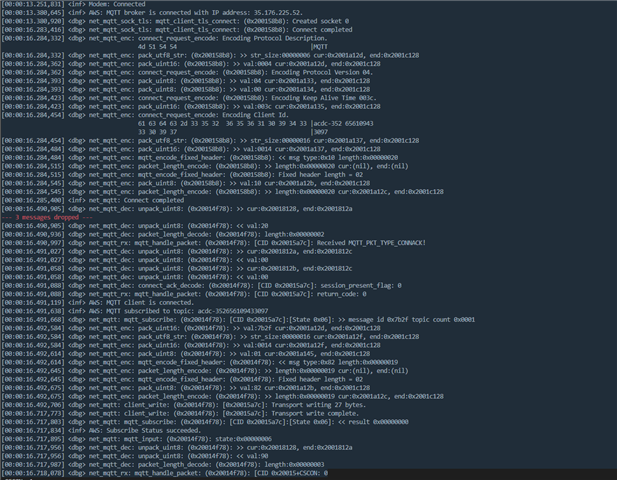
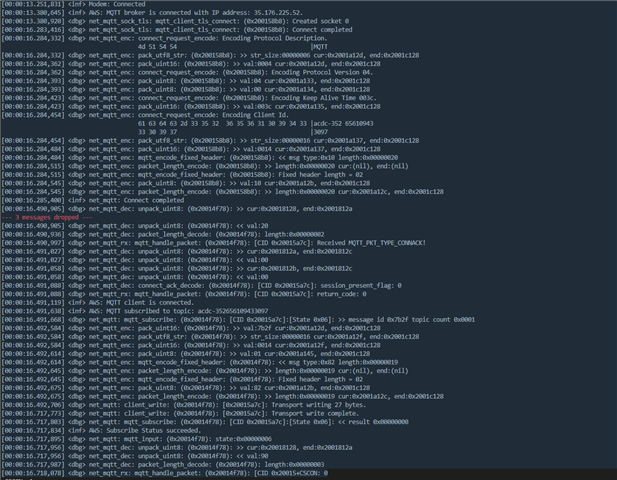
  • This is what I get in return. It still wont do anything after this.

  • This is what the terminal respons with. The log is still not responding on events hapening after.

  • Hm I see, could you please share your git repo, it would be easier for us to try running the code locally that way.

    -Einar

Related