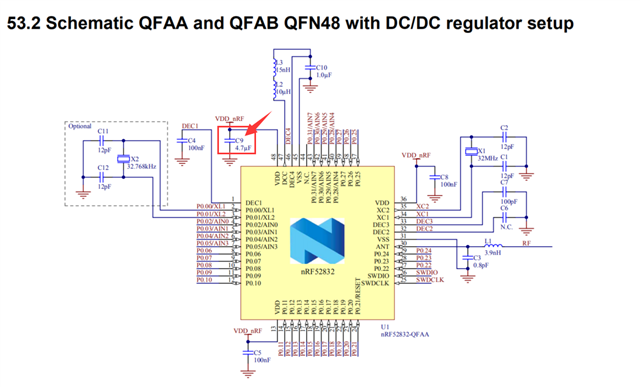
The effect of C9 capacitor on the power consumption of nRF52832 chip

We found that when testing the nRF52832 chip, if the C9 capacitor is empty, the chip broadcast power consumption increases from 20uA to 40uA, and the power consumption of the open serial port increases from 1.2mA to 12mA, but this does not happen on the nRf52810 chip. What is the reason for this difference?
Parents
  • Hi Roland,

    The nRF52810 has only one serial instance compared to the nRF52832 which has 2 serial instances, which means that in 52810 you cannot use TWIM and TWIS simultaneously. This could maybe be the reason for this, but I am not entirely sure. I can ask internally but kindly expect a delay as we are short staffed at the moment due to the vacation period. But this is the kind of anomaly that you observe is expected when not using the C9 capacitor as you make the system extra sensitive. This can also happen if you use the wrong value too. So I would advise you to use that.

    Best Regards,

    Priyanka

  • Hi Priyanka,

    Is there any update on this issue?

  • Hi Roland,

    Do you mean the peak current consumption increases when you remove the capacitor? This could be expected, since now there is no filtering of the narrow spikes that occur. Also, could you explain what you mean by "open serial port"?

    -Priyanka

  • 1. when this capacitor is removed, the average power consumption of the 52832 increases from 20uA to 40uA, while the average power consumption of the 52810 does not increase, and we would like to know the reason for this difference.
    2. when this capacitor is removed, the average power consumption of the 52832 using serial communication will increase from 1.2mA to 12mA, while the average power consumption of the 52810 does not increase, and we would like to know the reason for this difference.
    The answers to the above two questions help us to better understand the differences between these two chips, you can verify the phenomenon, thank you very much for your reply again!

  • Hi Roland,

    Are you using the PPK to measure the current? Removing the capacitor is not usually recommended as it is part of the reference design and unless you are sure about what you are doing, it's best to not remove it. Also, as I mentioned earlier, removing the capacitor can cause lot of jitters and this can cause the peak current to increase drastically and maybe the measurement equipment is not able follow and gives wrong readings.

    -Priyanka

Reply
  • Hi Roland,

    Are you using the PPK to measure the current? Removing the capacitor is not usually recommended as it is part of the reference design and unless you are sure about what you are doing, it's best to not remove it. Also, as I mentioned earlier, removing the capacitor can cause lot of jitters and this can cause the peak current to increase drastically and maybe the measurement equipment is not able follow and gives wrong readings.

    -Priyanka

Children
No Data
Related