PSM TAU not triggering - UDP application with Thingy:91

Hello,

I would be grateful if someone can help me to understand what I’m doing wrong or missing with my setup:

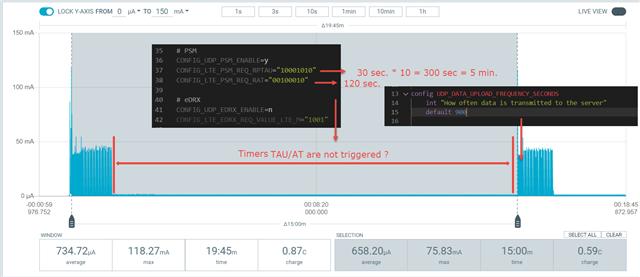
Basically, I’m using the UDP application with Thingy:91 and LTE-M SIM card to have a better understanding of the RRC Idle mode. i.e. T3412 Timer (TAU) and T3324 Timer (Active Time).

But for some reason, none of these two timers seems to be triggered when I turned on my device.

 I have flashed the application with different TAU & TAT values, but the only activity I can see is the UDP transmitting the 1k byte data every 900s (as expected). After the inactivity timer, the device seems to be in PSM for ever…

With my configuration, I was expecting to see a TAU every 5 min (10001010) and an Active Timer every 2 min (00100010).

Please let me know if any another information is required to help you understand what is not working…

Thanks a lot!
Bernard
Parents
  • Hello Bernard, and sorry about the delay.

    Could you check what PSM values you are getting from the network by running CEREG?

    Regards,

    Elfving

  • Hello Elfving,

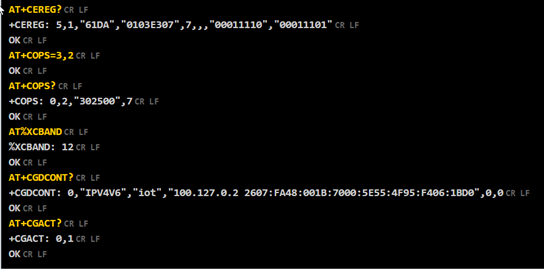
    The result of the CEREG is the following :

    So, from what I see, the TAU and A-T doesn’t match what I have put in prj.conf. With CEREG, the TAU and AT are:

    Periodic-TAU = 00011101, which is : 10 min. * 29 = 290 min.
    Active-Time = 00011110, which is: 2 sec. * 30 = 60 sec.


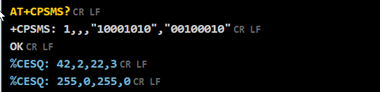
    But, if I check the current PSM setting (with CPSMS), I get what I have put in the prj.cong:


    So, what is the difference between CEREG & CPSMS ? Does it mean the PSM setting between the network and device are not aligned ? And further, does it mean the network does not accept the TAU and AT setting that I have put ?


    Thanks a lot!

    Regards,
    Bernard

  • Boudrox said:
    does it mean the network does not accept the TAU and AT setting that I have put ?

    Precisely.

    CPSMS just tells you what values you are requesting, to make sure that you have configured things the way you want to. Though it is up to the network whether or not it wants to give you those values. CEREG tells us that it is giving you something a bit different. You should preferably double check by using XMONITOR and taking a look at the Extended Periodic Tau value though. 

    The network usually gives you the closest accepted value to what you request. It might be that 5min is a bit too short. The network wants to minimize its load after all.

    Note that for questions on what values you are getting from the network you need to ask the network provider.

    Regards,

    Elfving

  • Hello Elfving,

    Thank you very much for the explanation. It is clear, but the gap from what requested values (CPSMS) and what received (CEREG) is huge:

    /* AT+CPSMS?
    +CPSMS: 1,,,"10001010","00100010"

    <Requested_Periodic-TAU>: 10001010 => 30s * 10 = 300 sec (5 min.)
    <Requested_Active-Time>:  00100010 => 1 min * 2 = 2 min.


    /* AT+CEREG?
    +CEREG: 5,1,"61DA","0103E307",7,,,"00011110","00011010"

    <Active-Time>:  00011110 => 2 sec.  * 30 = 60 sec.
    <Periodic-TAU>: 00011010 => 10 min. * 26 = 260 min.


    I will check with my network provider indeed.


    Now, I have check the %XMONITOR, and the result is the save as with CEREG. Though, the result shows two Periodic-TAU…

    /* AT%XMONITOR
    %XMONITOR: 1,"vlt","vtl","302500","61DA",7,12,"0103E307",,,,,"","00011110","00011010","01011111"

    <Active-Time>:      00011110 => 2 sec. * 30 = 60 sec.
    <Periodic-TAU-ext>: 00011010 => 10 min. * 26 = 260 min.
    <Periodic-TAU>:     01011111 => 10 hours * 31 = 310h

    So, could you please explain why there is two TAU parameters in the cmd and what is the difference between <Periodic-TAU-ext> and <Periodic-TAU>  ? (The documentation is not clear). I believe I’m using v1,3x


    Thanks again!

    Regards,
    Bernard

Reply
  • Hello Elfving,

    Thank you very much for the explanation. It is clear, but the gap from what requested values (CPSMS) and what received (CEREG) is huge:

    /* AT+CPSMS?
    +CPSMS: 1,,,"10001010","00100010"

    <Requested_Periodic-TAU>: 10001010 => 30s * 10 = 300 sec (5 min.)
    <Requested_Active-Time>:  00100010 => 1 min * 2 = 2 min.


    /* AT+CEREG?
    +CEREG: 5,1,"61DA","0103E307",7,,,"00011110","00011010"

    <Active-Time>:  00011110 => 2 sec.  * 30 = 60 sec.
    <Periodic-TAU>: 00011010 => 10 min. * 26 = 260 min.


    I will check with my network provider indeed.


    Now, I have check the %XMONITOR, and the result is the save as with CEREG. Though, the result shows two Periodic-TAU…

    /* AT%XMONITOR
    %XMONITOR: 1,"vlt","vtl","302500","61DA",7,12,"0103E307",,,,,"","00011110","00011010","01011111"

    <Active-Time>:      00011110 => 2 sec. * 30 = 60 sec.
    <Periodic-TAU-ext>: 00011010 => 10 min. * 26 = 260 min.
    <Periodic-TAU>:     01011111 => 10 hours * 31 = 310h

    So, could you please explain why there is two TAU parameters in the cmd and what is the difference between <Periodic-TAU-ext> and <Periodic-TAU>  ? (The documentation is not clear). I believe I’m using v1,3x


    Thanks again!

    Regards,
    Bernard

Children
  • Boudrox said:
    It is clear, but the gap from what requested values (CPSMS) and what received (CEREG) is huge

    True. Though it doesn't look too crazy to me, a Tau value of a few minutes is very short. People usually use a few hours when they need PSM. Waking up often can use more power than simply staying awake for the entire time. Verizon for instance requires a TAU of more than 3 hours.

    Boudrox said:

    So, could you please explain why there is two TAU parameters in the cmd and what is the difference between <Periodic-TAU-ext> and <Periodic-TAU>  ? (The documentation is not clear). I believe I’m using v1,3x

    Apparently the Periodic-TAU value that is given with CEREG is in fact Periodic-TAU-ext, I didn't know this. So you wouldn't really have to double check using XMONITOR.

    Though when both are provided you should use the Periodic-TAU-ext one, providing the Periodic-TAU value is optional. My understanding is that there are no 3GPP rules that define their difference when both are in use. So some network providers use Periodic-TAU for the same information with a different format, and some use Periodic-TAU for some different information. Though I might be mistaken here.

    Regards,

    Elfving

  • Hi Elfving,

    Thanks for the clarification!  I do not have any further question for now.

    Best regards, Bernard

Related