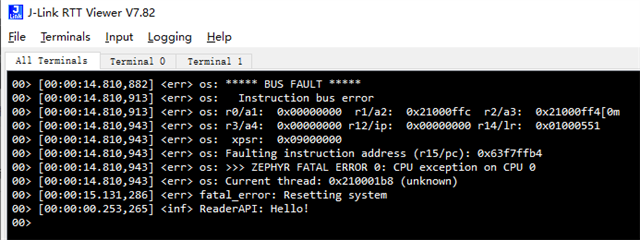
Hi there,
I have a problem to implement the SPIM in the Network core. I cannot detect any signal from SPI_SCK & SPI_MOSI by oscilloscope and logic analyzer (no signal from other two pins SS & MISO either)
Is there anything I need to configure to enable the SPIM in Network node?
I flashed the "peripheral_uart" example code to nrf5340,
And I wrote a simple code to test the SPIM functionality (signal output in SCK and MOSI)
It is the main.c for network core.
Here's my code:
main.c
#include <zephyr.h>
#include <sys/printk.h>
#include <logging/log.h>

#include "spi_driver.h"
// #include "Adafruit_NeoPixel.h"
#include <logging/log.h>

#define API_LOG_NAME ReaderAPI
LOG_MODULE_REGISTER(API_LOG_NAME);

void main(void)
{
	LOG_INF("Hello!\n");

        int inx = 0;
        spi_open(4000000);

        k_msleep(1000);

        nrf_spi_write("hello",5);

        while(1){
          //LOG_INF("Hello World!%d\n",inx++);
          k_msleep(500);
        }
}
spi_driver.c
#include "spi_driver.h"
#include <errno.h>
#include <fcntl.h>
#include <stdint.h>
#include <stdio.h>
#include <string.h>
#include <unistd.h>


#include <zephyr.h>
#include <device.h>
#include "hal/nrf_gpio.h"
#include <devicetree.h>
#include <drivers/gpio.h>
#include <logging/log.h>
#include <drivers/spi.h>

uint32_t default_clock_freq_hz = 8000000u;

#define SPI_DEVICE_NAME "SPI_0"
#define PIN_SPIM_CS     16
#define DELAY_SPI_CS_ACTIVE_US 3
#define TEST_STRING     "Nordic"

const struct device *spi_dev;

struct spi_cs_control *cs_ctrl =
          &(struct spi_cs_control){
                   .gpio_dev = DEVICE_DT_GET(DT_NODELABEL(gpio0)),
                   .delay    = DELAY_SPI_CS_ACTIVE_US,
                   .gpio_pin = PIN_SPIM_CS,
                   .gpio_dt_flags = GPIO_ACTIVE_LOW
          };


int spi_data_exchange(void* tx_buff, size_t length)
{
  int err;
  struct spi_config spi_cfg={0};

  spi_cfg.frequency = default_clock_freq_hz;
  spi_cfg.operation = SPI_WORD_SET(8)|!SPI_MODE_CPOL | SPI_MODE_CPHA|SPI_TRANSFER_MSB;

  spi_cfg.cs = cs_ctrl;

  struct spi_buf spi_buf[1] = {
          {
            .buf = tx_buff,
            .len = length,
          }
  };

  const struct spi_buf_set tx_set = {
          .buffers = spi_buf,
          .count = 1,
  };

  int i = 0;
  do{
   err = spi_transceive(spi_dev,&spi_cfg,&tx_set,NULL);
  }while(i--);
  if(err){
    printk("spi transcation failed err %d",err);
  }
  else{
    return tx_set.buffers->len;
  }
  return err;
}

int32_t spi_read_data(void* rx_buff, size_t length)
{
 int err;
  struct spi_config spi_cfg={0};

  spi_cfg.frequency = default_clock_freq_hz;
  spi_cfg.operation = SPI_WORD_SET(8)|!SPI_MODE_CPOL | SPI_MODE_CPHA|SPI_TRANSFER_MSB;

  struct spi_cs_control *cs_ctrl =
          &(struct spi_cs_control){
                   .gpio_dev = DEVICE_DT_GET(DT_NODELABEL(gpio0)),
                   .delay    = DELAY_SPI_CS_ACTIVE_US,
                   .gpio_pin = PIN_SPIM_CS,
                   .gpio_dt_flags = GPIO_ACTIVE_LOW
          };
  spi_cfg.cs = cs_ctrl;

  struct spi_buf spi_rxbuf[1] = {
          {
            .buf = rx_buff,
            .len = length,
          }
  };

  const struct spi_buf_set rx_set = {
          .buffers = spi_rxbuf,
          .count   = 1,
  };

  do{
    err = spi_transceive(spi_dev,&spi_cfg,NULL,&rx_set);
  }while(0);

  if(err){
    return 0;
  }else{
    return rx_set.buffers->len;
  }
}

int32_t nrf_spi_read(void* rx_buff, size_t length)
{
  int ret;
  ret = spi_read_data(rx_buff,length);
  return ret;
}

int32_t nrf_spi_write(const void* tx_buff, size_t length)
{
  int ret;
  ret = spi_data_exchange(tx_buff,length);
  return ret;
}

int32_t spi_open(uint32_t clock_freq_hz)
{
  default_clock_freq_hz = clock_freq_hz;


  spi_dev = device_get_binding(SPI_DEVICE_NAME);
  if(!spi_dev){
    return -1;
  }
  return 0;

}
void spi_close(void)
{
  /*do nothing*/
}
prj.conf
#spi
CONFIG_SPI=y
CONFIG_NRFX_SPIM=y
CONFIG_NRFX_SPIM0=y


#include NEWLIB_LIBC for math.h
CONFIG_NEWLIB_LIBC=y

CONFIG_UART_CONSOLE=n
CONFIG_LOG=y
CONFIG_USE_SEGGER_RTT=y
CONFIG_LOG_BACKEND_RTT=y
CONFIG_LOG_BACKEND_UART=n
nrf5340dk_nrf5340_cpunet.overlay
&spi0 {
	compatible = "nordic,nrf-spim";
	status = "okay";

	sck-pin = <30>;
	mosi-pin = <42>;
	miso-pin = <10>;
	clock-frequency = <4000000>;

};

&uart0 {
	status = "disabled";
};
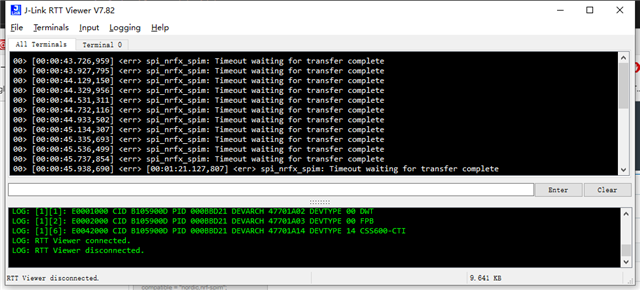
After flashed,the RTT always display " <err> spi_nrfx_spim: Timeout waiting for transfer complete"message,
How do I adjust my code?Or where can I find the network core SPIM's samples?