Libuarte + nus

  • Libuarte seems can't handle too many data or fast enough that comes from nus. 

  • Peripheral and central devices transmit data through Libuarte and nus.

  • Below is the part I have done,libuarte is unable to output complete data when transferring the file
  • What should I do to make B output complete data when transferring files

  • nrf52832   SDK_17.1.0
Parents
  • Hi,

    Which data rates are we talking about here? How fast do you want to communicate over UART and what do you achieve? What can you achieve if you skip the BLE part and only do dummy data over UARTE? Also, please elaborate more on the configuration (baud rate, flow control, etc), and what you have found from testing/debugging.

    PS: You can insert code using Insert -> Code instead of screenshots to make it more readable and searchable.

    • baud rate 460800  No flow control

    • The peripheral device receives the data of the central device completely, but it cannot output to the PC through libuarte in time, and the data overflow
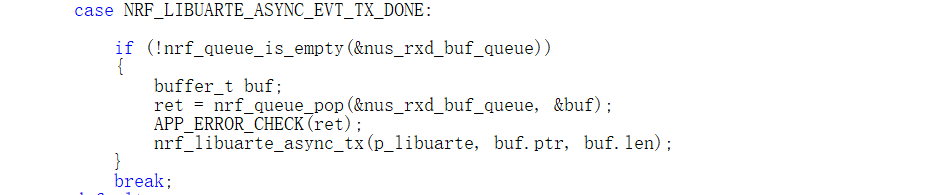
    •         case NRF_LIBUARTE_ASYNC_EVT_TX_DONE:
      
      			if (!nrf_queue_is_empty(&nus_rxd_buf_queue))
      			{
      				buffer_t buf;
      				ret = nrf_queue_pop(&nus_rxd_buf_queue, &buf);            
      				APP_ERROR_CHECK(ret);
      				nrf_libuarte_async_tx(p_libuarte, buf.ptr, buf.len);				
      			}
                  break;

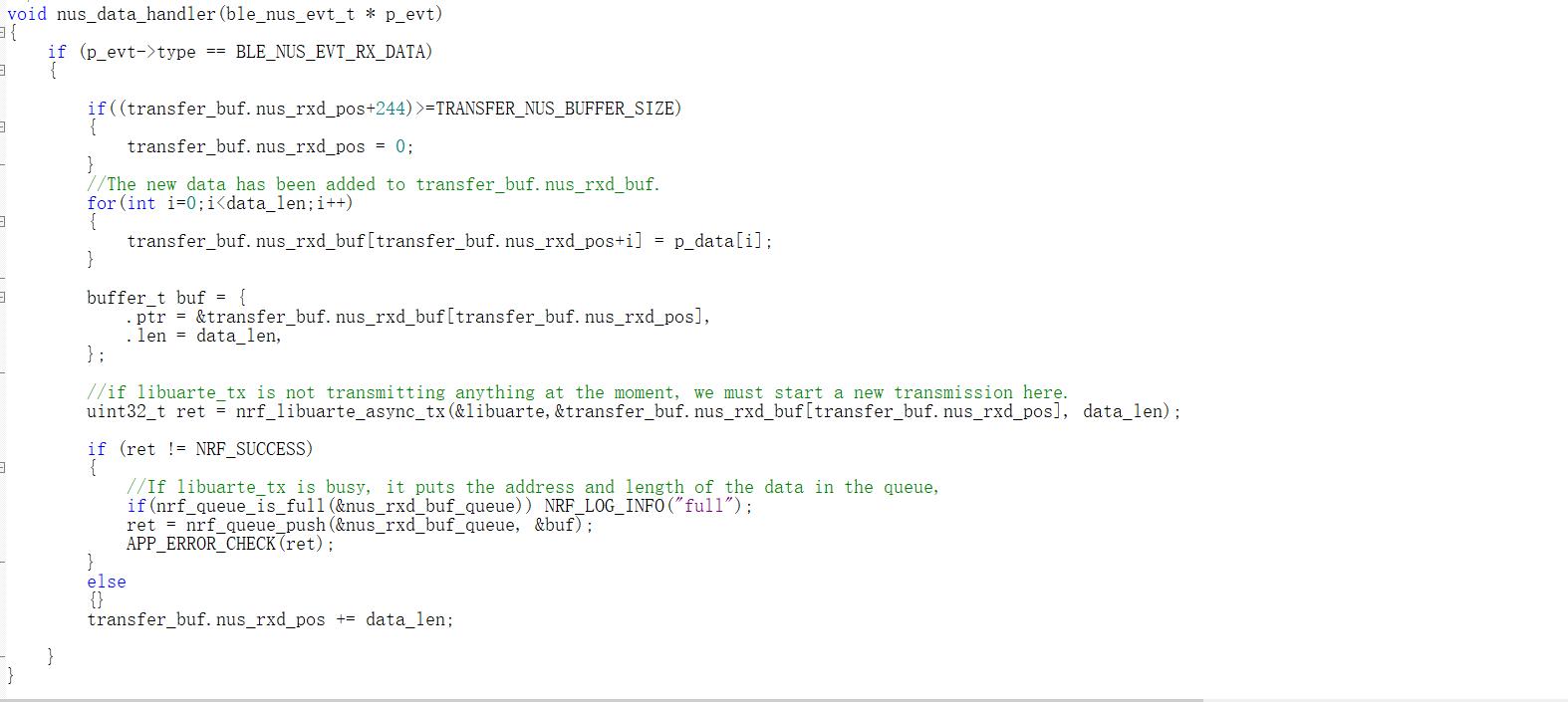
  • /**@brief Function for handling the data from the Nordic UART Service.
     *
     * @details This function will process the data received from the Nordic UART BLE Service and send
     *          it to the LIBUARTE module.
     *
     * @param[in] p_evt       Nordic UART Service event.
     */
    void nus_data_handler(ble_nus_evt_t * p_evt)
    {
        if (p_evt->type == BLE_NUS_EVT_RX_DATA)
        {
    		ble_nus_chars_received_uart_print((uint8_t*)p_evt->params.rx_data.p_data, p_evt->params.rx_data.length);        
        }
    }
    
    /**@brief Function for handling characters received by the Nordic UART Service (NUS).
     *
     * @details This function takes a list of characters of length data_len and prints the characters out on UART.
     *          If @ref ECHOBACK_BLE_UART_DATA is set, the data is sent back to sender.
     */
    static void ble_nus_chars_received_uart_print(uint8_t * p_data, uint16_t data_len)
    {
    	len+=data_len;
    	NRF_LOG_INFO("re %d",len);//Get the total NUS data length
    	if((transfer_buf.nus_rxd_pos+244)>=TRANSFER_NUS_BUFFER_SIZE)
    	{
    		transfer_buf.nus_rxd_pos = 0;
    	}	
    	//The new data has been added to transfer_buf.nus_rxd_buf.
    	for(int i=0;i<data_len;i++)
    	{
    		transfer_buf.nus_rxd_buf[transfer_buf.nus_rxd_pos+i] = p_data[i];
    	}
    	
    	buffer_t buf = {
    		.ptr = &transfer_buf.nus_rxd_buf[transfer_buf.nus_rxd_pos],
    		.len = data_len,
    	};
    
    	//if libuarte_tx is not transmitting anything at the moment, we must start a new transmission here.
        uint32_t ret = nrf_libuarte_async_tx(&libuarte,&transfer_buf.nus_rxd_buf[transfer_buf.nus_rxd_pos], data_len);
    	
        if (ret != NRF_SUCCESS)
        {
    		//If libuarte_tx is busy, it puts the address and length of the data in the queue,
    		if(nrf_queue_is_full(&nus_rxd_buf_queue)) NRF_LOG_INFO("full");
    		ret = nrf_queue_push(&nus_rxd_buf_queue, &buf);            
    		APP_ERROR_CHECK(ret);
        }
        else
        {}
    	transfer_buf.nus_rxd_pos += data_len;		
    }


    • My logic is to imitate app_uart_put.

    • I can confirm that nus received the data in its entirety and saved it in an 8k buffer.
    • libuarte is perfectly fine.

    • Transfer rates up to roughly 35kb/s are fine, but higher rates will cause byte loss. Buffers storing data received by nus also print overflow flags.
    • Under the same conditions, the mobile phone as the central device can receive data completely and print data completely.
  • I found a new phenomenon when the transfer rate is 23kb/s, and after 5 minutes of continuous transfer, the phenomenon of byte loss occurs. The same is true for the other rates but the time at which the loss starts is different. I think there is something wrong with my code. I will check it again. Thank you very much.

  • Did you make any progress (find anything when checking your code)?

  • I'm not getting anywhere.

    I want peripheral and central high-speed transmission.The problem is that libuarte cannot timely output the data received by nus.

    Set the baud rate for the peripheral to 115200,Set the baud rate for the central to 460800.The periphery sends data to the center,liburte in the center can print the data completely,But when the baud rate is the same,The periphery again sends data to the center,At this time, liburte in the center cannot complete the output data.The phone acts as the center and receives the data completely.But I don't have a solution yet.

    My test scenario. pc<-->periphery <-->Central<-->pc .


  • I see. You should be able to get much more than 35 kbps which I see you get. I did not fully understand from your last posts if you did verify that you got a good throughput via UART when using dummy data and not NUS? If not, please do this first. Secondly, when you start doing more than one thing you need to optimize a bit, so ensure you use double buffering as described in this thread. If you still cannot make it work, can you upload your code here along with instructions on how you test (I need to see more than just some snippets to get the full picture of how you are doing things)?

Reply
  • I see. You should be able to get much more than 35 kbps which I see you get. I did not fully understand from your last posts if you did verify that you got a good throughput via UART when using dummy data and not NUS? If not, please do this first. Secondly, when you start doing more than one thing you need to optimize a bit, so ensure you use double buffering as described in this thread. If you still cannot make it work, can you upload your code here along with instructions on how you test (I need to see more than just some snippets to get the full picture of how you are doing things)?

Children
  • #include <stdint.h>
    #include <string.h>
    #include "nordic_common.h"
    #include "nrf.h"
    #include "ble_hci.h"
    #include "ble_advdata.h"
    #include "ble_advertising.h"
    #include "ble_conn_params.h"
    #include "nrf_sdh.h"
    #include "nrf_sdh_soc.h"
    #include "nrf_sdh_ble.h"
    #include "nrf_ble_gatt.h"
    #include "nrf_ble_qwr.h"
    #include "app_timer.h"
    #include "ble_nus.h"
    #include "app_util_platform.h"
    #include "bsp_btn_ble.h"
    #include "nrf_pwr_mgmt.h"
    
    #include "nrf_libuarte_async.h"
    #include "nrf_drv_clock.h"
    
    #include "ble_db_discovery.h"
    #include "ble_gap.h"
    #include "ble_nus_c.h"
    #include "nrf_ble_scan.h"
    
    #include "nrf_log.h"
    #include "nrf_log_ctrl.h"
    #include "nrf_log_default_backends.h"
    
    #define ROLE 							2
    
    #define APP_BLE_CONN_CFG_TAG            1                                           /**< A tag identifying the SoftDevice BLE configuration. */
    
    #define DEVICE_NAME                     "Nordic_UART"                               /**< Name of device. Will be included in the advertising data. */
    #define NUS_SERVICE_UUID_TYPE           BLE_UUID_TYPE_VENDOR_BEGIN                  /**< UUID type for the Nordic UART Service (vendor specific). */
    
    #define APP_BLE_OBSERVER_PRIO           3                                           /**< Application's BLE observer priority. You shouldn't need to modify this value. */
    
    #define APP_ADV_INTERVAL                32                                          /**< The advertising interval (in units of 0.625 ms. This value corresponds to 40 ms). */
    
    #define APP_ADV_DURATION                1800                                       /**< The advertising duration (180 seconds) in units of 10 milliseconds. */
    
    #define MIN_CONN_INTERVAL               MSEC_TO_UNITS(20, UNIT_1_25_MS)             /**< Minimum acceptable connection interval (20 ms), Connection interval uses 1.25 ms units. */
    #define MAX_CONN_INTERVAL               MSEC_TO_UNITS(20, UNIT_1_25_MS)             /**< Maximum acceptable connection interval (75 ms), Connection interval uses 1.25 ms units. */
    #define SLAVE_LATENCY                   0                                           /**< Slave latency. */
    #define CONN_SUP_TIMEOUT                MSEC_TO_UNITS(4000, UNIT_10_MS)             /**< Connection supervisory timeout (4 seconds), Supervision Timeout uses 10 ms units. */
    #define FIRST_CONN_PARAMS_UPDATE_DELAY  APP_TIMER_TICKS(500000)                       /**< Time from initiating event (connect or start of notification) to first time sd_ble_gap_conn_param_update is called (5 seconds). */
    #define NEXT_CONN_PARAMS_UPDATE_DELAY   APP_TIMER_TICKS(300000)                      /**< Time between each call to sd_ble_gap_conn_param_update after the first call (30 seconds). */
    #define MAX_CONN_PARAMS_UPDATE_COUNT    3                                           /**< Number of attempts before giving up the connection parameter negotiation. */
    
    #define DEAD_BEEF                       0xDEADBEEF                                  /**< Value used as error code on stack dump, can be used to identify stack location on stack unwind. */
    
    #define UART_RXD_BUF_SIZE               2440                                         /**< . */
    #define NUS_RXD_BUF_SIZE                9760                                         /**< . */
    
    
    BLE_NUS_DEF(m_nus, NRF_SDH_BLE_TOTAL_LINK_COUNT);                                   /**< BLE NUS service instance. */
    NRF_BLE_GATT_DEF(m_gatt);                                                           /**< GATT module instance. */
    NRF_BLE_QWR_DEF(m_qwr);                                                             /**< Context for the Queued Write module.*/
    BLE_ADVERTISING_DEF(m_advertising);                                                 /**< Advertising module instance. */
    
    NRF_BLE_GQ_DEF(m_ble_gatt_queue,                                        			/**< BLE GATT Queue instance. */
                   NRF_SDH_BLE_CENTRAL_LINK_COUNT,
                   NRF_BLE_GQ_QUEUE_SIZE);
    BLE_NUS_C_DEF(m_ble_nus_c);                                             			/**< BLE Nordic UART Service (NUS) client instance. */
    NRF_BLE_SCAN_DEF(m_scan);                                               			/**< Scanning Module instance. */
    BLE_DB_DISCOVERY_DEF(m_db_disc);                                        			/**< Database discovery module instance. */
    
    typedef struct
    {
       uint8_t  *ptr; 
       uint16_t len;
    }buffer_t;
    
    /**@brief   Macro for defining a uart instance.*/
    static struct 
    {
    	uint8_t  uart_rxd_buf[UART_RXD_BUF_SIZE];
    	uint16_t uart_rxd_pos;
    	
        uint8_t  nus_rxd_buf [NUS_RXD_BUF_SIZE];
    	uint16_t nus_rxd_pos;
    }cache;
    
    NRF_LIBUARTE_ASYNC_DEFINE(libuarte, 0, 2, 2, NRF_LIBUARTE_PERIPHERAL_NOT_USED, BLE_NUS_MAX_DATA_LEN, 5);
    
    /**@brief   Create a queue instance.
     */
    
    NRF_QUEUE_DEF(buffer_t, uart_rxd_queue, 10, NRF_QUEUE_MODE_NO_OVERFLOW);
    NRF_QUEUE_DEF(buffer_t, nus_rxd_queue, 40, NRF_QUEUE_MODE_OVERFLOW);
    
    static uint16_t   m_conn_handle          = BLE_CONN_HANDLE_INVALID;                 /**< Handle of the current connection. */
    static uint16_t   m_ble_nus_max_data_len = BLE_GATT_ATT_MTU_DEFAULT - 3;            /**< Maximum length of data (in bytes) that can be transmitted to the peer by the Nordic UART service module. */
    static ble_uuid_t m_adv_uuids[]          =                                          /**< Universally unique service identifier. */
    {
        {BLE_UUID_NUS_SERVICE, NUS_SERVICE_UUID_TYPE}
    };
    
    /**@brief NUS UUID. */
    static ble_uuid_t const m_nus_uuid =
    {
        .uuid = BLE_UUID_NUS_SERVICE,
        .type = NUS_SERVICE_UUID_TYPE
    };
    
    uint32_t uart_rxd_len;
    
    void uart_event_handler(void * context, nrf_libuarte_async_evt_t * p_evt)
    {
        nrf_libuarte_async_t * p_libuarte = (nrf_libuarte_async_t *)context;
        ret_code_t ret;
    
        switch (p_evt->type)
        {
            case NRF_LIBUARTE_ASYNC_EVT_ERROR:
                //bsp_board_led_invert(0);
                break;
            case NRF_LIBUARTE_ASYNC_EVT_RX_DATA:
    		
    			if((cache.uart_rxd_pos+244)>=UART_RXD_BUF_SIZE)
    			{
    				cache.uart_rxd_pos = 0;
    			}
    			
    			memcpy(&cache.uart_rxd_buf[cache.uart_rxd_pos],p_evt->data.rxtx.p_data,p_evt->data.rxtx.length);				
    			
                buffer_t buf = {
                    .ptr = &cache.uart_rxd_buf[cache.uart_rxd_pos],//p_evt->data.rxtx.p_data,
                    .len = p_evt->data.rxtx.length,
                };
    			
    			ret = nrf_queue_push(&uart_rxd_queue, &buf);
    			APP_ERROR_CHECK(ret);
    			
    			cache.uart_rxd_pos += p_evt->data.rxtx.length;
                nrf_libuarte_async_rx_free(p_libuarte, p_evt->data.rxtx.p_data, p_evt->data.rxtx.length);
    			uart_rxd_len +=p_evt->data.rxtx.length;
    			NRF_LOG_INFO("uart_rxd_len %d",uart_rxd_len);		
                break;
    			
            case NRF_LIBUARTE_ASYNC_EVT_TX_DONE:
    //			NRF_LOG_INFO("rxd %d",p_evt->data.rxtx.length);
    			if (!nrf_queue_is_empty(&nus_rxd_queue))
    			{
    				buffer_t buf;
    				ret = nrf_queue_pop(&nus_rxd_queue, &buf);
    				APP_ERROR_CHECK(ret);
    				nrf_libuarte_async_tx(p_libuarte, buf.ptr, buf.len);				
    			}
                break;
            default:
                break;
        }
    }
    
    static void libuarte_init(void)
    {
        nrf_libuarte_async_config_t nrf_libuarte_async_config = {
                .tx_pin     = TX_PIN_NUMBER,
                .rx_pin     = RX_PIN_NUMBER,
                .baudrate   = NRF_UARTE_BAUDRATE_460800,
                .parity     = NRF_UARTE_PARITY_EXCLUDED,
                .hwfc       = NRF_UARTE_HWFC_DISABLED,
                .timeout_us = 10000,
                .int_prio   = APP_IRQ_PRIORITY_HIGH
    			//.pullup_rx  = true,
        };
    
        ret_code_t err_code = nrf_libuarte_async_init(&libuarte, &nrf_libuarte_async_config, uart_event_handler, (void *)&libuarte);
    
        APP_ERROR_CHECK(err_code);
    
        nrf_libuarte_async_enable(&libuarte);	
    }
    
    uint32_t nus_rxd_len;
    /**@brief Function for handling characters received by the Nordic UART Service (NUS).
     *
     * @details This function takes a list of characters of length data_len and prints the characters out on UART.
     *          If @ref ECHOBACK_BLE_UART_DATA is set, the data is sent back to sender.
     */
    static void ble_nus_chars_received_uart_print(uint8_t * p_data, uint16_t data_len)
    {
    	uint32_t ret;
        nus_rxd_len+=data_len;
        NRF_LOG_INFO("re %d ",nus_rxd_len);
    	if((cache.nus_rxd_pos+244)>=NUS_RXD_BUF_SIZE)
    	{
    		cache.nus_rxd_pos = 0;
    	}	
    	//The new data has been added to transfer_buf.nus_rxd_buf.
    	for(int i=0;i<data_len;i++)
    	{
    		cache.nus_rxd_buf[cache.nus_rxd_pos+i] = p_data[i];
    	}
    	
    	//if libuarte_tx is not transmitting anything at the moment, we must start a new transmission here.
    	ret = nrf_libuarte_async_tx(&libuarte,&cache.nus_rxd_buf[cache.nus_rxd_pos], data_len);
    	if(ret == NRF_ERROR_BUSY)
    	{	
    		buffer_t buf = {
    			.ptr = &cache.nus_rxd_buf[cache.nus_rxd_pos],
    			.len = data_len,
    		};
    		//NRF_LOG_INFO("queue_utilization %d ",nrf_queue_utilization_get(&nus_rxd_buf_queue));
    		if(nrf_queue_is_full(&nus_rxd_queue))
    		{
    			NRF_LOG_INFO("queue_is_full");
    		}
    		ret = nrf_queue_push(&nus_rxd_queue, &buf);
    		APP_ERROR_CHECK(ret);
    	}
    	else if(ret==NRF_SUCCESS)
    	{
    		//NRF_LOG_INFO("uart_free");
    	}
    	cache.nus_rxd_pos += data_len;	
    }
    
    /**@brief Function for assert macro callback.
     *
     * @details This function will be called in case of an assert in the SoftDevice.
     *
     * @warning This handler is an example only and does not fit a final product. You need to analyse
     *          how your product is supposed to react in case of Assert.
     * @warning On assert from the SoftDevice, the system can only recover on reset.
     *
     * @param[in] line_num    Line number of the failing ASSERT call.
     * @param[in] p_file_name File name of the failing ASSERT call.
     */
    void assert_nrf_callback(uint16_t line_num, const uint8_t * p_file_name)
    {
        app_error_handler(DEAD_BEEF, line_num, p_file_name);
    }
    
    /**@brief Function for initializing the timer module.
     */
    static void timers_init(void)
    {
        ret_code_t err_code = app_timer_init();
        APP_ERROR_CHECK(err_code);
    }
    
    /**@brief Function for the GAP initialization.
     *
     * @details This function will set up all the necessary GAP (Generic Access Profile) parameters of
     *          the device. It also sets the permissions and appearance.
     */
    static void gap_params_init(void)
    {
        uint32_t                err_code;
        ble_gap_conn_params_t   gap_conn_params;
        ble_gap_conn_sec_mode_t sec_mode;
    
        BLE_GAP_CONN_SEC_MODE_SET_OPEN(&sec_mode);
    
        err_code = sd_ble_gap_device_name_set(&sec_mode,
                                              (const uint8_t *) DEVICE_NAME,
                                              strlen(DEVICE_NAME));
        APP_ERROR_CHECK(err_code);
    
        memset(&gap_conn_params, 0, sizeof(gap_conn_params));
    
        gap_conn_params.min_conn_interval = MIN_CONN_INTERVAL;
        gap_conn_params.max_conn_interval = MAX_CONN_INTERVAL;
        gap_conn_params.slave_latency     = SLAVE_LATENCY;
        gap_conn_params.conn_sup_timeout  = CONN_SUP_TIMEOUT;
    
        err_code = sd_ble_gap_ppcp_set(&gap_conn_params);
        APP_ERROR_CHECK(err_code);
    }
    
    
    /**@brief Function for handling Queued Write Module errors.
     *
     * @details A pointer to this function will be passed to each service which may need to inform the
     *          application about an error.
     *
     * @param[in]   nrf_error   Error code containing information about what went wrong.
     */
    static void nrf_qwr_error_handler(uint32_t nrf_error)
    {
        APP_ERROR_HANDLER(nrf_error);
    }
    
    
    /**@brief Function for handling the data from the Nordic UART Service.
     *
     * @details This function will process the data received from the Nordic UART BLE Service and send
     *          it to the UART module.
     *
     * @param[in] p_evt       Nordic UART Service event.
     */
    /**@snippet [Handling the data received over BLE] */
    static void nus_data_handler(ble_nus_evt_t * p_evt)
    {
    
        if (p_evt->type == BLE_NUS_EVT_RX_DATA)
        {
            ble_nus_chars_received_uart_print((uint8_t*)p_evt->params.rx_data.p_data, p_evt->params.rx_data.length);
        }
    
    }
    /**@snippet [Handling the data received over BLE] */
    
    
    /**@brief Function for initializing services that will be used by the application.
     */
    static void services_init(void)
    {
        uint32_t           err_code;
        ble_nus_init_t     nus_init;
        nrf_ble_qwr_init_t qwr_init = {0};
    
        // Initialize Queued Write Module.
        qwr_init.error_handler = nrf_qwr_error_handler;
    
        err_code = nrf_ble_qwr_init(&m_qwr, &qwr_init);
        APP_ERROR_CHECK(err_code);
    
        // Initialize NUS.
        memset(&nus_init, 0, sizeof(nus_init));
    
        nus_init.data_handler = nus_data_handler;
    
        err_code = ble_nus_init(&m_nus, &nus_init);
        APP_ERROR_CHECK(err_code);
    }
    
    
    /**@brief Function for handling an event from the Connection Parameters Module.
     *
     * @details This function will be called for all events in the Connection Parameters Module
     *          which are passed to the application.
     *
     * @note All this function does is to disconnect. This could have been done by simply setting
     *       the disconnect_on_fail config parameter, but instead we use the event handler
     *       mechanism to demonstrate its use.
     *
     * @param[in] p_evt  Event received from the Connection Parameters Module.
     */
    static void on_conn_params_evt(ble_conn_params_evt_t * p_evt)
    {
        uint32_t err_code;
    
        if (p_evt->evt_type == BLE_CONN_PARAMS_EVT_FAILED)
        {
            err_code = sd_ble_gap_disconnect(m_conn_handle, BLE_HCI_CONN_INTERVAL_UNACCEPTABLE);
            APP_ERROR_CHECK(err_code);
        }
    }
    
    
    /**@brief Function for handling errors from the Connection Parameters module.
     *
     * @param[in] nrf_error  Error code containing information about what went wrong.
     */
    static void conn_params_error_handler(uint32_t nrf_error)
    {
        APP_ERROR_HANDLER(nrf_error);
    }
    
    
    /**@brief Function for initializing the Connection Parameters module.
     */
    static void conn_params_init(void)
    {
        uint32_t               err_code;
        ble_conn_params_init_t cp_init;
    
        memset(&cp_init, 0, sizeof(cp_init));
    
        cp_init.p_conn_params                  = NULL;
        cp_init.first_conn_params_update_delay = FIRST_CONN_PARAMS_UPDATE_DELAY;
        cp_init.next_conn_params_update_delay  = NEXT_CONN_PARAMS_UPDATE_DELAY;
        cp_init.max_conn_params_update_count   = MAX_CONN_PARAMS_UPDATE_COUNT;
        cp_init.start_on_notify_cccd_handle    = BLE_GATT_HANDLE_INVALID;
        cp_init.disconnect_on_fail             = false;
        cp_init.evt_handler                    = on_conn_params_evt;
        cp_init.error_handler                  = conn_params_error_handler;
    
        err_code = ble_conn_params_init(&cp_init);
        APP_ERROR_CHECK(err_code);
    }
    
    /**@brief Function to start scanning. */
    static void scan_start(void)
    {
        ret_code_t ret;
    
        ret = nrf_ble_scan_start(&m_scan);
        APP_ERROR_CHECK(ret);
    
        ret = bsp_indication_set(BSP_INDICATE_SCANNING);
        APP_ERROR_CHECK(ret);
    }
    
    /**@brief Function for handling database discovery events.
     *
     * @details This function is a callback function to handle events from the database discovery module.
     *          Depending on the UUIDs that are discovered, this function forwards the events
     *          to their respective services.
     *
     * @param[in] p_event  Pointer to the database discovery event.
     */
    static void db_disc_handler(ble_db_discovery_evt_t * p_evt)
    {
        ble_nus_c_on_db_disc_evt(&m_ble_nus_c, p_evt);
    }
    
    /** @brief Function for initializing the database discovery module. */
    static void db_discovery_init(void)
    {
        ble_db_discovery_init_t db_init;
    
        memset(&db_init, 0, sizeof(ble_db_discovery_init_t));
    
        db_init.evt_handler  = db_disc_handler;
        db_init.p_gatt_queue = &m_ble_gatt_queue;
    
        ret_code_t err_code = ble_db_discovery_init(&db_init);
        APP_ERROR_CHECK(err_code);
    }
    
    /**@brief Function for putting the chip into sleep mode.
     *
     * @note This function will not return.
     */
    static void sleep_mode_enter(void)
    {
        uint32_t err_code = bsp_indication_set(BSP_INDICATE_IDLE);
        APP_ERROR_CHECK(err_code);
    
        // Prepare wakeup buttons.
        err_code = bsp_btn_ble_sleep_mode_prepare();
        APP_ERROR_CHECK(err_code);
    
        // Go to system-off mode (this function will not return; wakeup will cause a reset).
        err_code = sd_power_system_off();
        APP_ERROR_CHECK(err_code);
    }
    
    
    /**@brief Function for handling advertising events.
     *
     * @details This function will be called for advertising events which are passed to the application.
     *
     * @param[in] ble_adv_evt  Advertising event.
     */
    static void on_adv_evt(ble_adv_evt_t ble_adv_evt)
    {
        uint32_t err_code;
    
        switch (ble_adv_evt)
        {
            case BLE_ADV_EVT_FAST:
                err_code = bsp_indication_set(BSP_INDICATE_ADVERTISING);
                APP_ERROR_CHECK(err_code);
                break;
            case BLE_ADV_EVT_IDLE:
                //sleep_mode_enter();
                break;
            default:
                break;
        }
    }
    
    
    /**@brief Function for handling BLE events.
     *
     * @param[in]   p_ble_evt   Bluetooth stack event.
     * @param[in]   p_context   Unused.
     */
    static void ble_evt_handler(ble_evt_t const * p_ble_evt, void * p_context)
    {
        uint32_t err_code;
        ble_gap_evt_t const * p_gap_evt = &p_ble_evt->evt.gap_evt;
    	
        switch (p_ble_evt->header.evt_id)
        {
            case BLE_GAP_EVT_CONNECTED:
    		#if ROLE==2
                NRF_LOG_INFO("Connected");
                err_code = bsp_indication_set(BSP_INDICATE_CONNECTED);
                APP_ERROR_CHECK(err_code);
                m_conn_handle = p_ble_evt->evt.gap_evt.conn_handle;
                err_code = nrf_ble_qwr_conn_handle_assign(&m_qwr, m_conn_handle);
                APP_ERROR_CHECK(err_code);
                break;
    		#else
                err_code = ble_nus_c_handles_assign(&m_ble_nus_c, p_ble_evt->evt.gap_evt.conn_handle, NULL);
                APP_ERROR_CHECK(err_code);
    
                err_code = bsp_indication_set(BSP_INDICATE_CONNECTED);
                APP_ERROR_CHECK(err_code);
    
                // start discovery of services. The NUS Client waits for a discovery result
                err_code = ble_db_discovery_start(&m_db_disc, p_ble_evt->evt.gap_evt.conn_handle);
                APP_ERROR_CHECK(err_code);
                break;		
    		#endif
    
            case BLE_GAP_EVT_DISCONNECTED:
    		#if ROLE == 2
                NRF_LOG_INFO("Disconnected");
                // LED indication will be changed when advertising starts.
                m_conn_handle = BLE_CONN_HANDLE_INVALID;
                break;
    		#else
    			NRF_LOG_INFO("Disconnected. conn_handle: 0x%x, reason: 0x%x",
    				 p_gap_evt->conn_handle,
    				 p_gap_evt->params.disconnected.reason);
                break;
    		#endif
    
            case BLE_GAP_EVT_PHY_UPDATE_REQUEST:
            {
                NRF_LOG_DEBUG("PHY update request.");
                ble_gap_phys_t const phys =
                {
                    .rx_phys = BLE_GAP_PHY_2MBPS,
                    .tx_phys = BLE_GAP_PHY_2MBPS,
                };
                err_code = sd_ble_gap_phy_update(p_ble_evt->evt.gap_evt.conn_handle, &phys);
                APP_ERROR_CHECK(err_code);
            } break;
    
            case BLE_GAP_EVT_SEC_PARAMS_REQUEST:
                // Pairing not supported
                err_code = sd_ble_gap_sec_params_reply(m_conn_handle, BLE_GAP_SEC_STATUS_PAIRING_NOT_SUPP, NULL, NULL);
                APP_ERROR_CHECK(err_code);
                break;
    
            case BLE_GATTS_EVT_SYS_ATTR_MISSING:
                // No system attributes have been stored.
                err_code = sd_ble_gatts_sys_attr_set(m_conn_handle, NULL, 0, 0);
                APP_ERROR_CHECK(err_code);
                break;
    
            case BLE_GATTC_EVT_TIMEOUT:
                // Disconnect on GATT Client timeout event.
                err_code = sd_ble_gap_disconnect(p_ble_evt->evt.gattc_evt.conn_handle,
                                                 BLE_HCI_REMOTE_USER_TERMINATED_CONNECTION);
                APP_ERROR_CHECK(err_code);
                break;
    
            case BLE_GATTS_EVT_TIMEOUT:
                // Disconnect on GATT Server timeout event.
                err_code = sd_ble_gap_disconnect(p_ble_evt->evt.gatts_evt.conn_handle,
                                                 BLE_HCI_REMOTE_USER_TERMINATED_CONNECTION);
                APP_ERROR_CHECK(err_code);
                break;
    		case BLE_GAP_EVT_TIMEOUT:
                if (p_gap_evt->params.timeout.src == BLE_GAP_TIMEOUT_SRC_CONN)
                {
                    NRF_LOG_INFO("Connection Request timed out.");
                }
                break;
    		case BLE_GAP_EVT_CONN_PARAM_UPDATE_REQUEST:
    		// Accepting parameters requested by peer.
    		err_code = sd_ble_gap_conn_param_update(p_gap_evt->conn_handle,
    												&p_gap_evt->params.conn_param_update_request.conn_params);
    		APP_ERROR_CHECK(err_code);
    		break;
    
            default:
                // No implementation needed.
                break;
        }
    }
    
    
    /**@brief Function for the SoftDevice initialization.
     *
     * @details This function initializes the SoftDevice and the BLE event interrupt.
     */
    static void ble_stack_init(void)
    {
        ret_code_t err_code;
    
        err_code = nrf_sdh_enable_request();
        APP_ERROR_CHECK(err_code);
    
        // Configure the BLE stack using the default settings.
        // Fetch the start address of the application RAM.
        uint32_t ram_start = 0;
        err_code = nrf_sdh_ble_default_cfg_set(APP_BLE_CONN_CFG_TAG, &ram_start);
        APP_ERROR_CHECK(err_code);
    
        ble_cfg_t ble_cfg;
        memset(&ble_cfg, 0, sizeof ble_cfg);
        ble_cfg.conn_cfg.conn_cfg_tag = APP_BLE_CONN_CFG_TAG;
        ble_cfg.conn_cfg.params.gatts_conn_cfg.hvn_tx_queue_size = 3;
        err_code = sd_ble_cfg_set(BLE_CONN_CFG_GATTS, &ble_cfg, ram_start);
        APP_ERROR_CHECK(err_code);
    	
        // Enable BLE stack.
        err_code = nrf_sdh_ble_enable(&ram_start);
        APP_ERROR_CHECK(err_code);
    
        // Register a handler for BLE events.
        NRF_SDH_BLE_OBSERVER(m_ble_observer, APP_BLE_OBSERVER_PRIO, ble_evt_handler, NULL);
    }
    
    
    /**@brief Function for handling events from the GATT library. */
    void gatt_evt_handler(nrf_ble_gatt_t * p_gatt, nrf_ble_gatt_evt_t const * p_evt)
    {
        if ((m_conn_handle == p_evt->conn_handle) && (p_evt->evt_id == NRF_BLE_GATT_EVT_ATT_MTU_UPDATED))
        {
            m_ble_nus_max_data_len = p_evt->params.att_mtu_effective - OPCODE_LENGTH - HANDLE_LENGTH;
            NRF_LOG_INFO("Data len is set to 0x%X(%d)", m_ble_nus_max_data_len, m_ble_nus_max_data_len);
        }
        NRF_LOG_DEBUG("ATT MTU exchange completed. central 0x%x peripheral 0x%x",
                      p_gatt->att_mtu_desired_central,
                      p_gatt->att_mtu_desired_periph);
    }
    
    
    /**@brief Function for initializing the GATT library. */
    void gatt_init(void)
    {
        ret_code_t err_code;
    
        err_code = nrf_ble_gatt_init(&m_gatt, gatt_evt_handler);
        APP_ERROR_CHECK(err_code);
    
        err_code = nrf_ble_gatt_att_mtu_periph_set(&m_gatt, NRF_SDH_BLE_GATT_MAX_MTU_SIZE);
        APP_ERROR_CHECK(err_code);
    }
    
    /**@brief Function for handling the Nordic UART Service Client errors.
     *
     * @param[in]   nrf_error   Error code containing information about what went wrong.
     */
    static void nus_error_handler(uint32_t nrf_error)
    {
        APP_ERROR_HANDLER(nrf_error);
    }
    
    /**@brief Callback handling Nordic UART Service (NUS) client events.
     *
     * @details This function is called to notify the application of NUS client events.
     *
     * @param[in]   p_ble_nus_c   NUS client handle. This identifies the NUS client.
     * @param[in]   p_ble_nus_evt Pointer to the NUS client event.
     */
    
    /**@snippet [Handling events from the ble_nus_c module] */
    static void ble_nus_c_evt_handler(ble_nus_c_t * p_ble_nus_c, ble_nus_c_evt_t const * p_ble_nus_evt)
    {
        ret_code_t err_code;
    
        switch (p_ble_nus_evt->evt_type)
        {
            case BLE_NUS_C_EVT_DISCOVERY_COMPLETE:
                NRF_LOG_INFO("Discovery complete.");
                err_code = ble_nus_c_handles_assign(p_ble_nus_c, p_ble_nus_evt->conn_handle, &p_ble_nus_evt->handles);
                APP_ERROR_CHECK(err_code);
    
                err_code = ble_nus_c_tx_notif_enable(p_ble_nus_c);
                APP_ERROR_CHECK(err_code);
                NRF_LOG_INFO("Connected to device with Nordic UART Service.");
                break;
    
            case BLE_NUS_C_EVT_NUS_TX_EVT:
                ble_nus_chars_received_uart_print(p_ble_nus_evt->p_data, p_ble_nus_evt->data_len);
                break;
    
            case BLE_NUS_C_EVT_DISCONNECTED:
                NRF_LOG_INFO("Disconnected.");
                scan_start();
                break;
        }
    }
    /**@snippet [Handling events from the ble_nus_c module] */
    
    /**@brief Function for initializing the Nordic UART Service (NUS) client. */
    static void nus_c_init(void)
    {
        ret_code_t       err_code;
        ble_nus_c_init_t init;
    
        init.evt_handler   = ble_nus_c_evt_handler;
        init.error_handler = nus_error_handler;
        init.p_gatt_queue  = &m_ble_gatt_queue;
    
        err_code = ble_nus_c_init(&m_ble_nus_c, &init);
        APP_ERROR_CHECK(err_code);
    }
    
    /**@brief Function for handling Scanning Module events.
     */
    static void scan_evt_handler(scan_evt_t const * p_scan_evt)
    {
        ret_code_t err_code;
    
        switch(p_scan_evt->scan_evt_id)
        {
             case NRF_BLE_SCAN_EVT_CONNECTING_ERROR:
             {
                  err_code = p_scan_evt->params.connecting_err.err_code;
                  APP_ERROR_CHECK(err_code);
             } break;
    
             case NRF_BLE_SCAN_EVT_CONNECTED:
             {
                  ble_gap_evt_connected_t const * p_connected =
                                   p_scan_evt->params.connected.p_connected;
                 // Scan is automatically stopped by the connection.
                 NRF_LOG_INFO("Connecting to target %02x%02x%02x%02x%02x%02x",
                          p_connected->peer_addr.addr[0],
                          p_connected->peer_addr.addr[1],
                          p_connected->peer_addr.addr[2],
                          p_connected->peer_addr.addr[3],
                          p_connected->peer_addr.addr[4],
                          p_connected->peer_addr.addr[5]
                          );
             } break;
    
             case NRF_BLE_SCAN_EVT_SCAN_TIMEOUT:
             {
                 NRF_LOG_INFO("Scan timed out.");
                 scan_start();
             } break;
    
             default:
                 break;
        }
    }
    
    /**@brief Function for initializing the scanning and setting the filters.
     */
    static void scan_init(void)
    {
        ret_code_t          err_code;
        nrf_ble_scan_init_t init_scan;
    
        memset(&init_scan, 0, sizeof(init_scan));
    
        init_scan.connect_if_match = true;
        init_scan.conn_cfg_tag     = APP_BLE_CONN_CFG_TAG;
    
        err_code = nrf_ble_scan_init(&m_scan, &init_scan, scan_evt_handler);
        APP_ERROR_CHECK(err_code);
    
        err_code = nrf_ble_scan_filter_set(&m_scan, SCAN_UUID_FILTER, &m_nus_uuid);
        APP_ERROR_CHECK(err_code);
    
        err_code = nrf_ble_scan_filters_enable(&m_scan, NRF_BLE_SCAN_UUID_FILTER, false);
        APP_ERROR_CHECK(err_code);
    }
    
    /**@brief Function for handling events from the BSP module.
     *
     * @param[in]   event   Event generated by button press.
     */
    void bsp_event_handler(bsp_event_t event)
    {
        uint32_t err_code;
        switch (event)
        {
            case BSP_EVENT_SLEEP:
                sleep_mode_enter();
                break;
    
            case BSP_EVENT_DISCONNECT:
                err_code = sd_ble_gap_disconnect(m_conn_handle, BLE_HCI_REMOTE_USER_TERMINATED_CONNECTION);
                if (err_code != NRF_ERROR_INVALID_STATE)
                {
                    APP_ERROR_CHECK(err_code);
                }
                break;
    
            case BSP_EVENT_WHITELIST_OFF:
                if (m_conn_handle == BLE_CONN_HANDLE_INVALID)
                {
                    err_code = ble_advertising_restart_without_whitelist(&m_advertising);
                    if (err_code != NRF_ERROR_INVALID_STATE)
                    {
                        APP_ERROR_CHECK(err_code);
                    }
                }
                break;
    
            default:
                break;
        }
    }
    
    /**@brief Function for initializing the Advertising functionality.
     */
    static void advertising_init(void)
    {
        uint32_t               err_code;
        ble_advertising_init_t init;
    
        memset(&init, 0, sizeof(init));
    
        init.advdata.name_type          = BLE_ADVDATA_FULL_NAME;
        init.advdata.include_appearance = false;
        init.advdata.flags              = BLE_GAP_ADV_FLAGS_LE_ONLY_LIMITED_DISC_MODE;
    
        init.srdata.uuids_complete.uuid_cnt = sizeof(m_adv_uuids) / sizeof(m_adv_uuids[0]);
        init.srdata.uuids_complete.p_uuids  = m_adv_uuids;
    
        init.config.ble_adv_fast_enabled  = true;
        init.config.ble_adv_fast_interval = APP_ADV_INTERVAL;
        init.config.ble_adv_fast_timeout  = APP_ADV_DURATION;
        init.evt_handler = on_adv_evt;
    
        err_code = ble_advertising_init(&m_advertising, &init);
        APP_ERROR_CHECK(err_code);
    
        ble_advertising_conn_cfg_tag_set(&m_advertising, APP_BLE_CONN_CFG_TAG);
    }
    
    
    /**@brief Function for initializing buttons and leds.
     *
     * @param[out] p_erase_bonds  Will be true if the clear bonding button was pressed to wake the application up.
     */
    static void buttons_leds_init(bool * p_erase_bonds)
    {
        bsp_event_t startup_event;
    
        uint32_t err_code = bsp_init(BSP_INIT_LEDS | BSP_INIT_BUTTONS, bsp_event_handler);
        APP_ERROR_CHECK(err_code);
    
        err_code = bsp_btn_ble_init(NULL, &startup_event);
        APP_ERROR_CHECK(err_code);
    
        *p_erase_bonds = (startup_event == BSP_EVENT_CLEAR_BONDING_DATA);
    }
    
    
    /**@brief Function for initializing the nrf log module.
     */
    static void log_init(void)
    {
        ret_code_t err_code = NRF_LOG_INIT(NULL);
        APP_ERROR_CHECK(err_code);
    
        NRF_LOG_DEFAULT_BACKENDS_INIT();
    }
    
    
    /**@brief Function for initializing power management.
     */
    static void power_management_init(void)
    {
        ret_code_t err_code;
        err_code = nrf_pwr_mgmt_init();
        APP_ERROR_CHECK(err_code);
    }
    
    
    /**@brief Function for handling the idle state (main loop).
     *
     * @details If there is no pending log operation, then sleep until next the next event occurs.
     */
    static void idle_state_handle(void)
    {
        if (NRF_LOG_PROCESS() == false)
        {
            nrf_pwr_mgmt_run();
        }
    }
    
    
    /**@brief Function for starting advertising.
     */
    static void advertising_start(void)
    {
        uint32_t err_code = ble_advertising_start(&m_advertising, BLE_ADV_MODE_FAST);
        APP_ERROR_CHECK(err_code);
    }
    
    uint32_t len;
    /**@brief Application main function.
     */
    int main(void)
    {
        bool erase_bonds;
    
        // Initialize.
        log_init();
    	libuarte_init();
        timers_init();
        buttons_leds_init(&erase_bonds);
        power_management_init();
        ble_stack_init();
        gap_params_init();
        gatt_init();
        services_init();
        advertising_init();
        conn_params_init();
    	
        db_discovery_init();
        nus_c_init();
        scan_init();
    
    #if ROLE == 2
        // Start execution.
        NRF_LOG_INFO("Debug logging for UART over RTT started.");
        advertising_start();
    
    #else
        // Start execution.
        NRF_LOG_INFO("BLE UART central example started.");
        scan_start();	
    	
    #endif
    
        // Enter main loop.
        for (;;)
        {
    		if(!nrf_queue_is_empty(&uart_rxd_queue))
    		{
    			buffer_t buf;
    			uint32_t ret = nrf_queue_pop(&uart_rxd_queue, &buf);    
    			APP_ERROR_CHECK(ret);
                #if ROLE == 2
    			while(ble_nus_data_send(&m_nus, buf.ptr,&buf.len, m_conn_handle)!= NRF_SUCCESS);
    			len+=buf.len;
    			NRF_LOG_INFO("sen %d .",len);
    			#else
    			while(ble_nus_c_string_send(&m_ble_nus_c, buf.ptr, buf.len)!= NRF_SUCCESS);
    			len+=buf.len;
    			NRF_LOG_INFO("sen %d .",len);
    			#endif			
    		}
            NRF_LOG_PROCESS();
        }
    }
    

    nrf52832  nRF5_SDK_17.1.0_ddde560   We use our own hardware. Central and peripheral devices are connected to the pc.Bluetooth receiver serial port TX buffer overflow during continuous transmission.

  • uint32_t ble_nus_c_string_send(ble_nus_c_t * p_ble_nus_c, uint8_t * p_string, uint16_t length)
    {
        VERIFY_PARAM_NOT_NULL(p_ble_nus_c);
    
        nrf_ble_gq_req_t write_req;
    
        memset(&write_req, 0, sizeof(nrf_ble_gq_req_t));
    
        if (length > BLE_NUS_MAX_DATA_LEN)
        {
            NRF_LOG_WARNING("Content too long.");
            return NRF_ERROR_INVALID_PARAM;
        }
        if (p_ble_nus_c->conn_handle == BLE_CONN_HANDLE_INVALID)
        {
            NRF_LOG_WARNING("Connection handle invalid.");
            return NRF_ERROR_INVALID_STATE;
        }
    
    	    ble_gattc_write_params_t const write_params =
        {
            .write_op = BLE_GATT_OP_WRITE_CMD,
            .flags    = BLE_GATT_EXEC_WRITE_FLAG_PREPARED_WRITE,
            .handle   = p_ble_nus_c->handles.nus_rx_handle,
            .offset   = 0,
            .len      = length,
            .p_value  = p_string
        };
        
        return sd_ble_gattc_write(p_ble_nus_c->conn_handle, &write_params);	
    	
    //    write_req.type                        = NRF_BLE_GQ_REQ_GATTC_WRITE;
    //    write_req.error_handler.cb            = gatt_error_handler;
    //    write_req.error_handler.p_ctx         = p_ble_nus_c;
    //    write_req.params.gattc_write.handle   = p_ble_nus_c->handles.nus_rx_handle;
    //    write_req.params.gattc_write.len      = length;
    //    write_req.params.gattc_write.offset   = 0;
    //    write_req.params.gattc_write.p_value  = p_string;
    //    write_req.params.gattc_write.write_op = BLE_GATT_OP_WRITE_CMD;
    //    write_req.params.gattc_write.flags    = BLE_GATT_EXEC_WRITE_FLAG_PREPARED_WRITE;
    
    //    return nrf_ble_gq_item_add(p_ble_nus_c->p_gatt_queue, &write_req, p_ble_nus_c->conn_handle);
    }

    And I've modified this.

  • Hi,

    Why did you modify ble_nus_c_string_send() to not use the GATT queue? As this is now, I expect you will often see that the call to sd_ble_gattc_write() within your modified ble_nus_c_string_send() returns NRF_ERROR_RESOURCES, and then your app starts spinning in this while loop doing nothing:

    			while(ble_nus_c_string_send(&m_ble_nus_c, buf.ptr, buf.len)!= NRF_SUCCESS);
    

    I don't see you doing much else in the main loop so unless I am overlooking something it should not be related to the issue you are seeing, but it is something that sticks out and that you should consider.

    Other than that, the code seems resonable to me, and the only think I would doble check is that you disable logging. It seems you have RTT logging enabled and in your m ain loop you have two NRF_LOG_INFO statements. This will consume a bit of CPU, so I would disable logging or at least comment out the two NRF_LOG_INFO you have in the loop and see if that helps.

  • I see. Did you consider the first an main point of my previous reply (about how "spinning" in a loop waiting for ble_nus_c_string_send() to succeed not being a good idea)?

Related