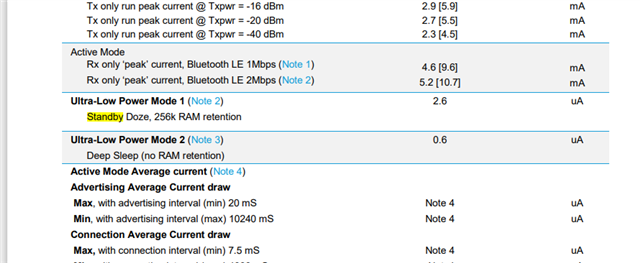
Power management modes.

Hi, 

I wanted to know that is there any example code for the power management. how we can enter into the stanby mode and how to come back to active mode, time required for that. i wanted measure the current consumption in standby mode and how i can achieve that? Which are the peripherals we can enable and disable in deep sleep mode and how to come from deep sleep mode to active mode, time required for that.

Parents Reply Children
  • From Power Consumption Note 2 in 4.1 Power Consumption:

    BL653µ modules Standby Doze is 2.6 uA typical. When using smartBASIC firmware, Standby Doze is entered automatically (when a waitevent statement is encountered within a smartBASIC application script). In Standby Doze, all peripherals that are enabled stay on and may re-awaken the chip. Depending on active peripherals, current consumption ranges from 2.6 μA to 370 uA (when UART is ON). See individual peripherals current consumption data in the Peripheral Block Current Consumption section. smartBASIC firmware has functionality to detect GPIO change with no current consumption cost, it is possible to close the UART and get to the 2.6 uA current consumption regime and still be able to detect for incoming data and be woken up so that the UART can be re-opened at expense of losing that first character. The BL653µ Standby Doze current (at 25°C) consists of the below nRF52833 blocks:

    • nRF52 System ON IDLE current (no RAM retention) (1.1 uA) – This is the base current of the CPU
    • LFRC (0.7 uA) and RTC (0.1uA or near 0uA) running as well as 128k RAM retention (0.8 uA) – This adds to the total of 2.7 uA typical. The RAM retention is 20nA per 4k block, but this can vary to 30nA per 4k block which would make the total 2.55uA to 2.86uA.
  • Any example is present for this mode? How to enter in this mode and exit from this mode?

  • Please read your data sheet thoroughly.

    Standby doze is implemented in smartBASIC, which is developed by Laird, and is not part of the nRF Connect SDK.

    In NCS this would translate to System ON mode with the additional active modules specified in my previous reply.

Related