Programming Thingy:53 with Bluetooth Mesh sensor_server example

I have successfully built the Bluetooth Mesh sensor_server example, using the thingy53_nrf5340_cpuspp_ns build configuration.

But when I come to try and program the Thingy:53, it does not appear in the Connected Devices list, when connected to an nRF5340-DK board with a standard 10-pin cable (I used one from a STLink-V3). The RGB LED on the Thingy:53 illuminates on power up and cycles through the three colours a couple of times before going out, as it does when not connected via the 10-pin cable. When the Thingy:53 is connected via the 10-pin cable to the nRF5340-DK, the LEDs on the latter are not illuminated and neither appear in the Connected Devices list.

When I unplug and replug the USB cable to the nRF5340-DK board without the Thingy:53 connected, then the nRF5340-DK is detected and does appear in the Connected Devices list.

What else do I need to do for the Thingy:53 to be detected please?

I am using nRF Connect SDK v2.3.0 on Windows 11.

Parents
  • alwalker said:
    I do not see NRF5340_xxAA_ENGD on the Connected Devices list when the Thingy:53 is switched off and/or disconnected from the nRF5340DK.

    So you do not see this exact part on the connected devices list, but I assume the rest of the section belonging to that DK is still there? Could you show me a screenshot of how this looks?

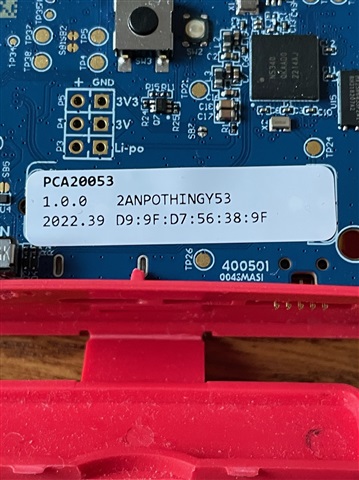
    What is the version of your Thingy:53? You should be able to see this number underneath the NFC tag, right below "PCA20053".

    alwalker said:
    and also to check using the same hardware setup?

    I haven't tried using your exact versions, but yeah I have tried it. The interface chip on the DK should read the UICR of the chip its programming and give it to you there. NRF5340_xxAA_ENGD should be referring to the SoC on the Thingy. I do not know exactly what you mean by selecting it though, would you mind expanding a bit on that?

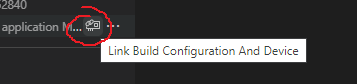
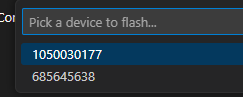
    You could in a way select something using the symbol in the image on the left, or after flashing when there are multiple options available. Though when making this selection you choose an id of the interface chips, not the name of the SoC.


    Regards,

    Elfving

  • Hi Elfving,

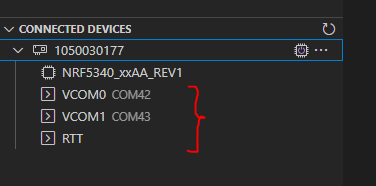
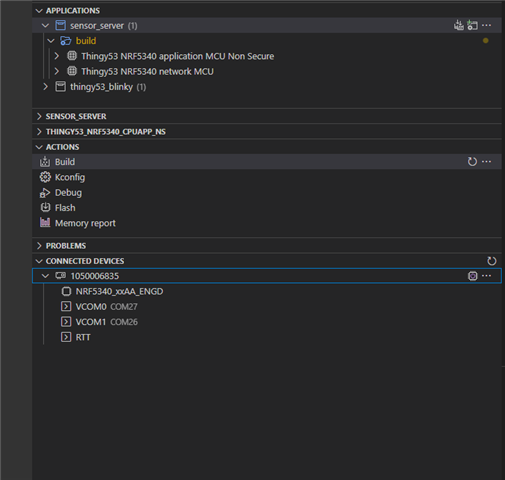
    This is what I see on the list of Connected Devices without the Thingy:53 connected/powered on:

    This is what I get with the Thingy:53 connected via the 10-pin cable and powered on:

    I select the NRF5340_xxAA_ENGD option in the normal way using the mouse pointer and right-clicking.

  • Thingy:53 serial number label.

    Kind regards,

    Al

  • Hi Elfving,

    I have three nRF5340DK boards, two purchased via Farnell UK in January 2022 and a third that I received as a gift during last October's Nordic roadshow.

    I have been using the newer board for programming the Thingy:53 in the above discussion thread.

    I am doing the Nordic DevAcademy nRF Fundamentals course and have found that now whilst I can flash the other two boards ok, I am getting an error report when I attempt to flash the newer board.

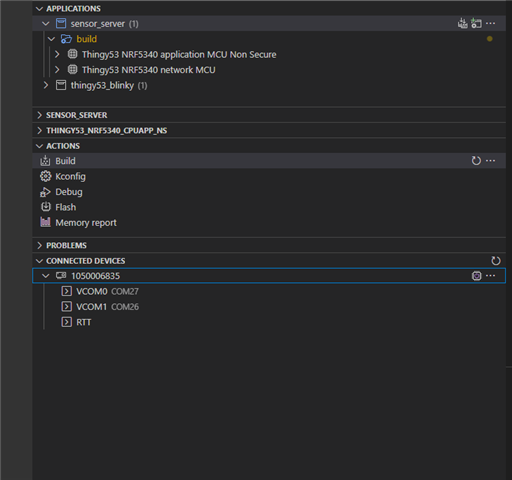
    As you've seen in the captures above, under the Connected Devices tab, COM0 and COM1 are listed as well as RTT. On the older boards COM0 and COM1 are not listed.

    What is also significant is that the nRF5340_xxAA_ENGD entry also appears automatically for the two older boards (along with just RTT) in the Connected Devices tab, but it does not appear for the newer board that I was using with the Thingy:53.

    This is the error message I get when I attempt to flash this board.

    Flashing build to 1050006835
    west flash -d c:\Workspace\Nordic\ncs-fund\v2.x.x\lesson3\fund_less3_exer1\build --skip-rebuild -r nrfjprog --dev-id 1050006835

    -- west flash: using runner nrfjprog
    -- runners.nrfjprog: Flashing file: C:\Workspace\Nordic\ncs-fund\v2.x.x\lesson3\fund_less3_exer1\build\zephyr\merged.hex
    ERROR: Unable to connect to a debugger.
    ERROR: JLinkARM DLL reported an error. Try again. If error condition
    ERROR: persists, run the same command again with argument --log, contact Nordic
    ERROR: Semiconductor and provide the generated log.log file to them.
    NOTE: For additional output, try running again with logging enabled (--log).
    NOTE: Any generated log error messages will be displayed.
    FATAL ERROR: command exited with status 33: nrfjprog --program 'C:\Workspace\Nordic\ncs-fund\v2.x.x\lesson3\fund_less3_exer1\build\zephyr\merged.hex' --sectorerase --verify -f NRF53 --snr 1050006835 --coprocessor CP_APPLICATION

    * The terminal process terminated with exit code: 33.
    * Terminal will be reused by tasks, press any key to close it.

    Is there some way to recover this board please?

    Kind regards,

    Al

Reply
  • Hi Elfving,

    I have three nRF5340DK boards, two purchased via Farnell UK in January 2022 and a third that I received as a gift during last October's Nordic roadshow.

    I have been using the newer board for programming the Thingy:53 in the above discussion thread.

    I am doing the Nordic DevAcademy nRF Fundamentals course and have found that now whilst I can flash the other two boards ok, I am getting an error report when I attempt to flash the newer board.

    As you've seen in the captures above, under the Connected Devices tab, COM0 and COM1 are listed as well as RTT. On the older boards COM0 and COM1 are not listed.

    What is also significant is that the nRF5340_xxAA_ENGD entry also appears automatically for the two older boards (along with just RTT) in the Connected Devices tab, but it does not appear for the newer board that I was using with the Thingy:53.

    This is the error message I get when I attempt to flash this board.

    Flashing build to 1050006835
    west flash -d c:\Workspace\Nordic\ncs-fund\v2.x.x\lesson3\fund_less3_exer1\build --skip-rebuild -r nrfjprog --dev-id 1050006835

    -- west flash: using runner nrfjprog
    -- runners.nrfjprog: Flashing file: C:\Workspace\Nordic\ncs-fund\v2.x.x\lesson3\fund_less3_exer1\build\zephyr\merged.hex
    ERROR: Unable to connect to a debugger.
    ERROR: JLinkARM DLL reported an error. Try again. If error condition
    ERROR: persists, run the same command again with argument --log, contact Nordic
    ERROR: Semiconductor and provide the generated log.log file to them.
    NOTE: For additional output, try running again with logging enabled (--log).
    NOTE: Any generated log error messages will be displayed.
    FATAL ERROR: command exited with status 33: nrfjprog --program 'C:\Workspace\Nordic\ncs-fund\v2.x.x\lesson3\fund_less3_exer1\build\zephyr\merged.hex' --sectorerase --verify -f NRF53 --snr 1050006835 --coprocessor CP_APPLICATION

    * The terminal process terminated with exit code: 33.
    * Terminal will be reused by tasks, press any key to close it.

    Is there some way to recover this board please?

    Kind regards,

    Al

Children
  • Hello Al,

    alwalker said:
    I am getting an error report when I attempt to flash the newer board.

    Ah okey, that makes a lot of sense. I thought you mentioned that you could flash the DK sometime earlier, but I guess that was just an oversight on my part. If the main SoC on the DK is not working (for some reason, we can get into that later) then it makes sense that NRF5340_xxAA_ENGD won't pop-up without anything else connected to the debug output of the DK. After all, NRF5340_xxAA_ENGD is just the SoC variant read from the UICR of the SoC its programming.

    alwalker said:
    Is there some way to recover this board please?

    There might be, to start off we can try just that. Without the Thingy connected to the DK, run:

    nrfjprog --recover --coprocessor CP_NETWORK
    nrfjprog --recover

    alwalker said:
    I select the NRF5340_xxAA_ENGD option in the normal way using the mouse pointer and right-clicking.

    This still doesn't make much sense to me, but as long as you are able to flash the device I guess that isn't really a problem.

    Regards,

    Elfving

  • Hi Elfving,

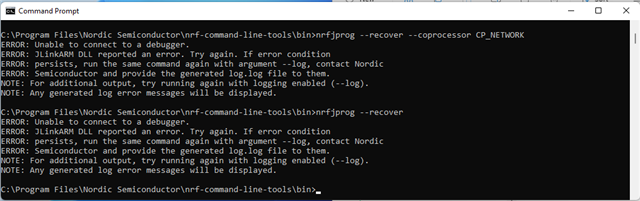
    I tried using nrfjprog without success:

    This was without the Thingy attached to the nRF540DK. What should the syntax be for using the logging please?

    Any other suggestions please?

    Kind regards,

    Al

  • Well it might be that the SoC on that DK has been bricked somehow. Could you run through the steps in this guide

    alwalker said:
    What should the syntax be for using the logging please?

    Could you expand a bit on what you mean by this?

    Regards,

    Elfving

  • Hi Elfving,

    As I have two other nRF5340DK board that program just fine, I think we can eliminate the computer,  USB cable and the J-Link driver as issues.

    For both good and bad boards, when I power on the board (connected to the PC via USB)  I get a window pop up called JLINK (E:) that only shows two files:

    Segger.html

    README.TXT

    I have the view hidden files option selected in File Explorer, but these are the only two files shown.

    The guide that you link to describes a folder called BOOTLOADER, I do not see that appear for either the good or bad boards.

    Should I follow this instruction please?

    If on step 4 the kit does not show up as "BOOTLOADER", try to download and install the mbed Windows serial port driver

    Regarding the syntax for logging, it is the format for the nrfjprog command to allow for logging as indicated in the above screen capture with the --log option. for example, what should I add to make this the complete command that can be executed?

    nrfjprog --recover --log

    I also note the suggestion to use J-Link Commander, but I am not sure whether the instructions are correct for the nRF5340DK.

    r

    w4 4001e504 2

    w4 4001e50c 1

    w4 4001e514 1

    qc

    Could you confirm please?

    Kind regards,

    Al

  • Hello,

    alwalker said:
    For both good and bad boards, when I power on the board (connected to the PC via USB)  I get a window pop up called JLINK (E:) that only shows two files:

    That is the interface chip showing up as a mass storage device. You can for instance flash your board by simply dropping the .hex file there. It is expected that it pops-up for all boards as there is nothing wrong with the interface chip on any of them. There shouldn't be anything else in the folder besides what you listed.

    alwalker said:
    The guide that you link to describes a folder called BOOTLOADER, I do not see that appear for either the good or bad boards.

    Ah yes for that you need to enter bootloader mode. That way you can do a DFU on the interface chip. Though I do not think that is necessary as this chip works as intended. Though are you saying that when you press the IF BOOT/RESET button while power cycling the kit the bootloader folder does not show up? Though once again, I do not think you need to reinstall the J-LINK interface MCU firmware.

    alwalker said:

    Regarding the syntax for logging, it is the format for the nrfjprog command to allow for logging as indicated in the above screen capture with the --log option. for example, what should I add to make this the complete command that can be executed?

    nrfjprog --recover --log

    Not sure if I understand what you mean here. Are you saying running nrfjprog --recover --log doesn't work for you?

    alwalker said:
    I also note the suggestion to use J-Link Commander, but I am not sure whether the instructions are correct for the nRF5340DK.

    No you don't have to worry about that step.

    Regards,

    Elfving

Related