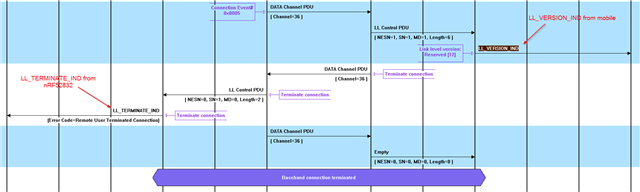
BLE_GAP_EVT_DISCONNECTED doesn't occur when connection is terminated after receiving LL_VERSION_IND

Hi

We established a connection with a mobie phone as central device and an nRF52832 or nRF52833 as peripheral device.
If we afterwards try to terminate the connection on the nRF with sd_ble_gap_disconnect(), the BLE_GAP_EVT_DISCONNECTED does not occur.

We have seen with a Bluetooth sniffer, that the SoftDevice sends the LL_TERMINATE_IND right after the central device has sent the LL_VERSION_IND.
Is it possible that the SoftDevice could not trigger BLE_GAP_EVT_DISCONNECTED because it is somehow stuck because it could not answer the LL_VERSION_IND?
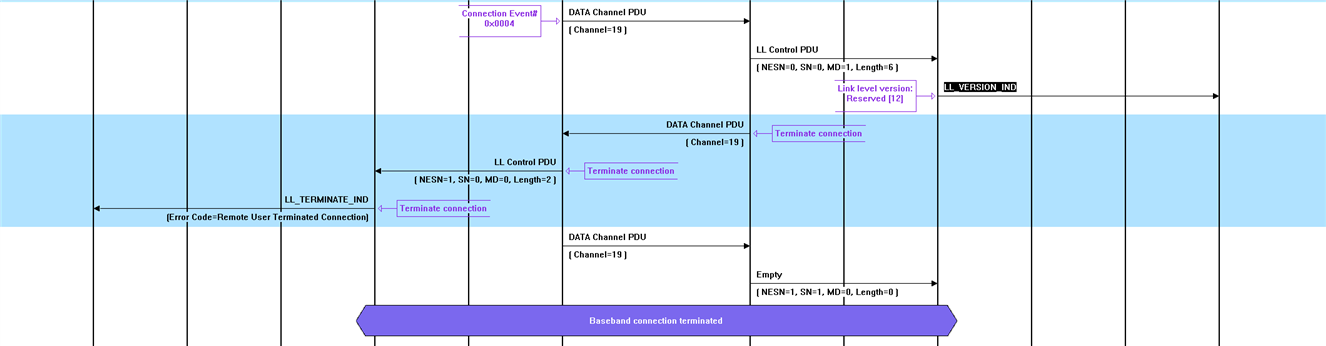
If we add a small delay so that the connection is terminated after the SoftDevice answered the LL_VERSION_IND, the BLE_GAP_EVT_DISCONNECTED is triggered.

The problem occurred on the nRF52832 (S132 V7.2.0) and on the nRF52833 (S140 V7.2.0).

Do you know this behavior?

Many thanks in advance.
Remo

Parents
  • Hi Remo,

    This is a known bug. It is fixed in version 7.3.0.

  • Hi Einar

    Thank you for your answer.

    I just replaced the SoftDevice 7.2.0 with 7.3.0 (without making any changes on our FW), but the problem still occurs.

    Is it possible that this issue is not the same as DRGN-15619? Do you have an idea what else I can try?

  • Hi Remo,

    I am not aware of any other known issues that would cause the disconnected event to be lost. You  may loose some events (like advertising reports), but critical events like this is prioritized and will not be intentionally dropped. There may be some bug we are not aware of, though.

    How do you handle the SoftDevice events in your application? Could there be an issue there? Are you able to share some code that can reproduce this on a DK?

  • Hi Einar

    Sorry for the late response. I needed some time to reproduce this behavior with the example "ble_peripheral\ble_app_hrs" from the nRF5 SDK V17.1.0 with S132 V7.3.0.

    While trying to reproduce it, I realized that the disconnected-event is not lost in the error-case (as I thought in the first place), but it occurs first after the supervision timeout has expired (after 5s in my case) with the reason 0x22 BLE_HCI_STATUS_CODE_LMP_RESPONSE_TIMEOUT. In the good case, the event occurs right away with the reason 0x16 BLE_HCI_LOCAL_HOST_TERMINATED_CONNECTION.

    Please see below the attached modified main.c from the example ble_app_hrs which showed also the described issue. The importent part starts on line 705. There, I have added two different delays to show the good and the bad case. Important is that the delay for the bad case needs to be adjusted so that the LL_TERMINATE_IND is sent as "reply" to LL_VERSION_IND for the mobile you're using.

    /**
     * Copyright (c) 2014 - 2021, Nordic Semiconductor ASA
     *
     * All rights reserved.
     *
     * Redistribution and use in source and binary forms, with or without modification,
     * are permitted provided that the following conditions are met:
     *
     * 1. Redistributions of source code must retain the above copyright notice, this
     *    list of conditions and the following disclaimer.
     *
     * 2. Redistributions in binary form, except as embedded into a Nordic
     *    Semiconductor ASA integrated circuit in a product or a software update for
     *    such product, must reproduce the above copyright notice, this list of
     *    conditions and the following disclaimer in the documentation and/or other
     *    materials provided with the distribution.
     *
     * 3. Neither the name of Nordic Semiconductor ASA nor the names of its
     *    contributors may be used to endorse or promote products derived from this
     *    software without specific prior written permission.
     *
     * 4. This software, with or without modification, must only be used with a
     *    Nordic Semiconductor ASA integrated circuit.
     *
     * 5. Any software provided in binary form under this license must not be reverse
     *    engineered, decompiled, modified and/or disassembled.
     *
     * THIS SOFTWARE IS PROVIDED BY NORDIC SEMICONDUCTOR ASA "AS IS" AND ANY EXPRESS
     * OR IMPLIED WARRANTIES, INCLUDING, BUT NOT LIMITED TO, THE IMPLIED WARRANTIES
     * OF MERCHANTABILITY, NONINFRINGEMENT, AND FITNESS FOR A PARTICULAR PURPOSE ARE
     * DISCLAIMED. IN NO EVENT SHALL NORDIC SEMICONDUCTOR ASA OR CONTRIBUTORS BE
     * LIABLE FOR ANY DIRECT, INDIRECT, INCIDENTAL, SPECIAL, EXEMPLARY, OR
     * CONSEQUENTIAL DAMAGES (INCLUDING, BUT NOT LIMITED TO, PROCUREMENT OF SUBSTITUTE
     * GOODS OR SERVICES; LOSS OF USE, DATA, OR PROFITS; OR BUSINESS INTERRUPTION)
     * HOWEVER CAUSED AND ON ANY THEORY OF LIABILITY, WHETHER IN CONTRACT, STRICT
     * LIABILITY, OR TORT (INCLUDING NEGLIGENCE OR OTHERWISE) ARISING IN ANY WAY OUT
     * OF THE USE OF THIS SOFTWARE, EVEN IF ADVISED OF THE POSSIBILITY OF SUCH DAMAGE.
     *
     */
    /** @example examples/ble_peripheral/ble_app_hrs/main.c
     *
     * @brief Heart Rate Service Sample Application main file.
     *
     * This file contains the source code for a sample application using the Heart Rate service
     * (and also Battery and Device Information services). This application uses the
     * @ref srvlib_conn_params module.
     */
    
    #include <stdint.h>
    #include <string.h>
    #include "nordic_common.h"
    #include "nrf.h"
    #include "nrf_sdm.h"
    #include "app_error.h"
    #include "ble.h"
    #include "ble_err.h"
    #include "ble_hci.h"
    #include "ble_srv_common.h"
    #include "ble_advdata.h"
    #include "ble_advertising.h"
    #include "ble_bas.h"
    #include "ble_hrs.h"
    #include "ble_dis.h"
    #include "ble_conn_params.h"
    #include "sensorsim.h"
    #include "nrf_sdh.h"
    #include "nrf_sdh_ble.h"
    #include "nrf_sdh_soc.h"
    #include "app_timer.h"
    #include "bsp_btn_ble.h"
    #include "peer_manager.h"
    #include "peer_manager_handler.h"
    #include "fds.h"
    #include "nrf_ble_gatt.h"
    #include "nrf_ble_lesc.h"
    #include "nrf_ble_qwr.h"
    #include "ble_conn_state.h"
    #include "nrf_pwr_mgmt.h"
    #include "nrf_delay.h"
    
    #include "nrf_log.h"
    #include "nrf_log_ctrl.h"
    #include "nrf_log_default_backends.h"
    
    
    #define DEVICE_NAME                         "Nordic_HRM"                            /**< Name of device. Will be included in the advertising data. */
    #define MANUFACTURER_NAME                   "NordicSemiconductor"                   /**< Manufacturer. Will be passed to Device Information Service. */
    #define APP_ADV_INTERVAL                    300                                     /**< The advertising interval (in units of 0.625 ms. This value corresponds to 187.5 ms). */
    
    #define APP_ADV_DURATION                    18000                                   /**< The advertising duration (180 seconds) in units of 10 milliseconds. */
    
    #define APP_BLE_CONN_CFG_TAG                1                                       /**< A tag identifying the SoftDevice BLE configuration. */
    #define APP_BLE_OBSERVER_PRIO               3                                       /**< Application's BLE observer priority. You shouldn't need to modify this value. */
    
    #define BATTERY_LEVEL_MEAS_INTERVAL         APP_TIMER_TICKS(2000)                   /**< Battery level measurement interval (ticks). */
    #define MIN_BATTERY_LEVEL                   81                                      /**< Minimum simulated battery level. */
    #define MAX_BATTERY_LEVEL                   100                                     /**< Maximum simulated 7battery level. */
    #define BATTERY_LEVEL_INCREMENT             1                                       /**< Increment between each simulated battery level measurement. */
    
    #define HEART_RATE_MEAS_INTERVAL            APP_TIMER_TICKS(1000)                   /**< Heart rate measurement interval (ticks). */
    #define MIN_HEART_RATE                      140                                     /**< Minimum heart rate as returned by the simulated measurement function. */
    #define MAX_HEART_RATE                      300                                     /**< Maximum heart rate as returned by the simulated measurement function. */
    #define HEART_RATE_INCREMENT                10                                      /**< Value by which the heart rate is incremented/decremented for each call to the simulated measurement function. */
    
    #define RR_INTERVAL_INTERVAL                APP_TIMER_TICKS(300)                    /**< RR interval interval (ticks). */
    #define MIN_RR_INTERVAL                     100                                     /**< Minimum RR interval as returned by the simulated measurement function. */
    #define MAX_RR_INTERVAL                     500                                     /**< Maximum RR interval as returned by the simulated measurement function. */
    #define RR_INTERVAL_INCREMENT               1                                       /**< Value by which the RR interval is incremented/decremented for each call to the simulated measurement function. */
    
    #define SENSOR_CONTACT_DETECTED_INTERVAL    APP_TIMER_TICKS(5000)                   /**< Sensor Contact Detected toggle interval (ticks). */
    
    #define MIN_CONN_INTERVAL                   MSEC_TO_UNITS(400, UNIT_1_25_MS)        /**< Minimum acceptable connection interval (0.4 seconds). */
    #define MAX_CONN_INTERVAL                   MSEC_TO_UNITS(650, UNIT_1_25_MS)        /**< Maximum acceptable connection interval (0.65 second). */
    #define SLAVE_LATENCY                       0                                       /**< Slave latency. */
    #define CONN_SUP_TIMEOUT                    MSEC_TO_UNITS(4000, UNIT_10_MS)         /**< Connection supervisory timeout (4 seconds). */
    
    #define FIRST_CONN_PARAMS_UPDATE_DELAY      APP_TIMER_TICKS(5000)                   /**< Time from initiating event (connect or start of notification) to first time sd_ble_gap_conn_param_update is called (5 seconds). */
    #define NEXT_CONN_PARAMS_UPDATE_DELAY       APP_TIMER_TICKS(30000)                  /**< Time between each call to sd_ble_gap_conn_param_update after the first call (30 seconds). */
    #define MAX_CONN_PARAMS_UPDATE_COUNT        3                                       /**< Number of attempts before giving up the connection parameter negotiation. */
    
    #define LESC_DEBUG_MODE                     0                                       /**< Set to 1 to use LESC debug keys, allows you to use a sniffer to inspect traffic. */
    
    #define SEC_PARAM_BOND                      1                                       /**< Perform bonding. */
    #define SEC_PARAM_MITM                      0                                       /**< Man In The Middle protection not required. */
    #define SEC_PARAM_LESC                      1                                       /**< LE Secure Connections enabled. */
    #define SEC_PARAM_KEYPRESS                  0                                       /**< Keypress notifications not enabled. */
    #define SEC_PARAM_IO_CAPABILITIES           BLE_GAP_IO_CAPS_NONE                    /**< No I/O capabilities. */
    #define SEC_PARAM_OOB                       0                                       /**< Out Of Band data not available. */
    #define SEC_PARAM_MIN_KEY_SIZE              7                                       /**< Minimum encryption key size. */
    #define SEC_PARAM_MAX_KEY_SIZE              16                                      /**< Maximum encryption key size. */
    
    #define DEAD_BEEF                           0xDEADBEEF                              /**< Value used as error code on stack dump, can be used to identify stack location on stack unwind. */
    
    
    BLE_HRS_DEF(m_hrs);                                                 /**< Heart rate service instance. */
    BLE_BAS_DEF(m_bas);                                                 /**< Structure used to identify the battery service. */
    NRF_BLE_GATT_DEF(m_gatt);                                           /**< GATT module instance. */
    NRF_BLE_QWR_DEF(m_qwr);                                             /**< Context for the Queued Write module.*/
    BLE_ADVERTISING_DEF(m_advertising);                                 /**< Advertising module instance. */
    APP_TIMER_DEF(m_battery_timer_id);                                  /**< Battery timer. */
    APP_TIMER_DEF(m_heart_rate_timer_id);                               /**< Heart rate measurement timer. */
    APP_TIMER_DEF(m_rr_interval_timer_id);                              /**< RR interval timer. */
    APP_TIMER_DEF(m_sensor_contact_timer_id);                           /**< Sensor contact detected timer. */
    
    static uint16_t m_conn_handle         = BLE_CONN_HANDLE_INVALID;    /**< Handle of the current connection. */
    static bool     m_rr_interval_enabled = true;                       /**< Flag for enabling and disabling the registration of new RR interval measurements (the purpose of disabling this is just to test sending HRM without RR interval data. */
    
    static sensorsim_cfg_t   m_battery_sim_cfg;                         /**< Battery Level sensor simulator configuration. */
    static sensorsim_state_t m_battery_sim_state;                       /**< Battery Level sensor simulator state. */
    static sensorsim_cfg_t   m_heart_rate_sim_cfg;                      /**< Heart Rate sensor simulator configuration. */
    static sensorsim_state_t m_heart_rate_sim_state;                    /**< Heart Rate sensor simulator state. */
    static sensorsim_cfg_t   m_rr_interval_sim_cfg;                     /**< RR Interval sensor simulator configuration. */
    static sensorsim_state_t m_rr_interval_sim_state;                   /**< RR Interval sensor simulator state. */
    
    #define OWN_UUID 0xFD17
    
    static ble_uuid_t m_adv_uuids[] =                                   /**< Universally unique service identifiers. */
    {
       {OWN_UUID,                           BLE_UUID_TYPE_BLE}
    //    {BLE_UUID_HEART_RATE_SERVICE,           BLE_UUID_TYPE_BLE},
    //    {BLE_UUID_BATTERY_SERVICE,              BLE_UUID_TYPE_BLE},
    //    {BLE_UUID_DEVICE_INFORMATION_SERVICE,   BLE_UUID_TYPE_BLE}
    };
    
    
    /**@brief Callback function for asserts in the SoftDevice.
     *
     * @details This function will be called in case of an assert in the SoftDevice.
     *
     * @warning This handler is an example only and does not fit a final product. You need to analyze
     *          how your product is supposed to react in case of Assert.
     * @warning On assert from the SoftDevice, the system can only recover on reset.
     *
     * @param[in] line_num   Line number of the failing ASSERT call.
     * @param[in] file_name  File name of the failing ASSERT call.
     */
    void assert_nrf_callback(uint16_t line_num, const uint8_t * p_file_name)
    {
        app_error_handler(DEAD_BEEF, line_num, p_file_name);
    }
    
    
    /**@brief Clear bond information from persistent storage.
     */
    static void delete_bonds(void)
    {
        ret_code_t err_code;
    
        NRF_LOG_INFO("Erase bonds!");
    
        err_code = pm_peers_delete();
        APP_ERROR_CHECK(err_code);
    }
    
    
    /**@brief Function for starting advertising.
     */
    void advertising_start(bool erase_bonds)
    {
        if (erase_bonds == true)
        {
            delete_bonds();
            // Advertising is started by PM_EVT_PEERS_DELETE_SUCCEEDED event.
        }
        else
        {
            ret_code_t err_code;
    
            err_code = ble_advertising_start(&m_advertising, BLE_ADV_MODE_FAST);
            APP_ERROR_CHECK(err_code);
        }
    }
    
    
    /**@brief Function for handling Peer Manager events.
     *
     * @param[in] p_evt  Peer Manager event.
     */
    static void pm_evt_handler(pm_evt_t const * p_evt)
    {
        pm_handler_on_pm_evt(p_evt);
        pm_handler_disconnect_on_sec_failure(p_evt);
        pm_handler_flash_clean(p_evt);
    
        switch (p_evt->evt_id)
        {
            case PM_EVT_PEERS_DELETE_SUCCEEDED:
                advertising_start(false);
                break;
    
            default:
                break;
        }
    }
    
    
    /**@brief Function for performing battery measurement and updating the Battery Level characteristic
     *        in Battery Service.
     */
    static void battery_level_update(void)
    {
        ret_code_t err_code;
        uint8_t  battery_level;
    
        battery_level = (uint8_t)sensorsim_measure(&m_battery_sim_state, &m_battery_sim_cfg);
    
        err_code = ble_bas_battery_level_update(&m_bas, battery_level, BLE_CONN_HANDLE_ALL);
        if ((err_code != NRF_SUCCESS) &&
            (err_code != NRF_ERROR_INVALID_STATE) &&
            (err_code != NRF_ERROR_RESOURCES) &&
            (err_code != NRF_ERROR_BUSY) &&
            (err_code != BLE_ERROR_GATTS_SYS_ATTR_MISSING)
           )
        {
            APP_ERROR_HANDLER(err_code);
        }
    }
    
    
    /**@brief Function for handling the Battery measurement timer timeout.
     *
     * @details This function will be called each time the battery level measurement timer expires.
     *
     * @param[in] p_context  Pointer used for passing some arbitrary information (context) from the
     *                       app_start_timer() call to the timeout handler.
     */
    static void battery_level_meas_timeout_handler(void * p_context)
    {
        UNUSED_PARAMETER(p_context);
        battery_level_update();
    }
    
    
    /**@brief Function for handling the Heart rate measurement timer timeout.
     *
     * @details This function will be called each time the heart rate measurement timer expires.
     *          It will exclude RR Interval data from every third measurement.
     *
     * @param[in] p_context  Pointer used for passing some arbitrary information (context) from the
     *                       app_start_timer() call to the timeout handler.
     */
    static void heart_rate_meas_timeout_handler(void * p_context)
    {
        static uint32_t cnt = 0;
        ret_code_t      err_code;
        uint16_t        heart_rate;
    
        UNUSED_PARAMETER(p_context);
    
        heart_rate = (uint16_t)sensorsim_measure(&m_heart_rate_sim_state, &m_heart_rate_sim_cfg);
    
        cnt++;
        err_code = ble_hrs_heart_rate_measurement_send(&m_hrs, heart_rate);
        if ((err_code != NRF_SUCCESS) &&
            (err_code != NRF_ERROR_INVALID_STATE) &&
            (err_code != NRF_ERROR_RESOURCES) &&
            (err_code != NRF_ERROR_BUSY) &&
            (err_code != BLE_ERROR_GATTS_SYS_ATTR_MISSING)
           )
        {
            APP_ERROR_HANDLER(err_code);
        }
    
        // Disable RR Interval recording every third heart rate measurement.
        // NOTE: An application will normally not do this. It is done here just for testing generation
        // of messages without RR Interval measurements.
        m_rr_interval_enabled = ((cnt % 3) != 0);
    }
    
    
    /**@brief Function for handling the RR interval timer timeout.
     *
     * @details This function will be called each time the RR interval timer expires.
     *
     * @param[in] p_context  Pointer used for passing some arbitrary information (context) from the
     *                       app_start_timer() call to the timeout handler.
     */
    static void rr_interval_timeout_handler(void * p_context)
    {
        UNUSED_PARAMETER(p_context);
    
        if (m_rr_interval_enabled)
        {
            uint16_t rr_interval;
    
            rr_interval = (uint16_t)sensorsim_measure(&m_rr_interval_sim_state,
                                                      &m_rr_interval_sim_cfg);
            ble_hrs_rr_interval_add(&m_hrs, rr_interval);
            rr_interval = (uint16_t)sensorsim_measure(&m_rr_interval_sim_state,
                                                      &m_rr_interval_sim_cfg);
            ble_hrs_rr_interval_add(&m_hrs, rr_interval);
            rr_interval = (uint16_t)sensorsim_measure(&m_rr_interval_sim_state,
                                                      &m_rr_interval_sim_cfg);
            ble_hrs_rr_interval_add(&m_hrs, rr_interval);
            rr_interval = (uint16_t)sensorsim_measure(&m_rr_interval_sim_state,
                                                      &m_rr_interval_sim_cfg);
            ble_hrs_rr_interval_add(&m_hrs, rr_interval);
            rr_interval = (uint16_t)sensorsim_measure(&m_rr_interval_sim_state,
                                                      &m_rr_interval_sim_cfg);
            ble_hrs_rr_interval_add(&m_hrs, rr_interval);
            rr_interval = (uint16_t)sensorsim_measure(&m_rr_interval_sim_state,
                                                      &m_rr_interval_sim_cfg);
            ble_hrs_rr_interval_add(&m_hrs, rr_interval);
        }
    }
    
    
    /**@brief Function for handling the Sensor Contact Detected timer timeout.
     *
     * @details This function will be called each time the Sensor Contact Detected timer expires.
     *
     * @param[in] p_context  Pointer used for passing some arbitrary information (context) from the
     *                       app_start_timer() call to the timeout handler.
     */
    static void sensor_contact_detected_timeout_handler(void * p_context)
    {
        static bool sensor_contact_detected = false;
    
        UNUSED_PARAMETER(p_context);
    
        sensor_contact_detected = !sensor_contact_detected;
        ble_hrs_sensor_contact_detected_update(&m_hrs, sensor_contact_detected);
    }
    
    
    /**@brief Function for the Timer initialization.
     *
     * @details Initializes the timer module. This creates and starts application timers.
     */
    static void timers_init(void)
    {
        ret_code_t err_code;
    
        // Initialize timer module.
        err_code = app_timer_init();
        APP_ERROR_CHECK(err_code);
    
        // Create timers.
        err_code = app_timer_create(&m_battery_timer_id,
                                    APP_TIMER_MODE_REPEATED,
                                    battery_level_meas_timeout_handler);
        APP_ERROR_CHECK(err_code);
    
        err_code = app_timer_create(&m_heart_rate_timer_id,
                                    APP_TIMER_MODE_REPEATED,
                                    heart_rate_meas_timeout_handler);
        APP_ERROR_CHECK(err_code);
    
        err_code = app_timer_create(&m_rr_interval_timer_id,
                                    APP_TIMER_MODE_REPEATED,
                                    rr_interval_timeout_handler);
        APP_ERROR_CHECK(err_code);
    
        err_code = app_timer_create(&m_sensor_contact_timer_id,
                                    APP_TIMER_MODE_REPEATED,
                                    sensor_contact_detected_timeout_handler);
        APP_ERROR_CHECK(err_code);
    }
    
    
    /**@brief Function for the GAP initialization.
     *
     * @details This function sets up all the necessary GAP (Generic Access Profile) parameters of the
     *          device including the device name, appearance, and the preferred connection parameters.
     */
    static void gap_params_init(void)
    {
        ret_code_t              err_code;
        ble_gap_conn_params_t   gap_conn_params;
        ble_gap_conn_sec_mode_t sec_mode;
    
        BLE_GAP_CONN_SEC_MODE_SET_OPEN(&sec_mode);
    
        err_code = sd_ble_gap_device_name_set(&sec_mode,
                                              (const uint8_t *)DEVICE_NAME,
                                              strlen(DEVICE_NAME));
        APP_ERROR_CHECK(err_code);
    
        err_code = sd_ble_gap_appearance_set(BLE_APPEARANCE_HEART_RATE_SENSOR_HEART_RATE_BELT);
        APP_ERROR_CHECK(err_code);
    
        memset(&gap_conn_params, 0, sizeof(gap_conn_params));
    
        gap_conn_params.min_conn_interval = MIN_CONN_INTERVAL;
        gap_conn_params.max_conn_interval = MAX_CONN_INTERVAL;
        gap_conn_params.slave_latency     = SLAVE_LATENCY;
        gap_conn_params.conn_sup_timeout  = CONN_SUP_TIMEOUT;
    
        err_code = sd_ble_gap_ppcp_set(&gap_conn_params);
        APP_ERROR_CHECK(err_code);
    }
    
    
    /**@brief GATT module event handler.
     */
    static void gatt_evt_handler(nrf_ble_gatt_t * p_gatt, nrf_ble_gatt_evt_t const * p_evt)
    {
        if (p_evt->evt_id == NRF_BLE_GATT_EVT_ATT_MTU_UPDATED)
        {
            NRF_LOG_INFO("GATT ATT MTU on connection 0x%x changed to %d.",
                         p_evt->conn_handle,
                         p_evt->params.att_mtu_effective);
        }
    
        ble_hrs_on_gatt_evt(&m_hrs, p_evt);
    }
    
    
    /**@brief Function for initializing the GATT module.
     */
    static void gatt_init(void)
    {
        ret_code_t err_code = nrf_ble_gatt_init(&m_gatt, gatt_evt_handler);
        APP_ERROR_CHECK(err_code);
    }
    
    
    /**@brief Function for handling Queued Write Module errors.
     *
     * @details A pointer to this function will be passed to each service which may need to inform the
     *          application about an error.
     *
     * @param[in]   nrf_error   Error code containing information about what went wrong.
     */
    static void nrf_qwr_error_handler(uint32_t nrf_error)
    {
        APP_ERROR_HANDLER(nrf_error);
    }
    
    
    /**@brief Function for initializing services that will be used by the application.
     *
     * @details Initialize the Heart Rate, Battery and Device Information services.
     */
    static void services_init(void)
    {
        ret_code_t         err_code;
        ble_hrs_init_t     hrs_init;
        ble_bas_init_t     bas_init;
        ble_dis_init_t     dis_init;
        nrf_ble_qwr_init_t qwr_init = {0};
        uint8_t            body_sensor_location;
    
        // Initialize Queued Write Module.
        qwr_init.error_handler = nrf_qwr_error_handler;
    
        err_code = nrf_ble_qwr_init(&m_qwr, &qwr_init);
        APP_ERROR_CHECK(err_code);
    
        // Initialize Heart Rate Service.
        body_sensor_location = BLE_HRS_BODY_SENSOR_LOCATION_FINGER;
    
        memset(&hrs_init, 0, sizeof(hrs_init));
    
        hrs_init.evt_handler                 = NULL;
        hrs_init.is_sensor_contact_supported = true;
        hrs_init.p_body_sensor_location      = &body_sensor_location;
    
        // Here the sec level for the Heart Rate Service can be changed/increased.
        hrs_init.hrm_cccd_wr_sec = SEC_OPEN;
        hrs_init.bsl_rd_sec      = SEC_OPEN;
    
        err_code = ble_hrs_init(&m_hrs, &hrs_init);
        APP_ERROR_CHECK(err_code);
    
        // Initialize Battery Service.
        memset(&bas_init, 0, sizeof(bas_init));
    
        bas_init.evt_handler          = NULL;
        bas_init.support_notification = true;
        bas_init.p_report_ref         = NULL;
        bas_init.initial_batt_level   = 100;
    
        // Here the sec level for the Battery Service can be changed/increased.
        bas_init.bl_rd_sec        = SEC_OPEN;
        bas_init.bl_cccd_wr_sec   = SEC_OPEN;
        bas_init.bl_report_rd_sec = SEC_OPEN;
    
        err_code = ble_bas_init(&m_bas, &bas_init);
        APP_ERROR_CHECK(err_code);
    
        // Initialize Device Information Service.
        memset(&dis_init, 0, sizeof(dis_init));
    
        ble_srv_ascii_to_utf8(&dis_init.manufact_name_str, (char *)MANUFACTURER_NAME);
    
        dis_init.dis_char_rd_sec = SEC_OPEN;
    
        err_code = ble_dis_init(&dis_init);
        APP_ERROR_CHECK(err_code);
    }
    
    
    /**@brief Function for initializing the sensor simulators.
     */
    static void sensor_simulator_init(void)
    {
        m_battery_sim_cfg.min          = MIN_BATTERY_LEVEL;
        m_battery_sim_cfg.max          = MAX_BATTERY_LEVEL;
        m_battery_sim_cfg.incr         = BATTERY_LEVEL_INCREMENT;
        m_battery_sim_cfg.start_at_max = true;
    
        sensorsim_init(&m_battery_sim_state, &m_battery_sim_cfg);
    
        m_heart_rate_sim_cfg.min          = MIN_HEART_RATE;
        m_heart_rate_sim_cfg.max          = MAX_HEART_RATE;
        m_heart_rate_sim_cfg.incr         = HEART_RATE_INCREMENT;
        m_heart_rate_sim_cfg.start_at_max = false;
    
        sensorsim_init(&m_heart_rate_sim_state, &m_heart_rate_sim_cfg);
    
        m_rr_interval_sim_cfg.min          = MIN_RR_INTERVAL;
        m_rr_interval_sim_cfg.max          = MAX_RR_INTERVAL;
        m_rr_interval_sim_cfg.incr         = RR_INTERVAL_INCREMENT;
        m_rr_interval_sim_cfg.start_at_max = false;
    
        sensorsim_init(&m_rr_interval_sim_state, &m_rr_interval_sim_cfg);
    }
    
    
    /**@brief Function for starting application timers.
     */
    static void application_timers_start(void)
    {
        ret_code_t err_code;
    
        // Start application timers.
        err_code = app_timer_start(m_battery_timer_id, BATTERY_LEVEL_MEAS_INTERVAL, NULL);
        APP_ERROR_CHECK(err_code);
    
        err_code = app_timer_start(m_heart_rate_timer_id, HEART_RATE_MEAS_INTERVAL, NULL);
        APP_ERROR_CHECK(err_code);
    
        err_code = app_timer_start(m_rr_interval_timer_id, RR_INTERVAL_INTERVAL, NULL);
        APP_ERROR_CHECK(err_code);
    
        err_code = app_timer_start(m_sensor_contact_timer_id, SENSOR_CONTACT_DETECTED_INTERVAL, NULL);
        APP_ERROR_CHECK(err_code);
    }
    
    
    /**@brief Function for handling the Connection Parameters Module.
     *
     * @details This function will be called for all events in the Connection Parameters Module which
     *          are passed to the application.
     *          @note All this function does is to disconnect. This could have been done by simply
     *                setting the disconnect_on_fail config parameter, but instead we use the event
     *                handler mechanism to demonstrate its use.
     *
     * @param[in] p_evt  Event received from the Connection Parameters Module.
     */
    static void on_conn_params_evt(ble_conn_params_evt_t * p_evt)
    {
        ret_code_t err_code;
    
        if (p_evt->evt_type == BLE_CONN_PARAMS_EVT_FAILED)
        {
            err_code = sd_ble_gap_disconnect(m_conn_handle, BLE_HCI_CONN_INTERVAL_UNACCEPTABLE);
            APP_ERROR_CHECK(err_code);
        }
    }
    
    
    /**@brief Function for handling a Connection Parameters error.
     *
     * @param[in] nrf_error  Error code containing information about what went wrong.
     */
    static void conn_params_error_handler(uint32_t nrf_error)
    {
        APP_ERROR_HANDLER(nrf_error);
    }
    
    
    /**@brief Function for initializing the Connection Parameters module.
     */
    static void conn_params_init(void)
    {
        ret_code_t             err_code;
        ble_conn_params_init_t cp_init;
    
        memset(&cp_init, 0, sizeof(cp_init));
    
        cp_init.p_conn_params                  = NULL;
        cp_init.first_conn_params_update_delay = FIRST_CONN_PARAMS_UPDATE_DELAY;
        cp_init.next_conn_params_update_delay  = NEXT_CONN_PARAMS_UPDATE_DELAY;
        cp_init.max_conn_params_update_count   = MAX_CONN_PARAMS_UPDATE_COUNT;
        cp_init.start_on_notify_cccd_handle    = m_hrs.hrm_handles.cccd_handle;
        cp_init.disconnect_on_fail             = false;
        cp_init.evt_handler                    = on_conn_params_evt;
        cp_init.error_handler                  = conn_params_error_handler;
    
        err_code = ble_conn_params_init(&cp_init);
        APP_ERROR_CHECK(err_code);
    }
    
    
    /**@brief Function for putting the chip into sleep mode.
     *
     * @note This function will not return.
     */
    static void sleep_mode_enter(void)
    {
        ret_code_t err_code;
    
        err_code = bsp_indication_set(BSP_INDICATE_IDLE);
        APP_ERROR_CHECK(err_code);
    
        // Prepare wakeup buttons.
        err_code = bsp_btn_ble_sleep_mode_prepare();
        APP_ERROR_CHECK(err_code);
    
        // Go to system-off mode (this function will not return; wakeup will cause a reset).
        err_code = sd_power_system_off();
        APP_ERROR_CHECK(err_code);
    }
    
    
    /**@brief Function for handling advertising events.
     *
     * @details This function will be called for advertising events which are passed to the application.
     *
     * @param[in] ble_adv_evt  Advertising event.
     */
    static void on_adv_evt(ble_adv_evt_t ble_adv_evt)
    {
        ret_code_t err_code;
    
        switch (ble_adv_evt)
        {
            case BLE_ADV_EVT_FAST:
                NRF_LOG_INFO("Fast advertising.");
                err_code = bsp_indication_set(BSP_INDICATE_ADVERTISING);
                APP_ERROR_CHECK(err_code);
                break;
    
            case BLE_ADV_EVT_IDLE:
                sleep_mode_enter();
                break;
    
            default:
                break;
        }
    }
    
    
    /**@brief Function for handling BLE events.
     *
     * @param[in]   p_ble_evt   Bluetooth stack event.
     * @param[in]   p_context   Unused.
     */
    static void ble_evt_handler(ble_evt_t const * p_ble_evt, void * p_context)
    {
        ret_code_t err_code;
    
        switch (p_ble_evt->header.evt_id)
        {
            case BLE_GAP_EVT_CONNECTED:
                NRF_LOG_INFO("Connected.");
                err_code = bsp_indication_set(BSP_INDICATE_CONNECTED);
                APP_ERROR_CHECK(err_code);
                m_conn_handle = p_ble_evt->evt.gap_evt.conn_handle;
                err_code = nrf_ble_qwr_conn_handle_assign(&m_qwr, m_conn_handle);
                APP_ERROR_CHECK(err_code);
    
                // :TODO: Nordic:
                //    - When the connection with the oppo Reno4 Z 5G is terminated after ~230ms, the SoftDevice sends the LL_TERMINATE_IND in the same connection interval as the mobile sends the LL_VERSION_IND.
                //      In this case, the BLE_GAP_EVT_DISCONNECTED occurs only after the supervision timeout has expired (i.e. 5s) with the reason 0x22: BLE_HCI_STATUS_CODE_LMP_RESPONSE_TIMEOUT.
                //    - When the connection with the same mobile is terminated after 500ms, the SoftDevice has already answered the LL_VERSION_IND when it sends the LL_TERMINATE_IND.
                //      In this case, the BLE_GAP_EVT_DISCONNECTED occurs as expected with the reason 0x16: BLE_HCI_LOCAL_HOST_TERMINATED_CONNECTION.
                //    - Do you know why this happens
                nrf_delay_ms(230);         // error case
    //            nrf_delay_ms(500);         // good case
                err_code = sd_ble_gap_disconnect(p_ble_evt->evt.gattc_evt.conn_handle,
                                                 BLE_HCI_REMOTE_USER_TERMINATED_CONNECTION);
                APP_ERROR_CHECK(err_code);
    //            err_code = pm_conn_secure(p_ble_evt->evt.gap_evt.conn_handle, false);
    //            if (err_code != NRF_ERROR_BUSY)
    //            {
    //                APP_ERROR_CHECK(err_code);
    //            }
                break;
    
            case BLE_GAP_EVT_DISCONNECTED:
                NRF_LOG_INFO("Disconnected, reason %d.",
                              p_ble_evt->evt.gap_evt.params.disconnected.reason);
                m_conn_handle = BLE_CONN_HANDLE_INVALID;
                break;
    
            case BLE_GAP_EVT_PHY_UPDATE_REQUEST:
            {
                NRF_LOG_DEBUG("PHY update request.");
                ble_gap_phys_t const phys =
                {
                    .rx_phys = BLE_GAP_PHY_AUTO,
                    .tx_phys = BLE_GAP_PHY_AUTO,
                };
                err_code = sd_ble_gap_phy_update(p_ble_evt->evt.gap_evt.conn_handle, &phys);
                APP_ERROR_CHECK(err_code);
            } break;
    
            case BLE_GATTC_EVT_TIMEOUT:
                // Disconnect on GATT Client timeout event.
                NRF_LOG_DEBUG("GATT Client Timeout.");
                err_code = sd_ble_gap_disconnect(p_ble_evt->evt.gattc_evt.conn_handle,
                                                 BLE_HCI_REMOTE_USER_TERMINATED_CONNECTION);
                APP_ERROR_CHECK(err_code);
                break;
    
            case BLE_GATTS_EVT_TIMEOUT:
                // Disconnect on GATT Server timeout event.
                NRF_LOG_DEBUG("GATT Server Timeout.");
                err_code = sd_ble_gap_disconnect(p_ble_evt->evt.gatts_evt.conn_handle,
                                                 BLE_HCI_REMOTE_USER_TERMINATED_CONNECTION);
                APP_ERROR_CHECK(err_code);
                break;
    
            case BLE_GAP_EVT_SEC_PARAMS_REQUEST:
                NRF_LOG_DEBUG("BLE_GAP_EVT_SEC_PARAMS_REQUEST");
                break;
    
            case BLE_GAP_EVT_AUTH_KEY_REQUEST:
                NRF_LOG_INFO("BLE_GAP_EVT_AUTH_KEY_REQUEST");
                break;
    
            case BLE_GAP_EVT_LESC_DHKEY_REQUEST:
                NRF_LOG_INFO("BLE_GAP_EVT_LESC_DHKEY_REQUEST");
                break;
    
             case BLE_GAP_EVT_AUTH_STATUS:
                 NRF_LOG_INFO("BLE_GAP_EVT_AUTH_STATUS: status=0x%x bond=0x%x lv4: %d kdist_own:0x%x kdist_peer:0x%x",
                              p_ble_evt->evt.gap_evt.params.auth_status.auth_status,
                              p_ble_evt->evt.gap_evt.params.auth_status.bonded,
                              p_ble_evt->evt.gap_evt.params.auth_status.sm1_levels.lv4,
                              *((uint8_t *)&p_ble_evt->evt.gap_evt.params.auth_status.kdist_own),
                              *((uint8_t *)&p_ble_evt->evt.gap_evt.params.auth_status.kdist_peer));
                break;
    
            default:
                // No implementation needed.
                break;
        }
    }
    
    
    /**@brief Function for initializing the BLE stack.
     *
     * @details Initializes the SoftDevice and the BLE event interrupt.
     */
    static void ble_stack_init(void)
    {
        ret_code_t err_code;
    
        err_code = nrf_sdh_enable_request();
        APP_ERROR_CHECK(err_code);
    
        // Configure the BLE stack using the default settings.
        // Fetch the start address of the application RAM.
        uint32_t ram_start = 0;
        err_code = nrf_sdh_ble_default_cfg_set(APP_BLE_CONN_CFG_TAG, &ram_start);
        APP_ERROR_CHECK(err_code);
    
        // Enable BLE stack.
        err_code = nrf_sdh_ble_enable(&ram_start);
        APP_ERROR_CHECK(err_code);
    
        // Register a handler for BLE events.
        NRF_SDH_BLE_OBSERVER(m_ble_observer, APP_BLE_OBSERVER_PRIO, ble_evt_handler, NULL);
    }
    
    
    /**@brief Function for handling events from the BSP module.
     *
     * @param[in]   event   Event generated by button press.
     */
    void bsp_event_handler(bsp_event_t event)
    {
        ret_code_t err_code;
    
        switch (event)
        {
            case BSP_EVENT_SLEEP:
                sleep_mode_enter();
                break;
    
            case BSP_EVENT_DISCONNECT:
                err_code = sd_ble_gap_disconnect(m_conn_handle,
                                                 BLE_HCI_REMOTE_USER_TERMINATED_CONNECTION);
                if (err_code != NRF_ERROR_INVALID_STATE)
                {
                    APP_ERROR_CHECK(err_code);
                }
                break;
    
            case BSP_EVENT_WHITELIST_OFF:
                if (m_conn_handle == BLE_CONN_HANDLE_INVALID)
                {
                    err_code = ble_advertising_restart_without_whitelist(&m_advertising);
                    if (err_code != NRF_ERROR_INVALID_STATE)
                    {
                        APP_ERROR_CHECK(err_code);
                    }
                }
                break;
    
            default:
                break;
        }
    }
    
    
    /**@brief Function for the Peer Manager initialization.
     */
    static void peer_manager_init(void)
    {
        ble_gap_sec_params_t sec_param;
        ret_code_t           err_code;
    
        err_code = pm_init();
        APP_ERROR_CHECK(err_code);
    
        memset(&sec_param, 0, sizeof(ble_gap_sec_params_t));
    
        // Security parameters to be used for all security procedures.
        sec_param.bond           = SEC_PARAM_BOND;
        sec_param.mitm           = SEC_PARAM_MITM;
        sec_param.lesc           = SEC_PARAM_LESC;
        sec_param.keypress       = SEC_PARAM_KEYPRESS;
        sec_param.io_caps        = SEC_PARAM_IO_CAPABILITIES;
        sec_param.oob            = SEC_PARAM_OOB;
        sec_param.min_key_size   = SEC_PARAM_MIN_KEY_SIZE;
        sec_param.max_key_size   = SEC_PARAM_MAX_KEY_SIZE;
        sec_param.kdist_own.enc  = 1;
        sec_param.kdist_own.id   = 1;
        sec_param.kdist_peer.enc = 1;
        sec_param.kdist_peer.id  = 1;
    
        err_code = pm_sec_params_set(&sec_param);
        APP_ERROR_CHECK(err_code);
    
        err_code = pm_register(pm_evt_handler);
        APP_ERROR_CHECK(err_code);
    }
    
    
    /**@brief Function for initializing the Advertising functionality.
     */
    static void advertising_init(void)
    {
        ret_code_t             err_code;
        ble_advertising_init_t init;
    
        memset(&init, 0, sizeof(init));
    
        init.advdata.name_type               = BLE_ADVDATA_FULL_NAME;
        init.advdata.include_appearance      = true;
        init.advdata.flags                   = BLE_GAP_ADV_FLAGS_LE_ONLY_GENERAL_DISC_MODE;
        init.advdata.uuids_complete.uuid_cnt = sizeof(m_adv_uuids) / sizeof(m_adv_uuids[0]);
        init.advdata.uuids_complete.p_uuids  = m_adv_uuids;
    
        // Set custom manufacturer specific data
        uint8_t mfc_data[] = {0x00, 0x00};
        static ble_advdata_manuf_data_t manuf_data;
        manuf_data.company_identifier = 0xFFFF;
        manuf_data.data.p_data = mfc_data;
        manuf_data.data.size = sizeof(mfc_data);
        init.advdata.p_manuf_specific_data = &manuf_data;
    
        init.config.ble_adv_fast_enabled  = true;
        init.config.ble_adv_fast_interval = APP_ADV_INTERVAL;
        init.config.ble_adv_fast_timeout  = APP_ADV_DURATION;
    
        init.evt_handler = on_adv_evt;
    
        err_code = ble_advertising_init(&m_advertising, &init);
        APP_ERROR_CHECK(err_code);
    
        ble_advertising_conn_cfg_tag_set(&m_advertising, APP_BLE_CONN_CFG_TAG);
    }
    
    
    /**@brief Function for initializing buttons and leds.
     *
     * @param[out] p_erase_bonds  Will be true if the clear bonding button was pressed to wake the application up.
     */
    static void buttons_leds_init(bool * p_erase_bonds)
    {
        ret_code_t err_code;
        bsp_event_t startup_event;
    
        err_code = bsp_init(BSP_INIT_LEDS | BSP_INIT_BUTTONS, bsp_event_handler);
        APP_ERROR_CHECK(err_code);
    
        err_code = bsp_btn_ble_init(NULL, &startup_event);
        APP_ERROR_CHECK(err_code);
    
        *p_erase_bonds = (startup_event == BSP_EVENT_CLEAR_BONDING_DATA);
    }
    
    
    /**@brief Function for initializing the nrf log module.
     */
    static void log_init(void)
    {
        ret_code_t err_code = NRF_LOG_INIT(NULL);
        APP_ERROR_CHECK(err_code);
    
        NRF_LOG_DEFAULT_BACKENDS_INIT();
    }
    
    
    /**@brief Function for initializing power management.
     */
    static void power_management_init(void)
    {
        ret_code_t err_code;
        err_code = nrf_pwr_mgmt_init();
        APP_ERROR_CHECK(err_code);
    }
    
    
    /**@brief Function for handling the idle state (main loop).
     *
     * @details If there is no pending log operation, then sleep until next the next event occurs.
     */
    static void idle_state_handle(void)
    {
        ret_code_t err_code;
    
        err_code = nrf_ble_lesc_request_handler();
        APP_ERROR_CHECK(err_code);
    
        if (NRF_LOG_PROCESS() == false)
        {
            nrf_pwr_mgmt_run();
        }
    }
    
    
    /**@brief Function for application main entry.
     */
    int main(void)
    {
        bool erase_bonds;
    
        // Initialize.
        log_init();
        timers_init();
        buttons_leds_init(&erase_bonds);
        power_management_init();
        ble_stack_init();
        gap_params_init();
        gatt_init();
        advertising_init();
        services_init();
        sensor_simulator_init();
        conn_params_init();
        peer_manager_init();
    
        // Start execution.
        NRF_LOG_INFO("Heart Rate Sensor example started.");
        application_timers_start();
        advertising_start(erase_bonds);
    
        // Enter main loop.
        for (;;)
        {
            idle_state_handle();
        }
    }


    Best regards
    Remo

Reply
  • Hi Einar

    Sorry for the late response. I needed some time to reproduce this behavior with the example "ble_peripheral\ble_app_hrs" from the nRF5 SDK V17.1.0 with S132 V7.3.0.

    While trying to reproduce it, I realized that the disconnected-event is not lost in the error-case (as I thought in the first place), but it occurs first after the supervision timeout has expired (after 5s in my case) with the reason 0x22 BLE_HCI_STATUS_CODE_LMP_RESPONSE_TIMEOUT. In the good case, the event occurs right away with the reason 0x16 BLE_HCI_LOCAL_HOST_TERMINATED_CONNECTION.

    Please see below the attached modified main.c from the example ble_app_hrs which showed also the described issue. The importent part starts on line 705. There, I have added two different delays to show the good and the bad case. Important is that the delay for the bad case needs to be adjusted so that the LL_TERMINATE_IND is sent as "reply" to LL_VERSION_IND for the mobile you're using.

    /**
     * Copyright (c) 2014 - 2021, Nordic Semiconductor ASA
     *
     * All rights reserved.
     *
     * Redistribution and use in source and binary forms, with or without modification,
     * are permitted provided that the following conditions are met:
     *
     * 1. Redistributions of source code must retain the above copyright notice, this
     *    list of conditions and the following disclaimer.
     *
     * 2. Redistributions in binary form, except as embedded into a Nordic
     *    Semiconductor ASA integrated circuit in a product or a software update for
     *    such product, must reproduce the above copyright notice, this list of
     *    conditions and the following disclaimer in the documentation and/or other
     *    materials provided with the distribution.
     *
     * 3. Neither the name of Nordic Semiconductor ASA nor the names of its
     *    contributors may be used to endorse or promote products derived from this
     *    software without specific prior written permission.
     *
     * 4. This software, with or without modification, must only be used with a
     *    Nordic Semiconductor ASA integrated circuit.
     *
     * 5. Any software provided in binary form under this license must not be reverse
     *    engineered, decompiled, modified and/or disassembled.
     *
     * THIS SOFTWARE IS PROVIDED BY NORDIC SEMICONDUCTOR ASA "AS IS" AND ANY EXPRESS
     * OR IMPLIED WARRANTIES, INCLUDING, BUT NOT LIMITED TO, THE IMPLIED WARRANTIES
     * OF MERCHANTABILITY, NONINFRINGEMENT, AND FITNESS FOR A PARTICULAR PURPOSE ARE
     * DISCLAIMED. IN NO EVENT SHALL NORDIC SEMICONDUCTOR ASA OR CONTRIBUTORS BE
     * LIABLE FOR ANY DIRECT, INDIRECT, INCIDENTAL, SPECIAL, EXEMPLARY, OR
     * CONSEQUENTIAL DAMAGES (INCLUDING, BUT NOT LIMITED TO, PROCUREMENT OF SUBSTITUTE
     * GOODS OR SERVICES; LOSS OF USE, DATA, OR PROFITS; OR BUSINESS INTERRUPTION)
     * HOWEVER CAUSED AND ON ANY THEORY OF LIABILITY, WHETHER IN CONTRACT, STRICT
     * LIABILITY, OR TORT (INCLUDING NEGLIGENCE OR OTHERWISE) ARISING IN ANY WAY OUT
     * OF THE USE OF THIS SOFTWARE, EVEN IF ADVISED OF THE POSSIBILITY OF SUCH DAMAGE.
     *
     */
    /** @example examples/ble_peripheral/ble_app_hrs/main.c
     *
     * @brief Heart Rate Service Sample Application main file.
     *
     * This file contains the source code for a sample application using the Heart Rate service
     * (and also Battery and Device Information services). This application uses the
     * @ref srvlib_conn_params module.
     */
    
    #include <stdint.h>
    #include <string.h>
    #include "nordic_common.h"
    #include "nrf.h"
    #include "nrf_sdm.h"
    #include "app_error.h"
    #include "ble.h"
    #include "ble_err.h"
    #include "ble_hci.h"
    #include "ble_srv_common.h"
    #include "ble_advdata.h"
    #include "ble_advertising.h"
    #include "ble_bas.h"
    #include "ble_hrs.h"
    #include "ble_dis.h"
    #include "ble_conn_params.h"
    #include "sensorsim.h"
    #include "nrf_sdh.h"
    #include "nrf_sdh_ble.h"
    #include "nrf_sdh_soc.h"
    #include "app_timer.h"
    #include "bsp_btn_ble.h"
    #include "peer_manager.h"
    #include "peer_manager_handler.h"
    #include "fds.h"
    #include "nrf_ble_gatt.h"
    #include "nrf_ble_lesc.h"
    #include "nrf_ble_qwr.h"
    #include "ble_conn_state.h"
    #include "nrf_pwr_mgmt.h"
    #include "nrf_delay.h"
    
    #include "nrf_log.h"
    #include "nrf_log_ctrl.h"
    #include "nrf_log_default_backends.h"
    
    
    #define DEVICE_NAME                         "Nordic_HRM"                            /**< Name of device. Will be included in the advertising data. */
    #define MANUFACTURER_NAME                   "NordicSemiconductor"                   /**< Manufacturer. Will be passed to Device Information Service. */
    #define APP_ADV_INTERVAL                    300                                     /**< The advertising interval (in units of 0.625 ms. This value corresponds to 187.5 ms). */
    
    #define APP_ADV_DURATION                    18000                                   /**< The advertising duration (180 seconds) in units of 10 milliseconds. */
    
    #define APP_BLE_CONN_CFG_TAG                1                                       /**< A tag identifying the SoftDevice BLE configuration. */
    #define APP_BLE_OBSERVER_PRIO               3                                       /**< Application's BLE observer priority. You shouldn't need to modify this value. */
    
    #define BATTERY_LEVEL_MEAS_INTERVAL         APP_TIMER_TICKS(2000)                   /**< Battery level measurement interval (ticks). */
    #define MIN_BATTERY_LEVEL                   81                                      /**< Minimum simulated battery level. */
    #define MAX_BATTERY_LEVEL                   100                                     /**< Maximum simulated 7battery level. */
    #define BATTERY_LEVEL_INCREMENT             1                                       /**< Increment between each simulated battery level measurement. */
    
    #define HEART_RATE_MEAS_INTERVAL            APP_TIMER_TICKS(1000)                   /**< Heart rate measurement interval (ticks). */
    #define MIN_HEART_RATE                      140                                     /**< Minimum heart rate as returned by the simulated measurement function. */
    #define MAX_HEART_RATE                      300                                     /**< Maximum heart rate as returned by the simulated measurement function. */
    #define HEART_RATE_INCREMENT                10                                      /**< Value by which the heart rate is incremented/decremented for each call to the simulated measurement function. */
    
    #define RR_INTERVAL_INTERVAL                APP_TIMER_TICKS(300)                    /**< RR interval interval (ticks). */
    #define MIN_RR_INTERVAL                     100                                     /**< Minimum RR interval as returned by the simulated measurement function. */
    #define MAX_RR_INTERVAL                     500                                     /**< Maximum RR interval as returned by the simulated measurement function. */
    #define RR_INTERVAL_INCREMENT               1                                       /**< Value by which the RR interval is incremented/decremented for each call to the simulated measurement function. */
    
    #define SENSOR_CONTACT_DETECTED_INTERVAL    APP_TIMER_TICKS(5000)                   /**< Sensor Contact Detected toggle interval (ticks). */
    
    #define MIN_CONN_INTERVAL                   MSEC_TO_UNITS(400, UNIT_1_25_MS)        /**< Minimum acceptable connection interval (0.4 seconds). */
    #define MAX_CONN_INTERVAL                   MSEC_TO_UNITS(650, UNIT_1_25_MS)        /**< Maximum acceptable connection interval (0.65 second). */
    #define SLAVE_LATENCY                       0                                       /**< Slave latency. */
    #define CONN_SUP_TIMEOUT                    MSEC_TO_UNITS(4000, UNIT_10_MS)         /**< Connection supervisory timeout (4 seconds). */
    
    #define FIRST_CONN_PARAMS_UPDATE_DELAY      APP_TIMER_TICKS(5000)                   /**< Time from initiating event (connect or start of notification) to first time sd_ble_gap_conn_param_update is called (5 seconds). */
    #define NEXT_CONN_PARAMS_UPDATE_DELAY       APP_TIMER_TICKS(30000)                  /**< Time between each call to sd_ble_gap_conn_param_update after the first call (30 seconds). */
    #define MAX_CONN_PARAMS_UPDATE_COUNT        3                                       /**< Number of attempts before giving up the connection parameter negotiation. */
    
    #define LESC_DEBUG_MODE                     0                                       /**< Set to 1 to use LESC debug keys, allows you to use a sniffer to inspect traffic. */
    
    #define SEC_PARAM_BOND                      1                                       /**< Perform bonding. */
    #define SEC_PARAM_MITM                      0                                       /**< Man In The Middle protection not required. */
    #define SEC_PARAM_LESC                      1                                       /**< LE Secure Connections enabled. */
    #define SEC_PARAM_KEYPRESS                  0                                       /**< Keypress notifications not enabled. */
    #define SEC_PARAM_IO_CAPABILITIES           BLE_GAP_IO_CAPS_NONE                    /**< No I/O capabilities. */
    #define SEC_PARAM_OOB                       0                                       /**< Out Of Band data not available. */
    #define SEC_PARAM_MIN_KEY_SIZE              7                                       /**< Minimum encryption key size. */
    #define SEC_PARAM_MAX_KEY_SIZE              16                                      /**< Maximum encryption key size. */
    
    #define DEAD_BEEF                           0xDEADBEEF                              /**< Value used as error code on stack dump, can be used to identify stack location on stack unwind. */
    
    
    BLE_HRS_DEF(m_hrs);                                                 /**< Heart rate service instance. */
    BLE_BAS_DEF(m_bas);                                                 /**< Structure used to identify the battery service. */
    NRF_BLE_GATT_DEF(m_gatt);                                           /**< GATT module instance. */
    NRF_BLE_QWR_DEF(m_qwr);                                             /**< Context for the Queued Write module.*/
    BLE_ADVERTISING_DEF(m_advertising);                                 /**< Advertising module instance. */
    APP_TIMER_DEF(m_battery_timer_id);                                  /**< Battery timer. */
    APP_TIMER_DEF(m_heart_rate_timer_id);                               /**< Heart rate measurement timer. */
    APP_TIMER_DEF(m_rr_interval_timer_id);                              /**< RR interval timer. */
    APP_TIMER_DEF(m_sensor_contact_timer_id);                           /**< Sensor contact detected timer. */
    
    static uint16_t m_conn_handle         = BLE_CONN_HANDLE_INVALID;    /**< Handle of the current connection. */
    static bool     m_rr_interval_enabled = true;                       /**< Flag for enabling and disabling the registration of new RR interval measurements (the purpose of disabling this is just to test sending HRM without RR interval data. */
    
    static sensorsim_cfg_t   m_battery_sim_cfg;                         /**< Battery Level sensor simulator configuration. */
    static sensorsim_state_t m_battery_sim_state;                       /**< Battery Level sensor simulator state. */
    static sensorsim_cfg_t   m_heart_rate_sim_cfg;                      /**< Heart Rate sensor simulator configuration. */
    static sensorsim_state_t m_heart_rate_sim_state;                    /**< Heart Rate sensor simulator state. */
    static sensorsim_cfg_t   m_rr_interval_sim_cfg;                     /**< RR Interval sensor simulator configuration. */
    static sensorsim_state_t m_rr_interval_sim_state;                   /**< RR Interval sensor simulator state. */
    
    #define OWN_UUID 0xFD17
    
    static ble_uuid_t m_adv_uuids[] =                                   /**< Universally unique service identifiers. */
    {
       {OWN_UUID,                           BLE_UUID_TYPE_BLE}
    //    {BLE_UUID_HEART_RATE_SERVICE,           BLE_UUID_TYPE_BLE},
    //    {BLE_UUID_BATTERY_SERVICE,              BLE_UUID_TYPE_BLE},
    //    {BLE_UUID_DEVICE_INFORMATION_SERVICE,   BLE_UUID_TYPE_BLE}
    };
    
    
    /**@brief Callback function for asserts in the SoftDevice.
     *
     * @details This function will be called in case of an assert in the SoftDevice.
     *
     * @warning This handler is an example only and does not fit a final product. You need to analyze
     *          how your product is supposed to react in case of Assert.
     * @warning On assert from the SoftDevice, the system can only recover on reset.
     *
     * @param[in] line_num   Line number of the failing ASSERT call.
     * @param[in] file_name  File name of the failing ASSERT call.
     */
    void assert_nrf_callback(uint16_t line_num, const uint8_t * p_file_name)
    {
        app_error_handler(DEAD_BEEF, line_num, p_file_name);
    }
    
    
    /**@brief Clear bond information from persistent storage.
     */
    static void delete_bonds(void)
    {
        ret_code_t err_code;
    
        NRF_LOG_INFO("Erase bonds!");
    
        err_code = pm_peers_delete();
        APP_ERROR_CHECK(err_code);
    }
    
    
    /**@brief Function for starting advertising.
     */
    void advertising_start(bool erase_bonds)
    {
        if (erase_bonds == true)
        {
            delete_bonds();
            // Advertising is started by PM_EVT_PEERS_DELETE_SUCCEEDED event.
        }
        else
        {
            ret_code_t err_code;
    
            err_code = ble_advertising_start(&m_advertising, BLE_ADV_MODE_FAST);
            APP_ERROR_CHECK(err_code);
        }
    }
    
    
    /**@brief Function for handling Peer Manager events.
     *
     * @param[in] p_evt  Peer Manager event.
     */
    static void pm_evt_handler(pm_evt_t const * p_evt)
    {
        pm_handler_on_pm_evt(p_evt);
        pm_handler_disconnect_on_sec_failure(p_evt);
        pm_handler_flash_clean(p_evt);
    
        switch (p_evt->evt_id)
        {
            case PM_EVT_PEERS_DELETE_SUCCEEDED:
                advertising_start(false);
                break;
    
            default:
                break;
        }
    }
    
    
    /**@brief Function for performing battery measurement and updating the Battery Level characteristic
     *        in Battery Service.
     */
    static void battery_level_update(void)
    {
        ret_code_t err_code;
        uint8_t  battery_level;
    
        battery_level = (uint8_t)sensorsim_measure(&m_battery_sim_state, &m_battery_sim_cfg);
    
        err_code = ble_bas_battery_level_update(&m_bas, battery_level, BLE_CONN_HANDLE_ALL);
        if ((err_code != NRF_SUCCESS) &&
            (err_code != NRF_ERROR_INVALID_STATE) &&
            (err_code != NRF_ERROR_RESOURCES) &&
            (err_code != NRF_ERROR_BUSY) &&
            (err_code != BLE_ERROR_GATTS_SYS_ATTR_MISSING)
           )
        {
            APP_ERROR_HANDLER(err_code);
        }
    }
    
    
    /**@brief Function for handling the Battery measurement timer timeout.
     *
     * @details This function will be called each time the battery level measurement timer expires.
     *
     * @param[in] p_context  Pointer used for passing some arbitrary information (context) from the
     *                       app_start_timer() call to the timeout handler.
     */
    static void battery_level_meas_timeout_handler(void * p_context)
    {
        UNUSED_PARAMETER(p_context);
        battery_level_update();
    }
    
    
    /**@brief Function for handling the Heart rate measurement timer timeout.
     *
     * @details This function will be called each time the heart rate measurement timer expires.
     *          It will exclude RR Interval data from every third measurement.
     *
     * @param[in] p_context  Pointer used for passing some arbitrary information (context) from the
     *                       app_start_timer() call to the timeout handler.
     */
    static void heart_rate_meas_timeout_handler(void * p_context)
    {
        static uint32_t cnt = 0;
        ret_code_t      err_code;
        uint16_t        heart_rate;
    
        UNUSED_PARAMETER(p_context);
    
        heart_rate = (uint16_t)sensorsim_measure(&m_heart_rate_sim_state, &m_heart_rate_sim_cfg);
    
        cnt++;
        err_code = ble_hrs_heart_rate_measurement_send(&m_hrs, heart_rate);
        if ((err_code != NRF_SUCCESS) &&
            (err_code != NRF_ERROR_INVALID_STATE) &&
            (err_code != NRF_ERROR_RESOURCES) &&
            (err_code != NRF_ERROR_BUSY) &&
            (err_code != BLE_ERROR_GATTS_SYS_ATTR_MISSING)
           )
        {
            APP_ERROR_HANDLER(err_code);
        }
    
        // Disable RR Interval recording every third heart rate measurement.
        // NOTE: An application will normally not do this. It is done here just for testing generation
        // of messages without RR Interval measurements.
        m_rr_interval_enabled = ((cnt % 3) != 0);
    }
    
    
    /**@brief Function for handling the RR interval timer timeout.
     *
     * @details This function will be called each time the RR interval timer expires.
     *
     * @param[in] p_context  Pointer used for passing some arbitrary information (context) from the
     *                       app_start_timer() call to the timeout handler.
     */
    static void rr_interval_timeout_handler(void * p_context)
    {
        UNUSED_PARAMETER(p_context);
    
        if (m_rr_interval_enabled)
        {
            uint16_t rr_interval;
    
            rr_interval = (uint16_t)sensorsim_measure(&m_rr_interval_sim_state,
                                                      &m_rr_interval_sim_cfg);
            ble_hrs_rr_interval_add(&m_hrs, rr_interval);
            rr_interval = (uint16_t)sensorsim_measure(&m_rr_interval_sim_state,
                                                      &m_rr_interval_sim_cfg);
            ble_hrs_rr_interval_add(&m_hrs, rr_interval);
            rr_interval = (uint16_t)sensorsim_measure(&m_rr_interval_sim_state,
                                                      &m_rr_interval_sim_cfg);
            ble_hrs_rr_interval_add(&m_hrs, rr_interval);
            rr_interval = (uint16_t)sensorsim_measure(&m_rr_interval_sim_state,
                                                      &m_rr_interval_sim_cfg);
            ble_hrs_rr_interval_add(&m_hrs, rr_interval);
            rr_interval = (uint16_t)sensorsim_measure(&m_rr_interval_sim_state,
                                                      &m_rr_interval_sim_cfg);
            ble_hrs_rr_interval_add(&m_hrs, rr_interval);
            rr_interval = (uint16_t)sensorsim_measure(&m_rr_interval_sim_state,
                                                      &m_rr_interval_sim_cfg);
            ble_hrs_rr_interval_add(&m_hrs, rr_interval);
        }
    }
    
    
    /**@brief Function for handling the Sensor Contact Detected timer timeout.
     *
     * @details This function will be called each time the Sensor Contact Detected timer expires.
     *
     * @param[in] p_context  Pointer used for passing some arbitrary information (context) from the
     *                       app_start_timer() call to the timeout handler.
     */
    static void sensor_contact_detected_timeout_handler(void * p_context)
    {
        static bool sensor_contact_detected = false;
    
        UNUSED_PARAMETER(p_context);
    
        sensor_contact_detected = !sensor_contact_detected;
        ble_hrs_sensor_contact_detected_update(&m_hrs, sensor_contact_detected);
    }
    
    
    /**@brief Function for the Timer initialization.
     *
     * @details Initializes the timer module. This creates and starts application timers.
     */
    static void timers_init(void)
    {
        ret_code_t err_code;
    
        // Initialize timer module.
        err_code = app_timer_init();
        APP_ERROR_CHECK(err_code);
    
        // Create timers.
        err_code = app_timer_create(&m_battery_timer_id,
                                    APP_TIMER_MODE_REPEATED,
                                    battery_level_meas_timeout_handler);
        APP_ERROR_CHECK(err_code);
    
        err_code = app_timer_create(&m_heart_rate_timer_id,
                                    APP_TIMER_MODE_REPEATED,
                                    heart_rate_meas_timeout_handler);
        APP_ERROR_CHECK(err_code);
    
        err_code = app_timer_create(&m_rr_interval_timer_id,
                                    APP_TIMER_MODE_REPEATED,
                                    rr_interval_timeout_handler);
        APP_ERROR_CHECK(err_code);
    
        err_code = app_timer_create(&m_sensor_contact_timer_id,
                                    APP_TIMER_MODE_REPEATED,
                                    sensor_contact_detected_timeout_handler);
        APP_ERROR_CHECK(err_code);
    }
    
    
    /**@brief Function for the GAP initialization.
     *
     * @details This function sets up all the necessary GAP (Generic Access Profile) parameters of the
     *          device including the device name, appearance, and the preferred connection parameters.
     */
    static void gap_params_init(void)
    {
        ret_code_t              err_code;
        ble_gap_conn_params_t   gap_conn_params;
        ble_gap_conn_sec_mode_t sec_mode;
    
        BLE_GAP_CONN_SEC_MODE_SET_OPEN(&sec_mode);
    
        err_code = sd_ble_gap_device_name_set(&sec_mode,
                                              (const uint8_t *)DEVICE_NAME,
                                              strlen(DEVICE_NAME));
        APP_ERROR_CHECK(err_code);
    
        err_code = sd_ble_gap_appearance_set(BLE_APPEARANCE_HEART_RATE_SENSOR_HEART_RATE_BELT);
        APP_ERROR_CHECK(err_code);
    
        memset(&gap_conn_params, 0, sizeof(gap_conn_params));
    
        gap_conn_params.min_conn_interval = MIN_CONN_INTERVAL;
        gap_conn_params.max_conn_interval = MAX_CONN_INTERVAL;
        gap_conn_params.slave_latency     = SLAVE_LATENCY;
        gap_conn_params.conn_sup_timeout  = CONN_SUP_TIMEOUT;
    
        err_code = sd_ble_gap_ppcp_set(&gap_conn_params);
        APP_ERROR_CHECK(err_code);
    }
    
    
    /**@brief GATT module event handler.
     */
    static void gatt_evt_handler(nrf_ble_gatt_t * p_gatt, nrf_ble_gatt_evt_t const * p_evt)
    {
        if (p_evt->evt_id == NRF_BLE_GATT_EVT_ATT_MTU_UPDATED)
        {
            NRF_LOG_INFO("GATT ATT MTU on connection 0x%x changed to %d.",
                         p_evt->conn_handle,
                         p_evt->params.att_mtu_effective);
        }
    
        ble_hrs_on_gatt_evt(&m_hrs, p_evt);
    }
    
    
    /**@brief Function for initializing the GATT module.
     */
    static void gatt_init(void)
    {
        ret_code_t err_code = nrf_ble_gatt_init(&m_gatt, gatt_evt_handler);
        APP_ERROR_CHECK(err_code);
    }
    
    
    /**@brief Function for handling Queued Write Module errors.
     *
     * @details A pointer to this function will be passed to each service which may need to inform the
     *          application about an error.
     *
     * @param[in]   nrf_error   Error code containing information about what went wrong.
     */
    static void nrf_qwr_error_handler(uint32_t nrf_error)
    {
        APP_ERROR_HANDLER(nrf_error);
    }
    
    
    /**@brief Function for initializing services that will be used by the application.
     *
     * @details Initialize the Heart Rate, Battery and Device Information services.
     */
    static void services_init(void)
    {
        ret_code_t         err_code;
        ble_hrs_init_t     hrs_init;
        ble_bas_init_t     bas_init;
        ble_dis_init_t     dis_init;
        nrf_ble_qwr_init_t qwr_init = {0};
        uint8_t            body_sensor_location;
    
        // Initialize Queued Write Module.
        qwr_init.error_handler = nrf_qwr_error_handler;
    
        err_code = nrf_ble_qwr_init(&m_qwr, &qwr_init);
        APP_ERROR_CHECK(err_code);
    
        // Initialize Heart Rate Service.
        body_sensor_location = BLE_HRS_BODY_SENSOR_LOCATION_FINGER;
    
        memset(&hrs_init, 0, sizeof(hrs_init));
    
        hrs_init.evt_handler                 = NULL;
        hrs_init.is_sensor_contact_supported = true;
        hrs_init.p_body_sensor_location      = &body_sensor_location;
    
        // Here the sec level for the Heart Rate Service can be changed/increased.
        hrs_init.hrm_cccd_wr_sec = SEC_OPEN;
        hrs_init.bsl_rd_sec      = SEC_OPEN;
    
        err_code = ble_hrs_init(&m_hrs, &hrs_init);
        APP_ERROR_CHECK(err_code);
    
        // Initialize Battery Service.
        memset(&bas_init, 0, sizeof(bas_init));
    
        bas_init.evt_handler          = NULL;
        bas_init.support_notification = true;
        bas_init.p_report_ref         = NULL;
        bas_init.initial_batt_level   = 100;
    
        // Here the sec level for the Battery Service can be changed/increased.
        bas_init.bl_rd_sec        = SEC_OPEN;
        bas_init.bl_cccd_wr_sec   = SEC_OPEN;
        bas_init.bl_report_rd_sec = SEC_OPEN;
    
        err_code = ble_bas_init(&m_bas, &bas_init);
        APP_ERROR_CHECK(err_code);
    
        // Initialize Device Information Service.
        memset(&dis_init, 0, sizeof(dis_init));
    
        ble_srv_ascii_to_utf8(&dis_init.manufact_name_str, (char *)MANUFACTURER_NAME);
    
        dis_init.dis_char_rd_sec = SEC_OPEN;
    
        err_code = ble_dis_init(&dis_init);
        APP_ERROR_CHECK(err_code);
    }
    
    
    /**@brief Function for initializing the sensor simulators.
     */
    static void sensor_simulator_init(void)
    {
        m_battery_sim_cfg.min          = MIN_BATTERY_LEVEL;
        m_battery_sim_cfg.max          = MAX_BATTERY_LEVEL;
        m_battery_sim_cfg.incr         = BATTERY_LEVEL_INCREMENT;
        m_battery_sim_cfg.start_at_max = true;
    
        sensorsim_init(&m_battery_sim_state, &m_battery_sim_cfg);
    
        m_heart_rate_sim_cfg.min          = MIN_HEART_RATE;
        m_heart_rate_sim_cfg.max          = MAX_HEART_RATE;
        m_heart_rate_sim_cfg.incr         = HEART_RATE_INCREMENT;
        m_heart_rate_sim_cfg.start_at_max = false;
    
        sensorsim_init(&m_heart_rate_sim_state, &m_heart_rate_sim_cfg);
    
        m_rr_interval_sim_cfg.min          = MIN_RR_INTERVAL;
        m_rr_interval_sim_cfg.max          = MAX_RR_INTERVAL;
        m_rr_interval_sim_cfg.incr         = RR_INTERVAL_INCREMENT;
        m_rr_interval_sim_cfg.start_at_max = false;
    
        sensorsim_init(&m_rr_interval_sim_state, &m_rr_interval_sim_cfg);
    }
    
    
    /**@brief Function for starting application timers.
     */
    static void application_timers_start(void)
    {
        ret_code_t err_code;
    
        // Start application timers.
        err_code = app_timer_start(m_battery_timer_id, BATTERY_LEVEL_MEAS_INTERVAL, NULL);
        APP_ERROR_CHECK(err_code);
    
        err_code = app_timer_start(m_heart_rate_timer_id, HEART_RATE_MEAS_INTERVAL, NULL);
        APP_ERROR_CHECK(err_code);
    
        err_code = app_timer_start(m_rr_interval_timer_id, RR_INTERVAL_INTERVAL, NULL);
        APP_ERROR_CHECK(err_code);
    
        err_code = app_timer_start(m_sensor_contact_timer_id, SENSOR_CONTACT_DETECTED_INTERVAL, NULL);
        APP_ERROR_CHECK(err_code);
    }
    
    
    /**@brief Function for handling the Connection Parameters Module.
     *
     * @details This function will be called for all events in the Connection Parameters Module which
     *          are passed to the application.
     *          @note All this function does is to disconnect. This could have been done by simply
     *                setting the disconnect_on_fail config parameter, but instead we use the event
     *                handler mechanism to demonstrate its use.
     *
     * @param[in] p_evt  Event received from the Connection Parameters Module.
     */
    static void on_conn_params_evt(ble_conn_params_evt_t * p_evt)
    {
        ret_code_t err_code;
    
        if (p_evt->evt_type == BLE_CONN_PARAMS_EVT_FAILED)
        {
            err_code = sd_ble_gap_disconnect(m_conn_handle, BLE_HCI_CONN_INTERVAL_UNACCEPTABLE);
            APP_ERROR_CHECK(err_code);
        }
    }
    
    
    /**@brief Function for handling a Connection Parameters error.
     *
     * @param[in] nrf_error  Error code containing information about what went wrong.
     */
    static void conn_params_error_handler(uint32_t nrf_error)
    {
        APP_ERROR_HANDLER(nrf_error);
    }
    
    
    /**@brief Function for initializing the Connection Parameters module.
     */
    static void conn_params_init(void)
    {
        ret_code_t             err_code;
        ble_conn_params_init_t cp_init;
    
        memset(&cp_init, 0, sizeof(cp_init));
    
        cp_init.p_conn_params                  = NULL;
        cp_init.first_conn_params_update_delay = FIRST_CONN_PARAMS_UPDATE_DELAY;
        cp_init.next_conn_params_update_delay  = NEXT_CONN_PARAMS_UPDATE_DELAY;
        cp_init.max_conn_params_update_count   = MAX_CONN_PARAMS_UPDATE_COUNT;
        cp_init.start_on_notify_cccd_handle    = m_hrs.hrm_handles.cccd_handle;
        cp_init.disconnect_on_fail             = false;
        cp_init.evt_handler                    = on_conn_params_evt;
        cp_init.error_handler                  = conn_params_error_handler;
    
        err_code = ble_conn_params_init(&cp_init);
        APP_ERROR_CHECK(err_code);
    }
    
    
    /**@brief Function for putting the chip into sleep mode.
     *
     * @note This function will not return.
     */
    static void sleep_mode_enter(void)
    {
        ret_code_t err_code;
    
        err_code = bsp_indication_set(BSP_INDICATE_IDLE);
        APP_ERROR_CHECK(err_code);
    
        // Prepare wakeup buttons.
        err_code = bsp_btn_ble_sleep_mode_prepare();
        APP_ERROR_CHECK(err_code);
    
        // Go to system-off mode (this function will not return; wakeup will cause a reset).
        err_code = sd_power_system_off();
        APP_ERROR_CHECK(err_code);
    }
    
    
    /**@brief Function for handling advertising events.
     *
     * @details This function will be called for advertising events which are passed to the application.
     *
     * @param[in] ble_adv_evt  Advertising event.
     */
    static void on_adv_evt(ble_adv_evt_t ble_adv_evt)
    {
        ret_code_t err_code;
    
        switch (ble_adv_evt)
        {
            case BLE_ADV_EVT_FAST:
                NRF_LOG_INFO("Fast advertising.");
                err_code = bsp_indication_set(BSP_INDICATE_ADVERTISING);
                APP_ERROR_CHECK(err_code);
                break;
    
            case BLE_ADV_EVT_IDLE:
                sleep_mode_enter();
                break;
    
            default:
                break;
        }
    }
    
    
    /**@brief Function for handling BLE events.
     *
     * @param[in]   p_ble_evt   Bluetooth stack event.
     * @param[in]   p_context   Unused.
     */
    static void ble_evt_handler(ble_evt_t const * p_ble_evt, void * p_context)
    {
        ret_code_t err_code;
    
        switch (p_ble_evt->header.evt_id)
        {
            case BLE_GAP_EVT_CONNECTED:
                NRF_LOG_INFO("Connected.");
                err_code = bsp_indication_set(BSP_INDICATE_CONNECTED);
                APP_ERROR_CHECK(err_code);
                m_conn_handle = p_ble_evt->evt.gap_evt.conn_handle;
                err_code = nrf_ble_qwr_conn_handle_assign(&m_qwr, m_conn_handle);
                APP_ERROR_CHECK(err_code);
    
                // :TODO: Nordic:
                //    - When the connection with the oppo Reno4 Z 5G is terminated after ~230ms, the SoftDevice sends the LL_TERMINATE_IND in the same connection interval as the mobile sends the LL_VERSION_IND.
                //      In this case, the BLE_GAP_EVT_DISCONNECTED occurs only after the supervision timeout has expired (i.e. 5s) with the reason 0x22: BLE_HCI_STATUS_CODE_LMP_RESPONSE_TIMEOUT.
                //    - When the connection with the same mobile is terminated after 500ms, the SoftDevice has already answered the LL_VERSION_IND when it sends the LL_TERMINATE_IND.
                //      In this case, the BLE_GAP_EVT_DISCONNECTED occurs as expected with the reason 0x16: BLE_HCI_LOCAL_HOST_TERMINATED_CONNECTION.
                //    - Do you know why this happens
                nrf_delay_ms(230);         // error case
    //            nrf_delay_ms(500);         // good case
                err_code = sd_ble_gap_disconnect(p_ble_evt->evt.gattc_evt.conn_handle,
                                                 BLE_HCI_REMOTE_USER_TERMINATED_CONNECTION);
                APP_ERROR_CHECK(err_code);
    //            err_code = pm_conn_secure(p_ble_evt->evt.gap_evt.conn_handle, false);
    //            if (err_code != NRF_ERROR_BUSY)
    //            {
    //                APP_ERROR_CHECK(err_code);
    //            }
                break;
    
            case BLE_GAP_EVT_DISCONNECTED:
                NRF_LOG_INFO("Disconnected, reason %d.",
                              p_ble_evt->evt.gap_evt.params.disconnected.reason);
                m_conn_handle = BLE_CONN_HANDLE_INVALID;
                break;
    
            case BLE_GAP_EVT_PHY_UPDATE_REQUEST:
            {
                NRF_LOG_DEBUG("PHY update request.");
                ble_gap_phys_t const phys =
                {
                    .rx_phys = BLE_GAP_PHY_AUTO,
                    .tx_phys = BLE_GAP_PHY_AUTO,
                };
                err_code = sd_ble_gap_phy_update(p_ble_evt->evt.gap_evt.conn_handle, &phys);
                APP_ERROR_CHECK(err_code);
            } break;
    
            case BLE_GATTC_EVT_TIMEOUT:
                // Disconnect on GATT Client timeout event.
                NRF_LOG_DEBUG("GATT Client Timeout.");
                err_code = sd_ble_gap_disconnect(p_ble_evt->evt.gattc_evt.conn_handle,
                                                 BLE_HCI_REMOTE_USER_TERMINATED_CONNECTION);
                APP_ERROR_CHECK(err_code);
                break;
    
            case BLE_GATTS_EVT_TIMEOUT:
                // Disconnect on GATT Server timeout event.
                NRF_LOG_DEBUG("GATT Server Timeout.");
                err_code = sd_ble_gap_disconnect(p_ble_evt->evt.gatts_evt.conn_handle,
                                                 BLE_HCI_REMOTE_USER_TERMINATED_CONNECTION);
                APP_ERROR_CHECK(err_code);
                break;
    
            case BLE_GAP_EVT_SEC_PARAMS_REQUEST:
                NRF_LOG_DEBUG("BLE_GAP_EVT_SEC_PARAMS_REQUEST");
                break;
    
            case BLE_GAP_EVT_AUTH_KEY_REQUEST:
                NRF_LOG_INFO("BLE_GAP_EVT_AUTH_KEY_REQUEST");
                break;
    
            case BLE_GAP_EVT_LESC_DHKEY_REQUEST:
                NRF_LOG_INFO("BLE_GAP_EVT_LESC_DHKEY_REQUEST");
                break;
    
             case BLE_GAP_EVT_AUTH_STATUS:
                 NRF_LOG_INFO("BLE_GAP_EVT_AUTH_STATUS: status=0x%x bond=0x%x lv4: %d kdist_own:0x%x kdist_peer:0x%x",
                              p_ble_evt->evt.gap_evt.params.auth_status.auth_status,
                              p_ble_evt->evt.gap_evt.params.auth_status.bonded,
                              p_ble_evt->evt.gap_evt.params.auth_status.sm1_levels.lv4,
                              *((uint8_t *)&p_ble_evt->evt.gap_evt.params.auth_status.kdist_own),
                              *((uint8_t *)&p_ble_evt->evt.gap_evt.params.auth_status.kdist_peer));
                break;
    
            default:
                // No implementation needed.
                break;
        }
    }
    
    
    /**@brief Function for initializing the BLE stack.
     *
     * @details Initializes the SoftDevice and the BLE event interrupt.
     */
    static void ble_stack_init(void)
    {
        ret_code_t err_code;
    
        err_code = nrf_sdh_enable_request();
        APP_ERROR_CHECK(err_code);
    
        // Configure the BLE stack using the default settings.
        // Fetch the start address of the application RAM.
        uint32_t ram_start = 0;
        err_code = nrf_sdh_ble_default_cfg_set(APP_BLE_CONN_CFG_TAG, &ram_start);
        APP_ERROR_CHECK(err_code);
    
        // Enable BLE stack.
        err_code = nrf_sdh_ble_enable(&ram_start);
        APP_ERROR_CHECK(err_code);
    
        // Register a handler for BLE events.
        NRF_SDH_BLE_OBSERVER(m_ble_observer, APP_BLE_OBSERVER_PRIO, ble_evt_handler, NULL);
    }
    
    
    /**@brief Function for handling events from the BSP module.
     *
     * @param[in]   event   Event generated by button press.
     */
    void bsp_event_handler(bsp_event_t event)
    {
        ret_code_t err_code;
    
        switch (event)
        {
            case BSP_EVENT_SLEEP:
                sleep_mode_enter();
                break;
    
            case BSP_EVENT_DISCONNECT:
                err_code = sd_ble_gap_disconnect(m_conn_handle,
                                                 BLE_HCI_REMOTE_USER_TERMINATED_CONNECTION);
                if (err_code != NRF_ERROR_INVALID_STATE)
                {
                    APP_ERROR_CHECK(err_code);
                }
                break;
    
            case BSP_EVENT_WHITELIST_OFF:
                if (m_conn_handle == BLE_CONN_HANDLE_INVALID)
                {
                    err_code = ble_advertising_restart_without_whitelist(&m_advertising);
                    if (err_code != NRF_ERROR_INVALID_STATE)
                    {
                        APP_ERROR_CHECK(err_code);
                    }
                }
                break;
    
            default:
                break;
        }
    }
    
    
    /**@brief Function for the Peer Manager initialization.
     */
    static void peer_manager_init(void)
    {
        ble_gap_sec_params_t sec_param;
        ret_code_t           err_code;
    
        err_code = pm_init();
        APP_ERROR_CHECK(err_code);
    
        memset(&sec_param, 0, sizeof(ble_gap_sec_params_t));
    
        // Security parameters to be used for all security procedures.
        sec_param.bond           = SEC_PARAM_BOND;
        sec_param.mitm           = SEC_PARAM_MITM;
        sec_param.lesc           = SEC_PARAM_LESC;
        sec_param.keypress       = SEC_PARAM_KEYPRESS;
        sec_param.io_caps        = SEC_PARAM_IO_CAPABILITIES;
        sec_param.oob            = SEC_PARAM_OOB;
        sec_param.min_key_size   = SEC_PARAM_MIN_KEY_SIZE;
        sec_param.max_key_size   = SEC_PARAM_MAX_KEY_SIZE;
        sec_param.kdist_own.enc  = 1;
        sec_param.kdist_own.id   = 1;
        sec_param.kdist_peer.enc = 1;
        sec_param.kdist_peer.id  = 1;
    
        err_code = pm_sec_params_set(&sec_param);
        APP_ERROR_CHECK(err_code);
    
        err_code = pm_register(pm_evt_handler);
        APP_ERROR_CHECK(err_code);
    }
    
    
    /**@brief Function for initializing the Advertising functionality.
     */
    static void advertising_init(void)
    {
        ret_code_t             err_code;
        ble_advertising_init_t init;
    
        memset(&init, 0, sizeof(init));
    
        init.advdata.name_type               = BLE_ADVDATA_FULL_NAME;
        init.advdata.include_appearance      = true;
        init.advdata.flags                   = BLE_GAP_ADV_FLAGS_LE_ONLY_GENERAL_DISC_MODE;
        init.advdata.uuids_complete.uuid_cnt = sizeof(m_adv_uuids) / sizeof(m_adv_uuids[0]);
        init.advdata.uuids_complete.p_uuids  = m_adv_uuids;
    
        // Set custom manufacturer specific data
        uint8_t mfc_data[] = {0x00, 0x00};
        static ble_advdata_manuf_data_t manuf_data;
        manuf_data.company_identifier = 0xFFFF;
        manuf_data.data.p_data = mfc_data;
        manuf_data.data.size = sizeof(mfc_data);
        init.advdata.p_manuf_specific_data = &manuf_data;
    
        init.config.ble_adv_fast_enabled  = true;
        init.config.ble_adv_fast_interval = APP_ADV_INTERVAL;
        init.config.ble_adv_fast_timeout  = APP_ADV_DURATION;
    
        init.evt_handler = on_adv_evt;
    
        err_code = ble_advertising_init(&m_advertising, &init);
        APP_ERROR_CHECK(err_code);
    
        ble_advertising_conn_cfg_tag_set(&m_advertising, APP_BLE_CONN_CFG_TAG);
    }
    
    
    /**@brief Function for initializing buttons and leds.
     *
     * @param[out] p_erase_bonds  Will be true if the clear bonding button was pressed to wake the application up.
     */
    static void buttons_leds_init(bool * p_erase_bonds)
    {
        ret_code_t err_code;
        bsp_event_t startup_event;
    
        err_code = bsp_init(BSP_INIT_LEDS | BSP_INIT_BUTTONS, bsp_event_handler);
        APP_ERROR_CHECK(err_code);
    
        err_code = bsp_btn_ble_init(NULL, &startup_event);
        APP_ERROR_CHECK(err_code);
    
        *p_erase_bonds = (startup_event == BSP_EVENT_CLEAR_BONDING_DATA);
    }
    
    
    /**@brief Function for initializing the nrf log module.
     */
    static void log_init(void)
    {
        ret_code_t err_code = NRF_LOG_INIT(NULL);
        APP_ERROR_CHECK(err_code);
    
        NRF_LOG_DEFAULT_BACKENDS_INIT();
    }
    
    
    /**@brief Function for initializing power management.
     */
    static void power_management_init(void)
    {
        ret_code_t err_code;
        err_code = nrf_pwr_mgmt_init();
        APP_ERROR_CHECK(err_code);
    }
    
    
    /**@brief Function for handling the idle state (main loop).
     *
     * @details If there is no pending log operation, then sleep until next the next event occurs.
     */
    static void idle_state_handle(void)
    {
        ret_code_t err_code;
    
        err_code = nrf_ble_lesc_request_handler();
        APP_ERROR_CHECK(err_code);
    
        if (NRF_LOG_PROCESS() == false)
        {
            nrf_pwr_mgmt_run();
        }
    }
    
    
    /**@brief Function for application main entry.
     */
    int main(void)
    {
        bool erase_bonds;
    
        // Initialize.
        log_init();
        timers_init();
        buttons_leds_init(&erase_bonds);
        power_management_init();
        ble_stack_init();
        gap_params_init();
        gatt_init();
        advertising_init();
        services_init();
        sensor_simulator_init();
        conn_params_init();
        peer_manager_init();
    
        // Start execution.
        NRF_LOG_INFO("Heart Rate Sensor example started.");
        application_timers_start();
        advertising_start(erase_bonds);
    
        // Enter main loop.
        for (;;)
        {
            idle_state_handle();
        }
    }


    Best regards
    Remo

Children
  • Hi Remo,

    Thank you, I will test this on my end. Just on question first so there are no misunderstandings: Is it so that you always get the BLE_GAP_EVT_DISCONNECTED event after all, just that you do not get the disconnect reason you expected?

  • Hi Einar

    Thank you. I expect that the BLE_GAP_EVT_DISCONNECTED event occurs right away when the link has been terminated and not after 5 seconds when the supervision timeout expired.

    I don't check the disconnect reason in my application. This was just an observation during reproducing the issue.

  • Hi Remo,

    Yes, you are right. You should get the disconnected event right away (and not as a supervision timeout). I need to look a bit more into this but will get back to you.

    Einar

  • Hi,

    I have not been able to reproduce this on my end yet. I ended up with a slightly more modified ble_app_hrs example, testing on the nRF52 DK (nRF52832) and SDK 17.1.0, but with S132 7.3.0.The changes are mostly your modified main.c file, but I modified it slightly. For reference, the slightly modified main.c and sdk_config.h (where the change there is to use default data length and ATT MTU) are attached together with the sniffer trace: nrf_connect_iphone_trace.pcapng.

    main.c:

    /**
     * Copyright (c) 2014 - 2021, Nordic Semiconductor ASA
     *
     * All rights reserved.
     *
     * Redistribution and use in source and binary forms, with or without modification,
     * are permitted provided that the following conditions are met:
     *
     * 1. Redistributions of source code must retain the above copyright notice, this
     *    list of conditions and the following disclaimer.
     *
     * 2. Redistributions in binary form, except as embedded into a Nordic
     *    Semiconductor ASA integrated circuit in a product or a software update for
     *    such product, must reproduce the above copyright notice, this list of
     *    conditions and the following disclaimer in the documentation and/or other
     *    materials provided with the distribution.
     *
     * 3. Neither the name of Nordic Semiconductor ASA nor the names of its
     *    contributors may be used to endorse or promote products derived from this
     *    software without specific prior written permission.
     *
     * 4. This software, with or without modification, must only be used with a
     *    Nordic Semiconductor ASA integrated circuit.
     *
     * 5. Any software provided in binary form under this license must not be reverse
     *    engineered, decompiled, modified and/or disassembled.
     *
     * THIS SOFTWARE IS PROVIDED BY NORDIC SEMICONDUCTOR ASA "AS IS" AND ANY EXPRESS
     * OR IMPLIED WARRANTIES, INCLUDING, BUT NOT LIMITED TO, THE IMPLIED WARRANTIES
     * OF MERCHANTABILITY, NONINFRINGEMENT, AND FITNESS FOR A PARTICULAR PURPOSE ARE
     * DISCLAIMED. IN NO EVENT SHALL NORDIC SEMICONDUCTOR ASA OR CONTRIBUTORS BE
     * LIABLE FOR ANY DIRECT, INDIRECT, INCIDENTAL, SPECIAL, EXEMPLARY, OR
     * CONSEQUENTIAL DAMAGES (INCLUDING, BUT NOT LIMITED TO, PROCUREMENT OF SUBSTITUTE
     * GOODS OR SERVICES; LOSS OF USE, DATA, OR PROFITS; OR BUSINESS INTERRUPTION)
     * HOWEVER CAUSED AND ON ANY THEORY OF LIABILITY, WHETHER IN CONTRACT, STRICT
     * LIABILITY, OR TORT (INCLUDING NEGLIGENCE OR OTHERWISE) ARISING IN ANY WAY OUT
     * OF THE USE OF THIS SOFTWARE, EVEN IF ADVISED OF THE POSSIBILITY OF SUCH DAMAGE.
     *
     */
    /** @example examples/ble_peripheral/ble_app_hrs/main.c
     *
     * @brief Heart Rate Service Sample Application main file.
     *
     * This file contains the source code for a sample application using the Heart Rate service
     * (and also Battery and Device Information services). This application uses the
     * @ref srvlib_conn_params module.
     */
    
    #include <stdint.h>
    #include <string.h>
    #include "nordic_common.h"
    #include "nrf.h"
    #include "nrf_sdm.h"
    #include "app_error.h"
    #include "ble.h"
    #include "ble_err.h"
    #include "ble_hci.h"
    #include "ble_srv_common.h"
    #include "ble_advdata.h"
    #include "ble_advertising.h"
    #include "ble_bas.h"
    #include "ble_hrs.h"
    #include "ble_dis.h"
    #include "ble_conn_params.h"
    #include "sensorsim.h"
    #include "nrf_sdh.h"
    #include "nrf_sdh_ble.h"
    #include "nrf_sdh_soc.h"
    #include "app_timer.h"
    #include "bsp_btn_ble.h"
    #include "peer_manager.h"
    #include "peer_manager_handler.h"
    #include "fds.h"
    #include "nrf_ble_gatt.h"
    #include "nrf_ble_lesc.h"
    #include "nrf_ble_qwr.h"
    #include "ble_conn_state.h"
    #include "nrf_pwr_mgmt.h"
    #include "nrf_delay.h"
    
    #include "nrf_log.h"
    #include "nrf_log_ctrl.h"
    #include "nrf_log_default_backends.h"
    
    
    #define DEVICE_NAME                         "Einars_HRM"                            /**< Name of device. Will be included in the advertising data. */
    #define MANUFACTURER_NAME                   "NordicSemiconductor"                   /**< Manufacturer. Will be passed to Device Information Service. */
    #define APP_ADV_INTERVAL                    300                                     /**< The advertising interval (in units of 0.625 ms. This value corresponds to 187.5 ms). */
    
    #define APP_ADV_DURATION                    18000                                   /**< The advertising duration (180 seconds) in units of 10 milliseconds. */
    
    #define APP_BLE_CONN_CFG_TAG                1                                       /**< A tag identifying the SoftDevice BLE configuration. */
    #define APP_BLE_OBSERVER_PRIO               3                                       /**< Application's BLE observer priority. You shouldn't need to modify this value. */
    
    #define BATTERY_LEVEL_MEAS_INTERVAL         APP_TIMER_TICKS(2000)                   /**< Battery level measurement interval (ticks). */
    #define MIN_BATTERY_LEVEL                   81                                      /**< Minimum simulated battery level. */
    #define MAX_BATTERY_LEVEL                   100                                     /**< Maximum simulated 7battery level. */
    #define BATTERY_LEVEL_INCREMENT             1                                       /**< Increment between each simulated battery level measurement. */
    
    #define HEART_RATE_MEAS_INTERVAL            APP_TIMER_TICKS(1000)                   /**< Heart rate measurement interval (ticks). */
    #define MIN_HEART_RATE                      140                                     /**< Minimum heart rate as returned by the simulated measurement function. */
    #define MAX_HEART_RATE                      300                                     /**< Maximum heart rate as returned by the simulated measurement function. */
    #define HEART_RATE_INCREMENT                10                                      /**< Value by which the heart rate is incremented/decremented for each call to the simulated measurement function. */
    
    #define RR_INTERVAL_INTERVAL                APP_TIMER_TICKS(300)                    /**< RR interval interval (ticks). */
    #define MIN_RR_INTERVAL                     100                                     /**< Minimum RR interval as returned by the simulated measurement function. */
    #define MAX_RR_INTERVAL                     500                                     /**< Maximum RR interval as returned by the simulated measurement function. */
    #define RR_INTERVAL_INCREMENT               1                                       /**< Value by which the RR interval is incremented/decremented for each call to the simulated measurement function. */
    
    #define SENSOR_CONTACT_DETECTED_INTERVAL    APP_TIMER_TICKS(5000)                   /**< Sensor Contact Detected toggle interval (ticks). */
    
    #define MIN_CONN_INTERVAL                   MSEC_TO_UNITS(400, UNIT_1_25_MS)        /**< Minimum acceptable connection interval (0.4 seconds). */
    #define MAX_CONN_INTERVAL                   MSEC_TO_UNITS(650, UNIT_1_25_MS)        /**< Maximum acceptable connection interval (0.65 second). */
    #define SLAVE_LATENCY                       0                                       /**< Slave latency. */
    #define CONN_SUP_TIMEOUT                    MSEC_TO_UNITS(4000, UNIT_10_MS)         /**< Connection supervisory timeout (4 seconds). */
    
    #define FIRST_CONN_PARAMS_UPDATE_DELAY      APP_TIMER_TICKS(5000)                   /**< Time from initiating event (connect or start of notification) to first time sd_ble_gap_conn_param_update is called (5 seconds). */
    #define NEXT_CONN_PARAMS_UPDATE_DELAY       APP_TIMER_TICKS(30000)                  /**< Time between each call to sd_ble_gap_conn_param_update after the first call (30 seconds). */
    #define MAX_CONN_PARAMS_UPDATE_COUNT        3                                       /**< Number of attempts before giving up the connection parameter negotiation. */
    
    #define LESC_DEBUG_MODE                     0                                       /**< Set to 1 to use LESC debug keys, allows you to use a sniffer to inspect traffic. */
    
    #define SEC_PARAM_BOND                      1                                       /**< Perform bonding. */
    #define SEC_PARAM_MITM                      0                                       /**< Man In The Middle protection not required. */
    #define SEC_PARAM_LESC                      1                                       /**< LE Secure Connections enabled. */
    #define SEC_PARAM_KEYPRESS                  0                                       /**< Keypress notifications not enabled. */
    #define SEC_PARAM_IO_CAPABILITIES           BLE_GAP_IO_CAPS_NONE                    /**< No I/O capabilities. */
    #define SEC_PARAM_OOB                       0                                       /**< Out Of Band data not available. */
    #define SEC_PARAM_MIN_KEY_SIZE              7                                       /**< Minimum encryption key size. */
    #define SEC_PARAM_MAX_KEY_SIZE              16                                      /**< Maximum encryption key size. */
    
    #define DEAD_BEEF                           0xDEADBEEF                              /**< Value used as error code on stack dump, can be used to identify stack location on stack unwind. */
    
    
    BLE_HRS_DEF(m_hrs);                                                 /**< Heart rate service instance. */
    BLE_BAS_DEF(m_bas);                                                 /**< Structure used to identify the battery service. */
    NRF_BLE_GATT_DEF(m_gatt);                                           /**< GATT module instance. */
    NRF_BLE_QWR_DEF(m_qwr);                                             /**< Context for the Queued Write module.*/
    BLE_ADVERTISING_DEF(m_advertising);                                 /**< Advertising module instance. */
    APP_TIMER_DEF(m_battery_timer_id);                                  /**< Battery timer. */
    APP_TIMER_DEF(m_heart_rate_timer_id);                               /**< Heart rate measurement timer. */
    APP_TIMER_DEF(m_rr_interval_timer_id);                              /**< RR interval timer. */
    APP_TIMER_DEF(m_sensor_contact_timer_id);                           /**< Sensor contact detected timer. */
    
    static uint16_t m_conn_handle         = BLE_CONN_HANDLE_INVALID;    /**< Handle of the current connection. */
    static bool     m_rr_interval_enabled = true;                       /**< Flag for enabling and disabling the registration of new RR interval measurements (the purpose of disabling this is just to test sending HRM without RR interval data. */
    
    static sensorsim_cfg_t   m_battery_sim_cfg;                         /**< Battery Level sensor simulator configuration. */
    static sensorsim_state_t m_battery_sim_state;                       /**< Battery Level sensor simulator state. */
    static sensorsim_cfg_t   m_heart_rate_sim_cfg;                      /**< Heart Rate sensor simulator configuration. */
    static sensorsim_state_t m_heart_rate_sim_state;                    /**< Heart Rate sensor simulator state. */
    static sensorsim_cfg_t   m_rr_interval_sim_cfg;                     /**< RR Interval sensor simulator configuration. */
    static sensorsim_state_t m_rr_interval_sim_state;                   /**< RR Interval sensor simulator state. */
    
    #define OWN_UUID 0xFD17
    
    static ble_uuid_t m_adv_uuids[] =                                   /**< Universally unique service identifiers. */
    {
       {OWN_UUID,                           BLE_UUID_TYPE_BLE}
    //    {BLE_UUID_HEART_RATE_SERVICE,           BLE_UUID_TYPE_BLE},
    //    {BLE_UUID_BATTERY_SERVICE,              BLE_UUID_TYPE_BLE},
    //    {BLE_UUID_DEVICE_INFORMATION_SERVICE,   BLE_UUID_TYPE_BLE}
    };
    
    
    /**@brief Callback function for asserts in the SoftDevice.
     *
     * @details This function will be called in case of an assert in the SoftDevice.
     *
     * @warning This handler is an example only and does not fit a final product. You need to analyze
     *          how your product is supposed to react in case of Assert.
     * @warning On assert from the SoftDevice, the system can only recover on reset.
     *
     * @param[in] line_num   Line number of the failing ASSERT call.
     * @param[in] file_name  File name of the failing ASSERT call.
     */
    void assert_nrf_callback(uint16_t line_num, const uint8_t * p_file_name)
    {
        app_error_handler(DEAD_BEEF, line_num, p_file_name);
    }
    
    
    /**@brief Clear bond information from persistent storage.
     */
    static void delete_bonds(void)
    {
        ret_code_t err_code;
    
        NRF_LOG_INFO("Erase bonds!");
    
        err_code = pm_peers_delete();
        APP_ERROR_CHECK(err_code);
    }
    
    
    /**@brief Function for starting advertising.
     */
    void advertising_start(bool erase_bonds)
    {
        if (erase_bonds == true)
        {
            delete_bonds();
            // Advertising is started by PM_EVT_PEERS_DELETE_SUCCEEDED event.
        }
        else
        {
            ret_code_t err_code;
    
            err_code = ble_advertising_start(&m_advertising, BLE_ADV_MODE_FAST);
            APP_ERROR_CHECK(err_code);
        }
    }
    
    
    /**@brief Function for handling Peer Manager events.
     *
     * @param[in] p_evt  Peer Manager event.
     */
    static void pm_evt_handler(pm_evt_t const * p_evt)
    {
        pm_handler_on_pm_evt(p_evt);
        pm_handler_disconnect_on_sec_failure(p_evt);
        pm_handler_flash_clean(p_evt);
    
        switch (p_evt->evt_id)
        {
            case PM_EVT_PEERS_DELETE_SUCCEEDED:
                advertising_start(false);
                break;
    
            default:
                break;
        }
    }
    
    
    /**@brief Function for performing battery measurement and updating the Battery Level characteristic
     *        in Battery Service.
     */
    static void battery_level_update(void)
    {
        ret_code_t err_code;
        uint8_t  battery_level;
    
        battery_level = (uint8_t)sensorsim_measure(&m_battery_sim_state, &m_battery_sim_cfg);
    
        err_code = ble_bas_battery_level_update(&m_bas, battery_level, BLE_CONN_HANDLE_ALL);
        if ((err_code != NRF_SUCCESS) &&
            (err_code != NRF_ERROR_INVALID_STATE) &&
            (err_code != NRF_ERROR_RESOURCES) &&
            (err_code != NRF_ERROR_BUSY) &&
            (err_code != BLE_ERROR_GATTS_SYS_ATTR_MISSING)
           )
        {
            APP_ERROR_HANDLER(err_code);
        }
    }
    
    
    /**@brief Function for handling the Battery measurement timer timeout.
     *
     * @details This function will be called each time the battery level measurement timer expires.
     *
     * @param[in] p_context  Pointer used for passing some arbitrary information (context) from the
     *                       app_start_timer() call to the timeout handler.
     */
    static void battery_level_meas_timeout_handler(void * p_context)
    {
        UNUSED_PARAMETER(p_context);
        battery_level_update();
    }
    
    
    /**@brief Function for handling the Heart rate measurement timer timeout.
     *
     * @details This function will be called each time the heart rate measurement timer expires.
     *          It will exclude RR Interval data from every third measurement.
     *
     * @param[in] p_context  Pointer used for passing some arbitrary information (context) from the
     *                       app_start_timer() call to the timeout handler.
     */
    static void heart_rate_meas_timeout_handler(void * p_context)
    {
        static uint32_t cnt = 0;
        ret_code_t      err_code;
        uint16_t        heart_rate;
    
        UNUSED_PARAMETER(p_context);
    
        heart_rate = (uint16_t)sensorsim_measure(&m_heart_rate_sim_state, &m_heart_rate_sim_cfg);
    
        cnt++;
        err_code = ble_hrs_heart_rate_measurement_send(&m_hrs, heart_rate);
        if ((err_code != NRF_SUCCESS) &&
            (err_code != NRF_ERROR_INVALID_STATE) &&
            (err_code != NRF_ERROR_RESOURCES) &&
            (err_code != NRF_ERROR_BUSY) &&
            (err_code != BLE_ERROR_GATTS_SYS_ATTR_MISSING)
           )
        {
            APP_ERROR_HANDLER(err_code);
        }
    
        // Disable RR Interval recording every third heart rate measurement.
        // NOTE: An application will normally not do this. It is done here just for testing generation
        // of messages without RR Interval measurements.
        m_rr_interval_enabled = ((cnt % 3) != 0);
    }
    
    
    /**@brief Function for handling the RR interval timer timeout.
     *
     * @details This function will be called each time the RR interval timer expires.
     *
     * @param[in] p_context  Pointer used for passing some arbitrary information (context) from the
     *                       app_start_timer() call to the timeout handler.
     */
    static void rr_interval_timeout_handler(void * p_context)
    {
        UNUSED_PARAMETER(p_context);
    
        if (m_rr_interval_enabled)
        {
            uint16_t rr_interval;
    
            rr_interval = (uint16_t)sensorsim_measure(&m_rr_interval_sim_state,
                                                      &m_rr_interval_sim_cfg);
            ble_hrs_rr_interval_add(&m_hrs, rr_interval);
            rr_interval = (uint16_t)sensorsim_measure(&m_rr_interval_sim_state,
                                                      &m_rr_interval_sim_cfg);
            ble_hrs_rr_interval_add(&m_hrs, rr_interval);
            rr_interval = (uint16_t)sensorsim_measure(&m_rr_interval_sim_state,
                                                      &m_rr_interval_sim_cfg);
            ble_hrs_rr_interval_add(&m_hrs, rr_interval);
            rr_interval = (uint16_t)sensorsim_measure(&m_rr_interval_sim_state,
                                                      &m_rr_interval_sim_cfg);
            ble_hrs_rr_interval_add(&m_hrs, rr_interval);
            rr_interval = (uint16_t)sensorsim_measure(&m_rr_interval_sim_state,
                                                      &m_rr_interval_sim_cfg);
            ble_hrs_rr_interval_add(&m_hrs, rr_interval);
            rr_interval = (uint16_t)sensorsim_measure(&m_rr_interval_sim_state,
                                                      &m_rr_interval_sim_cfg);
            ble_hrs_rr_interval_add(&m_hrs, rr_interval);
        }
    }
    
    
    /**@brief Function for handling the Sensor Contact Detected timer timeout.
     *
     * @details This function will be called each time the Sensor Contact Detected timer expires.
     *
     * @param[in] p_context  Pointer used for passing some arbitrary information (context) from the
     *                       app_start_timer() call to the timeout handler.
     */
    static void sensor_contact_detected_timeout_handler(void * p_context)
    {
        static bool sensor_contact_detected = false;
    
        UNUSED_PARAMETER(p_context);
    
        sensor_contact_detected = !sensor_contact_detected;
        ble_hrs_sensor_contact_detected_update(&m_hrs, sensor_contact_detected);
    }
    
    
    /**@brief Function for the Timer initialization.
     *
     * @details Initializes the timer module. This creates and starts application timers.
     */
    static void timers_init(void)
    {
        ret_code_t err_code;
    
        // Initialize timer module.
        err_code = app_timer_init();
        APP_ERROR_CHECK(err_code);
    
        // Create timers.
        err_code = app_timer_create(&m_battery_timer_id,
                                    APP_TIMER_MODE_REPEATED,
                                    battery_level_meas_timeout_handler);
        APP_ERROR_CHECK(err_code);
    
        err_code = app_timer_create(&m_heart_rate_timer_id,
                                    APP_TIMER_MODE_REPEATED,
                                    heart_rate_meas_timeout_handler);
        APP_ERROR_CHECK(err_code);
    
        err_code = app_timer_create(&m_rr_interval_timer_id,
                                    APP_TIMER_MODE_REPEATED,
                                    rr_interval_timeout_handler);
        APP_ERROR_CHECK(err_code);
    
        err_code = app_timer_create(&m_sensor_contact_timer_id,
                                    APP_TIMER_MODE_REPEATED,
                                    sensor_contact_detected_timeout_handler);
        APP_ERROR_CHECK(err_code);
    }
    
    
    /**@brief Function for the GAP initialization.
     *
     * @details This function sets up all the necessary GAP (Generic Access Profile) parameters of the
     *          device including the device name, appearance, and the preferred connection parameters.
     */
    static void gap_params_init(void)
    {
        ret_code_t              err_code;
        ble_gap_conn_params_t   gap_conn_params;
        ble_gap_conn_sec_mode_t sec_mode;
    
        BLE_GAP_CONN_SEC_MODE_SET_OPEN(&sec_mode);
    
        err_code = sd_ble_gap_device_name_set(&sec_mode,
                                              (const uint8_t *)DEVICE_NAME,
                                              strlen(DEVICE_NAME));
        APP_ERROR_CHECK(err_code);
    
        err_code = sd_ble_gap_appearance_set(BLE_APPEARANCE_HEART_RATE_SENSOR_HEART_RATE_BELT);
        APP_ERROR_CHECK(err_code);
    
        memset(&gap_conn_params, 0, sizeof(gap_conn_params));
    
        gap_conn_params.min_conn_interval = MIN_CONN_INTERVAL;
        gap_conn_params.max_conn_interval = MAX_CONN_INTERVAL;
        gap_conn_params.slave_latency     = SLAVE_LATENCY;
        gap_conn_params.conn_sup_timeout  = CONN_SUP_TIMEOUT;
    
        err_code = sd_ble_gap_ppcp_set(&gap_conn_params);
        APP_ERROR_CHECK(err_code);
    }
    
    
    /**@brief GATT module event handler.
     */
    static void gatt_evt_handler(nrf_ble_gatt_t * p_gatt, nrf_ble_gatt_evt_t const * p_evt)
    {
        if (p_evt->evt_id == NRF_BLE_GATT_EVT_ATT_MTU_UPDATED)
        {
            NRF_LOG_INFO("GATT ATT MTU on connection 0x%x changed to %d.",
                         p_evt->conn_handle,
                         p_evt->params.att_mtu_effective);
        }
    
        ble_hrs_on_gatt_evt(&m_hrs, p_evt);
    }
    
    
    /**@brief Function for initializing the GATT module.
     */
    static void gatt_init(void)
    {
        ret_code_t err_code = nrf_ble_gatt_init(&m_gatt, gatt_evt_handler);
        APP_ERROR_CHECK(err_code);
    }
    
    
    /**@brief Function for handling Queued Write Module errors.
     *
     * @details A pointer to this function will be passed to each service which may need to inform the
     *          application about an error.
     *
     * @param[in]   nrf_error   Error code containing information about what went wrong.
     */
    static void nrf_qwr_error_handler(uint32_t nrf_error)
    {
        APP_ERROR_HANDLER(nrf_error);
    }
    
    
    /**@brief Function for initializing services that will be used by the application.
     *
     * @details Initialize the Heart Rate, Battery and Device Information services.
     */
    static void services_init(void)
    {
        ret_code_t         err_code;
        ble_hrs_init_t     hrs_init;
        ble_bas_init_t     bas_init;
        ble_dis_init_t     dis_init;
        nrf_ble_qwr_init_t qwr_init = {0};
        uint8_t            body_sensor_location;
    
        // Initialize Queued Write Module.
        qwr_init.error_handler = nrf_qwr_error_handler;
    
        err_code = nrf_ble_qwr_init(&m_qwr, &qwr_init);
        APP_ERROR_CHECK(err_code);
    
        // Initialize Heart Rate Service.
        body_sensor_location = BLE_HRS_BODY_SENSOR_LOCATION_FINGER;
    
        memset(&hrs_init, 0, sizeof(hrs_init));
    
        hrs_init.evt_handler                 = NULL;
        hrs_init.is_sensor_contact_supported = true;
        hrs_init.p_body_sensor_location      = &body_sensor_location;
    
        // Here the sec level for the Heart Rate Service can be changed/increased.
        hrs_init.hrm_cccd_wr_sec = SEC_OPEN;
        hrs_init.bsl_rd_sec      = SEC_OPEN;
    
        err_code = ble_hrs_init(&m_hrs, &hrs_init);
        APP_ERROR_CHECK(err_code);
    
        // Initialize Battery Service.
        memset(&bas_init, 0, sizeof(bas_init));
    
        bas_init.evt_handler          = NULL;
        bas_init.support_notification = true;
        bas_init.p_report_ref         = NULL;
        bas_init.initial_batt_level   = 100;
    
        // Here the sec level for the Battery Service can be changed/increased.
        bas_init.bl_rd_sec        = SEC_OPEN;
        bas_init.bl_cccd_wr_sec   = SEC_OPEN;
        bas_init.bl_report_rd_sec = SEC_OPEN;
    
        err_code = ble_bas_init(&m_bas, &bas_init);
        APP_ERROR_CHECK(err_code);
    
        // Initialize Device Information Service.
        memset(&dis_init, 0, sizeof(dis_init));
    
        ble_srv_ascii_to_utf8(&dis_init.manufact_name_str, (char *)MANUFACTURER_NAME);
    
        dis_init.dis_char_rd_sec = SEC_OPEN;
    
        err_code = ble_dis_init(&dis_init);
        APP_ERROR_CHECK(err_code);
    }
    
    
    /**@brief Function for initializing the sensor simulators.
     */
    static void sensor_simulator_init(void)
    {
        m_battery_sim_cfg.min          = MIN_BATTERY_LEVEL;
        m_battery_sim_cfg.max          = MAX_BATTERY_LEVEL;
        m_battery_sim_cfg.incr         = BATTERY_LEVEL_INCREMENT;
        m_battery_sim_cfg.start_at_max = true;
    
        sensorsim_init(&m_battery_sim_state, &m_battery_sim_cfg);
    
        m_heart_rate_sim_cfg.min          = MIN_HEART_RATE;
        m_heart_rate_sim_cfg.max          = MAX_HEART_RATE;
        m_heart_rate_sim_cfg.incr         = HEART_RATE_INCREMENT;
        m_heart_rate_sim_cfg.start_at_max = false;
    
        sensorsim_init(&m_heart_rate_sim_state, &m_heart_rate_sim_cfg);
    
        m_rr_interval_sim_cfg.min          = MIN_RR_INTERVAL;
        m_rr_interval_sim_cfg.max          = MAX_RR_INTERVAL;
        m_rr_interval_sim_cfg.incr         = RR_INTERVAL_INCREMENT;
        m_rr_interval_sim_cfg.start_at_max = false;
    
        sensorsim_init(&m_rr_interval_sim_state, &m_rr_interval_sim_cfg);
    }
    
    
    /**@brief Function for starting application timers.
     */
    static void application_timers_start(void)
    {
        ret_code_t err_code;
    
        // Start application timers.
        err_code = app_timer_start(m_battery_timer_id, BATTERY_LEVEL_MEAS_INTERVAL, NULL);
        APP_ERROR_CHECK(err_code);
    
        err_code = app_timer_start(m_heart_rate_timer_id, HEART_RATE_MEAS_INTERVAL, NULL);
        APP_ERROR_CHECK(err_code);
    
        err_code = app_timer_start(m_rr_interval_timer_id, RR_INTERVAL_INTERVAL, NULL);
        APP_ERROR_CHECK(err_code);
    
        err_code = app_timer_start(m_sensor_contact_timer_id, SENSOR_CONTACT_DETECTED_INTERVAL, NULL);
        APP_ERROR_CHECK(err_code);
    }
    
    
    /**@brief Function for handling the Connection Parameters Module.
     *
     * @details This function will be called for all events in the Connection Parameters Module which
     *          are passed to the application.
     *          @note All this function does is to disconnect. This could have been done by simply
     *                setting the disconnect_on_fail config parameter, but instead we use the event
     *                handler mechanism to demonstrate its use.
     *
     * @param[in] p_evt  Event received from the Connection Parameters Module.
     */
    static void on_conn_params_evt(ble_conn_params_evt_t * p_evt)
    {
        ret_code_t err_code;
    
        if (p_evt->evt_type == BLE_CONN_PARAMS_EVT_FAILED)
        {
            err_code = sd_ble_gap_disconnect(m_conn_handle, BLE_HCI_CONN_INTERVAL_UNACCEPTABLE);
            APP_ERROR_CHECK(err_code);
        }
    }
    
    
    /**@brief Function for handling a Connection Parameters error.
     *
     * @param[in] nrf_error  Error code containing information about what went wrong.
     */
    static void conn_params_error_handler(uint32_t nrf_error)
    {
        APP_ERROR_HANDLER(nrf_error);
    }
    
    
    /**@brief Function for initializing the Connection Parameters module.
     */
    static void conn_params_init(void)
    {
        ret_code_t             err_code;
        ble_conn_params_init_t cp_init;
    
        memset(&cp_init, 0, sizeof(cp_init));
    
        cp_init.p_conn_params                  = NULL;
        cp_init.first_conn_params_update_delay = FIRST_CONN_PARAMS_UPDATE_DELAY;
        cp_init.next_conn_params_update_delay  = NEXT_CONN_PARAMS_UPDATE_DELAY;
        cp_init.max_conn_params_update_count   = MAX_CONN_PARAMS_UPDATE_COUNT;
        cp_init.start_on_notify_cccd_handle    = m_hrs.hrm_handles.cccd_handle;
        cp_init.disconnect_on_fail             = false;
        cp_init.evt_handler                    = on_conn_params_evt;
        cp_init.error_handler                  = conn_params_error_handler;
    
        err_code = ble_conn_params_init(&cp_init);
        APP_ERROR_CHECK(err_code);
    }
    
    
    /**@brief Function for putting the chip into sleep mode.
     *
     * @note This function will not return.
     */
    static void sleep_mode_enter(void)
    {
        ret_code_t err_code;
    
        err_code = bsp_indication_set(BSP_INDICATE_IDLE);
        APP_ERROR_CHECK(err_code);
    
        // Prepare wakeup buttons.
        err_code = bsp_btn_ble_sleep_mode_prepare();
        APP_ERROR_CHECK(err_code);
    
        // Go to system-off mode (this function will not return; wakeup will cause a reset).
        err_code = sd_power_system_off();
        APP_ERROR_CHECK(err_code);
    }
    
    
    /**@brief Function for handling advertising events.
     *
     * @details This function will be called for advertising events which are passed to the application.
     *
     * @param[in] ble_adv_evt  Advertising event.
     */
    static void on_adv_evt(ble_adv_evt_t ble_adv_evt)
    {
        ret_code_t err_code;
    
        switch (ble_adv_evt)
        {
            case BLE_ADV_EVT_FAST:
                NRF_LOG_INFO("Fast advertising.");
                err_code = bsp_indication_set(BSP_INDICATE_ADVERTISING);
                APP_ERROR_CHECK(err_code);
                break;
    
            case BLE_ADV_EVT_IDLE:
                sleep_mode_enter();
                break;
    
            default:
                break;
        }
    }
    
    
    /**@brief Function for handling BLE events.
     *
     * @param[in]   p_ble_evt   Bluetooth stack event.
     * @param[in]   p_context   Unused.
     */
    static void ble_evt_handler(ble_evt_t const * p_ble_evt, void * p_context)
    {
        ret_code_t err_code;
    
        switch (p_ble_evt->header.evt_id)
        {
            case BLE_GAP_EVT_CONNECTED:
                NRF_LOG_INFO("Connected.");
                err_code = bsp_indication_set(BSP_INDICATE_CONNECTED);
                APP_ERROR_CHECK(err_code);
                m_conn_handle = p_ble_evt->evt.gap_evt.conn_handle;
                err_code = nrf_ble_qwr_conn_handle_assign(&m_qwr, m_conn_handle);
                APP_ERROR_CHECK(err_code);
    
                // :TODO: Nordic:
                //    - When the connection with the oppo Reno4 Z 5G is terminated after ~230ms, the
                //      SoftDevice sends the LL_TERMINATE_IND in the same connection interval as the
                //      mobile sends the LL_VERSION_IND.
                //      In this case, the BLE_GAP_EVT_DISCONNECTED occurs only after the supervision
                //      timeout has expired (i.e. 5s) with the reason 0x22: BLE_HCI_STATUS_CODE_LMP_RESPONSE_TIMEOUT.
                //    - When the connection with the same mobile is terminated after 500ms, the SoftDevice
                //      has already answered the LL_VERSION_IND when it sends the LL_TERMINATE_IND.
                //      In this case, the BLE_GAP_EVT_DISCONNECTED occurs as expected with the reason
                //      0x16: BLE_HCI_LOCAL_HOST_TERMINATED_CONNECTION.
                //    - Do you know why this happens
    #if 1
                //nrf_delay_ms(1);         // error case
                err_code = sd_ble_gap_disconnect(p_ble_evt->evt.gattc_evt.conn_handle,
                                                 BLE_HCI_REMOTE_USER_TERMINATED_CONNECTION);
                APP_ERROR_CHECK(err_code);
    #endif
    //            err_code = pm_conn_secure(p_ble_evt->evt.gap_evt.conn_handle, false);
    //            if (err_code != NRF_ERROR_BUSY)
    //            {
    //                APP_ERROR_CHECK(err_code);
    //            }
                break;
    
            case BLE_GAP_EVT_DISCONNECTED:
                NRF_LOG_INFO("Disconnected, reason %d (0x%X).",
                              p_ble_evt->evt.gap_evt.params.disconnected.reason,
                              p_ble_evt->evt.gap_evt.params.disconnected.reason);
                m_conn_handle = BLE_CONN_HANDLE_INVALID;
                break;
    
            case BLE_GAP_EVT_PHY_UPDATE_REQUEST:
            {
                NRF_LOG_DEBUG("PHY update request.");
                ble_gap_phys_t const phys =
                {
                    .rx_phys = BLE_GAP_PHY_AUTO,
                    .tx_phys = BLE_GAP_PHY_AUTO,
                };
                err_code = sd_ble_gap_phy_update(p_ble_evt->evt.gap_evt.conn_handle, &phys);
                APP_ERROR_CHECK(err_code);
            } break;
    
            case BLE_GATTC_EVT_TIMEOUT:
                // Disconnect on GATT Client timeout event.
                NRF_LOG_DEBUG("GATT Client Timeout.");
                err_code = sd_ble_gap_disconnect(p_ble_evt->evt.gattc_evt.conn_handle,
                                                 BLE_HCI_REMOTE_USER_TERMINATED_CONNECTION);
                APP_ERROR_CHECK(err_code);
                break;
    
            case BLE_GATTS_EVT_TIMEOUT:
                // Disconnect on GATT Server timeout event.
                NRF_LOG_DEBUG("GATT Server Timeout.");
                err_code = sd_ble_gap_disconnect(p_ble_evt->evt.gatts_evt.conn_handle,
                                                 BLE_HCI_REMOTE_USER_TERMINATED_CONNECTION);
                APP_ERROR_CHECK(err_code);
                break;
    
            case BLE_GAP_EVT_SEC_PARAMS_REQUEST:
                NRF_LOG_DEBUG("BLE_GAP_EVT_SEC_PARAMS_REQUEST");
                break;
    
            case BLE_GAP_EVT_AUTH_KEY_REQUEST:
                NRF_LOG_INFO("BLE_GAP_EVT_AUTH_KEY_REQUEST");
                break;
    
            case BLE_GAP_EVT_LESC_DHKEY_REQUEST:
                NRF_LOG_INFO("BLE_GAP_EVT_LESC_DHKEY_REQUEST");
                break;
    
             case BLE_GAP_EVT_AUTH_STATUS:
                 NRF_LOG_INFO("BLE_GAP_EVT_AUTH_STATUS: status=0x%x bond=0x%x lv4: %d kdist_own:0x%x kdist_peer:0x%x",
                              p_ble_evt->evt.gap_evt.params.auth_status.auth_status,
                              p_ble_evt->evt.gap_evt.params.auth_status.bonded,
                              p_ble_evt->evt.gap_evt.params.auth_status.sm1_levels.lv4,
                              *((uint8_t *)&p_ble_evt->evt.gap_evt.params.auth_status.kdist_own),
                              *((uint8_t *)&p_ble_evt->evt.gap_evt.params.auth_status.kdist_peer));
                break;
    
            default:
                // No implementation needed.
                break;
        }
    }
    
    
    /**@brief Function for initializing the BLE stack.
     *
     * @details Initializes the SoftDevice and the BLE event interrupt.
     */
    static void ble_stack_init(void)
    {
        ret_code_t err_code;
    
        err_code = nrf_sdh_enable_request();
        APP_ERROR_CHECK(err_code);
    
        // Configure the BLE stack using the default settings.
        // Fetch the start address of the application RAM.
        uint32_t ram_start = 0;
        err_code = nrf_sdh_ble_default_cfg_set(APP_BLE_CONN_CFG_TAG, &ram_start);
        APP_ERROR_CHECK(err_code);
    
        // Enable BLE stack.
        err_code = nrf_sdh_ble_enable(&ram_start);
        APP_ERROR_CHECK(err_code);
    
        // Register a handler for BLE events.
        NRF_SDH_BLE_OBSERVER(m_ble_observer, APP_BLE_OBSERVER_PRIO, ble_evt_handler, NULL);
    }
    
    
    /**@brief Function for handling events from the BSP module.
     *
     * @param[in]   event   Event generated by button press.
     */
    void bsp_event_handler(bsp_event_t event)
    {
        ret_code_t err_code;
    
        switch (event)
        {
            case BSP_EVENT_SLEEP:
                sleep_mode_enter();
                break;
    
            case BSP_EVENT_DISCONNECT:
                err_code = sd_ble_gap_disconnect(m_conn_handle,
                                                 BLE_HCI_REMOTE_USER_TERMINATED_CONNECTION);
                if (err_code != NRF_ERROR_INVALID_STATE)
                {
                    APP_ERROR_CHECK(err_code);
                }
                break;
    
            case BSP_EVENT_WHITELIST_OFF:
                if (m_conn_handle == BLE_CONN_HANDLE_INVALID)
                {
                    err_code = ble_advertising_restart_without_whitelist(&m_advertising);
                    if (err_code != NRF_ERROR_INVALID_STATE)
                    {
                        APP_ERROR_CHECK(err_code);
                    }
                }
                break;
    
            default:
                break;
        }
    }
    
    
    /**@brief Function for the Peer Manager initialization.
     */
    static void peer_manager_init(void)
    {
        ble_gap_sec_params_t sec_param;
        ret_code_t           err_code;
    
        err_code = pm_init();
        APP_ERROR_CHECK(err_code);
    
        memset(&sec_param, 0, sizeof(ble_gap_sec_params_t));
    
        // Security parameters to be used for all security procedures.
        sec_param.bond           = SEC_PARAM_BOND;
        sec_param.mitm           = SEC_PARAM_MITM;
        sec_param.lesc           = SEC_PARAM_LESC;
        sec_param.keypress       = SEC_PARAM_KEYPRESS;
        sec_param.io_caps        = SEC_PARAM_IO_CAPABILITIES;
        sec_param.oob            = SEC_PARAM_OOB;
        sec_param.min_key_size   = SEC_PARAM_MIN_KEY_SIZE;
        sec_param.max_key_size   = SEC_PARAM_MAX_KEY_SIZE;
        sec_param.kdist_own.enc  = 1;
        sec_param.kdist_own.id   = 1;
        sec_param.kdist_peer.enc = 1;
        sec_param.kdist_peer.id  = 1;
    
        err_code = pm_sec_params_set(&sec_param);
        APP_ERROR_CHECK(err_code);
    
        err_code = pm_register(pm_evt_handler);
        APP_ERROR_CHECK(err_code);
    }
    
    
    /**@brief Function for initializing the Advertising functionality.
     */
    static void advertising_init(void)
    {
        ret_code_t             err_code;
        ble_advertising_init_t init;
    
        memset(&init, 0, sizeof(init));
    
        init.advdata.name_type               = BLE_ADVDATA_FULL_NAME;
        init.advdata.include_appearance      = true;
        init.advdata.flags                   = BLE_GAP_ADV_FLAGS_LE_ONLY_GENERAL_DISC_MODE;
        init.advdata.uuids_complete.uuid_cnt = sizeof(m_adv_uuids) / sizeof(m_adv_uuids[0]);
        init.advdata.uuids_complete.p_uuids  = m_adv_uuids;
    
        // Set custom manufacturer specific data
        uint8_t mfc_data[] = {0x00, 0x00};
        static ble_advdata_manuf_data_t manuf_data;
        manuf_data.company_identifier = 0xFFFF;
        manuf_data.data.p_data = mfc_data;
        manuf_data.data.size = sizeof(mfc_data);
        init.advdata.p_manuf_specific_data = &manuf_data;
    
        init.config.ble_adv_fast_enabled  = true;
        init.config.ble_adv_fast_interval = APP_ADV_INTERVAL;
        init.config.ble_adv_fast_timeout  = APP_ADV_DURATION;
    
        init.evt_handler = on_adv_evt;
    
        err_code = ble_advertising_init(&m_advertising, &init);
        APP_ERROR_CHECK(err_code);
    
        ble_advertising_conn_cfg_tag_set(&m_advertising, APP_BLE_CONN_CFG_TAG);
    }
    
    
    /**@brief Function for initializing buttons and leds.
     *
     * @param[out] p_erase_bonds  Will be true if the clear bonding button was pressed to wake the application up.
     */
    static void buttons_leds_init(bool * p_erase_bonds)
    {
        ret_code_t err_code;
        bsp_event_t startup_event;
    
        err_code = bsp_init(BSP_INIT_LEDS | BSP_INIT_BUTTONS, bsp_event_handler);
        APP_ERROR_CHECK(err_code);
    
        err_code = bsp_btn_ble_init(NULL, &startup_event);
        APP_ERROR_CHECK(err_code);
    
        *p_erase_bonds = (startup_event == BSP_EVENT_CLEAR_BONDING_DATA);
    }
    
    
    /**@brief Function for initializing the nrf log module.
     */
    static void log_init(void)
    {
        ret_code_t err_code = NRF_LOG_INIT(NULL);
        APP_ERROR_CHECK(err_code);
    
        NRF_LOG_DEFAULT_BACKENDS_INIT();
    }
    
    
    /**@brief Function for initializing power management.
     */
    static void power_management_init(void)
    {
        ret_code_t err_code;
        err_code = nrf_pwr_mgmt_init();
        APP_ERROR_CHECK(err_code);
    }
    
    
    /**@brief Function for handling the idle state (main loop).
     *
     * @details If there is no pending log operation, then sleep until next the next event occurs.
     */
    static void idle_state_handle(void)
    {
        ret_code_t err_code;
    
        err_code = nrf_ble_lesc_request_handler();
        APP_ERROR_CHECK(err_code);
    
        if (NRF_LOG_PROCESS() == false)
        {
            nrf_pwr_mgmt_run();
        }
    }
    
    
    /**@brief Function for application main entry.
     */
    int main(void)
    {
        bool erase_bonds;
    
        // Initialize.
        log_init();
        timers_init();
        buttons_leds_init(&erase_bonds);
        power_management_init();
        ble_stack_init();
        gap_params_init();
        gatt_init();
        advertising_init();
        services_init();
        sensor_simulator_init();
        conn_params_init();
        peer_manager_init();
    
        // Start execution.
        NRF_LOG_INFO("Heart Rate Sensor example started.");
        application_timers_start();
        advertising_start(erase_bonds);
    
        // Enter main loop.
        for (;;)
        {
            idle_state_handle();
        }
    }

    sdk_config.h:

    76725.sdk_config.h

    In the log I get this:

    ...
    <info> app: Disconnected, reason 22 (0x16).
    ...

    As BLE_HCI_STATUS_CODE_LMP_RESPONSE_TIMEOUT is 0x22 and BLE_HCI_LOCAL_HOST_TERMINATED_CONNECTION is 0x16 which is 22 decimal, this makes me wonder if it could be that  you accidentally mixed up decimal and hex? You should anyway get the disconnect event immediately though, but I want to double check.

    Can you share a full sniffer trace showing all packets for a complete connection (starting and ending with the peripheral advertising)? Perhaps with that it will be easier to see which exact conditions need to be present in order to reproduce the issue.

  • Hi Einar

    No, I didn't mix up the disconnected reasons. I received 0x22 in the error case and 0x16 in the good case.

    We are using the Frontline Sodera BLE sniffer. Are you able to open these trace files? I made here a screenshot of the last packages of the trace from the Sodera:

    I looked into the sniffer trace you sent. When I see it correctly, there are two empty PDU's between the LL_VERSION_IND of the mobile and the LL_TERMINATE_IND of the nRF52832. Can you adjust the timing so that there are no empty PDU's between the mentioned LL packets? I think that this should reproduce the problem.

    Best regards

Related