



Nordic Semiconductor just announced the nRF54LC10A, the newest addition to the nRF54L Series of ultra-low-power wireless SoCs. This SoC is built for space-constrained and cost-sensitive products and supports Bluetooth® LE, including Channel Sounding, as well as 802.15.4 for Thread, Zigbee, and Matter simple sensors.
Like the rest of the series, the nRF54LC10A is built on Nordic's 22 nm process node, combining a multiprotocol 2.4 GHz radio and an efficient MCU. The nRF54L Series is designed with low-power and low-leakage technologies to deliver roughly 30–50%* lower power consumption than the nRF52 Series. The nRF54LC10A is small and simple, but even at the entry level, it comes with the same qualified wireless stacks, software and tools, and technical support as the rest of the nRF54L Series.
In this blog post, we'll look at what the recently announced nRF54LC10A brings to the nRF54L Series, where it fits against other SoCs, and how to get samples and get started.
*) Presented improvement has been measured for Bluetooth LE use cases. To evaluate your specific use case head to Online Power Profiler.
Table of Contents
Introducing nRF54LC10A
The nRF54LC10A’s microcontroller capabilities combine a 128 MHz Arm® Cortex®-M33 core, RISC-V coprocessor, 1 MB of NVM, 192 KB of RAM, and an essential peripheral set of three SPI/TWI/UART instances and an ADC. For wireless, it integrates an advanced variant of Nordic's multiprotocol 2.4 GHz radio, with protocol support matching the high-end SoCs in the series.
For products that ship with the battery already installed, a sub-50 nA hibernation mode keeps shelf current low enough that devices arrive with a usable battery, even after many months in transit, storage, or on a distributor's shelf.
Advanced security features used across the nRF54L Series are built in as well: Arm® TrustZone® isolation and protection against physical attacks, combined with support for FOTA and remote observability through Nordic's nRF Cloud services to enable developers to meet regulatory requirements and keep products secure and maintainable in the field.
At a glance:
-
128 MHz Arm® Cortex®-M33 processor with a RISC-V coprocessor
-
1 MB NVM and 192 KB RAM
-
Bluetooth LE with Channel Sounding, 802.15.4 for Thread, Zigbee, and Matter simple sensors, and 2.4 GHz proprietary up to 4 Mbps
-
Essential peripheral set: three SPI/TWI/UART instances and an ADC
-
Advanced security, including Arm TrustZone® isolation and protection against physical attacks
-
Sub-50 nA hibernation mode for shipping and storage
That's the trade-off in short: less memory and a leaner peripheral set than the nRF54L15/10/05, but no compromise on the supported protocols side with Bluetooth LE, Bluetooth Channel Sounding, and 802.15.4.
It's available in two compact 1.9 × 2.3 mm CSP package options, featuring 12 or 20 GPIO, both matching the smallest size in the nRF54L Series to date. A QFN48 option with 31 GPIO is another, easier-to-handle option.
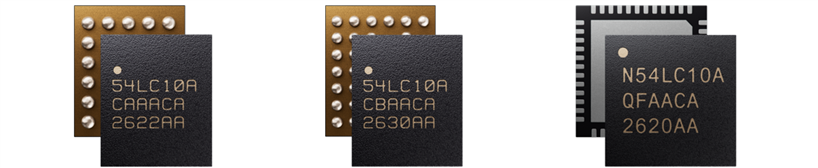
CSP29, CSP39, QFN48
Built for size- and cost-constrained applications
Bluetooth LE and location tags
The nRF54LC10A suits a broad range of cost-sensitive Bluetooth LE products, particularly asset trackers, item finders, and tags where small size and simplicity matters the most. Bluetooth Channel Sounding enables accurate distance measurement, and support for the Apple Find My network and Google Find Hub makes the nRF54LC10A a natural fit for both ecosystems.
Smart home
Thread and Zigbee accessories, networked sensor nodes, and Matter simple sensors sized to fit the 1 MB NVM and 192 KB RAM are a good match. In hubs and Thread Border Router designs, the nRF54LC10A can also serve as a Thread radio coprocessor (RCP) alongside a host application processor or MCU.
Industrial applications and building automation
nRF54LC10A enables implementations with KNX IoT for industrial and building automation applications to further expand the wireless networking capabilities in industrial settings. The memory size of nRF54LC10A is a good match for KNX IoT stack size and application requirements.
Healthcare and wearable biosensors
The nRF54LC10A's size and feature set also suit CGMs and other wearable biosensors. In this vertical, it's an alternative to the nRF54LV10A when a 1.5V silver-oxide battery isn't a requirement and the product can be supplied by a 3 V coin cell instead.
Broader view across the nRF54L Series
Common architecture across the series
Every SoC in the nRF54L Series shares the same qualified wireless stacks, software, and tools. That's what lets a design scale or move to a different SoC as requirements evolve. On that shared foundation of common architecture, ultra-low-power consumption, and MCU efficiency, the series spans a wide set of SoCs, differentiated mainly by memory size, wireless protocol support, and peripheral set.

Common nRF54L Series SoC architecture

nRF54L Series overview - all SoCs
Narrowing down to nRF54LC10A
The nRF54LC10A adds a lower point on the memory and peripheral scale for applications that don't need either. Here, let's pick the closest SoCs from the series that may be an alternative to nRF54LC10A:
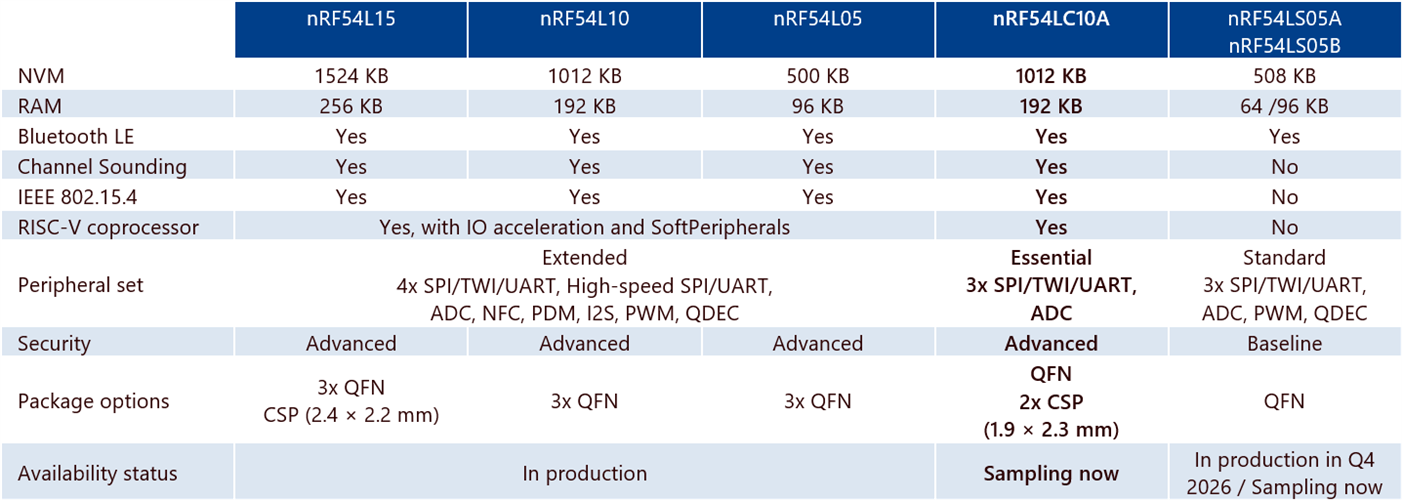
Comparison of the nRF54LC10A and selected alternative options in the nRF54L Series
Choosing between CSP options: nRF54LC10A vs. nRF54L15. If your design needs more memory than the nRF54LC10A offers, the nRF54L15 gives you up to 1524 KB NVM and 256 KB RAM, and still offers a compact CSP package option of its own.
In between: nRF54L10 and nRF54L05. The nRF54L10 shares the same memory footprint as the nRF54LC10A (1012 KB / 192 KB), but if your application needs the extended peripheral set, including NFC, PDM, I2S, PWM, or QDEC, the nRF54L10 is worth a look. The nRF54L05 flips that trade-off: less memory than the nRF54LC10A, but the same extended peripheral set as the nRF54L15 and nRF54L10.
Scaling down: Bluetooth LE-only with nRF54LS05A and nRF54LS05B. At the other end, the nRF54LS05A and nRF54LS05B trade away Channel Sounding, the RISC-V coprocessor, and some memory for a lower-cost, Bluetooth LE-only device. If your application needs multiprotocol support or distance measurement at all, the nRF54LC10A is the point where you'd step up from the nRF54LS Series.
Availability and sampling program
The nRF54LC10A is available now for sampling. We're running a project-based early-access program where anyone can apply. To get a DK and SoC samples, head to nordicsemi.com/nRF54LC10A and tell us about the project in the sample request form. Every request will be reviewed, and our sales team will contact qualified projects to arrange samples and further information.
Development kits are expected to be generally available in Q1 2027, with mass production of SoCs following in Q2 2027. Contact your Nordic sales representative for samples and early access to development kits.
How to get samples and get started
The nRF54LC10 DK is the development kit for the nRF54LC10A SoC. It’s an affordable single-board development kit that makes all features of the wireless SoC easily available to developers. The DK is available in the project-based sampling program.

nRF54LC10A DK features diagram
The nRF Connect SDK and tools fully support the nRF54LC10 DK. The Quick Start tool in nRF Connect for Desktop enables easy board setup. Nordic Developer Academy provides free hands-on courses to equip developers with the technical knowledge and skills to work with Nordic Semiconductor solutions. Developers can explore the nRF54LC10A’s potential with software samples, modules, and libraries from the nRF Connect SDK.
Documentation is available on the landing page for nRF54L Series on docs.nordicsemi.com
For any questions or troubleshooting, Nordic's technical support is available to all.
Closing
The nRF54LC10A brings the nRF54L Series' ultra-low-power efficiency and full software ecosystem down to a smaller, simpler, entry-level SoC while it doesn’t ask developers to give up the multiprotocol radio, security, or tooling that comes with the rest of the series. Whether it's the right fit comes down to the application: if size and cost matter more than memory or a full peripheral set, it's a fit, and the nRF54L15, nRF54L10, nRF54L05, and nRF54LS05A and nRF54LS05B remain there for when the trade-off runs the other way.
For more information and links to the datasheet and nRF Connect SDK documentation, visit nordicsemi.com/nRF54LC10A.
Make sure you haven’t missed the nRF54L15 Tag. You can read more about it in this blog post: Introducing the nRF54L15 Tag: Tiny, dual-antenna prototyping platform
