ADC Infuriating Behaviour With Multi-channel Scan Using PPI to RTC

Been on all day at this and ready to smash something! :)

I need to do three 'steps' or 'tasks' which are:

1. read 5 channels
2. read 3 channels, which are the same as above minus two (there's a pin aux)
3. read 2 channels repeatedly filling up one of two banks with additional looping.

For brevity I've removed (3) to just do a single read and then call (1).

Each step works from adc interrupt. In the case of (1) and (2) the SAMPLE is wired to STARTED by PPI. Primarily this is because the RTC tick at 32KHz) is too fast.

Then this PPI is disabled and the RTC TICK EVENT is wired to STARTED instead. This gives 30.5us, and the 2 channels plus overhead are well within it.

Behaviour

The routine(s) loop twice and then end with no further interrupts. I believe the ADC is stuck on (2) because the TICK EVENT isn't being pumped through when the PPI channel is re-enabled.

I think I've tried everything to get this working but maybe another pair of eyes could help! 


extern struct statusProto status;

#define ADC_RESOLUTION SAADC_RESOLUTION_VAL_12bit
#define ADC_SAMPLETIME_CFG_SLOW SAADC_CH_CONFIG_TACQ_40us
#define ADC_SAMPLETIME_CFG_MPPT_VOLTAGE SAADC_CH_CONFIG_TACQ_10us
#define ADC_SAMPLETIME_CFG_MPPT_CURRENT SAADC_CH_CONFIG_TACQ_10us

// ADC takes 2us per channel, 4us + 15us + 5us = 24us

// 32,768Hz = 30.52us
// 667 (fit into ram)*30 = 20ms
#define MPPT_SAMPLES 1

// 200ms total / 20ms
#define MPPT_LOOP 2

enum {
  ADC_CH_USB,
  ADC_CH_FRONT,
  ADC_CH_REAR,
  ADC_CH_STORE,
  ADC_CH_LIGHTSENSE,
  ADC_CH_MPPT_VOLTAGE,
  ADC_CH_MPPT_CURRENT
};

struct mpptReadProto {
  int16_t voltage;
  int16_t current;
};

struct {
  volatile struct {
    int16_t usb;
    int16_t front;
    int16_t rear;
    int16_t storage;
    int16_t lightsense;
  } voltages;
  volatile struct {
    int16_t usb;
    int16_t front;
    int16_t rear;
  } currents;
  struct mpptReadProto banks[2][MPPT_SAMPLES];
} reads;

static void step3n (void);
static void step3 (void);
static void step2 (void);
static void step1 (void);

static void (*step)(void);
static uint8_t loop;
static struct mpptTrackProto track;
static struct mpptReadProto *currentBank;

static void step1 (void) {

  step = &step2;

  NRF_PPI->CHENSET = 1 << CFG_PPI_ADC_SAMPLEONSTART;

  NRF_GPIO->OUTCLR = 1 << CFG_PIN_ADC_MUX;

  NRF_SAADC->CH[ADC_CH_USB].PSELP = CFG_ADC_USB_PSEL;
  NRF_SAADC->CH[ADC_CH_FRONT].PSELP = CFG_ADC_FRONT_PSEL;
  NRF_SAADC->CH[ADC_CH_REAR].PSELP = CFG_ADC_REAR_PSEL;
  NRF_SAADC->CH[ADC_CH_STORE].PSELP = CFG_ADC_STORE_PSEL;
  NRF_SAADC->CH[ADC_CH_LIGHTSENSE].PSELP = CFG_ADC_LIGHTSENSE_PSEL;
  NRF_SAADC->RESULT.PTR = (uint32_t) &reads.voltages;
  NRF_SAADC->RESULT.MAXCNT = sizeof(reads.voltages) / 2;
  NRF_SAADC->TASKS_START = SAADC_TASKS_START_TASKS_START_Trigger << SAADC_TASKS_START_TASKS_START_Pos; 
}

static void step2 (void) {

  step = &step3;

  NRF_GPIO->OUTSET = 1 << CFG_PIN_ADC_MUX;
  // rather than wait for adc task compute we do here and send as event
  // this is only benefical if the storage read is greater than 500ms (adc task)
  if (reads.voltages.storage < STORAGE_VOLTAGE_CRITICAL_ON) {
    POWERMANAGER_EventStorageCritical();
  }

  NRF_SAADC->CH[ADC_CH_STORE].PSELP = SAADC_CH_PSELP_PSELP_NC;
  NRF_SAADC->CH[ADC_CH_LIGHTSENSE].PSELP = SAADC_CH_PSELP_PSELP_NC;
  NRF_SAADC->RESULT.PTR = (uint32_t) &reads.currents;
  NRF_SAADC->RESULT.MAXCNT = sizeof(reads.currents) / 2;
  NRF_SAADC->TASKS_START = SAADC_TASKS_START_TASKS_START_Trigger << SAADC_TASKS_START_TASKS_START_Pos; 
}

static void step3 (void) {

  currentBank = &reads.banks[0][0];
  step = &step3n;

  NRF_PPI->CHENCLR = 1 << CFG_PPI_ADC_SAMPLEONSTART;

  NRF_SAADC->CH[ADC_CH_USB].PSELP = SAADC_CH_PSELP_PSELP_NC;
  NRF_SAADC->CH[ADC_CH_FRONT].PSELP = SAADC_CH_PSELP_PSELP_NC;
  NRF_SAADC->CH[ADC_CH_REAR].PSELP = SAADC_CH_PSELP_PSELP_NC;
  NRF_SAADC->CH[ADC_CH_MPPT_VOLTAGE].PSELP = CFG_ADC_MPPT_VOLTAGE_PSEL;
  NRF_SAADC->CH[ADC_CH_MPPT_CURRENT].PSELP = CFG_ADC_MPPT_CURRENT_PSEL;
  NRF_SAADC->RESULT.PTR = (uint32_t) &reads.banks[0];
  NRF_SAADC->RESULT.MAXCNT = sizeof(reads.banks[0]) / sizeof(reads.banks[0][0]);
  NRF_SAADC->TASKS_START = SAADC_TASKS_START_TASKS_START_Trigger << SAADC_TASKS_START_TASKS_START_Pos;
  NRF_PPI->CHENSET = 1 << CFG_PPI_ADC_SAMPLEBYTIMER;
}


static void step3n (void) {

  // code cut down to remove looping
  NRF_SAADC->CH[ADC_CH_MPPT_VOLTAGE].PSELP = SAADC_CH_PSELP_PSELP_NC;
  NRF_SAADC->CH[ADC_CH_MPPT_CURRENT].PSELP = SAADC_CH_PSELP_PSELP_NC;
  NRF_PPI->CHENCLR = 1 << CFG_PPI_ADC_SAMPLEBYTIMER;
  step1();
}

void SAADC_IRQHandler (void) {

  NRF_SAADC->EVENTS_END = SAADC_EVENTS_END_EVENTS_END_NotGenerated << SAADC_EVENTS_END_EVENTS_END_Pos;
  step();
}

uint32_t ADC_TaskCalibrate (void) {

  NRF_SAADC->ENABLE = SAADC_ENABLE_ENABLE_Enabled << SAADC_ENABLE_ENABLE_Pos;
  NRF_SAADC->TASKS_CALIBRATEOFFSET = SAADC_TASKS_CALIBRATEOFFSET_TASKS_CALIBRATEOFFSET_Trigger << SAADC_TASKS_CALIBRATEOFFSET_TASKS_CALIBRATEOFFSET_Pos;
  return CFG_SCHEDULER_TIMER_MINIMUM;
}

uint32_t ADC_TaskStart (void) {

  NRF_SAADC->EVENTS_END = SAADC_EVENTS_END_EVENTS_END_NotGenerated << SAADC_EVENTS_END_EVENTS_END_Pos;
  NRF_SAADC->INTENSET = SAADC_INTENSET_END_Enabled << SAADC_INTENSET_END_Pos;
  
  // Note RTC Event tick is enabled elsewhere!

  step1();
  return CFG_SCHEDULER_TIMER_MINIMUM;
}


inline void ADC_Init (void) {

  NRF_GPIO->PIN_CNF[CFG_PIN_ADC_STORE] = pinDisconnectInputBuffer;
  NRF_GPIO->PIN_CNF[CFG_PIN_ADC_USB] = pinDisconnectInputBuffer;
  NRF_GPIO->PIN_CNF[CFG_PIN_ADC_FRONT] = pinDisconnectInputBuffer;
  NRF_GPIO->PIN_CNF[CFG_PIN_ADC_REAR] = pinDisconnectInputBuffer;
  NRF_GPIO->PIN_CNF[CFG_PIN_ADC_MPPT_VOLTAGE] = pinDisconnectInputBuffer;
  NRF_GPIO->PIN_CNF[CFG_PIN_ADC_MPPT_CURRENT] = pinDisconnectInputBuffer;
  NRF_GPIO->PIN_CNF[CFG_PIN_ADC_LIGHTSENSE] = pinDisconnectInputBuffer;
  NRF_GPIO->PIN_CNF[CFG_PIN_ADC_MUX] = pinDisconnectInputBuffer | (GPIO_PIN_CNF_DIR_Output << GPIO_PIN_CNF_DIR_Pos);
  NRF_GPIO->OUTSET = 1 << CFG_PIN_ADC_MUX;

  NRF_SAADC->RESOLUTION = SAADC_RESOLUTION_VAL_12bit << SAADC_RESOLUTION_VAL_Pos;
  NRF_SAADC->CH[ADC_CH_USB].CONFIG = SAADC_CH_CONFIG_REFSEL_Internal << SAADC_CH_CONFIG_REFSEL_Pos | SAADC_CH_CONFIG_GAIN_Gain1 << SAADC_CH_CONFIG_GAIN_Pos | ADC_SAMPLETIME_CFG_SLOW << SAADC_CH_CONFIG_TACQ_Pos;
  NRF_SAADC->CH[ADC_CH_FRONT].CONFIG = SAADC_CH_CONFIG_REFSEL_Internal << SAADC_CH_CONFIG_REFSEL_Pos | SAADC_CH_CONFIG_GAIN_Gain1 << SAADC_CH_CONFIG_GAIN_Pos | ADC_SAMPLETIME_CFG_SLOW << SAADC_CH_CONFIG_TACQ_Pos;
  NRF_SAADC->CH[ADC_CH_REAR].CONFIG = SAADC_CH_CONFIG_REFSEL_Internal << SAADC_CH_CONFIG_REFSEL_Pos | SAADC_CH_CONFIG_GAIN_Gain1 << SAADC_CH_CONFIG_GAIN_Pos | ADC_SAMPLETIME_CFG_SLOW << SAADC_CH_CONFIG_TACQ_Pos;
  NRF_SAADC->CH[ADC_CH_STORE].CONFIG = SAADC_CH_CONFIG_REFSEL_Internal << SAADC_CH_CONFIG_REFSEL_Pos | SAADC_CH_CONFIG_GAIN_Gain1_2 << SAADC_CH_CONFIG_GAIN_Pos | ADC_SAMPLETIME_CFG_SLOW << SAADC_CH_CONFIG_TACQ_Pos;
  NRF_SAADC->CH[ADC_CH_LIGHTSENSE].CONFIG = SAADC_CH_CONFIG_REFSEL_Internal << SAADC_CH_CONFIG_REFSEL_Pos | SAADC_CH_CONFIG_GAIN_Gain2 << SAADC_CH_CONFIG_GAIN_Pos | ADC_SAMPLETIME_CFG_SLOW << SAADC_CH_CONFIG_TACQ_Pos;
  NRF_SAADC->CH[ADC_CH_MPPT_VOLTAGE].CONFIG = SAADC_CH_CONFIG_REFSEL_Internal << SAADC_CH_CONFIG_REFSEL_Pos | SAADC_CH_CONFIG_GAIN_Gain1_6 << SAADC_CH_CONFIG_GAIN_Pos | ADC_SAMPLETIME_CFG_MPPT_VOLTAGE << SAADC_CH_CONFIG_TACQ_Pos;
  NRF_SAADC->CH[ADC_CH_MPPT_CURRENT].CONFIG = SAADC_CH_CONFIG_REFSEL_Internal << SAADC_CH_CONFIG_REFSEL_Pos | SAADC_CH_CONFIG_GAIN_Gain1_6 << SAADC_CH_CONFIG_GAIN_Pos | ADC_SAMPLETIME_CFG_MPPT_CURRENT << SAADC_CH_CONFIG_TACQ_Pos;
  
  NRF_PPI->CH[CFG_PPI_ADC_SAMPLEONSTART].EEP = (uint32_t) &NRF_SAADC->EVENTS_STARTED;
  NRF_PPI->CH[CFG_PPI_ADC_SAMPLEONSTART].TEP = (uint32_t) &NRF_SAADC->TASKS_SAMPLE;
  NRF_PPI->CH[CFG_PPI_ADC_SAMPLEBYTIMER].EEP = (uint32_t) &NRF_RTC1->EVENTS_TICK;
  NRF_PPI->CH[CFG_PPI_ADC_SAMPLEBYTIMER].TEP = (uint32_t) &NRF_SAADC->TASKS_SAMPLE;
  
  NVIC_SetPriority(SAADC_IRQn, CFG_INTERRUPT_PRIORITY_ADC);
  NVIC_EnableIRQ(SAADC_IRQn);
}

void ADC_Shutdown (void) {

  NRF_SAADC->ENABLE = SAADC_ENABLE_ENABLE_Disabled << SAADC_ENABLE_ENABLE_Pos;
}




Parents
  • And into the evening it continues.

    I've managed to determine the loop is good, but when softdevice is enabled the reads tail off and stop.

    <info> app: Step2 11
    <info> app: Step2 10
    <info> app: Step2 15
    <info> app: Step2 16
    <info> app: Step2 17
    <info> app: Step2 -4
    <ends>

    I've now replaced the timer and PPI's with raw

      NRF_SAADC->EVENTS_STARTED = 0;
      NRF_SAADC->TASKS_START = SAADC_TASKS_START_TASKS_START_Trigger << SAADC_TASKS_START_TASKS_START_Pos;
      while (!NRF_SAADC->EVENTS_STARTED) {}
      NRF_SAADC->TASKS_SAMPLE = 1;


    Eventually I've found that the ADC dies if it's interrupt priority 4 or above. 3 works, above the softdevice non-critical timing ops. I can't tell why this is because I also have a few interrupts at higher levels and they are being serviced.

  • Right, so I've determined that it will mostly work with an RTC prescale of 9, but mostly the ADC will eventually fail and start giving crap out. At a prescale of 8 it will mostly not work and at 7 it's crap out all the time.

    A prescale of 9 equals 3631Hz, which is 274us. 

    Something is interfering with the operation and it worsens as load increases (i.e run softdevice).


    #define ADC_RESOLUTION SAADC_RESOLUTION_VAL_12bit
    #define ADC_SAMPLETIME_CFG_SLOW SAADC_CH_CONFIG_TACQ_20us
    #define ADC_SAMPLETIME_CFG_MPPT_VOLTAGE SAADC_CH_CONFIG_TACQ_20us
    #define ADC_SAMPLETIME_CFG_MPPT_CURRENT SAADC_CH_CONFIG_TACQ_10us
    
    // ADC takes 2us per channel, 4us + 40us + 40us = 84us
    
    // 3641Hz = 274us
    // 667 (fit into ram)*274 = 182ms
    #define MPPT_SAMPLES 350
    
    // 200ms total / 81ms
    #define MPPT_LOOP 3
    
    enum {
      ADC_CH_USB,
      ADC_CH_FRONT,
      ADC_CH_REAR,
      ADC_CH_STORE,
      ADC_CH_LIGHTSENSE,
      ADC_CH_MPPT_VOLTAGE,
      ADC_CH_MPPT_CURRENT
    };
    
    struct mpptReadProto {
      int16_t voltage;
      int16_t current;
    };
    
    volatile static struct {
      int16_t usb;
      int16_t front;
      int16_t rear;
      int16_t storage;
      int16_t lightsense;
    } voltages;
    volatile static struct {
      int16_t usb;
      int16_t front;
      int16_t rear;
    } currents;
    static struct mpptReadProto banks[2][MPPT_SAMPLES];
    
    static void step4 (void);
    static void step3 (void);
    static void step2 (void);
    static void step1 (void);
    
    static void (*step)(void);
    static uint8_t loop;
    static struct mpptTrackProto track;
    static uint8_t bank;
    
    static void step1 (void) {
    
      step = &step2;
    
      NRF_GPIO->OUTCLR = 1 << CFG_PIN_ADC_MUX;
      NRF_PPI->CHENSET = 1 << CFG_PPI_ADC_SAMPLEONSTART;
    
      NRF_SAADC->CH[ADC_CH_USB].PSELP = CFG_ADC_USB_PSEL;
      NRF_SAADC->CH[ADC_CH_FRONT].PSELP = CFG_ADC_FRONT_PSEL;
      NRF_SAADC->CH[ADC_CH_REAR].PSELP = CFG_ADC_REAR_PSEL;
      NRF_SAADC->CH[ADC_CH_STORE].PSELP = CFG_ADC_STORE_PSEL;
      NRF_SAADC->CH[ADC_CH_LIGHTSENSE].PSELP = CFG_ADC_LIGHTSENSE_PSEL;
    
      NRF_SAADC->RESULT.PTR = (uint32_t) &voltages;
      NRF_SAADC->RESULT.MAXCNT = sizeof(voltages) / 2;
    
      NRF_SAADC->TASKS_START = SAADC_TASKS_START_TASKS_START_Trigger << SAADC_TASKS_START_TASKS_START_Pos;
    }
    
    static void step2 (void) {
    
      step = &step3;
    
      NRF_GPIO->OUTSET = 1 << CFG_PIN_ADC_MUX;
    
      NRF_SAADC->RESULT.PTR = (uint32_t) &currents;
      NRF_SAADC->RESULT.MAXCNT = sizeof(currents) / 2;
      NRF_SAADC->TASKS_START = SAADC_TASKS_START_TASKS_START_Trigger << SAADC_TASKS_START_TASKS_START_Pos;
    }
    
    static void step3 (void) {
    
      step = &step4;
      NRF_PPI->CHENCLR = 1 << CFG_PPI_ADC_SAMPLEONSTART;
    
      NRF_SAADC->CH[ADC_CH_USB].PSELP = SAADC_CH_PSELP_PSELP_NC;
      NRF_SAADC->CH[ADC_CH_FRONT].PSELP = SAADC_CH_PSELP_PSELP_NC;
      NRF_SAADC->CH[ADC_CH_REAR].PSELP = SAADC_CH_PSELP_PSELP_NC;
      NRF_SAADC->CH[ADC_CH_STORE].PSELP = SAADC_CH_PSELP_PSELP_NC;
      NRF_SAADC->CH[ADC_CH_LIGHTSENSE].PSELP = SAADC_CH_PSELP_PSELP_NC;
      NRF_SAADC->CH[ADC_CH_MPPT_VOLTAGE].PSELP = CFG_ADC_MPPT_VOLTAGE_PSEL;
      NRF_SAADC->CH[ADC_CH_MPPT_CURRENT].PSELP = CFG_ADC_MPPT_CURRENT_PSEL;
    
      NRF_SAADC->RESULT.PTR = (uint32_t) &banks;
      NRF_SAADC->RESULT.MAXCNT = MPPT_SAMPLES * 2;
    
      NRF_SAADC->TASKS_START = SAADC_TASKS_START_TASKS_START_Trigger << SAADC_TASKS_START_TASKS_START_Pos;
      NRF_PPI->CHENSET = 1 << CFG_PPI_ADC_SAMPLEBYTIMER;
    }
    
    static void trackAssess (uint8_t bankId) {
    
      for(struct mpptReadProto *pCur = &banks[bankId][0]; pCur < &banks[bankId][0] + sizeof(banks[0]); pCur++) {
        if (pCur->voltage > track.voltage && pCur->current > track.current) {
          track.voltage = pCur->voltage;
          track.current = pCur->current;
        }
      }
    }
    
    static void step4 (void) {
    
      if (loop == MPPT_LOOP-1) {
        loop = 0;
        bank = 0;
    
        NRF_SAADC->CH[ADC_CH_MPPT_VOLTAGE].PSELP = SAADC_CH_PSELP_PSELP_NC;
        NRF_SAADC->CH[ADC_CH_MPPT_CURRENT].PSELP = SAADC_CH_PSELP_PSELP_NC;
        NRF_PPI->CHENCLR = 1 << CFG_PPI_ADC_SAMPLEBYTIMER;
        
        trackAssess(bank);
        MPPT_Track(&track);
        track.voltage = 0;
        track.current = 0;
        step1();
        return;
      }
    
      NRF_SAADC->RESULT.PTR = bank? (uint32_t) &banks[0] : (uint32_t) &banks[1];
      NRF_SAADC->TASKS_START = SAADC_TASKS_START_TASKS_START_Trigger << SAADC_TASKS_START_TASKS_START_Pos;
      trackAssess(bank);
      bank = bank? 0:1;
      loop++;
    }
    
    void SAADC_IRQHandler (void) {
    
      NRF_SAADC->EVENTS_END = SAADC_EVENTS_END_EVENTS_END_NotGenerated << SAADC_EVENTS_END_EVENTS_END_Pos;
      step();
    }
    
    uint32_t ADC_TaskCalibrate (void) {
    
      NRF_SAADC->ENABLE = SAADC_ENABLE_ENABLE_Enabled << SAADC_ENABLE_ENABLE_Pos;
      NRF_SAADC->TASKS_CALIBRATEOFFSET = SAADC_TASKS_CALIBRATEOFFSET_TASKS_CALIBRATEOFFSET_Trigger << SAADC_TASKS_CALIBRATEOFFSET_TASKS_CALIBRATEOFFSET_Pos;
      return CFG_SCHEDULER_TIMER_MINIMUM;
    }
    
    uint32_t ADC_TaskStart (void) {
    
      NRF_SAADC->EVENTS_END = SAADC_EVENTS_END_EVENTS_END_NotGenerated << SAADC_EVENTS_END_EVENTS_END_Pos;
      NRF_SAADC->INTENSET = SAADC_INTENSET_END_Enabled << SAADC_INTENSET_END_Pos;
    
      step1();
      return CFG_SCHEDULER_TIMER_MINIMUM;
    }
    
    inline void ADC_Init (void) {
    
      NRF_GPIO->PIN_CNF[CFG_PIN_ADC_STORE] = pinDisconnectInputBuffer;
      NRF_GPIO->PIN_CNF[CFG_PIN_ADC_USB] = pinDisconnectInputBuffer;
      NRF_GPIO->PIN_CNF[CFG_PIN_ADC_FRONT] = pinDisconnectInputBuffer;
      NRF_GPIO->PIN_CNF[CFG_PIN_ADC_REAR] = pinDisconnectInputBuffer;
      NRF_GPIO->PIN_CNF[CFG_PIN_ADC_MPPT_VOLTAGE] = pinDisconnectInputBuffer;
      NRF_GPIO->PIN_CNF[CFG_PIN_ADC_MPPT_CURRENT] = pinDisconnectInputBuffer;
      NRF_GPIO->PIN_CNF[CFG_PIN_ADC_LIGHTSENSE] = pinDisconnectInputBuffer;
      NRF_GPIO->PIN_CNF[CFG_PIN_ADC_MUX] = pinDisconnectInputBuffer | (GPIO_PIN_CNF_DIR_Output << GPIO_PIN_CNF_DIR_Pos);
      NRF_GPIO->OUTSET = 1 << CFG_PIN_ADC_MUX;
    
      NRF_SAADC->RESOLUTION = SAADC_RESOLUTION_VAL_12bit << SAADC_RESOLUTION_VAL_Pos;
      NRF_SAADC->CH[ADC_CH_USB].CONFIG = SAADC_CH_CONFIG_REFSEL_Internal << SAADC_CH_CONFIG_REFSEL_Pos | SAADC_CH_CONFIG_GAIN_Gain1 << SAADC_CH_CONFIG_GAIN_Pos | ADC_SAMPLETIME_CFG_SLOW << SAADC_CH_CONFIG_TACQ_Pos;
      NRF_SAADC->CH[ADC_CH_FRONT].CONFIG = SAADC_CH_CONFIG_REFSEL_Internal << SAADC_CH_CONFIG_REFSEL_Pos | SAADC_CH_CONFIG_GAIN_Gain1 << SAADC_CH_CONFIG_GAIN_Pos | ADC_SAMPLETIME_CFG_SLOW << SAADC_CH_CONFIG_TACQ_Pos;
      NRF_SAADC->CH[ADC_CH_REAR].CONFIG = SAADC_CH_CONFIG_REFSEL_Internal << SAADC_CH_CONFIG_REFSEL_Pos | SAADC_CH_CONFIG_GAIN_Gain1 << SAADC_CH_CONFIG_GAIN_Pos | ADC_SAMPLETIME_CFG_SLOW << SAADC_CH_CONFIG_TACQ_Pos;
      NRF_SAADC->CH[ADC_CH_STORE].CONFIG = SAADC_CH_CONFIG_REFSEL_Internal << SAADC_CH_CONFIG_REFSEL_Pos | SAADC_CH_CONFIG_GAIN_Gain1_2 << SAADC_CH_CONFIG_GAIN_Pos | ADC_SAMPLETIME_CFG_SLOW << SAADC_CH_CONFIG_TACQ_Pos;
      NRF_SAADC->CH[ADC_CH_LIGHTSENSE].CONFIG = SAADC_CH_CONFIG_REFSEL_Internal << SAADC_CH_CONFIG_REFSEL_Pos | SAADC_CH_CONFIG_GAIN_Gain2 << SAADC_CH_CONFIG_GAIN_Pos | ADC_SAMPLETIME_CFG_SLOW << SAADC_CH_CONFIG_TACQ_Pos;
      NRF_SAADC->CH[ADC_CH_MPPT_VOLTAGE].CONFIG = SAADC_CH_CONFIG_REFSEL_Internal << SAADC_CH_CONFIG_REFSEL_Pos | SAADC_CH_CONFIG_GAIN_Gain1_6 << SAADC_CH_CONFIG_GAIN_Pos | ADC_SAMPLETIME_CFG_MPPT_VOLTAGE << SAADC_CH_CONFIG_TACQ_Pos;
      NRF_SAADC->CH[ADC_CH_MPPT_CURRENT].CONFIG = SAADC_CH_CONFIG_REFSEL_Internal << SAADC_CH_CONFIG_REFSEL_Pos | SAADC_CH_CONFIG_GAIN_Gain1_6 << SAADC_CH_CONFIG_GAIN_Pos | ADC_SAMPLETIME_CFG_MPPT_CURRENT << SAADC_CH_CONFIG_TACQ_Pos;
      
      NRF_PPI->CH[CFG_PPI_ADC_SAMPLEONSTART].EEP = (uint32_t) &NRF_SAADC->EVENTS_STARTED;
      NRF_PPI->CH[CFG_PPI_ADC_SAMPLEONSTART].TEP = (uint32_t) &NRF_SAADC->TASKS_SAMPLE;
      NRF_PPI->CH[CFG_PPI_ADC_SAMPLEBYTIMER].EEP = (uint32_t) &NRF_RTC1->EVENTS_TICK;
      NRF_PPI->CH[CFG_PPI_ADC_SAMPLEBYTIMER].TEP = (uint32_t) &NRF_SAADC->TASKS_SAMPLE;
      
      NVIC_SetPriority(SAADC_IRQn, CFG_INTERRUPT_PRIORITY_ADC);
      NVIC_EnableIRQ(SAADC_IRQn);
    }
    
    void ADC_Shutdown (void) {
    
      NRF_SAADC->ENABLE = SAADC_ENABLE_ENABLE_Disabled << SAADC_ENABLE_ENABLE_Pos;
    }


    Here's an example of when it switches to crap out. High reads are valid.

    <info> app: Store 625
    <info> app: Store 633
    <info> app: Store 626
    <info> app: Store 628
    <info> app: Store 627
    <info> app: Store 632
    <info> app: Store 632
    <info> app: Store 5
    <info> app: Store 7
    <info> app: Store 11
    <info> app: Store 12


  • Hello,

    snoopy20 said:
    So after much testing yesterday it occasionally would skip, which in my case is a fatal flaw that can damage hardware. I literally exhausted everything and then finally went the whole hog and used the errata code before any adc operation to do a full reset and reconfig. This has solved it.

    I am sorry to read the struggles you've had to get this working as expected, which no doubt was a frustrating experience!

    My general suggestion for your setup would be to use the SAADC driver and to have the sampling triggered through PPI with the addition described in this answer by my colleague Jørgen referenced by hmolesworth earlier, but you would of course also need to pay heed to the erratas also mentioned by hmolesworth, which sounds close to what you are doing currently.

    snoopy20 said:
    My understanding (be good if someone from Nordic can verify) is that this will also reset internal calibration values if ran.

    Correct, adding this code will reset the entire SAADC peripheral, as mentioned in the workaround description. The offset calibration would indeed have to be run again, which should be done before you have started sampling (or after the END event, as described in the erratas), or anytime the ambient temperature has changed more than 10 degrees to counteract changes in the measurements caused by temperature. 
    Are there anything else than the offset calibration you are referring to here, when you say 'internal calibration values'?

    Best regards,
    Karl

  • Hi Karl,

    I'm in production with it, it's working well.

    I perform a number of steps in a adc-interrupt-loop with calibration being the first. Each step does a full reset of the adc using the errata code. It's not the fastest or the most optimal (i.e calibration every ~100ms) but it works and is fast enough!

    A.

  • Hello A,

    I am glad to hear that it now functions as expected! :)
    I understand that it is not ideal to have to go through the calibration so often, but unfortunately it is no way around the reset of the SAADC peripheral between the configurations you are using in this case.

    Alternatively, if the repeated calibration is effecting the performance of other components in your system you could also run some tests on the feasibility for your application not to perform the offset calibration at all - as mentioned in the Product Specification the SAADC has a temperature dependent offset, but if what you are after in your application is the relative change in voltage over time, and the device is operating in a small temperature range - less than 10 degrees change in ambient temperature - it could also be feasible for you to run without the calibration. At least I do not know enough about your applications requirements and constraints to rule this possibility out.

    Best regards,
    Karl

  • It's not an issue in this application and to be honest if it were I'd monitor the internal temperature of the die and skip the step if the delta isn't high enough. There's always a way! Slight smile

    I do think however that some work is needed on the errata. For the 810 at least there are two around the calibration, which are the same thing, and as I've shown in this thread the errata applies at any time configuration changes between scans and not just calibration.

  • snoopy20 said:
    It's not an issue in this application and to be honest if it were I'd monitor the internal temperature of the die and skip the step if the delta isn't high enough. There's always a way!

    Yeah, if it had been an issue for you we'd have to turn some rocks to see what the possible solutions could be, but I am glad to hear that this is not an issue! :) 

    snoopy20 said:
    I do think however that some work is needed on the errata. For the 810 at least there are two around the calibration, which are the same thing, and as I've shown in this thread the errata applies at any time configuration changes between scans and not just calibration.

    To me it looks like you are seeing the effects of Errata 212 paired with the buffer-shift issue explained by my colleague Jørgen in the other thread, could you elaborate what you mean when you say 'the errata applies at any time configuration changes between scans and not just calibration?

    I do agree that Errata 237 and Errata 252 perhaps should have been a single errata as I am not sure if their distinction is clear enough. I will check internally to see if what the background for this is.

    Best regards,
    Karl

Reply
  • snoopy20 said:
    It's not an issue in this application and to be honest if it were I'd monitor the internal temperature of the die and skip the step if the delta isn't high enough. There's always a way!

    Yeah, if it had been an issue for you we'd have to turn some rocks to see what the possible solutions could be, but I am glad to hear that this is not an issue! :) 

    snoopy20 said:
    I do think however that some work is needed on the errata. For the 810 at least there are two around the calibration, which are the same thing, and as I've shown in this thread the errata applies at any time configuration changes between scans and not just calibration.

    To me it looks like you are seeing the effects of Errata 212 paired with the buffer-shift issue explained by my colleague Jørgen in the other thread, could you elaborate what you mean when you say 'the errata applies at any time configuration changes between scans and not just calibration?

    I do agree that Errata 237 and Errata 252 perhaps should have been a single errata as I am not sure if their distinction is clear enough. I will check internally to see if what the background for this is.

    Best regards,
    Karl

Children
  • There are three erratas for 810 adc at least:

    1. when using calibration a sample may be taken, so one should configure the channels and dma after calibration.
    2. when using calibration if a task_sample is invoked the reads will be garbage from that point forth. Really this is misconfiguration of running a timer and ppi event and not exactly errata per say.
    3. when re-configuring adc registers (config,dma) after a multi-scan (not just one pass) then easydma will eventually buffer shift.

    The errata says that a TASK_STOP should be used, this is not true as one of my posts above shows, however the delay it introduces may change the timing upon which easydma fails and perhaps gave the impression of such.

    I actually use the 810 in another project where the adc is pushed to it's max computing real/apparent wattages for a generator. I don't have to reset there because I don't reconfigure the channels.

    Also...

    Another errata says that 5us channels can't be used with timer+PPI. This is untrue, I'm doing it and have never seen an issue.

    And in the datasheet it says burst can't be combined with scan mode. This is not true, I do it just fine. But it may be the case that it can only be one sweep.

    A.

  • Really useful discussion :-)  Adding to this note a couple of additional ways to improve the SAADC. Instead of calibration another way is to read the temperature and apply a correction based on that, simple to characterise to get a good curve fit and the sort of thing done frequently on (say) the 32kHz crystal for better timekeeping.

    Avoiding data shift can be improved by reducing the underlying cause (this affects SPIM as well). This example is for the nRF52810.

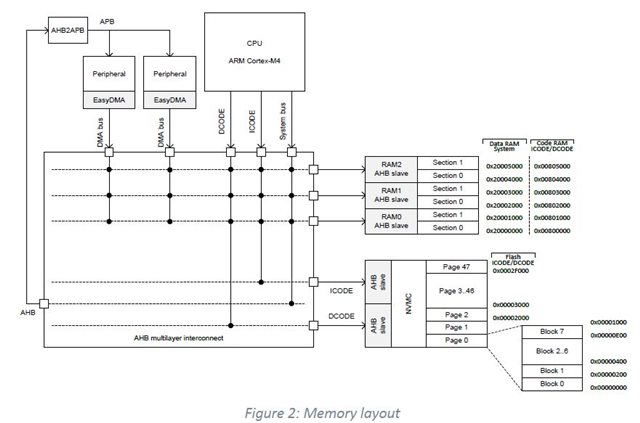
    "EasyDMA is an AHB bus master similar to CPU and is connected to the AHB multilayer interconnect for direct access to Data RAM. AHB multilayer enables parallel access paths between multiple masters and slaves in a system. Access is resolved using priorities.

    Each bus master is connected to the slave devices using an interconnection matrix. The bus masters are assigned priorities. Priorities are used to resolve access when two (or more) bus masters request access to the same slave device. The following applies:
    • If two (or more) bus masters request access to the same slave device, the master with the highest priority is granted the access first.
    • Bus masters with lower priority are stalled until the higher priority master has completed its transaction.
    • If the higher priority master pauses at any point during its transaction, the lower priority master in queue is temporarily granted access to the slave device until the higher priority master resumes its activity.
    • Bus masters that have the same priority are mutually exclusive, thus cannot be used concurrently."

    nRF52810 Priorities
    Bus master name Description
    CPU
    SPIM0/SPIS0 Same priority and mutually exclusive
    RADIO
    CCM/ECB/AAR Same priority and mutually exclusive
    SAADC
    UARTE0
    TWIM0/TWIS0 Same priority and mutually exclusive
    PDM
    PWM

    CPU, RADIO and SPIM0 are likely to cause a stall on the SAADC DMA which can lead to a data shift; with a fixed streaming rate over DMA this is a problem. Reduce this likelihood by dedicating an AHB Bus Master-Slave to a single RAM segment reserved for the SAADC and low-usage cpu data.

    READERBUFFER_SIZE 5
    WRITERBUFFER_SIZE 6
    uint8_t readerBuffer[READERBUFFER_SIZE] __at__ 0x20000000; <== choose dedicated RAM segment
    uint8_t writerBuffer[WRITERBUFFER_SIZE] __at__ 0x20000005;
    // Configuring the READER channel
    MYPERIPHERAL->READER.MAXCNT = READERBUFFER_SIZE;
    MYPERIPHERAL->READER.PTR = &readerBuffer;
    // Configure the WRITER channel
    MYPERIPHERAL->WRITER.MAXCNT = WRITEERBUFFER_SIZE;
    MYPERIPHERAL->WRITER.PTR = &writerBuffer;

    Reduce likelihood further by scheduling SAADC reads between RADIO and CPU and SPIM0 events (more tricky if streaming lots of ADC measurements).

  • So my implementation was based on another post on this forum by a nordic engineer saying the calibration values are retained until power reset, which doesn't appear to be the case according to Karl (probably because it wasn't factoring in the errata code).

    This means I have to do calibration on every step, of which there are 4 in a continuous loop running at around 5Hz. I'm unsure if it's worth the overhead.

    Regarding the buffer shift, the buffer always moves forwards not backwards, which I believe indicates a false signal (double or noise) not a missing one. The shift is also retained across all adc reconfiguration which indicates there's state held somewhere.

  • Hello again,

    A very useful discussion indeed! :) 

    snoopy20 said:
    So my implementation was based on another post on this forum by a nordic engineer saying the calibration values are retained until power reset, which doesn't appear to be the case according to Karl (probably because it wasn't factoring in the errata code).

    I dug deeper into this, and I stand corrected: You will fortunately not have to perform a new calibration each time the Errata 212 workaround is ran.

    Part of the workaround from the errata is to power cycle the peripheral - which means resetting all the internal registers, thus warranting a new calibration - but closer examination on my part has revealed that the previous calibration is actually carried over in the rest of the errata workaround.
    The easiest thing here is of course to abide by the Errata text and set up all registers again, but as it turns out for the specific offset calibration results this value will be carried over. Apologies for the confusion here.

    hmolesworth said:
    Avoiding data shift can be improved by reducing the underlying cause (this affects SPIM as well). This example is for the nRF52810.
    hmolesworth said:
    Reduce likelihood further

    Could you clarify on what you mean when you say that you can 'reduce likelihood' here?
    I agree with your analysis of the AHB priorities and the potential impact of the timing, but you should not see a buffer shift if you implement the workarounds (for each errata as they apply to your project) + the PPI channel described by my colleague Jørgen in the post you referenced earlier, and so you should not need to take actions to 'further reduce likelihood' - perhaps I am misunderstanding something here.

    snoopy20 said:
    The errata says that a TASK_STOP should be used, this is not true as one of my posts above shows, however the delay it introduces may change the timing upon which easydma fails and perhaps gave the impression of such.

    Which errata are you referring to here?
    Since we are discussing multiple ones it would be great if you could reference their number is possible.

    snoopy20 said:
    Another errata says that 5us channels can't be used with timer+PPI. This is untrue, I'm doing it and have never seen an issue.

    Are you here referring to the Errata 212? If so, it only comes into effect when you are also switching from multiple channels to single channel input.
    If not, please specify which errata this is in relation to.

    snoopy20 said:
    And in the datasheet it says burst can't be combined with scan mode. This is not true, I do it just fine. But it may be the case that it can only be one sweep.

    Could it be that you are here referring to that 'scan + oversampling' should not be combined?  It is also true that you may in fact do this if you also enable BURST on all channels.
    As per the Product specification you can use scan + burst so long as burst is enabled on all channels.

    Best regards,
    Karl

  • Cool, I'll revert the code to doing calibration once per loop, thanks. I also read the temperature of the die so will likely add some skipping code at the same time.

    Other matters

    Datasheet - "Scan mode and oversampling cannot be combined. "
    Outcome - Not true, it works. It may not work for repeated scans (I haven't tested) but for a single loop of multiple channels it works fine.

    The 5us, I was looking at #150 within v1 by mistake. I'm unlikely to have these chips in my inventory, likely v2 where it appears it was resolved.

Related