Two services on a single device

Here's what we're trying to do. We have a gesture recognition wearable that is intended to be used as a remote control for a smartphone. But some smartphone functions are easier to implement using the HID service and some using a custom service. We have the wearable and the phone connected and both services are shown in nRF Connect but if we pair with the HID service first we cannot connect to the custom service using a custom app on the smartphone. Similarly, if we pair to the custom service first, we cannot use the HID service. How do we get both services to work simultaneously from one device?

Parents
  • Hello,

    We have the wearable and the phone connected and both services are shown in nRF Connect but if we pair with the HID service first we cannot connect to the custom service using a custom app on the smartphone. Similarly, if we pair to the custom service first, we cannot use the HID service. How do we get both services to work simultaneously from one device?

    When you say 'pair with the HID service first', do you here mean that you have 2 different advertising payloads that you are using, and that you are connecting to one which contains the HID service UUID, or the other which contains the custom service UUID?
    If so, please note that the contents of the advertising payload does not matter for which services are exposed during a connection - once the connection is established the central will perform a discovery which then finds all services offered by the peripheral device.

    When you connect to your device, are you able to see both the HID service and the customer service?

    If so, I think the issue you are seeing stems from the 'control' of the BLE link in the smartphone side. I.e the OS could have control over the BLE link and use it as a HID device, or the custom app could take control over the BLE link (within the smartphone) to use the custom service. The OS will usually only allow a specific subset of known services, such as HID devices, but not custom ones, so the challenge here will perhaps be to find a way to be able to access the BLE connection both from the OS side (for use as HID) and from your custom smartphone app (to access the custom service).

    Best regards,
    Karl

  • Would it be possible to establish the HID connection first using the OS settings dialog and then advertise for the custom service? This is obviously not ideal, but would be a short-term fix.

    No, not using 2 different advertising payloads, Here is the UUID array:

    static ble_uuid_t m_adv_uuids[] = {{BLE_UUID_HUMAN_INTERFACE_DEVICE_SERVICE, BLE_UUID_TYPE_BLE},
                                       {CUSTOM_SERVICE_UUID, BLE_UUID_TYPE_VENDOR_BEGIN}}; 

    I use this for the m_advertising structure. I can see both services with nRF Connect app.

  • However, the same thing happens when the HID interface is working (ie, the custom is not advertised).

  • The custom service is still being disconnected when pairing to the HID service, reason is 19. 

  • I'm trying to increase the link count to 3 but I get an NRF_ERROR_NOMEM when enabling the BLE stack. I've tried increasing the stack and heap but that doesn't help, and ram_start is set to it's lowest value given the soft device.

  • Hello,

    apdobaj said:
    I'm trying to increase the link count to 3 but I get an NRF_ERROR_NOMEM when enabling the BLE stack. I've tried increasing the stack and heap but that doesn't help, and ram_start is set to it's lowest value given the soft device.

    Could you share your full logger output when this happens?
    Were you able to see the logs when you changed the logger backend as I mentioned in my previous comment?

    apdobaj said:
    The custom service is still being disconnected when pairing to the HID service, reason is 19. 

    Could you copy the full error message?

    Best regards,
    Karl

  • Logger output and offending code for no mem hardfault:

    <info> app_timer: RTC: initialized.
    <error> app: ERROR 4 [NRF_ERROR_NO_MEM] at C:\Nordic\gestr_GRM_Rev2.0\main.c:3565
    PC at: 0x0002C263
    <error> app: End of error report

        // Enable BLE stack.
        err_code = nrf_sdh_ble_enable(&ram_start);
        APP_ERROR_CHECK(err_code);
    

    Logger output when trying to exercise both HID and custom (link count set to 2 to avoid the nomem crash):

    Haptic driver interface go!
    LIS3MDL Sensor interface go!
    <info> app_timer: RTC: initialized.
    <debug> nrf_sdh: State request: 0x00000000
    <debug> nrf_sdh: Notify observer 0x00044604 => ready
    <debug> nrf_sdh: State change: 0x00000000
    <debug> nrf_sdh: State change: 0x00000001
    <debug> nrf_sdh_ble: RAM starts at 0x20002BE0
    <debug> nrf_sdh_ble: RAM start location can be adjusted to 0x20002990.
    <debug> nrf_sdh_ble: RAM size for application can be adjusted to 0x3D670.
    <info> ble_bms: Init complete.
    <info> app: HID Keyboard example started.
    <info> app: Fast advertising.
    <debug> nrf_sdh_ble: BLE event: 0x10.
    <info> app: Connected
    <debug> nrf_sdh_ble: BLE event: 0x14.
    <debug> nrf_sdh_ble: BLE event: 0x1A.
    <debug> nrf_sdh_ble: BLE event: 0x50.
    <info> app: on_write: len 2, p_evt_write->data[0]: 1, p_evt_write->data[1]: 0.
    <debug> nrf_sdh_ble: BLE event: 0x50.
    <debug> nrf_sdh_ble: BLE event: 0x12.
    gesture: 3
    <debug> nrf_sdh_ble: BLE event: 0x57.
    gesture: 3
    <debug> nrf_sdh_ble: BLE event: 0x57.
    gesture: 7
    <debug> nrf_sdh_ble: BLE event: 0x57.
    gesture: 2

    gesture: 2

    Note that when exercising the custom interface I get a BLE event 0x57, but no event when exercising the HID interface. Here is the code that goes with that log:

            switch (finalGesture) {
              case L2R:
                //ble_cus_custom_value_update(&m_cus, gestr_cus_key_array[volUp]);
                keys_send( 1, gestr_hid_key_array+finalGesture );
                break;
              case R2L:
                //ble_cus_custom_value_update(&m_cus, gestr_cus_key_array[volDown]);
                keys_send( 1, gestr_hid_key_array+finalGesture );
                break;
              case U2D:
                ble_cus_custom_value_update(&m_cus, gestr_cus_key_array[mediaPP1]);
                break;
              case D2U:
                 //ble_cus_custom_value_update(&m_cus, gestr_cus_key_array[mediaNext]);
                 keys_send( 1, gestr_hid_key_array+D2U );
                break;
    

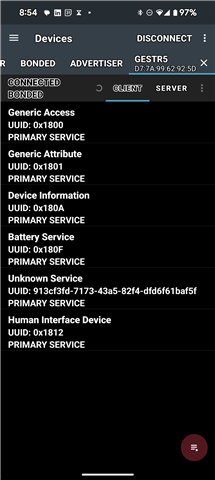
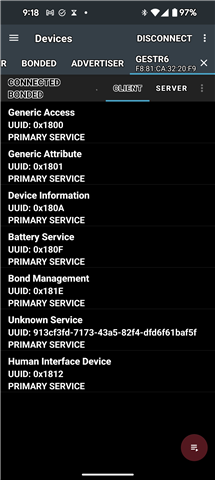
    In this case, gestures 3 and 7 run the custom service, 2 runs the HID interface. Here is a screenshot of the nRF Connect view of this connection. I have 4 services running, could it be that only two are enabled because of the link count setting?

Reply
  • Logger output and offending code for no mem hardfault:

    <info> app_timer: RTC: initialized.
    <error> app: ERROR 4 [NRF_ERROR_NO_MEM] at C:\Nordic\gestr_GRM_Rev2.0\main.c:3565
    PC at: 0x0002C263
    <error> app: End of error report

        // Enable BLE stack.
        err_code = nrf_sdh_ble_enable(&ram_start);
        APP_ERROR_CHECK(err_code);
    

    Logger output when trying to exercise both HID and custom (link count set to 2 to avoid the nomem crash):

    Haptic driver interface go!
    LIS3MDL Sensor interface go!
    <info> app_timer: RTC: initialized.
    <debug> nrf_sdh: State request: 0x00000000
    <debug> nrf_sdh: Notify observer 0x00044604 => ready
    <debug> nrf_sdh: State change: 0x00000000
    <debug> nrf_sdh: State change: 0x00000001
    <debug> nrf_sdh_ble: RAM starts at 0x20002BE0
    <debug> nrf_sdh_ble: RAM start location can be adjusted to 0x20002990.
    <debug> nrf_sdh_ble: RAM size for application can be adjusted to 0x3D670.
    <info> ble_bms: Init complete.
    <info> app: HID Keyboard example started.
    <info> app: Fast advertising.
    <debug> nrf_sdh_ble: BLE event: 0x10.
    <info> app: Connected
    <debug> nrf_sdh_ble: BLE event: 0x14.
    <debug> nrf_sdh_ble: BLE event: 0x1A.
    <debug> nrf_sdh_ble: BLE event: 0x50.
    <info> app: on_write: len 2, p_evt_write->data[0]: 1, p_evt_write->data[1]: 0.
    <debug> nrf_sdh_ble: BLE event: 0x50.
    <debug> nrf_sdh_ble: BLE event: 0x12.
    gesture: 3
    <debug> nrf_sdh_ble: BLE event: 0x57.
    gesture: 3
    <debug> nrf_sdh_ble: BLE event: 0x57.
    gesture: 7
    <debug> nrf_sdh_ble: BLE event: 0x57.
    gesture: 2

    gesture: 2

    Note that when exercising the custom interface I get a BLE event 0x57, but no event when exercising the HID interface. Here is the code that goes with that log:

            switch (finalGesture) {
              case L2R:
                //ble_cus_custom_value_update(&m_cus, gestr_cus_key_array[volUp]);
                keys_send( 1, gestr_hid_key_array+finalGesture );
                break;
              case R2L:
                //ble_cus_custom_value_update(&m_cus, gestr_cus_key_array[volDown]);
                keys_send( 1, gestr_hid_key_array+finalGesture );
                break;
              case U2D:
                ble_cus_custom_value_update(&m_cus, gestr_cus_key_array[mediaPP1]);
                break;
              case D2U:
                 //ble_cus_custom_value_update(&m_cus, gestr_cus_key_array[mediaNext]);
                 keys_send( 1, gestr_hid_key_array+D2U );
                break;
    

    In this case, gestures 3 and 7 run the custom service, 2 runs the HID interface. Here is a screenshot of the nRF Connect view of this connection. I have 4 services running, could it be that only two are enabled because of the link count setting?

Children
  • Hello,

    Thank you for the update.

    apdobaj said:
    <debug> nrf_sdh_ble: RAM start location can be adjusted to 0x20002990.
    <debug> nrf_sdh_ble: RAM size for application can be adjusted to 0x3D670.

    Please make sure to adjust your flash placement macros for the project to match the suggestion from the nrf_sdh_ble module.

    apdobaj said:
    I have 4 services running, could it be that only two are enabled because of the link count setting?

    No, the link could should not affect the number of enabled services.
    Have you tried connecting to your peripheral from 2 different centrals, and seeing that all the services work as intended then?
    I expect that there could be some issue on the smartphone side to 'share' the link between the OS and your custom application still, and so this would be a good test to verify that the peripheral is working as intended.

    Best regards,
    Karl

  • OK, I got both services to run at the same time by bonding the HID connection and then establishing that first (advertise the HID interface only), and then starting the custom service advertising only after the HID interface is connected in ble_evt_handler. However, when I do this the HID interface doesn't work because I get an attribute missing error 3401 when running sd_ble_gatts_hvx in the ble_hids_inp_rep_send subroutine in the file ble_hids.c. The code compiles and runs without error, but the values are never sent to the smartphone. I've tried restoring the sys attributes using sd_ble_gatts_sys_attr_get and sd_ble_gatts_sys_attr_set but that hasn't worked. Here is the code for the "Connected" case: 

        switch (p_ble_evt->header.evt_id)
        {
            case BLE_GAP_EVT_CONNECTED:
                NRF_LOG_INFO("Connected");
                err_code = bsp_indication_set(BSP_INDICATE_CONNECTED);
                APP_ERROR_CHECK(err_code);
                m_conn_handle = p_ble_evt->evt.gap_evt.conn_handle;
                err_code = nrf_ble_qwr_conn_handle_assign(&m_qwr, m_conn_handle);
                APP_ERROR_CHECK(err_code);
                //apdobaj 27Jun2023 set tx power
                err_code = sd_ble_gap_tx_power_set(BLE_GAP_TX_POWER_ROLE_CONN, m_conn_handle, +8);
                APP_ERROR_CHECK(err_code);
                attrs = sd_ble_gatts_sys_attr_get(m_conn_handle, p_attr_data, p_len, BLE_GATTS_SYS_ATTR_FLAG_SYS_SRVCS);
                err_code = sd_ble_gatts_sys_attr_get(m_conn_handle, p_attr_data, *p_len, BLE_GATTS_SYS_ATTR_FLAG_SYS_SRVCS);
                //apdobaj connect HID first then custom
                nrf_delay_ms(2);
    #if defined(USE_CUSTOM_SERVICE)
                advertising_init_cus();
                advertising_start_cus();
    #endif
    
                break;

  • More info: when I disable the custom service, the call to sd_ble_gatts_hvx returns error code 0x0F which I glean is NRF_ERROR_FORBIDDEN. How do I correct that?

  • Hello,

    apdobaj said:
    More info: when I disable the custom service, the call to sd_ble_gatts_hvx returns error code 0x0F which I glean is NRF_ERROR_FORBIDDEN. How do I correct that?

    The call to sd_ble_gatts_hvx will fail with the NRF_ERROR_FORBIDDEN return code if the security level of the connection is too low for the security requirements of the characteristic you are attempting to write. Could you bond for second device as well, to see if this resolves the issue?

    Best regards,
    Karl

  • There is no second device, only a second service from the same device. But I need both services to be working so I'm heading down that path. So I'm trying to fix the 3401 error (attribute missing) when calling sd_ble_gatts_hvx by getting the attributes and then setting them. Here is the code for that:

    static void ble_evt_handler(ble_evt_t const * p_ble_evt, void * p_context)
    {
        ret_code_t err_code;
        uint8_t p_attr_data[4];
        uint16_t p_len[1];
    
        switch (p_ble_evt->header.evt_id)
        {
            case BLE_GAP_EVT_CONNECTED:
                NRF_LOG_INFO("Connected");
                err_code = bsp_indication_set(BSP_INDICATE_CONNECTED);
                APP_ERROR_CHECK(err_code);
                m_conn_handle = p_ble_evt->evt.gap_evt.conn_handle;
                err_code = nrf_ble_qwr_conn_handle_assign(&m_qwr, m_conn_handle);
                APP_ERROR_CHECK(err_code);
                //apdobaj 27Jun2023 set tx power
                err_code = sd_ble_gap_tx_power_set(BLE_GAP_TX_POWER_ROLE_CONN, m_conn_handle, +8);
                APP_ERROR_CHECK(err_code);
    
                //apdobaj 3Mar2024 get and set system attributes to prevent error 3401 when calling
                //  sd_ble_gatts_hvx in ble_hids.c
                //Use a null pointer to get back the data length.
                err_code = sd_ble_gatts_sys_attr_get(m_conn_handle, NULL, p_len, BLE_GATTS_SYS_ATTR_FLAG_SYS_SRVCS);
                err_code = sd_ble_gatts_sys_attr_get(m_conn_handle, p_attr_data, p_len, BLE_GATTS_SYS_ATTR_FLAG_SYS_SRVCS);
                err_code = sd_ble_gatts_sys_attr_set(m_conn_handle, p_attr_data, *p_len, BLE_GATTS_SYS_ATTR_FLAG_SYS_SRVCS);
                //apdobaj connect HID first then custom
                nrf_delay_ms(2);
    #if defined(USE_CUSTOM_SERVICE)
                advertising_init_cus();
                advertising_start_cus();
    #endif
    
                break;
    

    The first call to sd_ble_gatts_sys_attr_get with the NULL attribute pointer is to get the length of the attribute data (this comes from the infocenter which states "NULL can be provided to obtain the length of the data."). But this call returns error code 5 which according to nrf_error.h means NRF_ERROR_NOT_FOUND which according to the comments in ble_gatts.h means "no system attributes found". The second call to sd_ble_gatts_sys_attr_get returns the same error. 

    Am I understanding this correctly? Is the 3401 error the root cause of the keycode not being sent to the smartphone? Why would this error change to 0x0F when disabling the second service? If this is the correct resolution, why is sd_ble_gatts_sys_attr_get  returning error 5? Please advise.

Related