Incorrect current measurements with PPK2 when using an nPM2100

Hello,

I am experiencing issues with the current measurements taken by the PPK2 when using the nPM2100-EK to power a device. The current drawn from the 2.7V power source (PPK2) is lower when using the nPM2100 (configured to output 3.0V) compared to a direct connection without the nPM. This is clearly incorrect. How should the PPK2 be configured to reliably measure our system, including the nPM2100?

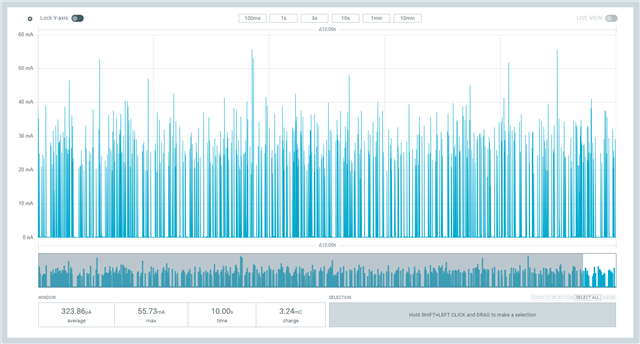
The system is a Bluetooth-enabled measurement device that uses an nRF52840 chip. When connected to a Bluetooth master, the system draws an average current of around 530µA at 2.7V, which is quite high for a CRxxxx coin cell primary battery. Therefore, I would like to use the nPM2100 to boost the voltage to a constant value of 3.0V. However, when using the nPM2100-EK for this purpose, the PPK2's current measurement shows large spikes and an average value of only 320µA. As the nPM2100 does not generate energy, this measurement must be incorrect. 

I am using Power Profiler Version 4.2.2 and even a second PPK2 produces similarly incorrect results. I have read about the phantom spikes occurring at the highest sampling rate. I therefore selected a sampling rate of 10kHz, but the values are still incorrect.

Has anyone else experienced this issue? What is wrong with the PPK2 measurements?
Parents
  • Hello David, 
    had some discussion here with others and in general the PPK2 might struggle with certain loads, especially if there is a lot of transients which I think you are seeing.
    Three things; 
    First is capacitance on the input to the nPM2100 might not be sufficient. Are you able to add large capacitors on the output from the PPK2 or input on the nPM2100-EK? 2x10uF could be a start to see if it stabilises the measurements. 
    Secondly, the FW on the PPK2 can discard measurements. When the PPK2 firmware suspects there is a measurement error caused by a measurement range transition happening at an inopportune time, the measurement is discarded.
    You can retrieve metrics from the PPK2 as described below. If there is a high amount of “samples dropped”, this would indicate that the PPK2 struggles with this particular load.
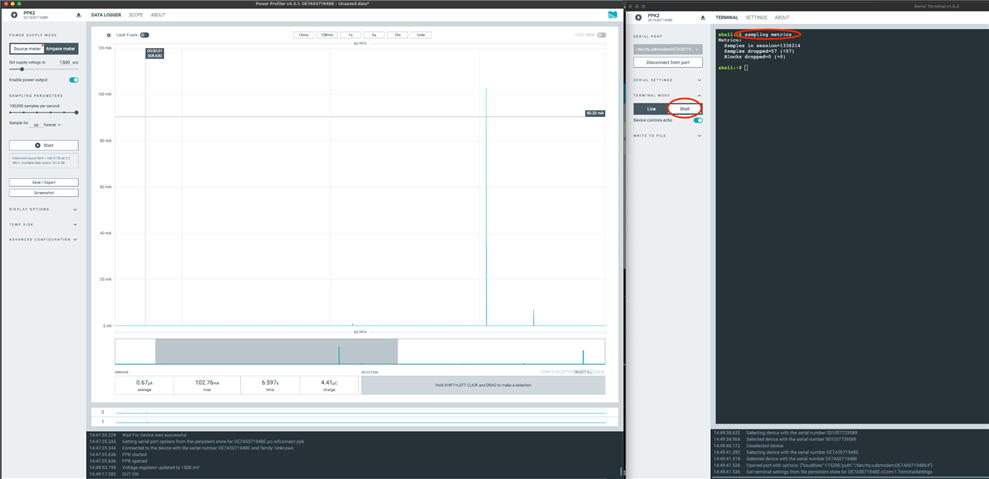
    The more recent version of PPK2  firmware has a 2nd tty/COM port that can be used for shell access. Open this port using for example the nRF Connect Serial Terminal application, and execute the “$ sampling metrics” shell command after you have stopped sampling.
    (The shell is by design unresponsive while sampling is active)
    This screenshot is taken without any load on nPM2100 EK VOUT.  VBAT = 1.5 V, VOUT = 3 V
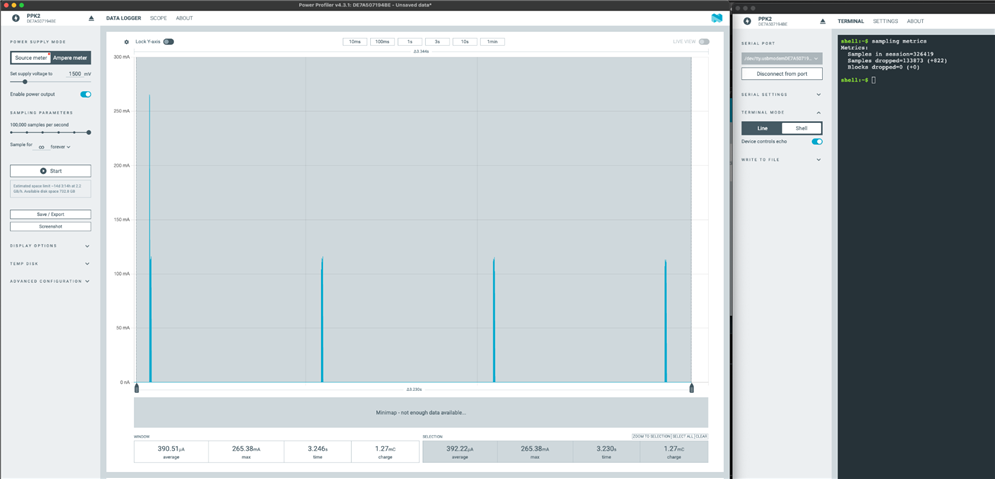
    Adding a 20 mA load pulse lasting 10 ms at 1 Hz generates more dropped samples:
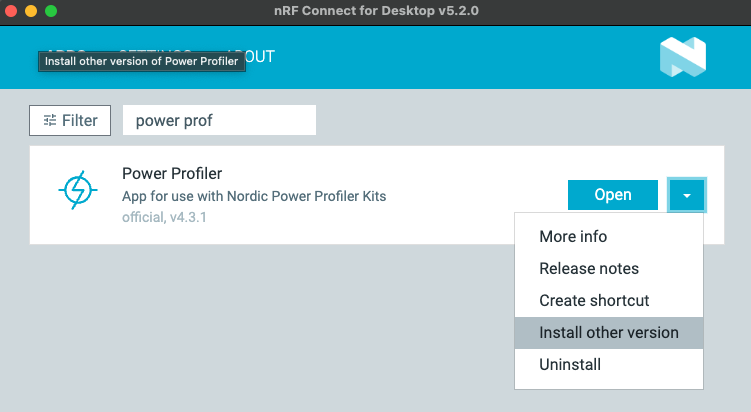
    Thirdly, it’s also possible to compare with an older PPK2 firmware version by downgrading the Power Profiler app to v4.1.3:
    So if you add capacitance and check if there number of dropped measurements decline or goes to zero, you should get more reasonable numbers.
    Best regards
    Asbjørn
Reply
  • Hello David, 
    had some discussion here with others and in general the PPK2 might struggle with certain loads, especially if there is a lot of transients which I think you are seeing.
    Three things; 
    First is capacitance on the input to the nPM2100 might not be sufficient. Are you able to add large capacitors on the output from the PPK2 or input on the nPM2100-EK? 2x10uF could be a start to see if it stabilises the measurements. 
    Secondly, the FW on the PPK2 can discard measurements. When the PPK2 firmware suspects there is a measurement error caused by a measurement range transition happening at an inopportune time, the measurement is discarded.
    You can retrieve metrics from the PPK2 as described below. If there is a high amount of “samples dropped”, this would indicate that the PPK2 struggles with this particular load.
    The more recent version of PPK2  firmware has a 2nd tty/COM port that can be used for shell access. Open this port using for example the nRF Connect Serial Terminal application, and execute the “$ sampling metrics” shell command after you have stopped sampling.
    (The shell is by design unresponsive while sampling is active)
    This screenshot is taken without any load on nPM2100 EK VOUT.  VBAT = 1.5 V, VOUT = 3 V
    Adding a 20 mA load pulse lasting 10 ms at 1 Hz generates more dropped samples:
    Thirdly, it’s also possible to compare with an older PPK2 firmware version by downgrading the Power Profiler app to v4.1.3:
    So if you add capacitance and check if there number of dropped measurements decline or goes to zero, you should get more reasonable numbers.
    Best regards
    Asbjørn
Children
  • Dear Asbjørn,

    Thank you for discussing the topic internally and for sharing your new insights. You are right. As the nPM2100 produces significant current spikes, the PPK2 is probably not the most suitable equipment for measuring its input current.

    According to the shell's output, the percentage of dropped samples is generally below 0.5%. Only the measurements taken with 10µF of capacitance on VINT (no jumper on P3, minimum value) produced higher values (between 3% and 4%) and the resulting average current was clearly incorrect. 

    Downgrading the PowerProfiler software to v4.1.3 also downgrades the PPK2 firmware to an earlier version, predating the introduction of shell access. Therefore, I was unable to check the dropped samples. However, this version does not improve the measurement accuracy.

    Adding 2x10µF of capacitance to VSUPPLY, together with minimum capacitance on VINT, results in a more accurate average current reading (500µA in my test case). Increasing the capacitance on VINT degrades the measurement values. 

    Currently, the only way to obtain correct values from the PPK2 is to perform a measurement with an ammeter connected in series with the nPM2100-EK. However, the µA scale on my ammeter incorporates a 100Ω resistor, creating a voltage drop in the EK's input voltage.

    Having said that, I'm slightly confused because the nPM2100-EK User Guide suggests using the PPK2 to measure the nPM2100's currents. Have you tried this method? I am certainly not the only one having trouble getting an accurate measurement with the PPK2. What is your opinion on this? Are you developing new software / firmware for the PPK2 that would be more effective in this situation?

    Best regards

    David

  • Hi David, 

    Unfortunately Asbjørn is away this week (and previous week), he is back on Monday. This case is slightly lengthy and I do believe he has been in direct contact with the team that made the hardware, so I suggest we wait until he is back before we can follow up.

    Kenneth

  • Dear Kenneth, 
    Thank you for the information. I am OK with your suggestion — I will wait for Asbjørn to return from holiday.
    Best regards

    David

  • Hello David,
    Thank you for waiting here, what surprises me a bit in your reply is that you are seeing about 0.5% discards and only with the capacitance on VINT it changes. Based on the conversation here I think this might be a good reason for us to try and look into the discard algorithm and see if we can find ways of improving it. The PPK2 setup was created for measuring directly on the nRF devices, not the nPM family. The usage and behaviour of nPM is different and I'd say there's room for improvement on our PPK2 offerings when used on nPM products. The resources allocated to the development of PPK2 are limited and the performance on nPM have not been the highest of priorities.
    "Having said that, I'm slightly confused because the nPM2100-EK User Guide suggests using the PPK2 to measure the nPM2100's currents. Have you tried this method?" 
    • The honest answer here is we've done some initial work, but the development for use on nPM and especially for nPM2100 is still very much ongoing. We haven't had this sort of feedback for the nPM2100 with PPK2, but I expect that we will see more as we go forward. We do intend to have the PPK2 as a tool and resource for the nPM2100EK for our customers, but we need to update the documentation to reflect setup of capacitance on supply, FW improvements and to some extend explain some limitations for the PPK2. I wish I could give you a timeline for these things, but that's beyond my scope and I'd have to refer you to our sales organisation to assist with timelines and feedback on those.
    Now for your situation, with the series ammeter, do you then also have additional capacitance on the supply net? What numbers are you reading from PPK2 with this setup?
    Best regards
    Asbjørn
  • Dear Asbjørn,

    Thank you for your honest response and evaluation of the situation. We really appreciate the PPK2 and have several in use. Hopefully, an update will be available soon so that we can achieve better results with the nPM2100 as well. 

    My simplified test with the PPK2, the nPM2100-EK, and a 7.5kΩ resistor does not include any additional capacitors. The VBATIN/VSUPPLY net has a 10µF capacitor and VINT a 10µF; that's it. With an ammeter in series, the PPK2 measures an average current of 546µA. The ammeter confirms this result. In this case, approximately 2.4% of the samples are discarded.

    Furthermore, I have found that accuracy increases when no samples are discarded. Without the ammeter in series, 3.8% of the measurements are discarded, resulting in an average value of 13µA. Using all the measurements (discard_switch_samples 0) results in an average value of 223µA, which is closer to the correct value of about 540µA, but still does not correspond to reality.

    I hope this information helps improve the accuracy of the PPK2 when used with the nPM2100.

    Best regards
    David

Related