Lowest power method of waiting for modem reset loop restriction timer to expire

To preface:

  • nRF9151DK
  • Modem firmware: mfw_nrf91x1_2.0.2
  • nRF Connect SDK / Toolchain: 2.9.0
  • Carrier: Verizon and T-Mobile
  • Device application will always initiate the data connection

Hello,

I am currently implementing logic to handle the potential scenario of the modem entering the reset loop restriction as detailed here:

https://docs.nordicsemi.com/bundle/nwp_042/page/WP/nwp_042/intro.html

Once the reset loop restriction occurs (%MDMEV: RESET LOOP), what AT+CFUN modes can the modem be in while waiting for the 30-minute lockout timer to expire?

Based on the thread linked below, Øyvind says the modem must be in CFUN=1 mode while waiting for the lockout timer to expire:

 How ro recover from modem reset loop restriction condition 

"If you device is in a reset restriction loop you will need to do as described in our documentation: Wait 30 minutes in AT+CFUN=1."

Question 1: Can the modem wait for the lockout timer to expire in AT+CFUN=4 (Flight mode)?

My concern is that leaving it in AT+CFUN=1 mode will consume a lot of power if PSM (Power Save Mode) can't be granted by the network due to the inability to register on the network.

Question 2: What is the most power efficient way to wait for the 30-minute lockout timer to expire, if not flight mode?

Thanks,

Derek

Parents
  • Hello Derek, 

    Once the reset loop restriction occurs (%MDMEV: RESET LOOP), what AT+CFUN modes can the modem be in while waiting for the 30-minute lockout timer to expire?

    The documentation you linked to states: 

    During this time, the modem blocks all Attach attempts. After the timer has expired, the modem starts normal behavior and automatically regains LTE service for possible connections the same way as when the modem is activated without the reset loop restriction.

    This means that the device must be in AT+CFUN=1 during the whole time (30 minutes). There should not be much battery consumption during this period. Switching to CFUN=0 or 4 will prolong the period.

    You should prevent modem reset loop using graceful shutdown i.e. AT+CFUN=0Reset loop restriction feature does not count deactivation/activation cycles, but compares count of init+activation and deactivation+deinit: When too many init+activation has occurred without deinit (i.e. AT+CFUN=0) the restriction steps in, in this case 7 times.

    Hope this provides some clarity.

    Kind regards,

    Øyvind

  • Hey Øyvind,

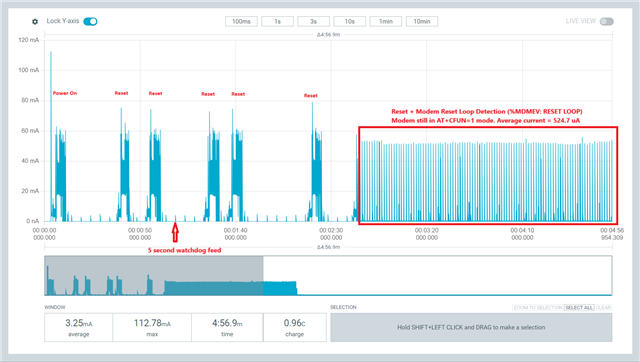
    I took some current measurements using a PPK2 while the modem reset loop detection mechanism was active and the modem was in AT+CFUN=1 mode. You can see from the screenshot below that each large spike of current is from me pushing the reset button on the nRF9151DK and the modem registering on the network. The small spikes are my 5 second watchdog feed, so ignore those. You can see the module enter PSM after every reset until the modem reset loop detection kicks in. At this point, the module has a large current spike every 1.28 seconds for what appears to be the entirety of the 30 minutes (I let it run for 11 minutes before stopping my capture).

    Averaging this current over ~3 minutes shows an average of 524.7 uA.

    My PSM floor current (Including the 5 second watchdog feed) is ~3.0 uA.

    524.7 uA is significant compared to 3.0 uA for an ultra-low power module that is blocked from network activity. The module appears to be in +CEREG: 2 (searching) mode during this lockout period.

    Ideally, the module should stop searching during this period. It would be great if I could put the module in airplane mode, proprietary PSM, or some ultra-low power mode during the 30-minute modem reset loop detection lockout period. Is this not possible?

    Also, I tested switching from AT+CFUN=1 and AT+CFUN=4 10 times back to back and this did not trigger the modem reset loop detection as expected.

    Thanks,

    Derek

Reply
  • Hey Øyvind,

    I took some current measurements using a PPK2 while the modem reset loop detection mechanism was active and the modem was in AT+CFUN=1 mode. You can see from the screenshot below that each large spike of current is from me pushing the reset button on the nRF9151DK and the modem registering on the network. The small spikes are my 5 second watchdog feed, so ignore those. You can see the module enter PSM after every reset until the modem reset loop detection kicks in. At this point, the module has a large current spike every 1.28 seconds for what appears to be the entirety of the 30 minutes (I let it run for 11 minutes before stopping my capture).

    Averaging this current over ~3 minutes shows an average of 524.7 uA.

    My PSM floor current (Including the 5 second watchdog feed) is ~3.0 uA.

    524.7 uA is significant compared to 3.0 uA for an ultra-low power module that is blocked from network activity. The module appears to be in +CEREG: 2 (searching) mode during this lockout period.

    Ideally, the module should stop searching during this period. It would be great if I could put the module in airplane mode, proprietary PSM, or some ultra-low power mode during the 30-minute modem reset loop detection lockout period. Is this not possible?

    Also, I tested switching from AT+CFUN=1 and AT+CFUN=4 10 times back to back and this did not trigger the modem reset loop detection as expected.

    Thanks,

    Derek

Children
No Data
Related