Weird schematic connection of TCK106AG on nRF52840DK schematics

Hi!

I have just received the nRF52840DK board and am currently perusing its schematics. Please don't be annoyed by my following question, but there are things I'm quite bewildered about.

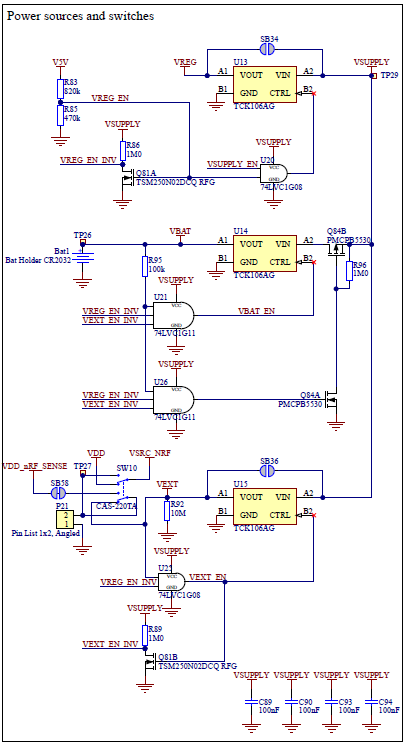
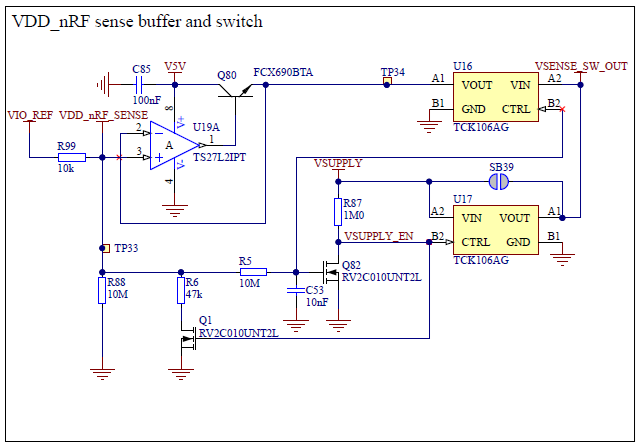
The schematics uses load switches TCK106AG. But sometimes they connected in a weird way. For example, U16 - this one is used in the part of VDD_nRF sense buffer. This buffer is definitely having the TP34 as output from emitter of bipolar transistor Q80, which is controlled by voltage from operational amplifier U19A - to create same voltage as the reference level VDD_nRF_SENSE. In this way Nordic implements 'repeater', so the generated voltage is of the same level as VDD_nRF_SENSE, while the actual power is drawn from the 5V rail. Here everything is clear, but then TP34 goes to OUT of TCK106AG (U16) and IN of TCK106AG (U16) goes to VSENSE_SW_OUT. By all logic at TP34 we have the generated voltage which must go to VSENSE_SW_OUT. But instead we have OUT and IN reversed. 

Same weird reversed connection is implemented on U13, U14, U15 where clearly by logic we see VREG, VBAT and VEXT are to be routed to output, to be merged at VSUPPLY. So logically, I'd expect VREG, VBAT, VEXT to be connected to IN pins on their respective TCK106AG-s, while OUTs to be merged into VSUPPLY. 

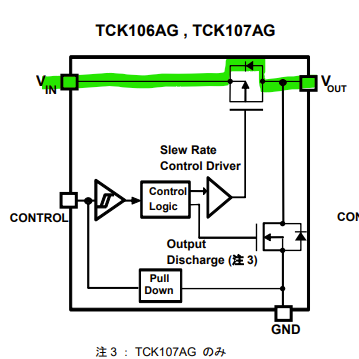
Is it some trick using TCK106AG, or TCK106AG is just a bidirectional device, so IN OUT are interchangeable? Though by TCK106AG's PDF, the IC uses a single P-Channel MOSFET which connects IN to OUT. As far as my knowledge lets me, a turned on MOSFET conducts from drain (D) to source (S). 

So I'm totally lost here. Please somebody explain what happens?
  

Parents
  • So, it looks like I'm kinda talking with myself, but maybe somebody will benefit from my reasoning. If I'm mistaken, kindly correct me.

    I have come to a great enlightenment about MOSFET transistors functioning. It comes out that MOSFET in the turned ON state has the SYMMETRICAL conductivity of the Source-Drain channel (yes, for me it was a revelation). If so, this explains everything.

    We must hold in mind, that MOSFET has a body diode (sometimes called a parasitic one) which is connected between Drain and Source (actually it is between Drain and Substrate, but since Source is connected to substrate also, so it is considered as a Source-Drain diode). In P-Channel MOSFET the body diode is such, that Source is cathode, and Drain is anode. Exactly such type of MOSFET is used in TCK106AG switches. Their VIN pin is connected to Source of MOSFET, and VOUT to the Drain.

    In normal use, when we connect Power source to VIN, and load to VOUT, we use TCK106AG as switch: when turned off (CTRL=0) the MOSFET is turned off, D-S channel is not present, body diode is reverse biased). When TCK106AG is turned on (CTRL=1) MOSFET turns ON, D-S channel opens, and Load (from VOUT) starts receiving power.

    But Nordic never intended to use it as switches in those cases. Like when it is needed to route multiple power sources to VSUPPLY: In this case Nordic guys do a trick and connect TCK106AG in the reverse manner. Initially, to a naked eye, it looks weird (as it was for me, total brain damage). But now it is clear: by connecting in reverse they reach 2 goals: multiplexing few power sources virtually without any loses and protecting the other not-used power sources from backward current. 

    The simple OR multiplexing could be schottki diodes - their anodes to VREG, VBAT and VEXT and cathodes to VSUPPLY. But diodes have voltage drop. So reverse TCK106AG are used: In this case, even in turned off state, thanks to the body diodes of their MOSFETS they conduct. Then VSUPPLY activates (never mind of some voltage drop on body diodes) from the most higher source and reverse biases other body diodes, thus protecting the other power sources. Then thanks to VSUPPLY presence, the corresponding TCK106AG is turned on. This opens the D-S channel, thus effectively lowers the voltage drop almost to 0 - no loses, everything is cool, the required power source is routed to VSUPPLY without voltage drops.

    The main point for P-channel MOSFETS, is that the turn-on gate potential must be always lower than the Source potential. Since source voltage in reverse TCK106AG connection is like VREG, VBAT or VEXT minus voltage drop on the body diode, then turning its MOSFET on still presents no troubles.

  • Indeed! The internal body diode is used to power VSUPPLY. That's needed to power the circuitry that turns on the switches:

    One could use another diode for this. But as you say, the MOSFET works both ways so using the switch "backwards" will save one diode.

Reply Children
Related