Channel Sounding Accuracy Issues nRF54L15-DK

Hello.

I am also currently working with two nRF54L15-DK kits with the nRF Connect SDK and Toolchain, both v3.0.2. I am using the latest updated examples from the SDK channel_sounding_ras_initiator and channel_sounding_ras_reflector.

I did several test runs while holding both devices stable at the same position and also while moving one over time. For all the test runs, the measurements are way off from what they should measure. Way off meaning:

Actual distance --> Measured distance (referring to the IFFT values)
0.3 m --> 0.45m up to 0.89m
0.5 m --> 0.47m up to 1.1m
1 m --> 1.6m up to 2m
(I can also provide more measurements, but I think this points out what I mean)

I also have the problem that the measurements are not stable even if they are fixated at the same position. I always measured for 2 minutes straight (getting a value every 5 seconds) and also tried different sliding windows (10, 50, 75, 100 samples per averaging), but it always varied by at least 10 cm up to 80 cm. (Depending on the distance)

I had seen the Nordic Demonstration (Youtube-Demo) beforehand, and there the accuracy and precision were way better.

Is it still an issue with the algorithm, as suggested by this post?
Do you have any tips on how to improve the sample project to get better accuracy? (Until now I have only changed the sliding window size as mentioned above.)

Thanks in advance for the help. 

Parents
  • Hi

    We are still in the process of improving and optimizing the channel sounding measurement procedure, so we don't have any guarantees for accuracy just yet I'm afraid. The accuracy will vary depending on a lot of factors, like environmental noise, line of sight, etc. 

    According to the Bluetooth SIG's marketing material, the Bluetooth Channel sounding is only typically able to achieve an accuracyt of +/- 50cm, so I would say your closest measurements look good at least. Can you share some more details on how you are testing this on your end, what environment etc. you're in?

    Best regards,

    Simon

  • Hello Simon. 

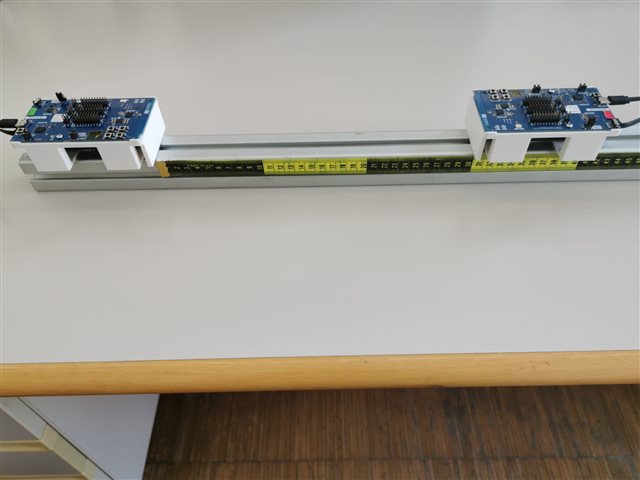
    We built a measurement station such that the devices will stay in place during measurements. (See picture) 
    The measurements took place in a “normal” indoor/office environment, I would say. 

    I was not aware of the +/- 50cm accuracy. I think I read that the accuracy should be up to +/- 10cm which would be much better. I also do not understand how the demonstration could have had so much better accuracy that what I am currently measuring. Can you give me some information what parameters were used during this demo? Or can you at least give me a hint which parameters I can take a closer look at? 

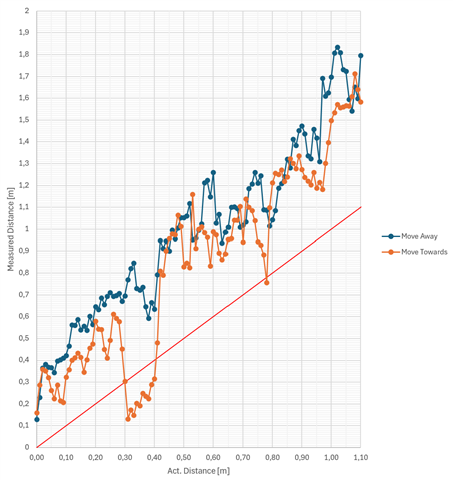
    I have also detected that even with a constant movement away from each other, the devices sometimes detect movements closer to each other. (See diagramm) Do you have any idea why this is happening? 


    Thanks in Advance,
    Tanja

Reply
  • Hello Simon. 

    We built a measurement station such that the devices will stay in place during measurements. (See picture) 
    The measurements took place in a “normal” indoor/office environment, I would say. 

    I was not aware of the +/- 50cm accuracy. I think I read that the accuracy should be up to +/- 10cm which would be much better. I also do not understand how the demonstration could have had so much better accuracy that what I am currently measuring. Can you give me some information what parameters were used during this demo? Or can you at least give me a hint which parameters I can take a closer look at? 

    I have also detected that even with a constant movement away from each other, the devices sometimes detect movements closer to each other. (See diagramm) Do you have any idea why this is happening? 


    Thanks in Advance,
    Tanja

Children
No Data
Related