Details of PPS when GNSS is disabled

In our application we need a PPS signal even when LTE is enabled (and GNSS is disabled).  The GNSS API gives some encouraging PPS info, stating "GNSS only starts giving pulses after it has got at least one fix. After this, the pulses will continue also when GNSS is no longer running, but the precision will start degrading."

That seems promising, but raises a couple of questions.

1. Just want to confirm that "when GNSS is no longer running" means PPS output can be maintained when LTE is enabled (and GNSS is disabled).

2. And how much can the precision be degraded?  This seems to be touched on in the same section of the GNSS API which states "In cases where GNSS is not running continuously, it may be beneficial to change the timing source used by GNSS during sleep periods, see Sleep timing source."

The Sleep Timing Source section suggests using the TCXO, which would be preferred.  But that raises some additional questions.

3. Presumably PPS accuracy will be defined by the timing source (preferably TCXO).  But what is the TCXO accuracy?  I couldn't find a spec in the datasheet.

4. The Sleep Timing Source section notes that (as expected) leaving the TCXO on will impact current consumption.  But what would be the expected TCXO current consumption?  Would it be expected to be as high as Igps_continuous (43.1mA typical)?

Parents
  • Hello, 

    1. Just want to confirm that "when GNSS is no longer running" means PPS output can be maintained when LTE is enabled (and GNSS is disabled).

    From the LTE coexistence interface chapter in the nRF9151 datasheet:

    COEX1 – Output from the LTE modem to the external device. When internal GPS is used, COEX1 delivers the GPS 1PPS (one pulse per second) time mark pulse. The 1PPS feature must not be used when LTE is enabled.

    2. And how much can the precision be degraded?  This seems to be touched on in the same section of the GNSS API which states "In cases where GNSS is not running continuously, it may be beneficial to change the timing source used by GNSS during sleep periods, see Sleep timing source."

    The Sleep Timing Source section suggests using the TCXO, which would be preferred.  But that raises some additional questions.


    That is correct. Significantly improved 1PPS accuracy, by orders of magnitude, can be achieved when the TCXO remains active during sleep mode.

    3. Presumably PPS accuracy will be defined by the timing source (preferably TCXO).  But what is the TCXO accuracy?  I couldn't find a spec in the datasheet.

    We don't disclose or guarantee the frequency stability of TCXO because the part numbers for TCXO often change even during the lifetime of single product. But here is a typical data sheet from a TCXO we've used 

    Assuming stable room temperature conditions, stable supply voltage etc. the frequency error of the TCXO is no greater than 1.5ppm. This corresponds to 1.5 us error per second of wall clock time. This equals to about 5ms per minute. Note that this is the worst case scenario where the frequency error is constantly at the maximum level permitted by the data sheet. Usually components behave better that this because a component not meeting the data sheet performance would be considered defective. So you can consider this number as a rough upper limit for the 1PPS error when GNSS is sleeping and TCXO cannot be disciplined from GNSS fixes.

    4. The Sleep Timing Source section notes that (as expected) leaving the TCXO on will impact current consumption.  But what would be the expected TCXO current consumption?  Would it be expected to be as high as Igps_continuous (43.1mA typical)?
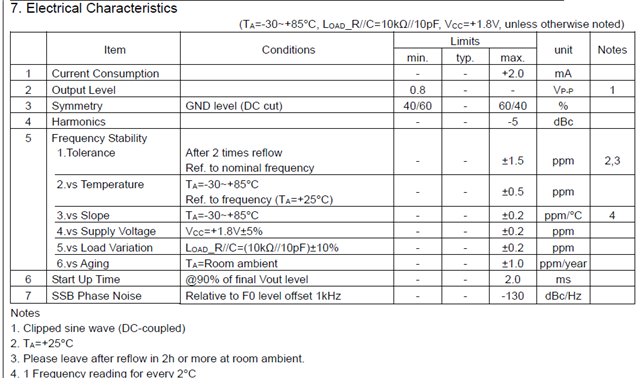
    According to same datasheet the current consumption should be round 2mA @ 1.8V

    Let me know how that works for you!

    Kind regards,
    Øyvind

Reply
  • Hello, 

    1. Just want to confirm that "when GNSS is no longer running" means PPS output can be maintained when LTE is enabled (and GNSS is disabled).

    From the LTE coexistence interface chapter in the nRF9151 datasheet:

    COEX1 – Output from the LTE modem to the external device. When internal GPS is used, COEX1 delivers the GPS 1PPS (one pulse per second) time mark pulse. The 1PPS feature must not be used when LTE is enabled.

    2. And how much can the precision be degraded?  This seems to be touched on in the same section of the GNSS API which states "In cases where GNSS is not running continuously, it may be beneficial to change the timing source used by GNSS during sleep periods, see Sleep timing source."

    The Sleep Timing Source section suggests using the TCXO, which would be preferred.  But that raises some additional questions.


    That is correct. Significantly improved 1PPS accuracy, by orders of magnitude, can be achieved when the TCXO remains active during sleep mode.

    3. Presumably PPS accuracy will be defined by the timing source (preferably TCXO).  But what is the TCXO accuracy?  I couldn't find a spec in the datasheet.

    We don't disclose or guarantee the frequency stability of TCXO because the part numbers for TCXO often change even during the lifetime of single product. But here is a typical data sheet from a TCXO we've used 

    Assuming stable room temperature conditions, stable supply voltage etc. the frequency error of the TCXO is no greater than 1.5ppm. This corresponds to 1.5 us error per second of wall clock time. This equals to about 5ms per minute. Note that this is the worst case scenario where the frequency error is constantly at the maximum level permitted by the data sheet. Usually components behave better that this because a component not meeting the data sheet performance would be considered defective. So you can consider this number as a rough upper limit for the 1PPS error when GNSS is sleeping and TCXO cannot be disciplined from GNSS fixes.

    4. The Sleep Timing Source section notes that (as expected) leaving the TCXO on will impact current consumption.  But what would be the expected TCXO current consumption?  Would it be expected to be as high as Igps_continuous (43.1mA typical)?

    According to same datasheet the current consumption should be round 2mA @ 1.8V

    Let me know how that works for you!

    Kind regards,
    Øyvind

Children
No Data
Related