Real-Time Requirements | EasyDMA

Hello Nordic,

I am developing for a project that requires real-time accuracy. We are using ncs v2.9.1 Zephyr, an nRF54L15 and an IMU (w/ SPI interface) to acquire positional data. 

An observed issue is that we cannot reliably sample our IMU during BLE communications due to BLE interrupts. The interrupts prevent our main CPU thread and block us from calling spi_transceive_dt(). Because the IMU is tracking real-time data, any missed communications with the IMU cause significant accuracy loss in our system.

In theory, this should be solvable if we can use the DMA to cyclically service and buffer IMU communications. From the examples on the forum, I have found no other posts that contain this use case and as such no suitable answers. From my understanding the SPI peripheral is intrinsically using EasyDMA, but I cannot tell how to take advantage of this. Is it assumed while calling spi_transceive_dt() other threads can be run during this function call? If so, is there a way to schedule a SPI transceive that will not get interrupted by Bluetooth communication? 

Is this problem solvable using EasyDMA or otherwise?

Thank you,
Levi

  • Hello,

    Yes, the reason is probably the external flash chip on the DK, which is controlled by the SPI. 

    If you look in the NCS v2.9.1\zephyr\boards\nordic\nrf54l15dk\nrf54l_05_10_15_cpuapp_common.dtsi, you can see that the default configuration for SPI00 is:

    &spi00 {
    	status = "okay";
    	cs-gpios = <&gpio2 5 GPIO_ACTIVE_LOW>;
    	pinctrl-0 = <&spi00_default>;
    	pinctrl-1 = <&spi00_sleep>;
    	pinctrl-names = "default", "sleep";
    
    	mx25r64: mx25r6435f@0 {
    		compatible = "jedec,spi-nor";
    		status = "okay";
    		reg = <0>;
    		spi-max-frequency = <8000000>;
    		jedec-id = [c2 28 17];
    		sfdp-bfp = [
    			e5 20 f1 ff  ff ff ff 03  44 eb 08 6b  08 3b 04 bb
    			ee ff ff ff  ff ff 00 ff  ff ff 00 ff  0c 20 0f 52
    			10 d8 00 ff  23 72 f5 00  82 ed 04 cc  44 83 48 44
    			30 b0 30 b0  f7 c4 d5 5c  00 be 29 ff  f0 d0 ff ff
    		];
    		size = <67108864>;
    		has-dpd;
    		t-enter-dpd = <10000>;
    		t-exit-dpd = <35000>;
    	};
    };

    meaning, SPI00 is enabled, and it is used for the mx25r6435f, which is the external flash chip.

    So to fix this, either disable spi00's mx25r64, so that it is not used for the external flash chip (because then it will be enabled), or use another SPI instance in your application.

    To disable the mx25r64 please add this to your .overlay (near the top):

    /delete-node/ &mx25r64;

    Best regards,

    Edvin

  • Hello Edvin,

    I have made progress in implementing this interface, but found some confusing behavior. First when looking into the nrfx_spim.h file, for NRFX_SPIM_FLAG_HOLD_XFER, it states "Chip select must be configured to @ref NRF_SPIM_PIN_NOT_CONNECTED and managed outside the driver." What does this mean? Am I expected to setup a GPIO to also be triggered via GPPI for my SPI driver separately.

    Second, I was able to setup the GPPI interface correctly, but I am using GPIOTE instead of the timer. Our IMUs have an interrupt line which are triggered cyclically, so it serves the same purpose. The problem I am having is that when I try to schedule a repeated transfer to be used on each GPIOTE interrupt, the full SPI MOSI transmission is not being sent. Any ideas?

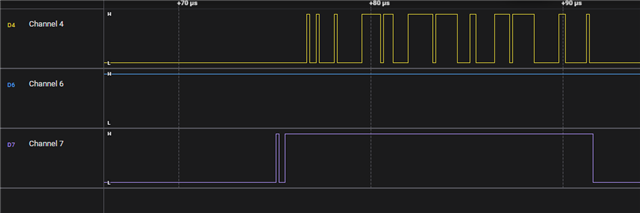
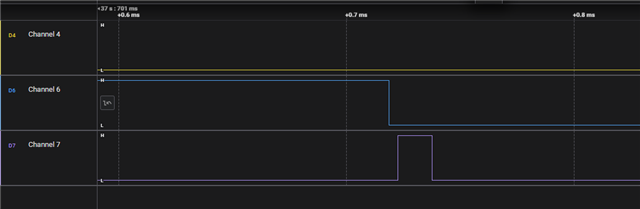
    Here are some waveforms:

    Channel 4 (Yellow): SPI MISO

    Channel 6 (Blue): IMU Interrupt Line

    Channel 7 (Purple): SPI MOSI

    (Previous) Healthy SPI Communication (Polled) with No Interrupts 

    (Current) IMU Interrupt GPIOTE Triggered SPI Communication  

    From above, it seems my GPIOTE linkage with the GPPI interface is working: every IMU interrupt is followed by an attempted SPI transmission. The SPI transmission is only a high for a few moments, and then low. It should be sending the value 0x8C = 0b1000 1100. See code below:

    static void setupSPITrigger() {
        // Prepare Configuration
        // Note: SPI CS is Floating for Repeated Automatic Transfer
        nrfx_spim_config_t spiConfig = {
            .sck_pin = SPI_CLK_PIN_201,
            .mosi_pin = SPI_MOSI_PIN_202,
            .miso_pin = SPI_MISO_PIN_204,
            .ss_pin = NRF_SPIM_PIN_NOT_CONNECTED,
            .ss_active_high = false,
            .irq_priority = NRFX_SPIM_DEFAULT_CONFIG_IRQ_PRIORITY,
            .orc = 0xFF,
            .frequency = NRFX_MHZ_TO_HZ(8),
            .mode = NRF_SPIM_MODE_0,
            .bit_order = NRF_SPIM_BIT_ORDER_MSB_FIRST,
            .miso_pull = NRF_GPIO_PIN_NOPULL,
            .ss_duration = 5UL,
            .dcx_pin = NRF_SPIM_PIN_NOT_CONNECTED,
            .use_hw_ss = false,  // TODO LR: Not sure if this should be true
            .rx_delay = 2UL,
        };
    
        // Perform Reconfigure
        nrfx_err_t err = nrfx_spim_reconfigure(&spiDev, &spiConfig);
        if (err != NRFX_SUCCESS) {
            printk("[SPI] FAILURE: Reconfiguration Failed\n");
            uPbit.SPI = FAIL;
            return;
        }
    
        // Setup Buffer for Transfers
        txBuffer[0] = (uint8_t)(0x0C | 0x80);
        nrfx_spim_xfer_desc_t spiTransferBuffer = NRFX_SPIM_XFER_TRX(txBuffer, 1,
                                                                     rxBuffer, 17);
    
        // Setup the Following Flags
        // NRFX_SPIM_FLAG_RX_POSTINC - Increments RX buffer address after transceive. Allows for repeated reads w/ same buf
        // NRFX_SPIM_FLAG_NO_XFER_EVT_HANDLER - Does not trigger an interrupt after transfer.
        // NRFX_SPIM_FLAG_HOLD_XFER - Sets up the transceive, but doesn't actually perform the transceive.
        // NRFX_SPIM_FLAG_REPEATED_XFER - Prepares for multiple transceives.
        uint32_t spiFlags = NRFX_SPIM_FLAG_RX_POSTINC | NRFX_SPIM_FLAG_NO_XFER_EVT_HANDLER |
                            NRFX_SPIM_FLAG_HOLD_XFER | NRFX_SPIM_FLAG_REPEATED_XFER;
    
        // Setup Transfer
        err = nrfx_spim_xfer(&spiDev, &spiTransferBuffer, spiFlags);
        if (err != NRFX_SUCCESS) {
            printk("[SPI] FAILURE: Transfer Setup Failed\n");
            uPbit.SPI = FAIL;
            return;
        }
    
        printk("[SPI] NRFX SPIM Setup for Repeated Transfer");
    }

    /********************************************************************************************/  /**
     *  <!-- Function Name: XXXX()  -->
     *  @brief
     *
     *************************************************************************************************/
    static void setupGPIOTE() {
        nrfx_err_t err;
    	uint8_t imuGPIOChannel;
    
    	// /* Connect GPIOTE instance IRQ to irq handler */
    	// IRQ_CONNECT(DT_IRQN(GPIOTE_NODE), DT_IRQ(GPIOTE_NODE, priority), nrfx_isr,
    	// 	    NRFX_CONCAT(nrfx_gpiote_, GPIOTE_INST, _irq_handler), 0);
    
    	/* Initialize GPIOTE (the interrupt priority passed as the parameter
    	 * here is ignored, see nrfx_glue.h).
    	 */
        // Initialize GPIOTE
        // NRFX_GPIOTE_DEFAULT_CONFIG_IRQ_PRIORITY
    	err = nrfx_gpiote_init(&gpioteDev, 0);
    	if (err != NRFX_SUCCESS && err != NRFX_ERROR_ALREADY) {
    		printk("nrfx_gpiote_init error: 0x%08X", err);
    		return;
    	}
    
    	err = nrfx_gpiote_channel_alloc(&gpioteDev, &imuGPIOChannel);
    	if (err != NRFX_SUCCESS) {
    		printk("Failed to allocate in_channel, error: 0x%08X", err);
    		return;
    	}
    
    	/* Initialize input pin to generate event on high to low transition
    	 * (falling edge) and call button_handler()
    	 */
    	static const nrf_gpio_pin_pull_t gpioPinConfig = NRF_GPIO_PIN_PULLUP;
    	nrfx_gpiote_trigger_config_t triggerConfig = {
    		.trigger = NRFX_GPIOTE_TRIGGER_HITOLO,
    		.p_in_channel = &imuGPIOChannel,
    	};
    	nrfx_gpiote_input_pin_config_t gpioteConfig = {
    		.p_pull_config = &gpioPinConfig,
    		.p_trigger_config = &triggerConfig,
    		.p_handler_config = NULL,
    	};
    
    	err = nrfx_gpiote_input_configure(&gpioteDev, GPIO_IMU_PIN, &gpioteConfig);
    	if (err != NRFX_SUCCESS) {
    		printk("nrfx_gpiote_input_configure error: 0x%08X", err);
    		return ;
    	}
    }
    
    /********************************************************************************************/  /**
     *  <!-- Function Name: XXXX()  -->
     *  @brief
     *
     *************************************************************************************************/
    static void setupGPPI() {
        nrfx_err_t err;
        uint8_t gppiChannel;
    
        // Allocate GPPI Channel
        err = nrfx_gppi_channel_alloc(&gppiChannel);
        printk("[SPI] NRFX GPPI Channel: %s\n", (err == NRFX_SUCCESS) ? "initialized" : "not initialized");
    
        // Connect GPIOTE to SPI Event Task
        nrfx_gppi_channel_endpoints_setup(gppiChannel,
    		nrfx_gpiote_in_event_address_get(&gpioteDev, GPIO_IMU_PIN),
    		nrfx_spim_start_task_address_get(&spiDev));
    
        // Enable GPPI Channel
        nrfx_gppi_channels_enable(BIT(gppiChannel));
        nrfx_gpiote_trigger_enable(&gpioteDev, GPIO_IMU_PIN, true);
    }
    

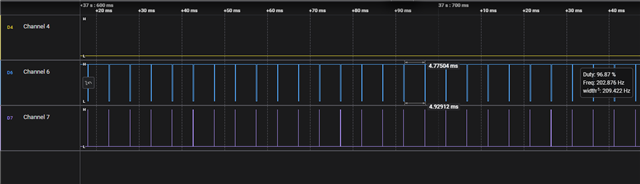
  • Here is a zoomed out picture of the GPIOTE working with SPI. 

  • Update on this, I realized that my logic analyzer was sampling at 6.25 Mb/s while the SPI bus is operating at 8MHz, so the communication is fine. The logic displayer was just aliasing data. At the moment, I have most of the driver working with the following two GPPI pipelines.

    GPIOTE --> GPPI --> SPI Transfer   

    then     

    SPI End Event --> GPPI --> Timer (Counter) --> Interrupt (Reset DMA List Rx Buffer Pointer)

    Despite the above, I am still unsure how the chip select is intended to be setup for this. The header file cryptically states that it must be handled outside the driver... Are we intended to use the fork functionality to trigger a GPIO low whenever we intend to perform a SPI Transfer?

    Additionally, I found a few interesting forum posts that stated there is no way for the SPI Transfer from GPPI to know when the DMA List (which is what is being used underneath) is full. As such, the DMA list's Rx Buffer must be regularly serviced otherwise a crash WILL occur. I find this to be very odd design... My intent with this feature overall was to mitigate data loss during Bluetooth disconnections which I believe to be as long as 5 seconds. 

    Pondering this scenario, for the data collected, there are 17 bytes of data sampled at 200Hz for 5 seconds. This means for a buffer to not fill up during one of these disconnections we would need:

    17bytes * 200Hz *  5 seconds = 17,000 byte

    Moreover, to use the data in the buffers, it seems most convenient to double buffer all the data versus ring the buffer. Ringing the buffer poses the risk of overflow if a Bluetooth interrupt occurs that blocks the processor from ringing the buffer and thus, the DMA list overruns the buffer it is selected...

    So, double buffering requires twice the amount of bytes: 34,000 ~= 34kB.

    From my pipeline, the last step (the counter interrupt) is intended to reset the buffer as quickly possible once the processor is no longer blocked by Bluetooth interrupts. The device overflowing its memory and crashing is not tolerable in my application.

    None of this seems to be clearly documented, so I am piecing together what I can from forum posts. Is this the intended way for these peripherals to function?

  • For the CSN pin this can't be controlled by GPPI. Do you have any other devices on the SPI bus? Is it an alternative to just set it before you start your 5 second routine, and then unset it after it is done?

    Best regards,

    Edvin

Related