Real-Time Requirements | EasyDMA

Hello Nordic,

I am developing for a project that requires real-time accuracy. We are using ncs v2.9.1 Zephyr, an nRF54L15 and an IMU (w/ SPI interface) to acquire positional data. 

An observed issue is that we cannot reliably sample our IMU during BLE communications due to BLE interrupts. The interrupts prevent our main CPU thread and block us from calling spi_transceive_dt(). Because the IMU is tracking real-time data, any missed communications with the IMU cause significant accuracy loss in our system.

In theory, this should be solvable if we can use the DMA to cyclically service and buffer IMU communications. From the examples on the forum, I have found no other posts that contain this use case and as such no suitable answers. From my understanding the SPI peripheral is intrinsically using EasyDMA, but I cannot tell how to take advantage of this. Is it assumed while calling spi_transceive_dt() other threads can be run during this function call? If so, is there a way to schedule a SPI transceive that will not get interrupted by Bluetooth communication? 

Is this problem solvable using EasyDMA or otherwise?

Thank you,
Levi

Parents
  • Hello,

    At what speed/rate are you reading the IMU? And how many readings are you missing due to BLE events?

    If you want to look into DMA, you can have a look at this ticket, which discusses this:

     NRF54L15DK unable to use NRFX_SPIM_FLAG_TX_POSTINC flag in nrfx_spim_xfer API 

    Alternatively, there is an option to use PPI (Programmable peripheral interface). This way, you can connect events in one peripheral to a task in another. In your case, you would typipcally connect a timer event to the PPI, and you can trigger a transceive command from there.

    As an example, you can look at how the sample found in NCS\modules\hal\nordic\nrfx\samples\src\nrfx_ppi

    This uses a timer to toggle a GPIO, but you can replace the GPIO with any peripheral.

    You can see that this sample uses nrfx_giote_out_task_address_get() to find the address of the task in the GPIO. The equivavalent function for SPI is found in ncs\modules\hal\nordic\nrfx\drivers\include\nrfx_spim.h. Search for "address_get(" in that file, and you should find the ones that you need.

    Best regards,

    Edvin

  • Hi Edvin,

    Thanks for your response. The IMU is being sampled every 5ms and for missed readings, this can vary. Depending on the connection quality, we have missed over 100ms of data. Losing 1-2 samples can be impactful to our system accuracy.

    Thank you for your suggestion about the PPI as a solution. I agree it appears to have the functionality required. I will be traveling for business this next week, so I am unable to test my code. I will provide an update for other visitors of this thread and will fully respond late next week. 

    Looking over the example you suggested, I have found the functions you described:

    nrfx_spim_start_task_address_get()
    nrfx_spim_end_event_address_get()
    For the first function, I have the following code which links the timer to the SPI peripheral using the GPPI channel.
    nrfx_gppi_channel_endpoints_setup(gppiChannel, 
            nrfx_timer_compare_event_address_get(&timerDev, NRF_TIMER_CC_CHANNEL0),
            nrfx_spim_start_task_address_get(&spiDev));
    For the second function, the documentation suggests that you can use it to determine the number of events but does not go into detail. I am assuming you can calculate a delta?
    printk("Address Difference %d \n", nrfx_spim_end_event_address_get(&spiDev) - 
        nrfx_spim_start_task_address_get(&spiDev));
    The last puzzle piece is setting up the cyclical SPI transfer. The nrfx_spim_xfer() documentation goes into great detail which is nice. 
    static void prepareSPITransfer() {
        nrfx_err_t err;
        // Setup Buffer for Transfers
        nrfx_spim_xfer_desc_t spiTransferBuffer = NRFX_SPIM_XFER_TRX(txBuffer, sizeof(txBuffer), 
                                                                     rxBuffer, sizeof(rxBuffer));
        
        // Setup the Following Flags
        // NRFX_SPIM_FLAG_RX_POSTINC - Increments RX buffer address after transceive. Allows for repeated reads w/ same buf
        // NRFX_SPIM_FLAG_NO_XFER_EVT_HANDLER - Does not trigger an interrupt after transfer.
        // NRFX_SPIM_FLAG_HOLD_XFER - Sets up the transceive, but doesn't actually perform the transceive.
        // NRFX_SPIM_FLAG_REPEATED_XFER - Prepares for multiple transceives.
        uint32_t spiFlags = NRFX_SPIM_FLAG_RX_POSTINC | NRFX_SPIM_FLAG_NO_XFER_EVT_HANDLER | 
                            NRFX_SPIM_FLAG_HOLD_XFER | NRFX_SPIM_FLAG_REPEATED_XFER;
        
        // Setup Transfer
        err = nrfx_spim_xfer(&spiDev, &spiTransferBuffer, spiFlags);
        printk("SPIM Tansfer: %s\n", (err == NRFX_SUCCESS) ? "setup" : "not setup");
    }
    Most of the setup seems to be in the flags and how they operate. 

    All other code seems to be copy/paste from the GPIOTE example you suggested.

    Regards,

    Levi

  • Hi Edvin,


    The bus is serviced every 5ms, so setting and unsetting manually is not ideal.

    It looks like you can set multiple channels from the same event. I was thinking of the following:

    First,

    IMU Interrupt (GPIOTE)  ---> GPPI Channel --->  SPI Transmission Start

                                           ----> GPPI Channel ---> Chip Select High-to-Low (GPIOTE)

    Then,

    SPI Transmission End ----> GPPI Channel ---> Chip Select Low-to-High (GPIOTE)


    Would this work reliably?                

  • That is up to you to test. The last one (hooked on the SPI Transmission End) is fine. The question is whether or not it is enough to set the CSN pin at the same time as you start the transmission. Is it enough for the SPI slave to react to it? Does it behave the way you want when you do it this way?

    If not, you probably need to set it a little bit sooner. Perhaps you need to include a timer, first set the CSN, start the timer, and when the timer reaches a certain value, then start the SPI transmission.

    Best regards,

    Edvin

  • Ok, thank you for the instruction.

    One final question: When testing the module, I did not do as the driver instructed. The driver states to leave "Chip select must be configured to @ref NRF_SPIM_PIN_NOT_CONNECTED and managed outside the driver."  Instead, I configured it to pin 69. See below.

    #define SPI_CLK_PIN_201      65
    #define SPI_MOSI_PIN_202     66
    #define SPI_MISO_PIN_204     68
    #define SPI_CS_PIN_205       69
    #define SPI_INSTANCE_IDX     00
    const nrfx_spim_t spiDev = NRFX_SPIM_INSTANCE(SPI_INSTANCE_IDX);
    
    nrfx_spim_config_t spiConfig = {
            .sck_pin = SPI_CLK_PIN_201,
            .mosi_pin = SPI_MOSI_PIN_202,
            .miso_pin = SPI_MISO_PIN_204,
            .ss_pin = SPI_CS_PIN_205,
            .ss_active_high = false,
            .irq_priority = NRFX_SPIM_DEFAULT_CONFIG_IRQ_PRIORITY,
            .orc = 0x00,
            .frequency = NRFX_MHZ_TO_HZ(8),
            .mode = NRF_SPIM_MODE_0,
            .bit_order = NRF_SPIM_BIT_ORDER_MSB_FIRST,
            .miso_pull = NRF_GPIO_PIN_NOPULL,
            .ss_duration = 5UL,
            .dcx_pin = NRF_SPIM_PIN_NOT_CONNECTED,
            .use_hw_ss = true,  // TODO LR: Not sure if this should be true
            .rx_delay = 2UL,
        };
    
        // Perform Reconfigure
        nrfx_err_t err = nrfx_spim_reconfigure(&spiDev, &spiConfig);
        if (err != NRFX_SUCCESS) {
            printk("[SPI] FAILURE: Reconfiguration Failed\n");
        }

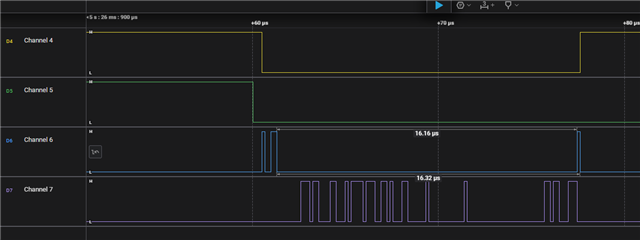
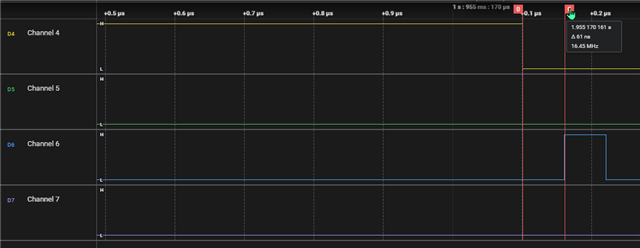
    Despite this, the device seems to operate fine. When scoping the lines, the CS functions appropriately. Is there any consequence or negative side effect if I keep it this way? Why does this work?

    Channel 4 (Yellow) - SPI CS

    Channel 5 (Green) - IMU Interrupt

    Channel 6 (Blue) - SPI MOSI

    Channel 7 (Purple) - SPI MISO

  • I guess the SPIS device that you are using accepts that the CS pin is set at the same time as the MOSI starts outputting data. Some devices uses this as a wakeup source to trigger some task, and is not ready to receive data before a certain amount of time has passed. 

    How do you trigger the CS pin? Is it being done by the driver, or do you do it using the fork and PPI?

    BR,

    Edvin

  • Yes, that makes sense. my device only needs 40ns for CS setup/hold time. Upon closer inspection of the waveform there is a 60ns hold time.


    For my code, the CS is being trigger by the driver. Is the CS being triggered (almost) at the same time as the MOSI why the documentation states to handle the CS outside the driver? Can I leave it like this?

Reply
  • Yes, that makes sense. my device only needs 40ns for CS setup/hold time. Upon closer inspection of the waveform there is a 60ns hold time.


    For my code, the CS is being trigger by the driver. Is the CS being triggered (almost) at the same time as the MOSI why the documentation states to handle the CS outside the driver? Can I leave it like this?

Children
Related