Hi all,
I'm trying to use SPI Slave on a proprietary Hardware that use Ezurio BL54L15 (that contain a Nordic nRF54L15 chip). The environment is VSC + nRF Connect SDK 3.1.1.
As a first step I got the example from https://github.com/too1/ncs-spi-master-slave-example using only the slave part (the master is another MCU on our board).
I configured SPIS to use the dedicated pin on Port 2 (clk, MISO, MOSI and another pin for CSN).
What I can see is SPIS driver is waiting for EVENTS_END by Easy DMA that never comes. Looking with a debugger seems that SPIS configuration is ok (PSEL and DMA). If I generate the event with the debugger the SPIS driver respond correctly
CLK and MISO are working, I can see the default char going out with an oscilloscope; CSN seems to be ignored by the SPIS/EasyDMA; MOSI I don't know, never see a rx char coming.
So I went using the Development kit Ezurio DVK BL54L15 (that is similar to nRF54L15 DK) to see if could be some trouble with our hardware.
This time I used the SPI master slave example as is, without modification.
I only added a nrf54l15dk_nrf54l15_cpuapp.overlay (the 54l15 was not in the example)
&pinctrl {
	spi_master_default: spi_master_default {
		group1 {
			psels = <NRF_PSEL(SPIM_SCK, 0, 3)>,
					<NRF_PSEL(SPIM_MOSI, 0, 0)>,
					<NRF_PSEL(SPIM_MISO, 0, 1)>;
		};
	};

	spi_master_sleep: spi_master_sleep {
		group1 {
			psels = <NRF_PSEL(SPIM_SCK, 0, 3)>,
					<NRF_PSEL(SPIM_MOSI, 0, 0)>,
					<NRF_PSEL(SPIM_MISO, 0, 1)>;
			low-power-enable;
		};
	};

	spi_slave_default: spi_slave_default {
		group1 {
			psels = <NRF_PSEL(SPIS_SCK, 2, 6)>,
					<NRF_PSEL(SPIS_MOSI, 2, 9)>,
					<NRF_PSEL(SPIS_MISO, 2, 8)>,
					<NRF_PSEL(SPIS_CSN, 2, 10)>;
			// psels = <NRF_PSEL(SPIS_SCK, 2, 1)>,
			// 		<NRF_PSEL(SPIS_MOSI, 2, 4)>,
			// 		<NRF_PSEL(SPIS_MISO, 2, 2)>,
			// 		<NRF_PSEL(SPIS_CSN, 2, 0)>;
		};
	};

	spi_slave_sleep: spi_slave_sleep {
		group1 {
			psels = <NRF_PSEL(SPIS_SCK, 2, 6)>,
					<NRF_PSEL(SPIS_MOSI, 2, 9)>,
					<NRF_PSEL(SPIS_MISO, 2, 8)>,
					<NRF_PSEL(SPIS_CSN, 2, 10)>;
			// psels = <NRF_PSEL(SPIS_SCK, 2, 1)>,
			// 		<NRF_PSEL(SPIS_MOSI, 2, 4)>,
			// 		<NRF_PSEL(SPIS_MISO, 2, 2)>,
			// 		<NRF_PSEL(SPIS_CSN, 2, 0)>;
			low-power-enable;
		};
	};
};

my_spi_master: &spi30 {
	compatible = "nordic,nrf-spim";
	status = "okay";
	pinctrl-0 = <&spi_master_default>;
	pinctrl-1 = <&spi_master_sleep>;
	pinctrl-names = "default", "sleep";
	cs-gpios = <&gpio0 2 GPIO_ACTIVE_LOW>;
	reg_my_spi_master: spi-dev-a@0 {
		reg = <0>;
	};
	/delete-property/ rx-delay-supported;
	/delete-property/ rx-delay;
};

my_spi_slave: &spi00 {
	compatible = "nordic,nrf-spis";
	status = "okay";
	pinctrl-0 = <&spi_slave_default>;
	pinctrl-1 = <&spi_slave_sleep>;
	pinctrl-names = "default", "sleep";
	def-char = <0x33>;
	/delete-property/ rx-delay-supported;
	/delete-property/ rx-delay;
};

&pwm20 {
	status = "disabled";
};
&uart00 {
	status = "disabled";
};
&uart20 {
	status = "disabled";
};
&uart30 {
	status = "disabled";
};
&nfct {
	status = "disabled";
};
&temp {
	status = "disabled";
};
&adc {
	status = "disabled";
};
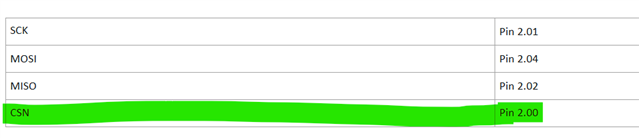
I tested using SPIS00 (or SPIS20) and pin equal to our board:
|
SCK |
Pin 2.01 |
|
MOSI |
Pin 2.04 |
|
MISO |
Pin 2.02 |
|
CSN |
Pin 2.00 |
I got the same behaviour, SPIS is stuck waiting EVENTS_END from Easy DMA
Then I tested using SPIS00 (or SPIS21) and pin
|
SCK |
Pin 2.06 |
|
MOSI |
Pin 2.09 |
|
MISO |
Pin 2.08 |
|
CSN |
Pin 2.10 |
This works fine, I can receive char from master correctly.
SPI RX: 0x00, 0x2d
SPI SLAVE RX: 0x2d, 0x00
SPI SLAVE TX: 0x00, 0x2e
SPI TX: 0x2e, 0x00
[00:00:46.012,517] <dbg> spi_nrfx_spim: spi_context_buffers_setup: tx_bufs 0x20002a20 - rx_bufs 0x20002a10 - 1
[00:00:46.012,530] <dbg> spi_nrfx_spim: spi_context_buffers_setup: current_tx 0x20002a28 (1), current_rx 0x20002a18 (1), tx buf/len 0x2000113c/2, rx buf/len 0x20001138/2
[00:00:46.012,567] <dbg> spi_nrfx_spim: spi_context_update_tx: tx buf/len 0/0
[00:00:46.012,576] <dbg> spi_nrfx_spim: spi_context_update_rx: rx buf/len 0/0
[00:00:46.012,585] <dbg> spi_nrfx_spim: finish_transaction: Transaction finished with status 0
SPI RX: 0x00, 0x2e
SPI SLAVE RX: 0x2e, 0x00
SPI SLAVE TX: 0x00, 0x2f
SPI TX: 0x2f, 0x00
[00:00:47.012,751] <dbg> spi_nrfx_spim: spi_context_buffers_setup: tx_bufs 0x20002a20 - rx_bufs 0x20002a10 - 1
[00:00:47.012,762] <dbg> spi_nrfx_spim: spi_context_buffers_setup: current_tx 0x20002a28 (1), current_rx 0x20002a18 (1), tx buf/len 0x2000113c/2, rx buf/len 0x20001138/2
[00:00:47.012,799] <dbg> spi_nrfx_spim: spi_context_update_tx: tx buf/len 0/0
[00:00:47.012,808] <dbg> spi_nrfx_spim: spi_context_update_rx: rx buf/len 0/0
[00:00:47.012,817] <dbg> spi_nrfx_spim: finish_transaction: Transaction finished with status 0
So the question is, why I can't use pin 00-04 of port 2 but I can use pin 06-10 of the same port? The are some limitation? But in this case why are not documented? I need some extra configuration that I miss? But in example + DK the configuration is the same.
Last note:
Also using
CONFIG_SPI_LOG_LEVEL_DBG=y
I can't get any debug message from SPIS library code, but I get from SPIM. Do I need a different flag to configure this?
Thanks,
Pier