PPK2 Measurement Issue

Hi,


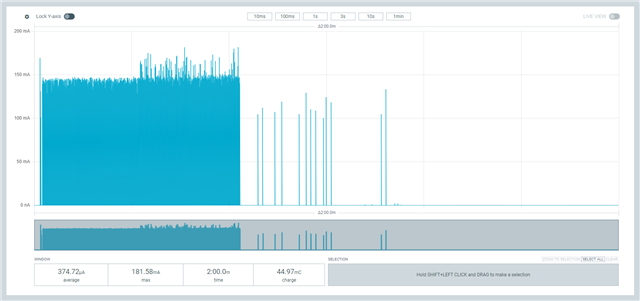
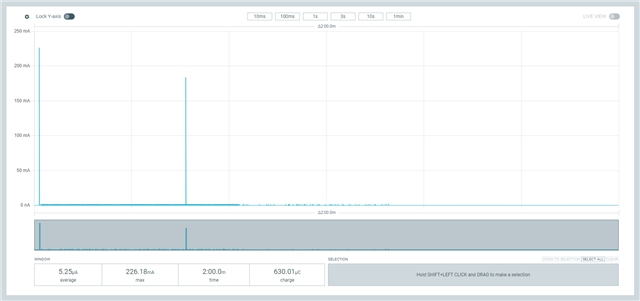
I have two PPK2 units, and under the exact same test environment and PPK2 settings, simply swapping the PPK2 results in completely different measurement results.
Which PPK2 should I trust, and what should I do with the other one?
Thanks!

PPK2-1
PPK2-2
Parents
  • Hi,

    I don't have any explanation as to why on might seem to fail, but I guess you need to find out if the difference is in ampere mode or supply mode or both. And if it's specific ranges that one fail while the other doesn't. I guess you in either cases need something to compare with, e.g. some static current you have measured using a different tool for comparison. You can find the ranges and expected accuracy here:
    https://docs.nordicsemi.com/bundle/ug_ppk2/page/UG/ppk/ppk_measure_accuracy.html 

    Kenneth

  • Hi,

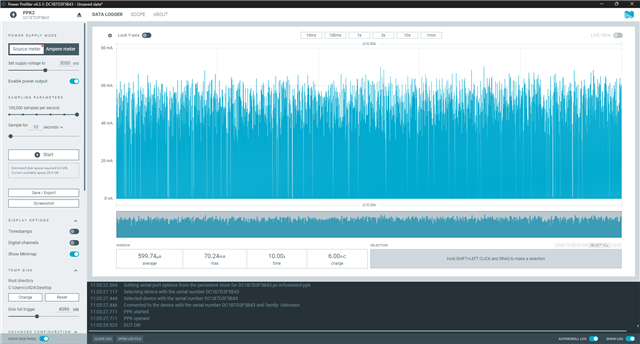
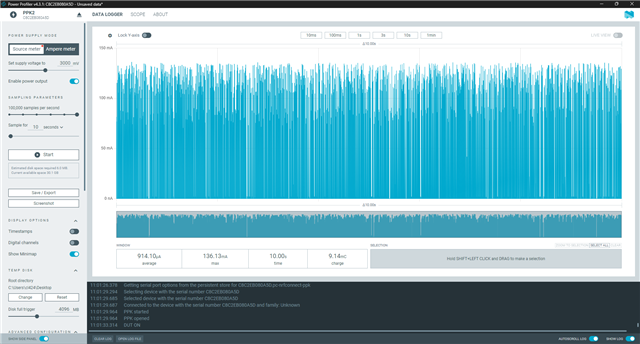
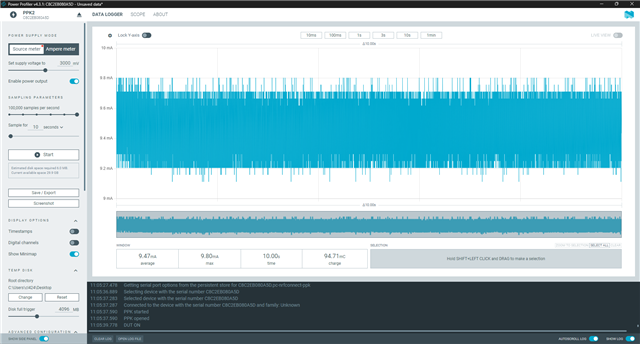
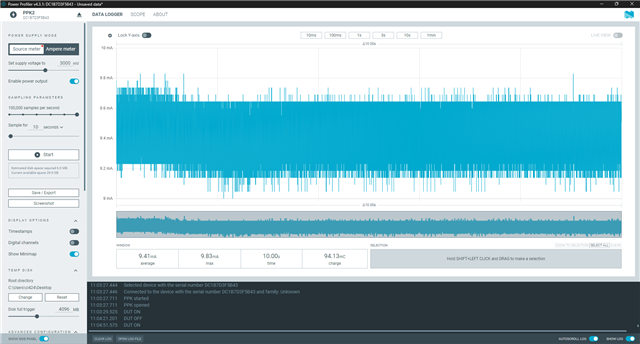
    I followed your suggestion and compared Ampere mode with Source mode.

    The table below shows the 10-second average values.

      Source Ampere
    PPK2-1 DUT 599.74uA 780.86uA
    E-Load 9.41mA 9.47mA
    PPK2-1 DUT 914.1uA 1.19mA
    E-Load 9.47mA 9.54mA

    I found that when using an e-load, the measurement results are quite similar.
    However, when switching to the DUT, the results become significantly different.

    But I am using two PPK2 units to test the same DUT.
    Does this mean the PPK2 units need calibration?

    Thanks!


    Note: The DUT is a PCBA with an nPM2100 and an nRF54L05, and it remains in BLE pairing mode.

Reply
  • Hi,

    I followed your suggestion and compared Ampere mode with Source mode.

    The table below shows the 10-second average values.

      Source Ampere
    PPK2-1 DUT 599.74uA 780.86uA
    E-Load 9.41mA 9.47mA
    PPK2-1 DUT 914.1uA 1.19mA
    E-Load 9.47mA 9.54mA

    I found that when using an e-load, the measurement results are quite similar.
    However, when switching to the DUT, the results become significantly different.

    But I am using two PPK2 units to test the same DUT.
    Does this mean the PPK2 units need calibration?

    Thanks!


    Note: The DUT is a PCBA with an nPM2100 and an nRF54L05, and it remains in BLE pairing mode.

Children
  • Hi,

    You can find some typical accuracy numbers here depending on the range:
    https://docs.nordicsemi.com/bundle/ps_nrf52840/page/clock.html#ariaid-title37 

    As you can see it's typically 10%, but can be more yes. In my experience it's mostly when changing memory range that it measure with less accuracy. So it can be both PPK are within specifications. I guess adding a large capacitor and maybe a small resistor on the lines can even out the transients and possible help with the accuracy, but then it will be more difficult to observe all the transients in real-time. Even though the accuracy might not be the best, it's still overall a good tool for debugging and benchmarking.

    Kenneth

  • Hi,
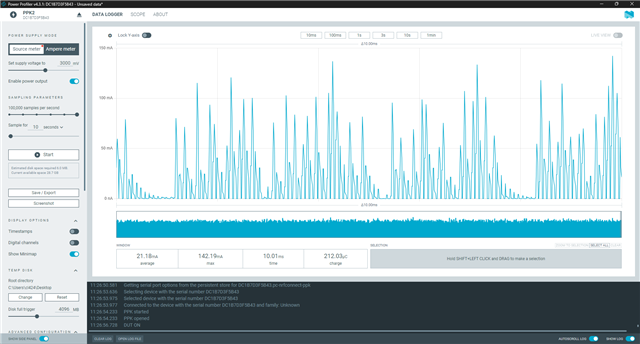
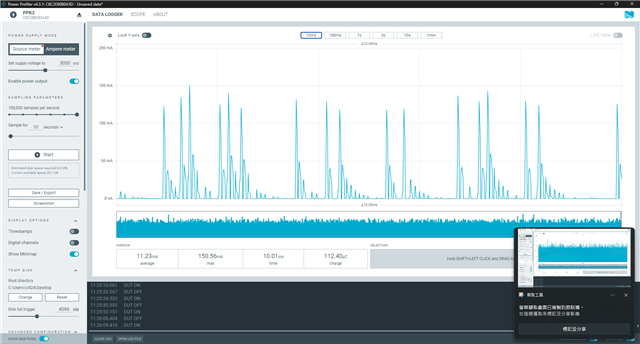
    I ran a few more comparisons and selected the two images that show the most significant differences.


    From these images, it seems clear that the two PPK2 units have a noticeable discrepancy in their ability to capture peak current.

    However, I don’t have any other instruments on hand to verify which one is accurate.
    Which PPK2 should I trust? Or do you have any other suggestions?
    Thanks!

  • This can be also related to the PP2 will have challenges sampling the nPM2100 input current. The sampling rate of the PPK2 is not fast enough to really record the current pulse caused by the boost converter operating in hysteretic mode of the nPM2100. The dynamic range needed for this measurement causes difficulties since the current peaks can be in the tens of mA range, but the base current is <1uA. So it needs autorange to record this.

    Adding bigger bulk capacitor in parallel with the nPM2100 input would reduce the current peaks and make them longer. This should help at least reducing the error seen.

    Kenneth

Related