nRF52832-CIAA-G-R7 Rx Sensitivity

Hi There,

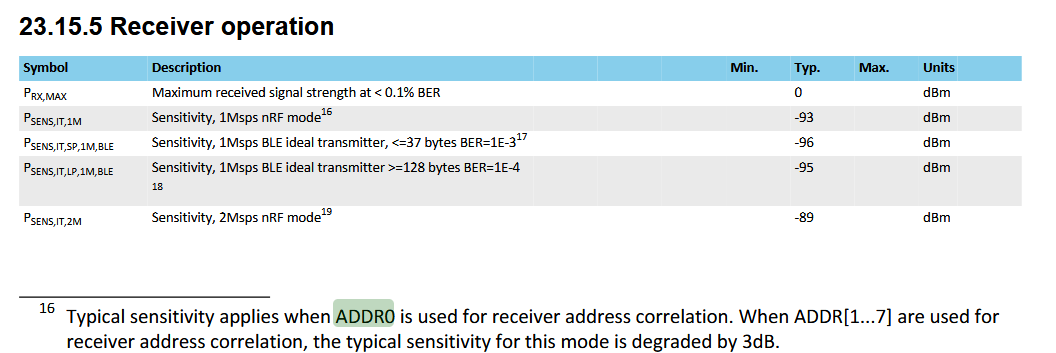
During the transmission and reception performance test, I found that the LE1M's maximum sensitivity was only -92 dBm, while the LE2M's maximum sensitivity was only -89 dBm. These values were measured using the IQ and added pathloss. The data do not match sensitivity of -96dBm in datasheet. Could you please confirm whether the configuration mode for SDK 2.6.1 is nRF mode?

Parents
  • Hello Star Tong,
    Regarding the sensitivity, it comes down to layout and implementation as well. So what sort of HW did you run the test on? Are you able to compare performance with a nRF52832 DK?
    The results we have reported in the product specification come from performance on boards using the reference schematic and layout with an ideal transmitter. It's optimum conditions, but this is what we would expect to see customers getting close to as well with a reference schematic and layout.
    ---------------------------------------
    I don't understand what you are asking here:
    "Could you please confirm whether the configuration mode for SDK 2.6.1 is nRF mode?"
    May I ask you to elaborate  what you mean by this?
    Best regards
    Asbjørn
  • Hi Asbjørn,

    Thank you for your reply.

    I tested on my own custom-designed product board.

    Regarding the layout issues you mentioned, I have the following additional comments from a hardware perspective:

    1. I verified the Tx performance aligns with the link budget, so sensitivity degradation due to mismatch can be ruled out.

    2. If the issue stemmed from desensitization, the 3dB degradation observed at LE2M compared to the datasheet would imply over 6dB degradation at LE1M—not just another 3dB. Currently, the 3dB sensitivity difference between LE1M and LE2M aligns with theoretical calculations.

    3. I noticed the following statement in the datasheet:

    'Typical sensitivity applies when ADDR0 is used for receiver address correlation. When ADDR[1...7] are used for receiver address correlation, the typical sensitivity for this mode is degraded by 3dB.'

    Therefore, I request your assistance in verifying whether any errors exist in the register configuration at the software level.

    Best Regard.

    Star.Tong

  • Hello Star Tong,
    The -96dBm sensitivity 1M mode is for ADDR0 only. For the remaining pipes (1..7), it is 3dB worse, so -93dBm. Which address field are you using for your tests?
    For 2M mode the sensitivity is -89dBm:
    Q1: Aligned with TX performance, yes this is right. So as long as you have 0dBm out in TX, you should have good receiver performance as well given that the carrier frequency/crystal accuracy is good.
    Q2 and Q3: I suspect you are using addr1-7 during these tests? Can you confirm or share how you configure the receiver for these tests?
    Best regards
    Asbjørn
  • Hi Asbjørn,

    Thank you for your kindly reply!

    What information do you need me to provide? Could you tell me how to export the file?

    THX & BR.

    Star.Tong

  • Hello Star.Tong,
    I don't think you need to export anything to me as long as you check how you set up and configure the radio for your test. You must be loading some FW into the device to run your test, how does it configure the receiver, specifically if ADDR0 is used. You can check this yourself in your code as I don't know what sort of FW you have built for this purpose. Have you gotten the FW from somewhere else? What are you using as a transmitter during your tests?
    -------------------------------------
    Best regards
    Asbjørn
  • Hi Asbjørn,

    Our software told me that he use the standard SDK and the version is 2.6.1.

    Would you mind tell me how can I check the information related to the address?

    I use the Litepoint MW-7G as generator during test, and the waveform file is attached.

    Thanks!

    Best Regard.

    Star.Tong

Reply Children
Related