Trouble with nrf_802154_transmit_raw after SDK upgrade

Hi,

I just noticed that there's another issue with my project after upgrading from SDK 2.3.0 to 3.1.1. 

I am using the 802.15.4 radio for low level packet communications with nrf_802154_transmit_raw() to send packets. I overrode the weak definitions of nrf_802154_received_raw(), nrf_802154_transmitted_raw(), and nrf_802154_transmit_failed() to handle packet reception and TX completion. See attached radio_interface.c file.

After the upgrade I noticed that every time I transmit, I get a "Transmit failure" message in my log. So my call to nrf_802154_transmit_raw(txdata, NULL) is returning false every time. I confirmed that this was not happening before the SDK upgrade.

I am still getting calls to nrf_802154_transmitted_raw() for every attempted transmit, and I am generally not getting calls to nrf_802154_transmit_failed(). So it seems like maybe my transmits are working even though the transmit call returns a fail.

I just tried sending a reset command to one of my wireless nodes to see if transmit packets are actually working, and it does look like they are - though apparently something went off the rails when that device replied, as I got an "Illegal use of the EPSR" usage failure and my processor rebooted.

Note that this is on a Fanstel module with a FEM, so I'm using MPSL because I believe it's required for FEM control. I attached my prj.conf in case that's helpful.

I tried comparing my project to the only sample I can find that uses the raw interface, but I haven't found the problem yet: \ncs\v3.1.1\nrf\samples\peripheral\802154_phy_test\

Thanks,

Glen

Log snippet showing the usage fault:

U/A to transmit to 837632Transmit failure
Forward
Rx Data
Data from 1067402[01:19:54.213,500] <err> os: ***** USAGE FAULT *****
[01:19:54.219,085] <err> os: Illegal use of the EPSR
[01:19:54.224,945] <err> os: r0/a1: 0x00000000 r1/a2: 0x00000020 r2/a3: 0
x00000001
[01:19:54.233,612] <err> os: r3/a4: 0x00000000 r12/ip: 0x20003640 r14/lr: 0
x0001e455
[01:19:54.242,309] <err> os: xpsr: 0x00000000
[01:19:54.247,528] <err> os: Faulting instruction address (r15/pc): 0x0001e468
[01:19:54.255,432] <err> os: >>> ZEPHYR FATAL ERROR 35: Unknown error on CPU 0
[01:19:54.263,336] <err> os: Current thread: 0x20003870 (main)
[01:19:54.269,836] <err> os: Halting system
à*** Booting nRF Connect SDK v3.1.1-e2a97fe2578a ***
*** Using Zephyr OS v4.1.99-ff8f0c579eeb ***

4111.prj.conf

//============================================================================
//  Title   : radio_interface
//  Desc    : Nordic radio 802.15.4 interface functions
//  2022-8-5   Glen     Created
//============================================================================
// Documentation on the 802.15.4 driver here:
// https://developer.nordicsemi.com/nRF_Connect_SDK/doc/1.9.1/nrfxlib/nrf_802154/README.html
//
// Sample code used for low level radio functions, rx pool, and how to receive
// are in the SDK here: \nRF_Connect\v2.0.0\nrf\samples\peripheral\802154_phy_test\src
//
//== Includes ================================================================
#include "radio_interface.h"
#include <string.h>
#include <zephyr/kernel.h>
#include <zephyr/device.h>
#include <zephyr/devicetree.h>
#include <zephyr/sys/byteorder.h>
#include <zephyr/sys/printk.h>
#include <hal/nrf_radio.h>
#include <string.h>
#include <stdio.h>
#include "radio.h"
#include "iomapping.h"

//== Definitions and Types ===================================================
//#define NO_TRANSMIT_FCC_VERSION                  1
#define RF_FCS_SIZE                                (2u)
#define POWER_OUTPUT_LEVEL_INTO_AMPLIFIER          0      // dBm
#define POWER_INCREASE_AMPLIFIER                   22     // dBm

typedef uint16_t ptt_pkt_len_t;

struct rf_rx_pkt_s {
	uint8_t *rf_buf; /**< pointer to buffer inside radio driver with a received packet */
	uint8_t *data; /**< pointer to payload */
	ptt_pkt_len_t length; /**< size of payload of received packet */
	int8_t rssi; /**< RSSI */
	uint8_t lqi; /**< LQI */
};

//== Global Variables ========================================================
static volatile bool m_tx_complete = true;

//== Function prototypes =====================================================

//============================================================================

//----------------------------------------------------------------------------
// Name  : radio_interface_config
// Desc  : Meant to reset the radio but there isn't an obvious nrf function to
//         that and it might not even make sense for an on-processor radio
// Ins   : none
// Outs  : none
//----------------------------------------------------------------------------
void radio_interface_config(void)
{
   // Clear the TX in progress flag
   m_tx_complete = true;
}

//----------------------------------------------------------------------------
// Name  : radio_interface_receive
// Desc  : Start the radio to receive packets
// Ins   : none
// Outs  : none
//----------------------------------------------------------------------------
void radio_interface_receive(void)
{
  nrf_802154_receive();
}

//----------------------------------------------------------------------------
// Name  : radio_interface_init
// Desc  : Configure the radio
// Ins   : none
// Outs  : none
//----------------------------------------------------------------------------
int radio_interface_init(void)
{
  /* nrf radio driver initialization */
   nrf_802154_init();

   uint8_t panId[] = { 0x00, 0x01 };
   nrf_802154_pan_id_set(&panId[0]);
   nrf_802154_channel_set(25);
   nrf_802154_promiscuous_set(false);
   return 0;
}

//----------------------------------------------------------------------------
// Name  : radio_interface_channel_set
// Desc  : Send the channel to the radio driver
// Ins   : none
// Outs  : none
//----------------------------------------------------------------------------
void radio_interface_channel_set(uint8_t channel)
{
   nrf_802154_channel_set(channel);
}

//----------------------------------------------------------------------------
// Name  : nrf_802154_received_raw
// Desc  : Received a packet from the nrf radio. Save off needed data and call 
//         rf_process_rx_packets to handle it
// Ins   : none
// Outs  : none
//----------------------------------------------------------------------------
void nrf_802154_received_raw(uint8_t *data, int8_t power, uint8_t lqi)
{
	struct rf_rx_pkt_s rx_pkt;
	bool pkt_placed = false;

	if (data == NULL)
   {
      return;
   }
   
   rx_pkt.rf_buf = data;
   rx_pkt.data = &data[1];
   rx_pkt.length = data[0] - RF_FCS_SIZE;

   rx_pkt.lqi = lqi; // It looks like we don't need these ED conversions after all
   pkt_placed = true;

   // Convert the RSSI from dBm to a custom scale
   rx_pkt.rssi = radio_interface_signal_strength_lookup(power);

   radio_interrupt(true, false, rx_pkt.data, rx_pkt.length, rx_pkt.rssi, rx_pkt.lqi, 0);
   nrf_802154_buffer_free_raw(rx_pkt.rf_buf);
}

//----------------------------------------------------------------------------
// Name  : nrf_802154_transmitted_raw
// Desc  : Override the WEAK defined library "tx done" function so that I can
//         add a call to the radio_interrupt in radio.c for status tracking
//         If ACK was requested for the transmitted frame, this function is 
//         called after a proper ACK is received. If ACK was not requested, 
//         this function is called just after transmission has ended.
// Ins   : none
// Outs  : none
//----------------------------------------------------------------------------
void nrf_802154_transmitted_raw(uint8_t * p_frame, const nrf_802154_transmit_done_metadata_t * p_metadata)
{
    (void)p_frame;

    uint8_t * p_ack = p_metadata->data.transmitted.p_ack;

    if (p_ack != NULL)
    {
        nrf_802154_buffer_free_raw(p_ack);
    }

    radio_interrupt(false, true, NULL, 0, 0, 0, 0);   // Call the radio TX complete interrupt, no failure
    //printk("TXDONE m_tx_complete = true\r\n");
    m_tx_complete = true;
}

//----------------------------------------------------------------------------
// Name  : nrf_802154_transmit_failed
// Desc  : Notifies that a frame was not transmitted due to a busy channel.
// Ins   : p_frame      Pointer to a buffer that contains PHR and PSDU of the frame that was not transmitted
// Ins   : error        Reason of the failure.
// Ins   : p_metadata   Pointer to a metadata structure describing frame passed in @p p_frame.
// Outs  : none
//----------------------------------------------------------------------------
void nrf_802154_transmit_failed(uint8_t * p_frame, nrf_802154_tx_error_t error, const nrf_802154_transmit_done_metadata_t * p_metadata)
{
   radio_interrupt(false, true, NULL, 0, 0, 0, 1);   // Call the radio TX complete interrupt, with a failure
   m_tx_complete = true;
   //printk("TXFAIL m_tx_complete = true\r\n");
   printk("\r\nrf_802154_transmit_failed\r\n");
}

//----------------------------------------------------------------------------
// Name  : radio_interface_transmit_packet
// Desc  : Send a packet out
// Ins   : A pointer to the data to send
// Outs  : none
//----------------------------------------------------------------------------
void radio_interface_transmit_packet(uint8_t *txdata)
{
   bool txstatus; 

   // The library is aware of the gain added by the PA, so you have to set the final output
   // power level you want, not just the level you want to go into the amplifier like it used to be
   nrf_802154_tx_power_set(POWER_OUTPUT_LEVEL_INTO_AMPLIFIER + POWER_INCREASE_AMPLIFIER);

   //printk("PRE-TX Set m_tx_complete false, Was %d\r\n", m_tx_complete);
   m_tx_complete = false;  // Set a flag that will be cleared when the transmission is either complete (plus acknowledgment) or it has failed      

   txstatus = nrf_802154_transmit_raw(txdata, NULL);

   if (txstatus == false)  // Failure to transmit 
   {
      printk("\r\nTransmit failure\r\n");
   }
}


//----------------------------------------------------------------------------
// Name  : radio_interface_get_tx_busy
// Desc  : Returns 1 if the radio has not yet completed its transmit (including receiving the hardware ACK if requested)
// Ins   : none
// Outs  : 1 for busy, 0 for not busy
//----------------------------------------------------------------------------
uint8_t radio_interface_get_tx_busy(void)
{
   if (m_tx_complete == false)
   {
      return 1;
   }
   else
   {
      return 0;
   }
}

  • Does explicitly enabling CONFIG_IEEE802154_DRIVER_LOG_LEVEL_DBG and CONFIG_IEEE802154_DRIVER_LOG_LEVEL_CHOICE help?

    Glen M said:
    Also, I still have to have CONFIG_NRF_802154_TEMPERATURE_UPDATE=n or I get a kernel panic at startup. I don't need the temperature, but that seems like a red flag that something else might be up or that I'm missing something I need to get the driver working properly. Any thoughts on that?

    Oh. Yeah I agree that sounds odd. Could you get me the log of that?

    I think I'll have to run this by the relevant R&D team.

    Regards,

    Elfving

  • That log level choice thing isn't something I can define - it requires digging into the driver kconfig stuff to figure out which thing has to be present for that item to be selected.

  • Regarding the temperature update config:

    I set CONFIG_NRF_802154_TEMPERATURE_UPDATE=y and this is what I get with just that one change:
    *** Booting nRF Connect SDK v3.1.1-e2a97fe2578a ***
    *** Using Zephyr OS v4.1.99-ff8f0c579eeb ***
    [00:00:00.009,796] <err> os: r0/a1: 0x00000004 r1/a2: 0x00000014 r2/a3: 0x020228d5
    [00:00:00.018,493] <err> os: r3/a4: 0x00000004 r12/ip: 0x0000000f r14/lr: 0x0002a775
    [00:00:00.027,160] <err> os: xpsr: 0x21000000
    [00:00:00.032,409] <err> os: Faulting instruction address (r15/pc): 0x0002a1a6
    [00:00:00.040,344] <err> os: >>> ZEPHYR FATAL ERROR 4: Kernel panic on CPU 0
    [00:00:00.048,095] <err> os: Current thread: 0x20001820 (sysworkq)
    [00:00:00.054,962] <err> os: Halting system

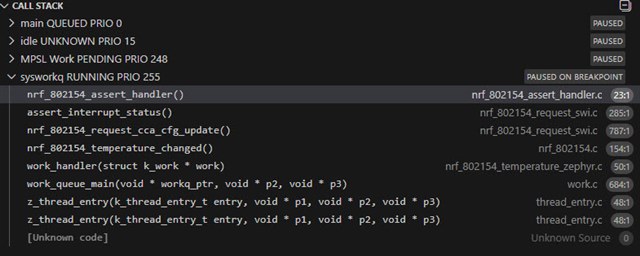
    I used addr2line to find the line of code where the panic happened and it's just in nrf_802154_assert_handler()

    ...arm-zephyr-eabi-addr2line.exe -e ...\trunk\Fanstel\build\Fanstel\zephyr\zephyr.elf -a 0x0002a1a6
    0x0002a1a6
    C:/ncs/v3.1.1/zephyr/modules/hal_nordic/nrf_802154/nrf_802154_assert_handler.c:24

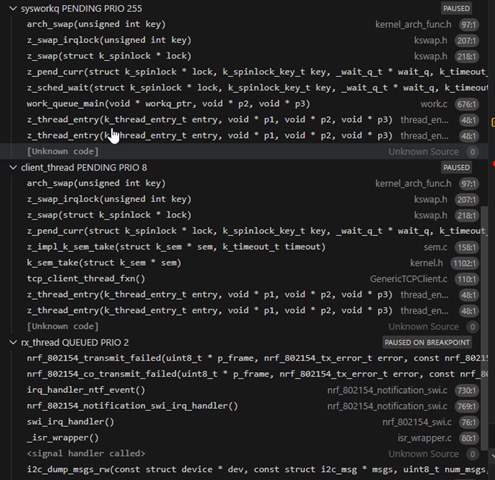
    I recompiled for debug and set a breakpoint in the assert handler. Here is what I found in the call stack window:

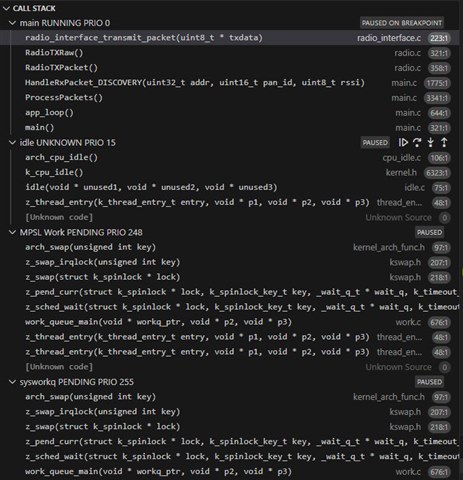
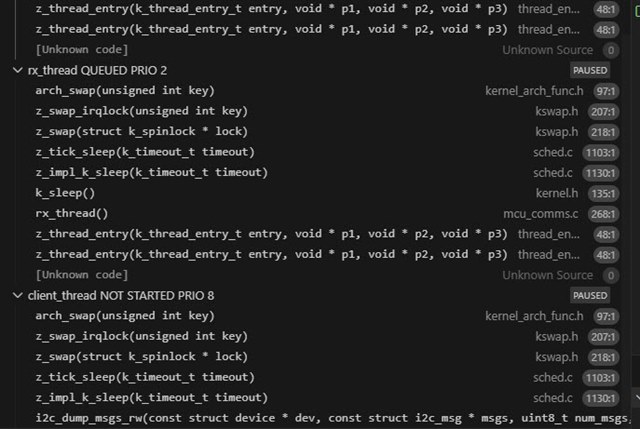
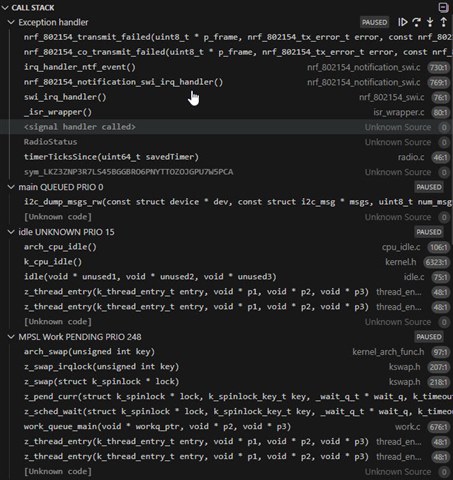
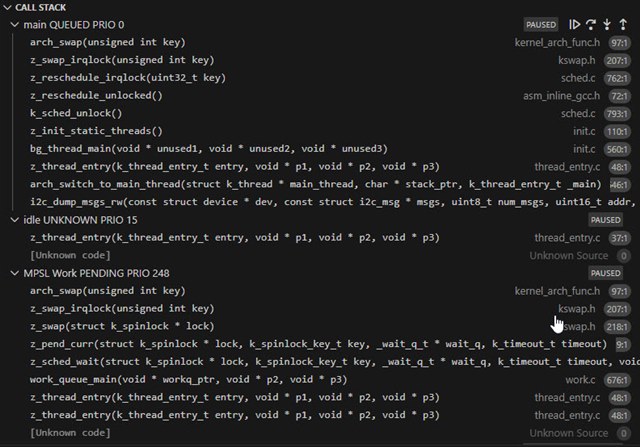
  • I decided to capture the call stack for my other errors in case it helps you help me - so I turned  the temperature config back off. I found that I am still occasionally getting a false response to 

    nrf_802154_transmit_raw in addition to hitting 
    nrf_802154_transmit_failed - I said previously that I wasn't getting that first one anymore but apparently that was incorrect.
    Screenshots for nrf_802154_transmit_raw  returning false:
     
    Screenshots for nrf_802154_transmit_failed:

  • Hi Elfving,

    I've done some rewriting to make my code look more like the 802.15.4 phy test example, with workqueues etc. It seems like i'm getting fewer errors, and with improved debug prints I know more about the kinds of errors I'm getting (mostly NRF_802154_TX_ERROR_NO_ACK and NRF_802154_TX_ERROR_ABORTED 0x06).

    I'm letting it run overnight to see how many errors I get and to collect a new debug log, but in the meantime I've attached the two relevant radio files I'm using to send and receive data. Can you please code-review them and just see if it looks like I'm doing everything properly with regards to the radio?

    Thanks very much,

    Glen

    //============================================================================
    //  Title   : radio_interface
    //  Desc    : Nordic radio 802.15.4 interface functions
    //  2022-8-5   Glen     Created
    //============================================================================
    // Documentation on the 802.15.4 driver here:
    // https://developer.nordicsemi.com/nRF_Connect_SDK/doc/1.9.1/nrfxlib/nrf_802154/README.html
    //
    // Sample code used for low level radio functions, rx pool, and how to receive
    // are in the SDK here: \nRF_Connect\v2.0.0\nrf\samples\peripheral\802154_phy_test\src
    //
    //== Includes ================================================================
    #include "radio_interface.h"
    #include <string.h>
    #include <zephyr/kernel.h>
    #include <zephyr/sys/atomic.h>
    #include <zephyr/device.h>
    #include <zephyr/devicetree.h>
    #include <zephyr/sys/byteorder.h>
    #include <zephyr/sys/printk.h>
    #include <hal/nrf_radio.h>
    #include <string.h>
    #include <stdio.h>
    #include "radio.h"
    #include "iomapping.h"
    
    //== Definitions and Types ===================================================
    //#define NO_TRANSMIT_FCC_VERSION                  1
    #define RF_FCS_SIZE                                (2u)
    #define POWER_OUTPUT_LEVEL_INTO_AMPLIFIER          0      // dBm
    #define POWER_INCREASE_AMPLIFIER                   22     // dBm
    
    typedef uint16_t ptt_pkt_len_t;
    
    struct rf_rx_pkt_s {
    	uint8_t *rf_buf; /**< pointer to buffer inside radio driver with a received packet */
    	uint8_t *data; /**< pointer to payload */
    	ptt_pkt_len_t length; /**< size of payload of received packet */
    	int8_t rssi; /**< RSSI */
    	uint8_t lqi; /**< LQI */
    };
    
    #define RF_WORKQ_STACK_SIZE 2048
    #define RF_WORKQ_PRIORITY   5
    
    K_THREAD_STACK_DEFINE(rf_wq_stack, RF_WORKQ_STACK_SIZE);
    
    /* RX queue item (stores the driver buffer pointer until we process+free it) */
    struct rx_item {
        sys_snode_t node;
        uint8_t *rf_buf;     /* driver-owned buffer */
        uint8_t *data;       /* &rf_buf[1] */
        uint16_t length;     /* rf_buf[0] - FCS */
        int8_t rssi;
        uint8_t lqi;
    };
    
    typedef enum {
        TX_FAIL_NONE = 0,
        TX_FAIL_START,
        TX_FAIL_ON_AIR,
    } tx_fail_reason_t;
    
    //== Global Variables ========================================================
    static volatile tx_fail_reason_t tx_fail_reason;
    
    static uint8_t failure_reason;
    static struct k_work_q rf_wq;
    static struct k_work_delayable tx_start_work;
    
    /* Serialize RF operations (similar to ptt_rf lock) */
    static atomic_t rf_tx_in_flight;
    
    /* Stage TX frame to guarantee lifetime until TX done */
    static uint8_t tx_frame_buf[RADIO_MAX_PAYLOAD_LEN + 1]; /* length byte + payload */
    
    static sys_slist_t rx_list;
    static struct k_work rx_work;
    
    /* TX completion work */
    static struct k_work tx_done_work;
    static struct k_work tx_fail_work;
    
    
    static volatile bool m_tx_complete = true;
    uint8_t m_rssi_lookup[54] = 
    {
       1, 2, 5, 9, 13, 18, 23, 27, 32, 37, 43, 48, 53, 58, 63, 68, 
       73, 78, 83, 89, 95, 100, 107, 111, 117, 121, 125, 129, 133, 
       138, 143, 148, 153, 159, 165, 170, 176, 183, 188, 193, 198, 
       203, 207, 212, 216, 221, 225, 228, 233, 239, 245, 250, 253, 254
    };
    
    //== Function prototypes =====================================================
    uint8_t radio_interface_signal_strength_lookup(int8_t rssi);
    static void tx_start_handler(struct k_work *work);
    static void rx_work_handler(struct k_work *work);
    static void tx_done_handler(struct k_work *work);
    static void tx_fail_handler(struct k_work *work);
    
    //============================================================================
    
    //----------------------------------------------------------------------------
    // Name  : radio_interface_config
    // Desc  : Meant to reset the radio but there isn't an obvious nrf function to
    //         that and it might not even make sense for an on-processor radio
    // Ins   : none
    // Outs  : none
    //----------------------------------------------------------------------------
    void radio_interface_config(void)
    {
       // Clear the TX in progress flag
       //printk("Config m_tx_complete = true\r\n");
       m_tx_complete = true;
       //nrf_802154_deinit();
       //radio_interface_init();
    }
    
    //----------------------------------------------------------------------------
    // Name  : radio_interface_receive
    // Desc  : Start the radio to receive packets
    // Ins   : none
    // Outs  : none
    //----------------------------------------------------------------------------
    void radio_interface_receive(void)
    {
      nrf_802154_receive();
    }
    
    //----------------------------------------------------------------------------
    // Name  : radio_interface_init
    // Desc  : Configure the radio
    // Ins   : none
    // Outs  : none
    //----------------------------------------------------------------------------
    int radio_interface_init(void)
    {
       atomic_clear(&rf_tx_in_flight);
       sys_slist_init(&rx_list);
    
       k_work_queue_start(&rf_wq, rf_wq_stack,
                         K_THREAD_STACK_SIZEOF(rf_wq_stack),
                         RF_WORKQ_PRIORITY, NULL);
    
       k_work_init(&rx_work, rx_work_handler);
       k_work_init(&tx_done_work, tx_done_handler);
       k_work_init(&tx_fail_work, tx_fail_handler);
       k_work_init(&tx_start_work, tx_start_handler);
    
      /* nrf radio driver initialization */
       nrf_802154_init();
    
       uint8_t panId[] = { 0x00, 0x01 };
       nrf_802154_pan_id_set(&panId[0]);
       nrf_802154_channel_set(25);
       nrf_802154_promiscuous_set(false);
       
       return 0;
    }
    
    //----------------------------------------------------------------------------
    // Name  : radio_interface_channel_set
    // Desc  : Send the channel to the radio driver
    // Ins   : none
    // Outs  : none
    //----------------------------------------------------------------------------
    void radio_interface_channel_set(uint8_t channel)
    {
       nrf_802154_channel_set(channel);
    }
    
    //----------------------------------------------------------------------------
    // Name  : nrf_802154_received_raw
    // Desc  : Received a packet from the nrf radio. Save off needed data and call 
    //         rf_process_rx_packets to handle it
    // Ins   : none
    // Outs  : none
    //----------------------------------------------------------------------------
    /* Simple fixed pool to avoid malloc in callback */
    #define RX_ITEM_POOL_N 16
    static struct rx_item rx_pool[RX_ITEM_POOL_N];
    
    static struct rx_item *rx_item_alloc(void)
    {
        for (int i = 0; i < RX_ITEM_POOL_N; i++) 
        {
            if (rx_pool[i].rf_buf == NULL) 
            {
                return &rx_pool[i];
            }
        }
        return NULL;
    }
    
    static void rx_item_free(struct rx_item *it)
    {
        it->rf_buf = NULL;
        it->data = NULL;
        it->length = 0;
        it->rssi = 0;
        it->lqi = 0;
    }
    
    void nrf_802154_received_raw(uint8_t *data, int8_t power, uint8_t lqi)
    {
        if (data == NULL) 
        {
            return;
        }
    
        struct rx_item *it = rx_item_alloc();
        if (!it) 
        {
            /* No space: drop (phy_test does this too) */
            printk("FAILURE - RX buffer overrun\r\n");
            nrf_802154_buffer_free_raw(data);
            return;
        }
    
        it->rf_buf = data;
        it->data = &data[1];
        it->length = data[0] - RF_FCS_SIZE;
    
        /* RSSI conversion */
        it->rssi = radio_interface_signal_strength_lookup(power);
        it->lqi = lqi;
    
        /* enqueue and schedule work */
        sys_slist_append(&rx_list, &it->node);
        k_work_submit_to_queue(&rf_wq, &rx_work);
    }
    
    static void rx_work_handler(struct k_work *work)
    {
        while (1) 
        {
            sys_snode_t *n = sys_slist_get(&rx_list);
            if (!n) {
                break;
            }
    
            struct rx_item *it = CONTAINER_OF(n, struct rx_item, node);
    
            radio_interrupt(true, false, it->data, it->length, it->rssi, it->lqi, 0);
    
            nrf_802154_buffer_free_raw(it->rf_buf);
            rx_item_free(it);
        }
    }
    
    //----------------------------------------------------------------------------
    // Name  : nrf_802154_transmitted_raw
    // Desc  : Override the WEAK defined library "tx done" function so that I can
    //         add a call to the radio_interrupt in radio.c for status tracking
    //         If ACK was requested for the transmitted frame, this function is 
    //         called after a proper ACK is received. If ACK was not requested, 
    //         this function is called just after transmission has ended.
    // Ins   : none
    // Outs  : none
    //----------------------------------------------------------------------------
    void nrf_802154_transmitted_raw(uint8_t *p_frame,
                                   const nrf_802154_transmit_done_metadata_t *p_metadata)
    {
        (void)p_frame;
    
        uint8_t *p_ack = p_metadata->data.transmitted.p_ack;
        if (p_ack != NULL) {
            /* You can either free here (as you do now), or defer like phy_test.
               Freeing here is usually OK, but deferring is more consistent. */
            nrf_802154_buffer_free_raw(p_ack);
        }
    
        k_work_submit_to_queue(&rf_wq, &tx_done_work);
    }
    
    //----------------------------------------------------------------------------
    // Name  : nrf_802154_transmit_failed
    // Desc  : Notifies that a frame was not transmitted due to a busy channel.
    // Ins   : p_frame      Pointer to a buffer that contains PHR and PSDU of the frame that was not transmitted
    // Ins   : error        Reason of the failure.
    // Ins   : p_metadata   Pointer to a metadata structure describing frame passed in @p p_frame.
    // Outs  : none
    //----------------------------------------------------------------------------
    void nrf_802154_transmit_failed(uint8_t *p_frame, nrf_802154_tx_error_t error,
                                    const nrf_802154_transmit_done_metadata_t *p_metadata)
    {
        (void)p_frame;
        (void)error;
        (void)p_metadata;
    
        printk("Failure: TX_ON_AIR_FAIL: error=%d\r\n", error);
        tx_fail_reason = TX_FAIL_ON_AIR;
        k_work_submit_to_queue(&rf_wq, &tx_fail_work);
    }
    
    //----------------------------------------------------------------------------
    // Name  : radio_interface_transmit_packet
    // Desc  : Send a packet out
    // Ins   : A pointer to the data to send
    // Outs  : none
    //----------------------------------------------------------------------------
    void radio_interface_transmit_packet(uint8_t *txdata)
    {
    #ifndef NO_TRANSMIT_FCC_VERSION
        if (txdata == NULL) {
            return;
        }
    
        /* Prevent overlapping TX attempts */
        if (atomic_cas(&rf_tx_in_flight, 0, 1) == false) {
            /* Already busy */
            printk("FAILURE - TX request while busy\r\n");
            return;
        }
    
        /* Set power */
        nrf_802154_tx_power_set(POWER_OUTPUT_LEVEL_INTO_AMPLIFIER + POWER_INCREASE_AMPLIFIER);
    
        /* Stage TX buffer */
        uint16_t total_len = txdata[0] + 1;  /* length byte + PSDU */
        if (total_len > sizeof(tx_frame_buf)) 
        {
            atomic_clear(&rf_tx_in_flight);
            printk("FAILURE - TX frame too large\r\n");
            return;
        }
    
        memcpy(tx_frame_buf, txdata, total_len);
    
        /* Start TX in rf workqueue context */
        m_tx_complete = false;
    
        //k_work_submit_to_queue(&rf_wq, &tx_start_work);
        k_work_schedule_for_queue(&rf_wq, &tx_start_work, K_MSEC(1));
    #endif
    }
    
    //----------------------------------------------------------------------------
    // Name  : radio_interface_get_tx_busy
    // Desc  : Returns 1 if the radio has not yet completed its transmit (including receiving the hardware ACK if requested)
    // Ins   : none
    // Outs  : 1 for busy, 0 for not busy
    //----------------------------------------------------------------------------
    uint8_t radio_interface_get_tx_busy(void)
    {
       if (m_tx_complete == false)
       {
          return 1;
       }
       else
       {
          return 0;
       }
    }
    
    //----------------------------------------------------------------------------
    // Name  : radio_interface_signal_strength_lookup
    // Desc  : Looks up the RSSI value needed by this app from the RSSI/dBm value
    // Ins   : traditional RSSI in dBm
    // Outs  : converted RSSI value per the lookup table in the MRF24J20 datasheet lookup table 3-8.
    //----------------------------------------------------------------------------
    uint8_t radio_interface_signal_strength_lookup(int8_t rssi)
    {
       // After lookup, RSSI will be a value from 255 (great) to 0 (bad)
       // An RSSI of -90dBm or below is 0
       // An RSSI of -35dBm or above is 255
       // In-between lookup table
       uint8_t signal_strength_lookup;
       if (rssi <= -90 )
       {
          signal_strength_lookup = 0;
       }
       else if (rssi >= -35 )
       {
          signal_strength_lookup = 255;
       }
       else
       {  // It's somewhere in the middle. Use a lookup table
          signal_strength_lookup = m_rssi_lookup[rssi + 89];
       }
       return signal_strength_lookup;
    }
    
    // This function is called when we start to send an ACK. Just using it temporarily for amplifier control debug
    //void nrf_802154_tx_ack_started(const uint8_t * p_data)
    //{
    //   iomapping_set_tp2(0);      
    //}
    
    static void tx_start_handler(struct k_work *work)
    {
        bool ok;
    
        /* NOTE: we are already logically "locked" here via rf_tx_in_flight */
        const nrf_802154_transmit_metadata_t metadata = {
            .frame_props = NRF_802154_TRANSMITTED_FRAME_PROPS_DEFAULT_INIT,
            .cca = true,  /* set based on what you want */
        };
    
    //#warning DEBUG PRINT
    //printk("TX FCF bytes: %02x %02x\r\n", tx_frame_buf[1], tx_frame_buf[2]);
    //uint8_t len = tx_frame_buf[0];
    //uint16_t fcf = (uint16_t)tx_frame_buf[1] | ((uint16_t)tx_frame_buf[2] << 8);
    //uint8_t seq = tx_frame_buf[3];
    //bool ackreq = (fcf & (1u << 5)) != 0;   // 802.15.4 ACK request bit is bit 5 of FCF
    //printk("TX: len=%u fcf=0x%04x seq=%u ackreq(bit)=%u\r\n", len, fcf, seq, ackreq);
    
    
        ok = nrf_802154_transmit_raw(tx_frame_buf, &metadata);
    
        if (!ok) {
            /* Could not even start TX: complete as failure */
            tx_fail_reason = TX_FAIL_START;
            k_work_submit_to_queue(&rf_wq, &tx_fail_work);
        }
    }
    
    
    static void tx_done_handler(struct k_work *work)
    {
        radio_interrupt(false, true, NULL, 0, 0, 0, 0);
        m_tx_complete = true;
        atomic_clear(&rf_tx_in_flight);
    }
    
    static void tx_fail_handler(struct k_work *work)
    {
        radio_interrupt(false, true, NULL, 0, 0, 0, 1);
        m_tx_complete = true;
        atomic_clear(&rf_tx_in_flight);
        if (tx_fail_reason == TX_FAIL_START)
        {
          printk("\r\nFAILURE - Failed to start transmit\r\n");
        }
        else if (tx_fail_reason == TX_FAIL_ON_AIR)
        {
          //printk("\r\nFAILURE - Transmit failed on-air\r\n");      
        }
    }
    #if(0)
    void nrf_802154_tx_ack_started(const uint8_t *p_data)
    {
        printk("AUTOACK started\r\n");
    }
    
    void nrf_802154_tx_ack_finished(const uint8_t *p_data)
    {
        printk("AUTOACK finished\r\n");
    }
    #endif
    //============================================================================
    //  Title   : radio
    //  Desc    : Driver for Nordic nRF52840 802.15.4 radio
    //  2022-9-12   Glen     Created
    //============================================================================
    
    //== Includes ================================================================
    #include <zephyr/kernel.h>
    #include <zephyr/device.h>
    #include <zephyr/devicetree.h>
    #include <zephyr/sys/byteorder.h>
    #include <zephyr/sys/printk.h>
    #include <string.h> // memset()
    #include "iomapping.h"
    #include "radioAddress.h" // addr for radio
    #include "M_uart.h"
    #include "M_timer.h"
    #include "crc.h"
    #include "radio.h"
    #include <stdbool.h>
    #include "radio_interface.h"
    #include "tls.h"
    
    //== Definitions and Types ===================================================
    #define TRANSMIT_BUFFER_SIZE     256
    
    //== Global Variables ========================================================
    extern unsigned char flag_reset_radio;
    
    RADIO_STATUS volatile RadioStatus;                         // radio state
    uint8_t volatile RXBuffer[PACKET_BUFFERS][RX_BUFFER_SIZE]; // rx packet buffers
    PACKET Tx;                                                 // structures describing transmitted and received packets
    PACKET Rx;                                                 // structures describing transmitted and received packets
    uint8_t m_transmit_buffer[TRANSMIT_BUFFER_SIZE];
    
    //== Function prototypes =====================================================
    
    //============================================================================
    
    //----------------------------------------------------------------------------
    // Name  : timerTicksSince
    // Desc  : Return elapsed time in 256us increments
    //----------------------------------------------------------------------------
    uint64_t timerTicksSince(uint64_t savedTimer)
    {
       return (m_timer_get_radio_timer() - savedTimer);  
    }
    
    //----------------------------------------------------------------------------
    // Name  : readBytes
    // Desc  : This combines memcpy with incrementing the source point.  It copies 
    //         bytewise, allowing it to copy to/from unaligned addresses
    //----------------------------------------------------------------------------
    unsigned char *readBytes(unsigned char *dstPtr, unsigned char *srcPtr, unsigned int count)
    {
       while (count--)
       {
          *dstPtr++ = *srcPtr++;
       }
    
       return srcPtr;
    }
    
    //----------------------------------------------------------------------------
    // Name  : toTXfifo
    // Desc  : Writes count consecutive bytes from source into consecutive FIFO slots starting at "register".  
    // Ins   : none
    // Outs  : Returns next empty register #.
    //----------------------------------------------------------------------------
    uint8_t toTXfifo(uint16_t reg, uint8_t *source, uint8_t count)
    {
       uint8_t *ptr;
       size_t buf_size = sizeof(m_transmit_buffer);
    
       ptr = &m_transmit_buffer[0];
       ptr += reg;
    
       if ((size_t)reg > buf_size) 
       {
          printk("toTXfifo: reg=%u out of range (buf=%zu)\n", reg, buf_size);
       }
    
       if ((size_t)reg + (size_t)count > buf_size) 
       {
          printk("toTXfifo: overflow reg=%u count=%u (buf=%zu)\n", reg, count, buf_size);
       }
    
       if (source == NULL) 
       {
          printk("toTXfifo: source NULL (reg=%u, count=%u)\n", reg, count);
          return reg;
       }
    
       memcpy(ptr, source, count);
       return (count + reg);
    }
    
    //----------------------------------------------------------------------------
    // Name  : initRADIO
    // Desc  : Warm start radio hardware, tunes to Channel.  Takes about 0.37 ms on PIC32 at 20 MHz, 10 MHz SPI hardware clock 
    // Ins   : none
    // Outs  : On return, 0=no radio hardare, 1=radio is reset
    //----------------------------------------------------------------------------
    uint8_t initRADIO(void)
    {
       m_timer_init_radio_timer();
       RadioStatus.LastTXTriggerTick = 0;
       RadioStatus.ResetCount++;
    
       RadioStatus.TX_FAIL = 0;
       RadioStatus.TX_PENDING_ACK = 0; // not pending an ack after reset
       RadioStatus.SLEEPING = 0;       // radio is not sleeping
    
       // Reset the radio
       radio_interface_config();
    
       RadioSetAddress(RadioStatus.MyShortAddress, RadioStatus.MyLongAddress, RadioStatus.MyPANID);
       RadioSetChannel(RadioStatus.Channel); // tune to current radio channel
    
       RadioSetSleep(0);
    
       return 1;
    }
    
    //----------------------------------------------------------------------------
    // Name  : RadioInit
    // Desc  : Initialize the RadioStatus structure and then call the lower level radio init function
    // Ins   : none
    // Outs  : on return, 1=radio is setup, 0=there is no radio
    //----------------------------------------------------------------------------
    bool RadioInit(unsigned char chan, unsigned long address, unsigned int panid) // cold start radio init
    {
       bool radio;
    
       memset((void *)&RadioStatus, 0, sizeof(RadioStatus));
    
       RadioStatus.MyPANID = panid;
       RadioStatus.MyShortAddress = 0x0001; //???
       RadioStatus.MyLongAddress = address;
    
       RadioStatus.Channel = chan; // Channel 25 should not interfere with Wifi
    
       radio = initRADIO(); // init radio hardware, tune to RadioStatus.Channel
    
       return 0;
    }
    
    //----------------------------------------------------------------------------
    // Name  : RadioSetAddress
    // Desc  : Set short address and PANID
    // Ins   : Short 16-bit address, long 64-bit address, and PAN ID
    // Outs  : none
    //----------------------------------------------------------------------------
    void RadioSetAddress(uint16_t shortAddress, uint64_t longAddress, uint16_t panID)
    {
       nrf_802154_pan_id_set((const uint8_t *)(&panID));
       nrf_802154_extended_address_set((const uint8_t *)(&longAddress));
       nrf_802154_short_address_set((const uint8_t *)(&shortAddress));
    }
    
    //----------------------------------------------------------------------------
    // Name  : RadioSetChannel
    // Desc  : Set radio channel.  
    // Ins   : none
    // Outs  : Returns with success/fail flag.
    //----------------------------------------------------------------------------
    bool RadioSetChannel(uint8_t channel)
    {
       if (channel < 11 || channel > 26)
       {
          return false;
       }
    
    #if defined(ENABLE_PA_LNA) // Permitted band is 2400 to 2483.5 MHz.
       if (channel == 26)
       {                // Center Freq. is 2405+5(k-11) MHz, for k=channel 11 to 26
          return false; // max output is 100mW (USA)
       }
    #endif // rolloff is not steep enough to avoid 2483.5 from channel 26 center of 2480 MHz at full MB power
    
       RadioStatus.Channel = channel;
    
       // Push the channel to the radio
       radio_interface_channel_set(channel);
    
       // Start receive
       //radio_interface_receive();     // This happens in RadioSetSleep(0), which is called next
    
       return true;
    }
    
    //----------------------------------------------------------------------------
    // Name  : RadioSetSleep
    // Desc  : Put the RF transceiver into sleep or wake it up
    // Radio power, RADIOMB - ENABLE_PA_LNA on:
    //	RX:  	28.4 mA
    //	TX: 	65.8 mA (as fast as I can xmit; nominal peak 130 mA)
    //	Sleep:	0.245 mA (spec is 5 uA with 'sleep clock disabled'; setting register 0x211 to 0x01 doesn't seem to help)
    // Note that you can in practice turn the radio power off completely for short periods (with a MOSFET) and then do a warm start.
    // Ins   : 1 to put the radio to sleep, 0 to wake it up
    // Outs  : none
    //----------------------------------------------------------------------------
    void RadioSetSleep(uint8_t powerState)
    {
       if (powerState)
       {
          RadioStatus.SLEEPING = 1; // radio is sleeping
          nrf_802154_sleep();       // Put the radio to sleep
       }
       else
       {
          RadioStatus.SLEEPING = 0;
          nrf_802154_receive(); // Wake up the radio and put it back in receive mode
       }
    }
    
    //----------------------------------------------------------------------------
    // Name  : RadioEnergyDetect
    // Desc  : Do a single (128 us) energy scan on current channel.  Return RSSI.
    // Ins   : none
    // Outs  : none
    //----------------------------------------------------------------------------
    uint8_t RadioEnergyDetect(void)
    {   
       // This function is not currently called from anywhere, so it has not been updated
       // This can be done using the following functions: nrf_802154_rssi_measure_begin, then nrf_802154_rssi_last_get
       // Info here: https://infocenter.nordicsemi.com/index.jsp?topic=%2Fsdk_tz_v4.1.0%2Fgroup__nrf__802154__rssi.html
    #if (0)
       uint8_t RSSIcheck;
    
       RSSIcheck = lowRead(READ_BBREG6); // Read RSSIRDY
       while ((RSSIcheck & 0x01) != 0x01)
       {                                    // Wait until RSSIRDY goes to 1; this indicates result is ready
          RSSIcheck = lowRead(READ_BBREG6); // this takes max 8 symbol periods (16 uS each = 128 uS)
       }
    
       RSSIcheck = highRead(0x210); // read the RSSI
    
       lowWrite(WRITE_BBREG6, 0x40); // enable RSSI on received packets again after energy scan is finished
    
    #if defined(ENABLE_PA_LNA)
       lowWrite(WRITE_GPIO, 0);
       lowWrite(WRITE_GPIODIR, 0x00); // Set GPIO direction to INPUT
       highWrite(TESTMODE, 0x0F);     // setup for automatic PA/LNA control
    #endif
    
       return RSSIcheck;
    #else
       return 0;
    #endif
    }
    
    //----------------------------------------------------------------------------
    // Name  : RadioTXRaw
    // Desc  : Radio transmit function
    // Ins   : none
    // Outs  : none
    //----------------------------------------------------------------------------
    void RadioTXRaw(void)
    {
       uint8_t wReg; // radio write register (into TX FIFO starting at long addr 0)
       uint16_t startRegGoodPayload;
       uint8_t zeroval = 0;
    
       wReg = toTXfifo(0, &zeroval, 1);                                // Frame length goes here - inserted at the end
       wReg = toTXfifo(1, BYTEPTR(Tx.frameControl), 2);
       wReg = toTXfifo(wReg, BYTEPTR(Tx.frameNumber), 1);
    
       if (Tx.frameControl.dstAddrMode == SHORT_ADDR_FIELD)
       {                                                  // if a short dest addr is present
          wReg = toTXfifo(wReg, BYTEPTR(Tx.dstPANID), 2); // write dstPANID
          wReg = toTXfifo(wReg, BYTEPTR(Tx.dstAddr), 2);  // write short address
       }
       else if (Tx.frameControl.dstAddrMode == LONG_ADDR_FIELD)
       {                                                  // if a long dest addr is present
          wReg = toTXfifo(wReg, BYTEPTR(Tx.dstPANID), 2); // write dstPANID
          wReg = toTXfifo(wReg, BYTEPTR(Tx.dstAddr), 8);  // long addr
       }
    
       // now wReg is at start of source PANID (if present)
    
       if (Tx.frameControl.srcAddrMode != NO_ADDR_FIELD && // if source present
           Tx.frameControl.dstAddrMode != NO_ADDR_FIELD && // and dest present
           !Tx.frameControl.panIDcomp)
       {                                                  // and no PANID compression
          wReg = toTXfifo(wReg, BYTEPTR(Tx.srcPANID), 2); // then write src PANID
       }
    
       if (Tx.frameControl.srcAddrMode == SHORT_ADDR_FIELD)
       { // if a short src addr is present
          wReg = toTXfifo(wReg, BYTEPTR(Tx.srcAddr), 2);
       }
       else if (Tx.frameControl.srcAddrMode == LONG_ADDR_FIELD)
       { // if a long src addr is present
          wReg = toTXfifo(wReg, BYTEPTR(Tx.srcAddr), 8);
       }
    
       // now wReg is pointing to first wReg after header (m)
       startRegGoodPayload = wReg;
    
       wReg = toTXfifo(wReg, Tx.payload, Tx.payloadLength);
    
       if (tls_encrypt(wReg - 4, startRegGoodPayload, m_transmit_buffer) == FAIL)
       { // encrypts payload (but not CRC), 'wreg - 4' corresponds to CRC start address
          return;
       }
    
       // The Nordic radio wants the full frame length to be in the first byte of the packet
       wReg++;  // Include the length
       toTXfifo(0, &wReg, 1); 
    
       printk("Sending packet - ACK requested=%d\r\n", Tx.frameControl.ackRequest);
    
       radio_interface_transmit_packet(m_transmit_buffer);
    
       RadioStatus.TX_PENDING_ACK = Tx.frameControl.ackRequest;
       RadioStatus.LastTXTriggerTick = m_timer_get_radio_timer(); // record time (used to check for locked-up radio or PLL loss)
    }
    
    //----------------------------------------------------------------------------
    // Name  : RadioTXPacket
    // Desc  : Sends next packet from Tx.  Blocks for up to RADIO_TIMEOUT_TICKS if transmitter is
    // not ready (RadioStatus.TX_BUSY).  If you don't want to be blocked, don't call
    // ths until RadioStatus.TX_BUSY == 0.
    // This automatically sets frame number and source address for you
    // Ins   : none
    // Outs  : none
    //----------------------------------------------------------------------------
    void RadioTXPacket(void)
    {
       if (Tx.frameControl.srcAddrMode == SHORT_ADDR_FIELD)
       {
          Tx.srcAddr = RadioStatus.MyShortAddress;
       }
       else if (Tx.frameControl.srcAddrMode == LONG_ADDR_FIELD)
       {
          Tx.srcAddr = RadioStatus.MyLongAddress;
       }
    
       Tx.frameNumber = RadioStatus.IEEESeqNum++;
    
       while (radio_interface_get_tx_busy())
       { // If TX is busy, wait for it to clear (for a resaonable time)
          if (timerTicksSince(RadioStatus.LastTXTriggerTick) > RADIO_TIMEOUT_TICKS)
          {
             // if not ready in a resonable time
             initRADIO(); // reset radio hardware (stay on same channel) -- JS Removed this
          }
       }
    
       RadioTXRaw();
    }
    
    //----------------------------------------------------------------------------
    // Name  : RadioTXResult
    // Desc  : Returns status of last transmitted packe
    // Ins   : none
    // Outs  : TX_SUCCESS (1), TX_FAILED (2), or 0 = no result yet because TX busy
    //----------------------------------------------------------------------------
    uint8_t RadioTXResult(void)
    {
       if (radio_interface_get_tx_busy())
       { // if TX not done yet
          return TX_RESULT_BUSY;
       }
    
       return TX_RESULT_SUCCESS + RadioStatus.TX_FAIL; // 1=success, 2=fail
    }
    
    //----------------------------------------------------------------------------
    // Name  : RadioWaitTXResult
    // Desc  : Wait for the transmit to complete
    // Ins   : none
    // Outs  : Returns TX_RESULT_SUCCESS or TX_RESULT_FAILED.  Waits up to RADIO_TIMEOUT_TICKS.
    //----------------------------------------------------------------------------
    uint8_t RadioWaitTXResult(void)
    {
       while (radio_interface_get_tx_busy())
       { // If TX is busy, wait for it to clear (for a resaonable time)
          clear_watchdog();
          if (timerTicksSince(RadioStatus.LastTXTriggerTick) > RADIO_TIMEOUT_TICKS)
          {               // if not ready in a resonable time
             initRADIO(); // reset radio hardware (stay on same channel)
          }
       }
       return TX_RESULT_SUCCESS + RadioStatus.TX_FAIL; // 1=success, 2=fail
    }
    
    //----------------------------------------------------------------------------
    // Name  : RadioRXPacket
    // Desc  : RX side - what goes in RXBuffer (from RADIO datasheet figure 3-9)
    //	Size	Offset
    //	1		0		Frame length (m+n+2 = header + 102 + FCS)
    //	1		1		LSB of Frame Control (bits)
    //	1		2		MSB of Frame Control (type)
    //	1		3		Sequence number
    //	20		23		Addressing fields, worst case (PANIDx2 = 4, MACx2=16 total =20)
    //	103		126		Payload
    //	1		127		LQI
    //	1		128		RSSI
    
    // Returns count of received packets waiting to be processed & discarded.  Next packet to process is in "Rx".
    // Note this gives you ALL received packets (not just ones addressed to you).   Check the addressing yourself if you care.
    // Also be aware that sucessive identical packets (same frame number) will be received if the far-end misses your ACK (it
    // will re-transmit).  Check for that if you care.
    //----------------------------------------------------------------------------
    uint8_t RadioRXPacket(void)
    {
       if (!RadioStatus.RXPacketCount)
       {
          return 0; // no packets to process
       }
    
       uint8_t *readPoint = (uint8_t *)RXBuffer[RadioStatus.RXReadBuffer]; // recieved packet read point
    
       if (radio_interface_get_tx_busy())
       { // time out and reset radio if we missed interrupts for a long time
          if (timerTicksSince(RadioStatus.LastTXTriggerTick) > RADIO_TIMEOUT_TICKS)
          {
             initRADIO(); // reset radio hardware (stay on same channel)
          }
       }
    
       readPoint = readBytes(BYTEPTR(Rx.frameLength), readPoint, 1); // copy frame length (1), frame control (2), frame number (1), PANID (2)
       readPoint = readBytes(BYTEPTR(Rx.frameControl.w), readPoint, 2);
       readPoint = readBytes(BYTEPTR(Rx.frameNumber), readPoint, 1);
       readPoint = readBytes(BYTEPTR(Rx.dstPANID), readPoint, 2);
    
       // If security is enabled for this packet, toss it (not supported). Also reject Beacon packets as we don't use them
       if ( (Rx.frameControl.securityEnabled) || (Rx.frameControl.frameType == PACKET_TYPE_BEACON) ) 
       {
          RadioStatus.RXSecurityEnabled++; // log error
          RadioDiscardPacket();
          return 0; // avoid recursion
       }
    
       if (Rx.frameControl.frameType == PACKET_TYPE_ACK)
       { // no PANID present on ACK frames [802.15.4 weakness: No way to know if this ACK is really for you]
          readPoint -= 2;
       }
    
       // readPoint now just after first PANID field
    
       if (Rx.frameControl.dstAddrMode == SHORT_ADDR_FIELD) // if a short dest addr is present
          readPoint = readBytes(BYTEPTR(Rx.dstAddr), readPoint, 2);
       else if (Rx.frameControl.dstAddrMode == LONG_ADDR_FIELD) // if a long dest addr is present
          readPoint = readBytes(BYTEPTR(Rx.dstAddr), readPoint, 8);
    
       Rx.srcPANID = Rx.dstPANID; // copy first PANID because we don't know if it's src or dst yet
       Rx.srcAddr = Rx.dstAddr;   // ditto for address
    
       // now readPoint is at start of source PANID (if present)
    
       if (Rx.frameControl.srcAddrMode != NO_ADDR_FIELD &&           // if source present
           Rx.frameControl.dstAddrMode != NO_ADDR_FIELD &&           // and dest present
           !Rx.frameControl.panIDcomp)                               // and no PANID compression
          readPoint = readBytes(BYTEPTR(Rx.srcPANID), readPoint, 2); // then read src PANID
    
       if (Rx.frameControl.srcAddrMode == SHORT_ADDR_FIELD)
       { // if a short src addr is present
          readPoint = readBytes(BYTEPTR(Rx.srcAddr), readPoint, 2);
       }
       else if (Rx.frameControl.srcAddrMode == LONG_ADDR_FIELD)
       { // if a long src addr is present
          readPoint = readBytes(BYTEPTR(Rx.srcAddr), readPoint, 8);
       }
    
       Rx.payload = readPoint; // now readPoint points at the start of the payload
    
       if (tls_decrypt() == FAIL)
       { // if the decryption was bad
          printk("Decryption failed. Src: %llu, Dst: %llu, PanID: %u\r\n", Rx.srcAddr, Rx.dstAddr, Rx.srcPANID);
          RadioDiscardPacket();
          // return RadioRXPacket(); //recursion may be allowed above with securityEnabled check, but am worried this causes occasional crash
          return 0; // avoid recursion
       }
    
       Rx.payloadLength = Rx.frameLength - (readPoint - RXBuffer[RadioStatus.RXReadBuffer]) + 1;
    
       readBytes(BYTEPTR(Rx.lqi), readPoint + Rx.payloadLength, 1);
       readBytes(BYTEPTR(Rx.rssi), readPoint + Rx.payloadLength + 1, 1);
    
       //uint32_t src, dst;
       //src = (uint32_t)(Rx.srcAddr);
       //dst = (uint32_t)(Rx.dstAddr);
       //printk("\r\nGood pkt. ");
       //printk("Src: %lu", src);
       //printk(", Dst: %lu", dst);
       //printk(", PanID: %u", Rx.srcPANID);   
       //printk(", RSSI: %u", Rx.rssi);   
       //printk(", LQI: %u\r\n", Rx.lqi);   
    
       return RadioStatus.RXPacketCount;
    }
    
    //----------------------------------------------------------------------------
    // Name  : RadioDiscardPacket
    // Desc  : If our RX buffer is overrunning, discard a packet
    //----------------------------------------------------------------------------
    void RadioDiscardPacket(void)
    {
       if (RadioStatus.RXPacketCount)
       { // just in case we get called more than we ought
          RadioStatus.RXPacketCount--;
          RadioStatus.RXReadBuffer = (RadioStatus.RXReadBuffer + 1) & (PACKET_BUFFERS - 1);
       }
       else
       {
          RadioStatus.RadioExtraDiscard++;
       }
    }
    
    //----------------------------------------------------------------------------
    // Name  : radio_interrupt
    // Desc  : Called from the radio packet TX/RX interrupt service routine to handle 
    //         the rx data or TX event
    // Ins   : read_interrupt is true if this was a read, false if this was a write
    // Outs  : none
    //----------------------------------------------------------------------------
    void radio_interrupt(bool rx_interrupt, bool tx_interrupt, uint8_t *data, uint16_t length, int8_t rssi, uint8_t lqi, uint8_t tx_fail)
    {
       if (rx_interrupt == true)
       { // RX int?
          uint8_t i;
    
          if (length > RX_BUFFER_SIZE)
          { // if too big for the RX buffer
             RadioStatus.RXPacketTooBig++;
             length = RX_BUFFER_SIZE; // truncate to fit
          }
    
          RXBuffer[RadioStatus.RXWriteBuffer][0] = length; // store length of packet (not counting length byte, FCS, LQI and RSSI)
    
          for (i = 1; i <= length; i++)
          { // copy data from the FIFO into the RX buffer, plus RSSI and LQI
             RXBuffer[RadioStatus.RXWriteBuffer][i] = *data++;
          }
    
          // Insert the RSSI and LQI at the end of the received data
          RXBuffer[RadioStatus.RXWriteBuffer][i++] = lqi;
    
          RXBuffer[RadioStatus.RXWriteBuffer][i++] = rssi;
    
          RadioStatus.RXPacketCount++;
          RadioStatus.RXWriteBuffer = (RadioStatus.RXWriteBuffer + 1) & (PACKET_BUFFERS - 1); // mod PACKET_BUFFERS
    
          if ((RadioStatus.RXPacketCount > PACKET_BUFFERS) || (RadioStatus.RXWriteBuffer == RadioStatus.RXReadBuffer))
          {
             RadioStatus.RXBufferOverruns++;
             //printk("RADIO PACKET OVERRUN\r\n");
             //Throw out two of the oldest unprocessed RX packet to keep from getting overrun
             RadioDiscardPacket();
             RadioDiscardPacket();
          }
       }
    
       if (tx_interrupt == true)
       {                           // TX int?  If so, this means TX is no longer busy, and the result (if any) of the ACK request is in
          if (RadioStatus.TX_PENDING_ACK)
          {                                                      // if we were waiting for an ACK
             RadioStatus.TX_FAIL = tx_fail;                      // 1 for a failure, 0 for success
             RadioStatus.TX_RETRIES = 0;                         // read TXNRETRY, number of retries of last sent packet (0..3)
             RadioStatus.TX_CCAFAIL = 0;                         // read CCAFAIL
             RadioStatus.TX_PENDING_ACK = 0;                     // TX finished, clear that I am pending an ACK, already got it (if I was gonna get it)
          }
       }
    }
    

Related