

We are running some internal training on cellular, and it seems that Lesson 4, Exercise 2 is missing something (in the tab for NCS v3.2.0); the instructions to provide the build system with the server certificate seem to be truncated (see image below):
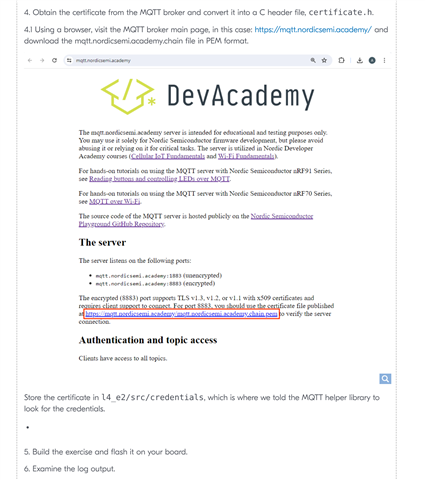
Even leaving aside the course content itself, it seems the solution (in l4_e2_sol) gets a -111 (connection refused) when trying to connect to the nordic academy MQTT broker:
*** Booting nRF Connect SDK v3.2.0-5dcc6bd39b0f ***
*** Using Zephyr OS v4.2.99-a57ad913cf4e ***
[00:00:00.281,555] <inf> Lesson4_Exercise2: Initializing modem library
[00:00:00.654,052] <inf> Lesson4_Exercise2: Connecting to LTE network
[00:00:01.723,175] <inf> Lesson4_Exercise2: RRC mode: Connected
[00:00:05.888,549] <inf> Lesson4_Exercise2: Network registration status: Connected - roaming
[00:00:05.888,641] <inf> Lesson4_Exercise2: Connected to LTE network
[00:00:06.908,905] <err> mqtt_helper: mqtt_connect, error: -111
[00:00:06.908,935] <err> Lesson4_Exercise2: Failed to connect to MQTT, error code: -111
[00:00:18.166,107] <inf> Lesson4_Exercise2: RRC mode: Idle
This seems to be specific to v3.2.0: the repo at https://github.com/NordicDeveloperAcademy/cell-fund has 3 commits (4808121, b525c06 and c2c1ce0), all with the same commit message that fundamentally altered the lesson, removing the crt_to_header python script and moving the exercise to the MQTT Helper library.
The exercise text also mentions including modem_key_mgmt.h, which was a necessary step in the old mqtt_connection.c file for v3.1.0, but has been removed since.
In short, it seems that updating l4_e2 to NCS v3.2.0 somehow went wrong and the course is now out of sync with the code.

