Questions regarding Generic three-wire coexistence pulses on nRF54L15

Hi Devzone,

Currently, we are attempting to use the Generic three-wire coexistence (refer link: https://docs.nordicsemi.com/bundle/ncs-2.9.2/page/nrf/app_dev/device_guides/wifi_coex.html )feature on the nRF54L15 to implement PTA (Packet Traffic Arbitration) control with a Wi-Fi host (BES2610).
I have created an example based on NCS v2.9.2 to test the three-wire control logic.
The example(NCS2.9.2) is as follows:

1016.PTA_peripheral_hr.7z

During testing, I observed that when the program is advertising, there is a pulse of approximately 1.4ms on the req-gpios. When connected, there is a pulse of approximately 519us on the req-gpios.
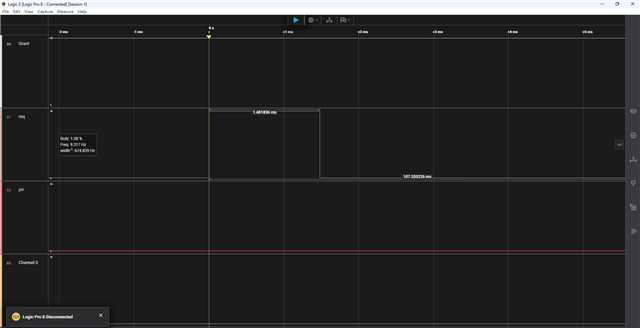
BLE advertising req-gpio pulse is around 1.4ms
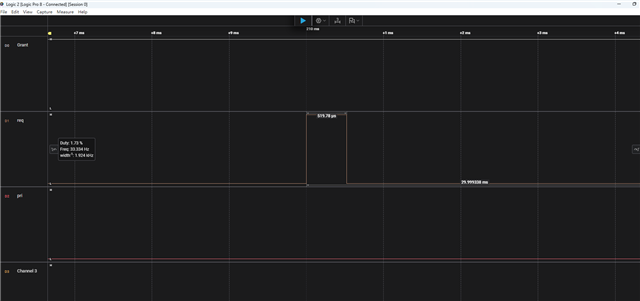
BLE connected req-gpio pulse is around 519us

Questions:
I would like to confirm the following two points:

Is the pulse on req-gpios exactly the duration for which the Bluetooth radio needs to be used? For example, if the pulse on req-gpios is 519us during a Bluetooth connection, can it be understood that the nRF54L15 requires the RF for 519us?

If my understanding of the first question is correct, can the Wi-Fi host perform RF switching according to the following logic: When the Wi-Fi host detects a transition from low to high on req-gpios, it sets grant-gpios to high to switch the RADIO to the nRF54L15. When req-gpios transitions from high to low, the Wi-Fi host sets grant-gpios to low to switch the RF back to Wi-Fi.


BR

Parents
  • Hi David, 

    Is the pulse on req-gpios exactly the duration for which the Bluetooth radio needs to be used? For example, if the pulse on req-gpios is 519us during a Bluetooth connection, can it be understood that the nRF54L15 requires the RF for 519us?

    Yes, there are some added delays, etc., to ensure that any external circuitry is being switched/told about this change, but generally, yes.

    If my understanding of the first question is correct, can the Wi-Fi host perform RF switching according to the following logic: When the Wi-Fi host detects a transition from low to high on req-gpios, it sets grant-gpios to high to switch the RADIO to the nRF54L15. When req-gpios transitions from high to low, the Wi-Fi host sets grant-gpios to low to switch the RF back to Wi-Fi.
    Currently, we are attempting to use the Generic three-wire coexistence (refer link: https://docs.nordicsemi.com/bundle/ncs-2.9.2/page/nrf/app_dev/device_guides/wifi_coex.html )feature on the nRF54L15 to implement PTA (Packet Traffic Arbitration) control with a Wi-Fi host (BES2610).

    That wifi host is a non-Nordic device. I would recommend that you ask the manufacturer.

    Regards,
    AmandaH.

  • Hi Amanda,
    Thank you for your reply. My client has two additional questions that require your confirmation:
    1. Should the PTA switch to BT when the req-gpios signal is high, and switch to Wi-Fi when the req-gpios is low?
    2. Does the grant-gpio signal level follow the req-gpios? Specifically, does grant-gpio go high when req-gpios is high, and go low when req-gpios is low?
    BR
Reply
  • Hi Amanda,
    Thank you for your reply. My client has two additional questions that require your confirmation:
    1. Should the PTA switch to BT when the req-gpios signal is high, and switch to Wi-Fi when the req-gpios is low?
    2. Does the grant-gpio signal level follow the req-gpios? Specifically, does grant-gpio go high when req-gpios is high, and go low when req-gpios is low?
    BR
Children
  • Hi, 

    David Duan said:
    Should the PTA switch to BT when the req-gpios signal is high, and switch to Wi-Fi when the req-gpios is low?

    It depends on its internal arbitration and configuration, not just the REQ level. In the Shared Antenna mode, the PTA makes priority decisions, controls the switch between Bluetooth LE/IEEE 802.15.4 and Wi-Fi. The PTA also grants TX/RX requests from the Bluetooth LE/IEEE 802.15.4 device. Only one interface, either Bluetooth LE/IEEE 802.15.4 or or Wi-Fi is connected to the antenna at any time. See Coexistence.

    David Duan said:
    Does the grant-gpio signal level follow the req-gpios? Specifically, does grant-gpio go high when req-gpios is high, and go low when req-gpios is low?

    GRANT is driven by the PTA according to its timing and arbitration rules (e.g., it may stay low/negated even while REQ is high if Wi‑Fi keeps the medium, or be asserted only during an allowed window). See Bluetooth LE/IEEE 802.15.4 timing

    -Amanda H. 

Related