nRF7002 Frequency Trimming and Temperature Effects

I am implementing the production line frequency trimming step for the nRF7002, as per https://docs.nordicsemi.com/bundle/nan_043/page/APP/nan_043/xtalxo_freq_trimming.html

We are using the Transmission-Based approach.

As the device is a small wearable device, the device heats up internally during operation, even at idle.  As expected, this affects the output frequency.  From a small test, you can see that there is a ~5PPM difference between boot-up and the eventual stable frequency.
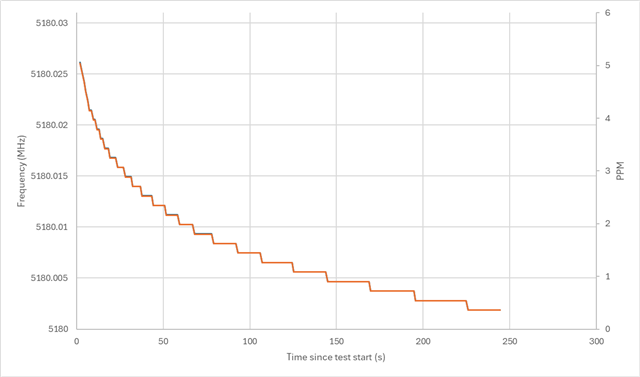
Do you have any guidance on how to handle this?  I understand that the crystal should be at the ideal 25°C during trimming to ensure correct operation.

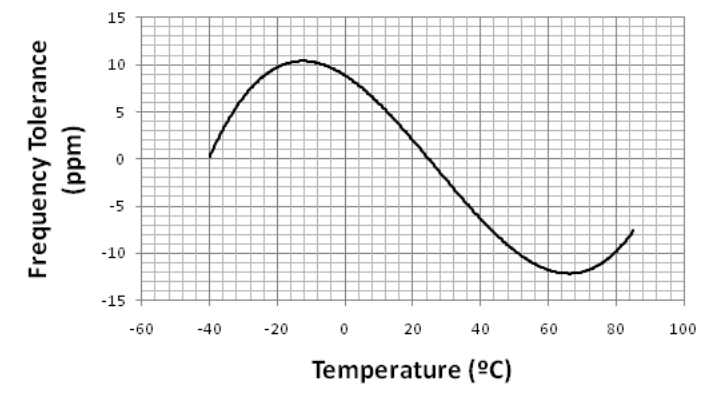
  • Hi,


    This is expected when you are emitting a TX tone, as high current will flow and temperature of the IC will change.

    Here is a typical curve for an arbitrary HF crystal:


    Kind regards,

    Håkon

  • Hi Håkon,

    Thanks, yes I am aware that this is normal behaviour for the crystal.  I am just wondering how I should handle this as part of the trimming process?

    Because, if I let the device heat up, e.g. so there is a -5PPM shift from the 25°C nominal value and perform the trimming there to the exact centre frequency, then the crystal over temperature would cause a +15 PPM to -5 PPM shift, rather than a ±10 PPM shift.  Thus with the tolerance stackup it will end up out of specification at some certain cold temperature.

    So I am wondering if there is any standard best-practice of how to handle this during the trimming step.  E.g. I could attempt to perform the trimming as quickly as possible after device turn-on, to try to get it as close to 25°C as possible, but then I risk that for some reason the device has been turned on early and heated up already.  Alternatively, I could allow the device to reach temperature equilibrium and apply an offset, but then the test time will be much longer and I don't know how consistent the crystal temperature change will be.

  • Hi,


    Adam M said:
    I am just wondering how I should handle this as part of the trimming process?

    Trimming should be the first thing to perform, to ensure that the temperature of the IC has not been raised too much over room temperature.

    If you are running other tests, or have a higher (or lower for that matter) temperature when running the trim process, you can use the wifi/radio_test to get the temperature:

    uart:~$ wifi_radio_test get_temperature
    [00:01:14.548,217] <inf> wifi_nrf: The temperature is = 28 degree celsius


    you can then map it either higher or lower based on where you want to be on the xtal curve vs. temperature.


    Kind regards,

    Håkon

Related