nRF7002 Frequency Trimming and Temperature Effects

I am implementing the production line frequency trimming step for the nRF7002, as per https://docs.nordicsemi.com/bundle/nan_043/page/APP/nan_043/xtalxo_freq_trimming.html

We are using the Transmission-Based approach.

As the device is a small wearable device, the device heats up internally during operation, even at idle.  As expected, this affects the output frequency.  From a small test, you can see that there is a ~5PPM difference between boot-up and the eventual stable frequency.
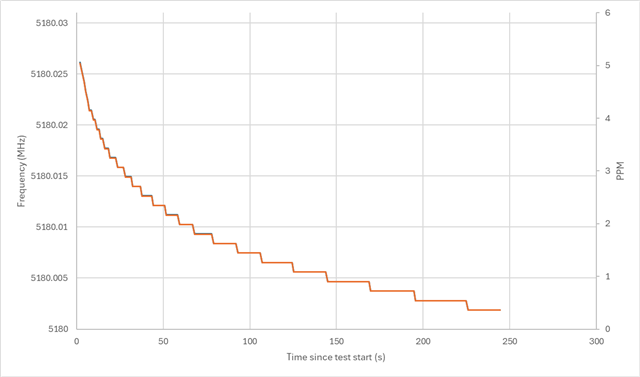
Do you have any guidance on how to handle this?  I understand that the crystal should be at the ideal 25°C during trimming to ensure correct operation.

Parents
  • Hi,


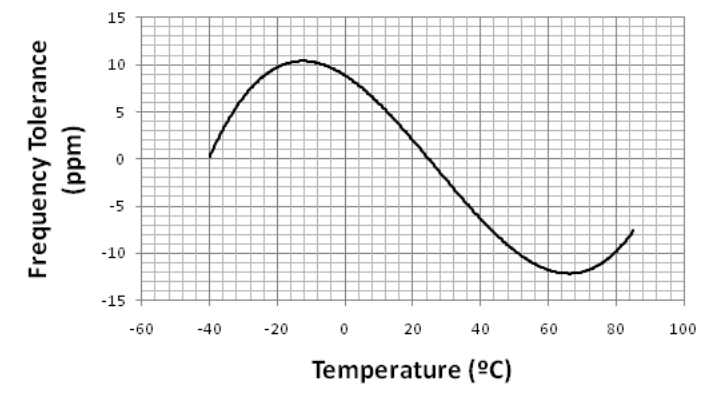
    This is expected when you are emitting a TX tone, as high current will flow and temperature of the IC will change.

    Here is a typical curve for an arbitrary HF crystal:


    Kind regards,

    Håkon

  • Hi Håkon,

    Thanks, yes I am aware that this is normal behaviour for the crystal.  I am just wondering how I should handle this as part of the trimming process?

    Because, if I let the device heat up, e.g. so there is a -5PPM shift from the 25°C nominal value and perform the trimming there to the exact centre frequency, then the crystal over temperature would cause a +15 PPM to -5 PPM shift, rather than a ±10 PPM shift.  Thus with the tolerance stackup it will end up out of specification at some certain cold temperature.

    So I am wondering if there is any standard best-practice of how to handle this during the trimming step.  E.g. I could attempt to perform the trimming as quickly as possible after device turn-on, to try to get it as close to 25°C as possible, but then I risk that for some reason the device has been turned on early and heated up already.  Alternatively, I could allow the device to reach temperature equilibrium and apply an offset, but then the test time will be much longer and I don't know how consistent the crystal temperature change will be.

Reply
  • Hi Håkon,

    Thanks, yes I am aware that this is normal behaviour for the crystal.  I am just wondering how I should handle this as part of the trimming process?

    Because, if I let the device heat up, e.g. so there is a -5PPM shift from the 25°C nominal value and perform the trimming there to the exact centre frequency, then the crystal over temperature would cause a +15 PPM to -5 PPM shift, rather than a ±10 PPM shift.  Thus with the tolerance stackup it will end up out of specification at some certain cold temperature.

    So I am wondering if there is any standard best-practice of how to handle this during the trimming step.  E.g. I could attempt to perform the trimming as quickly as possible after device turn-on, to try to get it as close to 25°C as possible, but then I risk that for some reason the device has been turned on early and heated up already.  Alternatively, I could allow the device to reach temperature equilibrium and apply an offset, but then the test time will be much longer and I don't know how consistent the crystal temperature change will be.

Children
No Data
Related