
Hello,
I'm working with Power Profiler Kit II and i see that we can use a digital port.
I would like to know what the electrical levels for a valid High and Low.
I can't find any informations in the documentation.
Best regards,

Hello,
I'm working with Power Profiler Kit II and i see that we can use a digital port.
I would like to know what the electrical levels for a valid High and Low.
I can't find any informations in the documentation.
Best regards,
Hi Maxime,
The high and low voltage depend on the voltage you put on the VCC pin from the Logic port.
So if the VCC is at 3.3V it means that a 1 is >2.145 and a 0 means <1.155V
The VCC pin must be between 1.6V and 5.5V. If you are under, the digital input might not work. And if you are over, you might break the device.
I also want to make you aware that the logic ports on the PPK2 are sampled with a 100kHz frequency with a typical bandwidth of 50kHz.
Best regards,
Simon D-M
Hi Simon D-M,
Thanks for your answer,
I have another question about sample rate.
I see in the documentation that the PPK2 samples at 100K samples/s.
But if i understand corectly this is the window that only keeps a lower amount of samples.
My question is : if i use Power Profiler software with 100K samples and i want to monitor 500 days of sample and if i have an enough hard drive.
Can i save 500 days of samples with 100K sample resolution ?
Best regards,
Hi Maxime,
Max01 said:But if i understand corectly this is the window that only keeps a lower amount of samples.
I'm not sure that I understand what you mean... Can you please try to rephrase it?
Max01 said:My question is : if i use Power Profiler software with 100K samples and i want to monitor 500 days of sample and if i have an enough hard drive.
Can i save 500 days of samples with 100K sample resolution ?
Theoretically, it should be possible. However, I would strongly recommend you to split your measurement in multiple smaller time periods. Because the probability that something goes wrong somewhere in the 500 days period is very likely. And, just for your information, at 100k samples/s you would need something like 30 TB of storage to store the whole measurement.
Best regards,
Simon D-M
Hi Simon D-M,
Thanks for your answer,
To rephrase, i see this table which show sample rate variation with the time.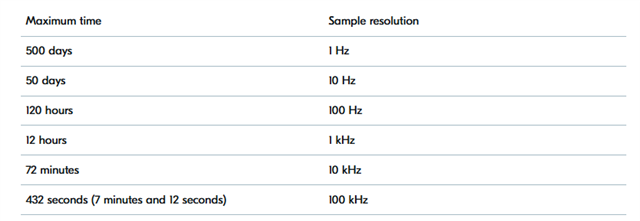
Can you tell me if I will lose sample numbers for very long measurements ?
I don't really understand the meaning of this table.
Thanks for your help,
Best regards,
Hi Maxime,
The table you are referring is from an old blog post. Some of the information in that blog post are not relevant anymore.
We had that limitation because we used to store the measurement into RAM. But now, we are storing directly to the drive. Which means that now, the only limitation you have, is the space on your hard drive.
Sorry for the confusion with that blog post.
Best regards,
Simon D-M
Hi Maxime,
The table you are referring is from an old blog post. Some of the information in that blog post are not relevant anymore.
We had that limitation because we used to store the measurement into RAM. But now, we are storing directly to the drive. Which means that now, the only limitation you have, is the space on your hard drive.
Sorry for the confusion with that blog post.
Best regards,
Simon D-M
Hi Simon,
Thank you for clarifying the situation.
That's very intresting if the only limitation now is drive space.
I'm thinking to use it to make a benchtest to monitor consumption or my device for a long time.
Could you tell me if it's possible to get data from a script ?
Best regards,
Hi,
Theoretically it is possible to talk to the PPK2 directly, but I would strongly recommend using the nRF Connect application "Power Profiler". It can export the measurement in CSV after the measurement. And then you can have a script that analyze your data.
Best regards,
Simon D-M

I disagree slightly with the quoted electrical High and Low digital voltage inputs, if I may. The digital inputs are buffered via a Digital io port input buffer/level shifter FXMA108 on 3V3 (3.3Volts).
"The FXMA108 is a configurable dual-voltage supply translator designed for both uni-directional and bidirectional voltage translation between two logic levels. The device allows translation between voltages as high as 5.5V to as low as 1.65V. The A port tracks the VCCA level and the B port tracks the VCCB level."
Hi,
Thanks for this informations,
I don't have any more questions now.
Thanks for your helps,
Best regards,

Hi,
Correct! I'm sorry I misread the datasheet. The logic '1' is indeed 0.65 x Vccx.
Best regards,
Simon D-M