nRF9151 Power consumption over NTN

Hi everyone,

I am currently working with Circuit Dojo nRF9151 using nRF Connect SDK v3.0.1.

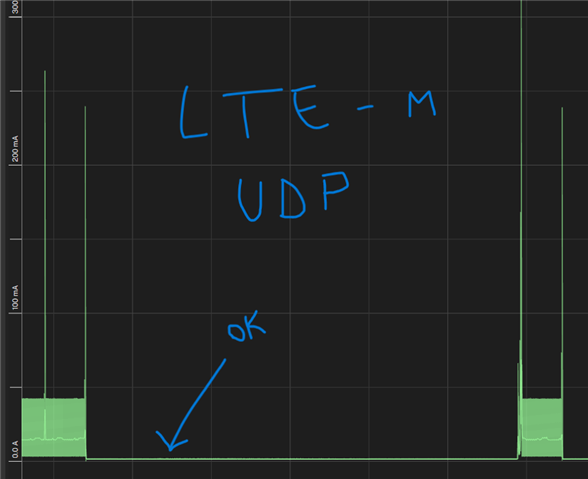
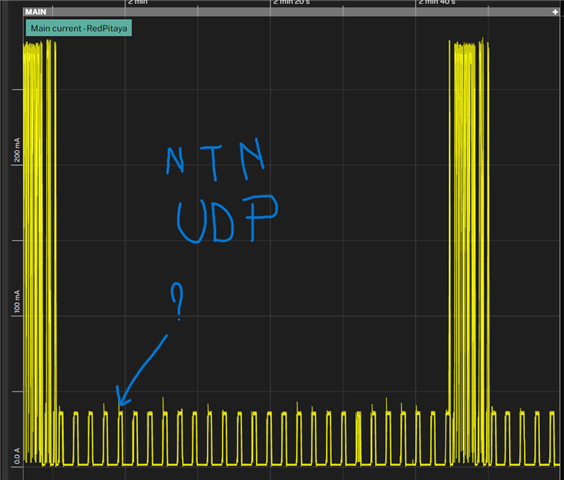
When measuring power consumption over MQTT and UDP, i noticed ~25mA every ~1.4s when using NTN, what is not the case on LTE-M. Someone knows how to reduce or eliminate it ?

Setup :

Firmware : mfw_nrf9151-ntn_1.0.0-1.alpha

PSM/eDRX : enabled

Protocols : MQTT & UDP

Crucially, it disappears immediately once the socket is closed

Questions:

  1. Is this 1.4s cycle a mandatory requirement for NTN synchronization to handle Doppler/latency?

  2. Is there a way to trigger a faster RRC Release without manually closing the socket every time (already used RAI)?

  3. Has anyone managed to get a "clean" RRC-Idle state (no spikes) while keeping a TCP/UDP socket dormant in NTN?

Jostin
Parents
  • Hello, are you able to provide more information on the steps that you are using? What application are you running?

    What SIM are you running in order to connect with an NTN constellation, GEO or LEO? 

    I am currently working with Circuit Dojo nRF9151 using nRF Connect SDK v3.0.1.

    When working with NTN we recommend using the nRF9151 SMA DK to ensure the best antenna for the application. I would recommend looking at the Evalute NTN on the nRF9151 SMA DK product page.

    Kind regards,
    Øyvind

  • Hello, are you able to provide more information on the steps that you are using? What application are you running?

    Hello, I'm using MQTT & UDP samples 

    Setup & Config:

    • Hardware: Circuit Dojo nRF9151

    • Modem FW: mfw_nrf9151-ntn_1.0.0-1.alpha

    • Network: Band 256

    • PSM: Enabled (RAT="00000000", T3412="00101000")

    • eDRX: Requested, but %XMONITOR shows network-provided value 11100000.

    • RAI: CONFIG_LTE_RAI_MODULE=y enabled.

    • MQTT: Keep-alive disabled, clean session.

    • SIM : Terrestar

    • Constellation : GEO

      Response : %XMONITOR: 5,"","","90198","0FA6",14,256,"00093766",6,229366,10,20,"","00000000","00101000","11100000",10

    What SIM are you running in order to connect with an NTN constellation, GEO or LEO?

    I use Terrestar over GEO 

    In my experience in the last 6 months the nRF9151 feather works pretty well with NTN/GEO

    Could you share the average power consumption and duration during transmission please ?

  • nRF9151-NTN-March-2026.csv

    That the data from my test run, nRF9151, mfw_nrf9151-ntn_1.0.0-1, NCS 3.2.4, CoAP/DTLS 1.2 CID.

    About 350 bytes uplink, 100 bytes downlink, every 9h.

    The times vary a lot, RTT from 10s to 160s. 

    73 messages are send without retransmission, 7 with one retransmissions, 4 with 2 and 1 with 3 retransmission. And 5 failures (gave up after 3 retransmission or lost network while transmitting).

    The device runs on a 4000mAh LiPo but it's hard to determine the power consumption from the voltage. The device reports to be currently at 60% and reports to run additional 900 days from battery (assuming, the same consumption that in the last 32 days, the battery was not full, when I started the test). But that forecast may be ways away from reality. In the end, I assume that for the most use-cases the data-costs are the limiting factor, not the energy. For GEO satellites the device must be be operated outdoor, and so I would consider some solar-charger and -panel or larger batteries.

Reply
  • nRF9151-NTN-March-2026.csv

    That the data from my test run, nRF9151, mfw_nrf9151-ntn_1.0.0-1, NCS 3.2.4, CoAP/DTLS 1.2 CID.

    About 350 bytes uplink, 100 bytes downlink, every 9h.

    The times vary a lot, RTT from 10s to 160s. 

    73 messages are send without retransmission, 7 with one retransmissions, 4 with 2 and 1 with 3 retransmission. And 5 failures (gave up after 3 retransmission or lost network while transmitting).

    The device runs on a 4000mAh LiPo but it's hard to determine the power consumption from the voltage. The device reports to be currently at 60% and reports to run additional 900 days from battery (assuming, the same consumption that in the last 32 days, the battery was not full, when I started the test). But that forecast may be ways away from reality. In the end, I assume that for the most use-cases the data-costs are the limiting factor, not the energy. For GEO satellites the device must be be operated outdoor, and so I would consider some solar-charger and -panel or larger batteries.

Children
Related