Channel sounding tips & tricks? Do i need a second antenna?

Hi,

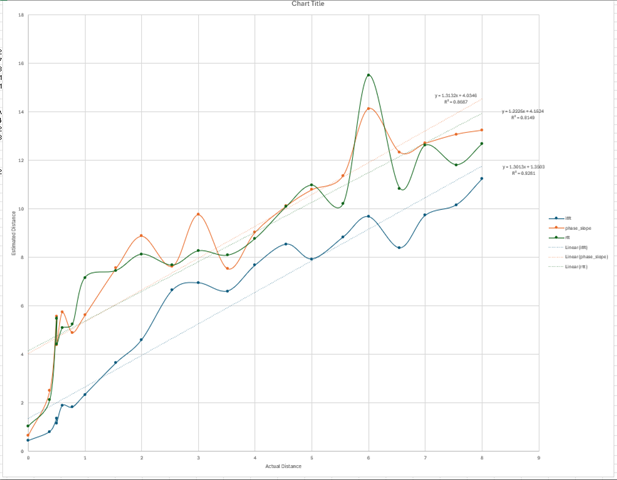
I am working on a project with channel sounding requirements and I have collected some test data. I am using the example codes Bluetooth: Channel Sounding Initiator with Ranging Requestor and Requestor one. However data is not accurate or precise. I have also tried outside and accuracy still isn't perfect. The data also fluctuates a lot. I heard adding a second antenna might help.

We are using nrf54l15-dk. 

So my questions are:

1. What are the data analysis tips & tricks people are using? Is median better than calculating mean? Or what are the cs parameters i can change to get more accurate results? Ifft is tway better than the other data. Why is that?

2. How can i add a second antenna? Datasheet and documentation for the board wasnt super explaining.
Parents
  • We normally use a median filter as the noise is not normal distribution noise. 3 stage is usually quite good. Having more than one antenna on at least one side makes the ranging more robust as you can then detect multipath issues. You can see this as each measurement isn't more accurate but you can get rid of some of the bad ones. This can give a more reliable ranging. And we recommend the IFFT algorithm as it is usually the better. 

Reply
  • We normally use a median filter as the noise is not normal distribution noise. 3 stage is usually quite good. Having more than one antenna on at least one side makes the ranging more robust as you can then detect multipath issues. You can see this as each measurement isn't more accurate but you can get rid of some of the bad ones. This can give a more reliable ranging. And we recommend the IFFT algorithm as it is usually the better. 

Children
Related