

i have a "bare-metal" (register-level access) BLE advertising program which does not consistently consume the same amount of power when transmitting....
here's what the power profiles looks like when things are working correctly:
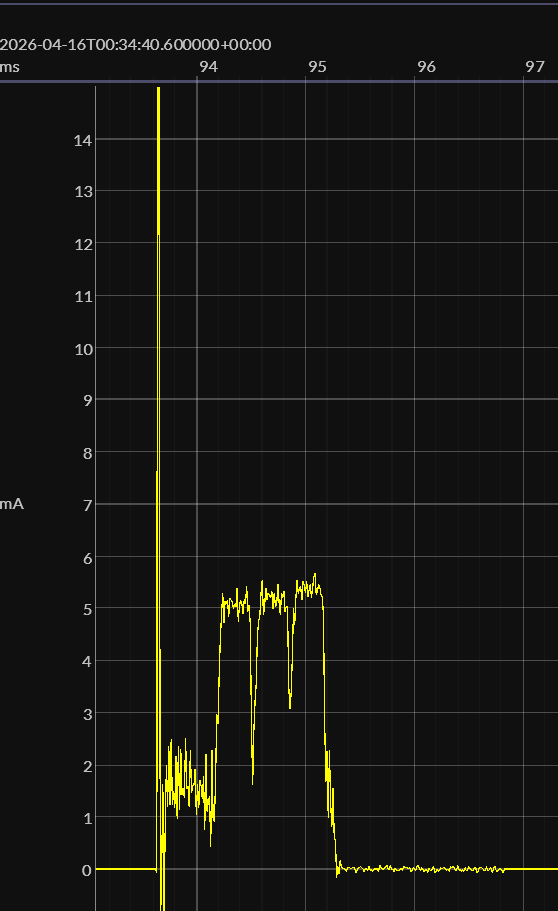
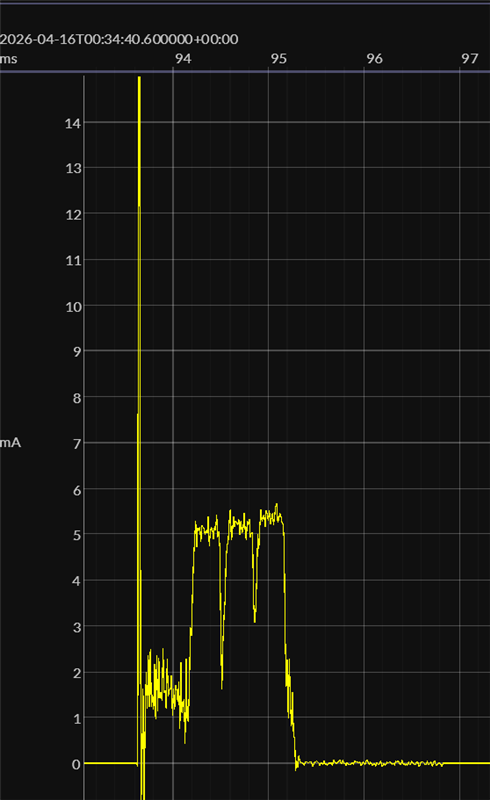
the TX current draw of ~5uA is consistent with my expectations (0dB, 3.0V).... the present implementation actively polls the HFXTAL for it to stabilize, which explains the ~400us of CPU current before transmission begins.... (yes, i know how to make this more efficient....)
what happens quite often, however, is that my advertising events consume about 5mA *more* current throughout the entire event -- including during the initial period of CPU activity when i awaiting the HFXTAL to stabilize:
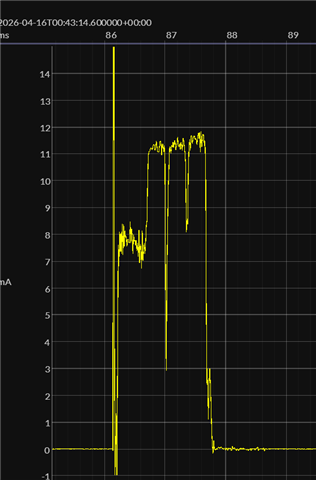
same code, same board, same configuration.... this program is *very minimal* (about 2K of code), and configures the HFXTAL and RADIO at the register level.... based on very recent nrf52 and nrf54 experiences, i'm extra careful to ensure HFXTAL and RADIO have in fact flagged an appropriate event after i've triggered a particular task...
still, this seems to suggest some problem on my end with "starting" the HFXTAL and RADIO before transmission... though not by design, it's as if some other portion of the MCU is (still) powered when i'm waiting for a RADIO interrupt to signal TX on the current channel has finished....
using a standard zephyr-based program as my baseline, i've systematically compared hardware registers; and i've applied all the errata seen in zephyr's SystemInit....
one difference i did notice was a value of 0x27 for OSCILLATORS.XOSC32M.CONFIG.INTCAP in the zephyr program; i had been using the default of 0x20.... making this change, however, did not fix the problem....
when sleeping, however, my current draw is right where it should be; the problem occurs only when awake... another thought -- i seemed to almost immediately consume ~5mA of additional current (even as i'm starting the HFXTAL).... perhaps i'm not "going idle" correctly -- though my current draw of <2uA suggests i'm fine)
one final caveat: i'm running on a v0.9 DK board.... i should be shortly receiving a v1.0 DK board....

