nRF5340 BLE Audio Request for Schematic Review

I am designing an ultra-low-power BLE Audio TWS board based on the nRF5340 and have followed the recommended hardware design guidelines throughout the project. This is my final design, and I would appreciate a review.

  1. For the Bluetooth antenna matching network, are any additional components required, or is the current configuration sufficient? The antenna will be implemented directly on the PCB. Specificaly do i need the extended antenna matching part? 
  2. This is currently a test board, but the final version will need to be significantly smaller. At the moment, there are quite a few decoupling capacitors included in the design. Which ones are essential, and which could potentially be removed or reduced to save space?

    The scematic PDF: 
    8081.MSBE_V3.pdf
Parents
  • Hi David,


    For the Bluetooth antenna matching network, are any additional components required, or is the current configuration sufficient? The antenna will be implemented directly on the PCB. Specificaly do i need the extended antenna matching part? 

    Yes, a antenna matching circuit is required. C41, L8 and C42 are used for impedance matching and filtering the ANT pin. These can not be used for antenna impedance matching.

    Most simple PCB trace antennas can be matched using just one shunt capacitor, however if you have the room on the board I recommend implementing a full pi matching network with 2 shunt and one series component. This will allow for more flexibility when tuning the antenna. \

    What type of trace antenna are you planning on using?

    Note that the antenna tune is specific to the size and shape of the board, so any tuning done on the test board will not be applicable for the final board.

    This is currently a test board, but the final version will need to be significantly smaller. At the moment, there are quite a few decoupling capacitors included in the design. Which ones are essential, and which could potentially be removed or reduced to save space?

    All decoupling capacitors shown in the nPM100 and nRF5340 reference schematics are required.

    The only ones that can be removed in your schematic is the load capacitors for the 32MHz crystal. The nRF5340 have internal configurable load capacitors, so external capacitors are not required.


    Other than the missing antenna tuning components the schematic looks OK.


    Best regards,

    Bendik

Reply
  • Hi David,


    For the Bluetooth antenna matching network, are any additional components required, or is the current configuration sufficient? The antenna will be implemented directly on the PCB. Specificaly do i need the extended antenna matching part? 

    Yes, a antenna matching circuit is required. C41, L8 and C42 are used for impedance matching and filtering the ANT pin. These can not be used for antenna impedance matching.

    Most simple PCB trace antennas can be matched using just one shunt capacitor, however if you have the room on the board I recommend implementing a full pi matching network with 2 shunt and one series component. This will allow for more flexibility when tuning the antenna. \

    What type of trace antenna are you planning on using?

    Note that the antenna tune is specific to the size and shape of the board, so any tuning done on the test board will not be applicable for the final board.

    This is currently a test board, but the final version will need to be significantly smaller. At the moment, there are quite a few decoupling capacitors included in the design. Which ones are essential, and which could potentially be removed or reduced to save space?

    All decoupling capacitors shown in the nPM100 and nRF5340 reference schematics are required.

    The only ones that can be removed in your schematic is the load capacitors for the 32MHz crystal. The nRF5340 have internal configurable load capacitors, so external capacitors are not required.


    Other than the missing antenna tuning components the schematic looks OK.


    Best regards,

    Bendik

Children
  • Hello and thanks for the quick reply. 
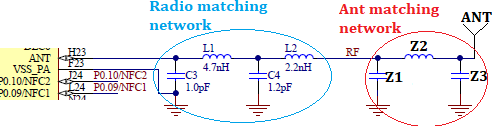
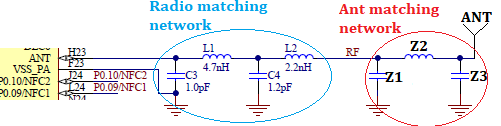
     To avoid confusion latter on my part, the filtering part is this red circulated one right (from the picture below)? And that is wat i need? And any suggestions on what starting values to put on the antenna matching part? 

    What type of trace antenna are you planning on using?

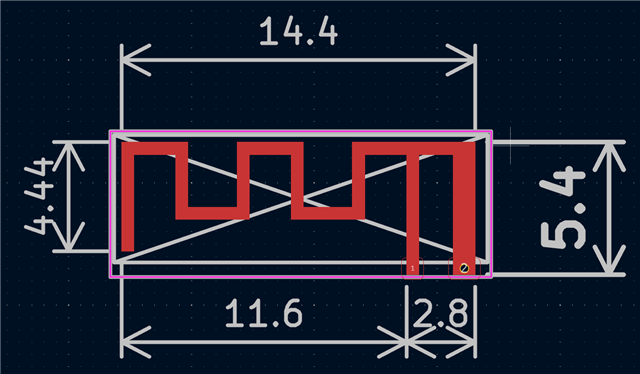
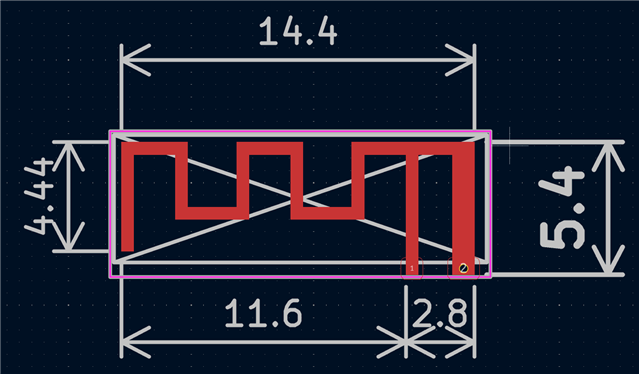
    I am planing on using the stanrad 2.4ghz from texas instruments, they have that desing/footprint on kicad and i used that for desinging a bt atnenna with a Jieli AC695xx chinese chip and it worked fine (without the antenna matching part). It's the "Texas_SWRA117D_2.4GHz" The dimensions are:

    I will use the same footprint in the final version of the board, and in that new board with a different layout i will only need to change the Antenna mathing part right? 

  • DavidMorina103 said:
     To avoid confusion latter on my part, the filtering part is this red circulated one right (from the picture below)? And that is wat i need? And any suggestions on what starting values to put on the antenna matching part? 

    Correct, Z1-Z3 is a pi antenna matching network. As as starting point Z1 and Z3 does not need to be populated, and Z2 can be a 0 Ohm resistor. The values must be determined by measuring the antenna impedance.

    DavidMorina103 said:
    I am planing on using the stanrad 2.4ghz from texas instruments, they have that desing/footprint on kicad and i used that for desinging a bt atnenna with a Jieli AC695xx chinese chip and it worked fine (without the antenna matching part). It's the "Texas_SWRA117D_2.4GHz" The dimensions are:

    This type of antenna should by design be close to 50Ohm, but there will still be external factors influencing the impedance.  It should be possible to tune this with just one capacitor(Z3 for example) and by adjusting the length of the antenna. This way of tuning will result in a change to the PCB after tuning, while using a pi network will only result in a BOM change after tuning.

    DavidMorina103 said:
    I will use the same footprint in the final version of the board, and in that new board with a different layout i will only need to change the Antenna mathing part right? 

    Yes, I would assume that the antenna will work OK without tuning for the test board. So I suggest only doing the tuning for the final board when the PCB enclosure is finalized, as the enclosure(even if its just made of plastic) can impact the antenna impedance. Tuning the antenna with the enclosure will allow for compensating for any de-tuning of the antenna.

Related