Failure in ble_stack_init during startup

We are trying to bring up a new run of an existing PCB design. No changes in the area of the processor, but a different assembly house. The first call inside ble_stack_init, a call to nrf_sdh_enable_request(), fails and returns an error code of 8. No reference anywhere gives a usable explanation.

Strangely, if started by "copying" the hex file onto the Jlink "drive" (the nRF52832 DevKit), it succeeds.

What should we be looking for?

Parents
  • Hello,

    It seems like the issue might be with how the firmware is programmed since it appears to work when you use drag&drop programming. How are you programming the device when it fails? Is the same error also returned after a reset? Note that the "SoftDevice enable" function may return NRF_ERROR_INVALID_STATE (8) if the debugger forces execution to start from the application start address instead of address 0x0. This prevents the softdevice's reset handler from running on startup.

    Best regards,

    Vidar

  • I was starting it from SES (Segger) just as I have on dozens of previous nRF52832 projects, and indeed successfully on previous runs of this board. So there's something different in the hardware, and I'm asking where to look. What sort of "invalid state" is likely?

  • I tried every RESET_ listed for nrfutil device reset --reset-kind. SYSTEM, HARD, SOFT, DEBUG, PIN and DEFAULT do nothing; VIA_SECDOM returns an error message as would be expected.

    In the course of testing this, I made an interesting discovery: With the device programmed, if I power-cycle it, it stays in that infinte reset loop. However, if I disconnect USB power from the devkit (which is still connected), the reset happens perfectly and the device comes up.

    Danged if I can figure out why that works, but surely it points to something, even if only a band-aid, that we could use to get past this problem. The Reset/P0.21 line already has a 10K pullup to Vcc, just as it has on all past designs where we've used this processor. Hints??

  • SteveHx said:
    Apparently I was unclear. I have never suspected a reset in a busy loop. I did at one point try a busy loop to shift the timing, to eliminate the possibility of some kind of watchdog reset. The resets have always come from the same point within the softdevice, in sd_softdevice_enable().

    How can you be certain that the device is indeed going in a reset loop?  Again, there is no code in the softdevice that can trigger a reset and this is also contradicts what you said here:

    SteveHx said:

    I have been experimenting with different delays near the beginning of main(), before calling any of the BLE initialization. With no delay, or with a null for() loop of 10000 cycles, a reset happens sometime after calling sd_softdevice_enable() and before it returns. If I increase the for() loop to 20000 or higher (up to 10000000), it seems to reset before the loop completes.

    SteveHx said:
    The build code differences were answered already.

    I'm unclear what this refers to.

    This is what I answered earlier:

    Vidar Berg said:
    Regarding the build code difference, please have a look at the PCN here: https://nrfconnectdocs.nordicsemi.com/pdf/PCN/pcn_106_v1.0.pdf. It's the same silicon. It's just that it's tested and assembled at different locations.

  • Try to disable the drive in the Segger J-Link Configuration.

    I suspect that you have software on the PC that tries to write a hidden file to the "new" USB drive that pops up. Which the debugger will try to flash as firmware...

    That would explain why the file method works, it overwrites the junk data in flash.

    You should not need the drive at all, flashing can be done with nrfutil/nrfjprog or with the Segger tools directly.

  • How can you be certain that the device is indeed going in a reset loop?

    I have code that records a lot of internal events to external NV memory. It clearly shows reaching the line prior to the call to sd_softdevice_enable(), followed immediately by running the startup code at the beginning of main().

  • I'm running Windows 10, as I have from the very first time I used Nordic and the Segger tools, which have always worked fine. Highly unlikely that anything is writing to that virtual drive; I have scanned for malware within the past few days. Also, I did a complete dump of the flash both after programming via build&run, and after programming via drag&drop. A file compare utility declared the two files to be identical.

Reply
  • I'm running Windows 10, as I have from the very first time I used Nordic and the Segger tools, which have always worked fine. Highly unlikely that anything is writing to that virtual drive; I have scanned for malware within the past few days. Also, I did a complete dump of the flash both after programming via build&run, and after programming via drag&drop. A file compare utility declared the two files to be identical.

Children
  • Aha, a glimmer of daylight....

    It appears that I need to investigate my power supply, even though it's identical to that on the previous rev. Please confirm that the following waveform would be causing resets. Steady at 1.8V, rising to 3.35V over the course of 9.5 mSec, immediately falling to 2.2V over 5.2 mSec, then more steeply to the baseline steady 1.8V over 600 µSec.Cycle repeats every 37.8 mSec, which seems reasonable for the reset loop I'm seeing.

    I don't know how the supply can be doing that, but clearly it is. The previous rev does not show this behavior, despite being by design identical. Something must be different in the build, that is causing a power supply disruption as the softdevice starts up. But why would it behave differently when programmed via drag&drop?

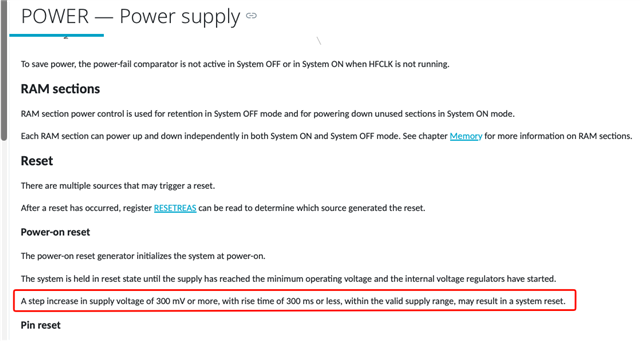
  • This is great progress. It seems safe to assume that POR is the likely culprit now. Here is from the nRF52832 Product Specification:

    (Ref. https://docs.nordicsemi.com/r/bundle/ps_nrf52832/page/power.html).

    I don't have a good explanation for why you're not experiencing sudden PORs in debug interface mode or when using drag&drop programming. Generally on powerup, there will be more inrush current, and the regulator may also need some time to settle. Perhaps it becomes more apparent what is happening when you probe VDD in these different scenarios and across different boards.

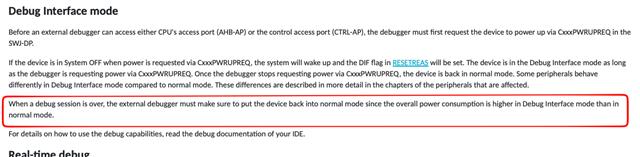
    The current draw from the chip could also have something to do with it. The current will never drop down in the uA range when the chip is in debug interface mode. So if the drag&drop method is not existing debug mode after programming, then that could potentially explain why it is behaving the same as when you start a debug session in Segger embedded studio.

    (https://docs.nordicsemi.com/r/bundle/ps_nrf52832/page/dif.html?section=debuginterfacemode)

Related